Release Summary
Nano Banana 2.1 is Google's October 6, 2026 update to Nano Banana 2. It targets image generation and conversational editing, with documented improvements that matter for text-heavy creative work and wide-format assets.
For designers and marketers, the reason to try it is more precise output for the same brief. For API users, there is also a migration reason: Google has deprecated the previous model and recommends its GA successor. The recommendations below are editorial judgments based on official documentation; no hands-on comparison was performed for this update.
What Changed
Visual Quality and Prompt Adherence
Google reports improved realism and adherence to instructions. This makes 2.1 worth evaluating when an ad concept needs a specific composition, rather than accepting a visually attractive result that misses the brief.
Text Rendering and Infographic Layout
Typography and infographic layout receive further improvements. Text generation already existed in Nano Banana 2; this release refines it. Posters, offer graphics and explanatory visuals are relevant evaluation cases, though the documentation does not guarantee error-free copy.
Panoramic Tiling Fixes
The model reference identifies a fix for tiling artifacts at 2K and 4K in the 1:4, 4:1, 1:8 and 8:1 formats. These ratios already existed. The practical change concerns output quality when making unusually wide banners or tall compositions.
Multi-Turn Consistency
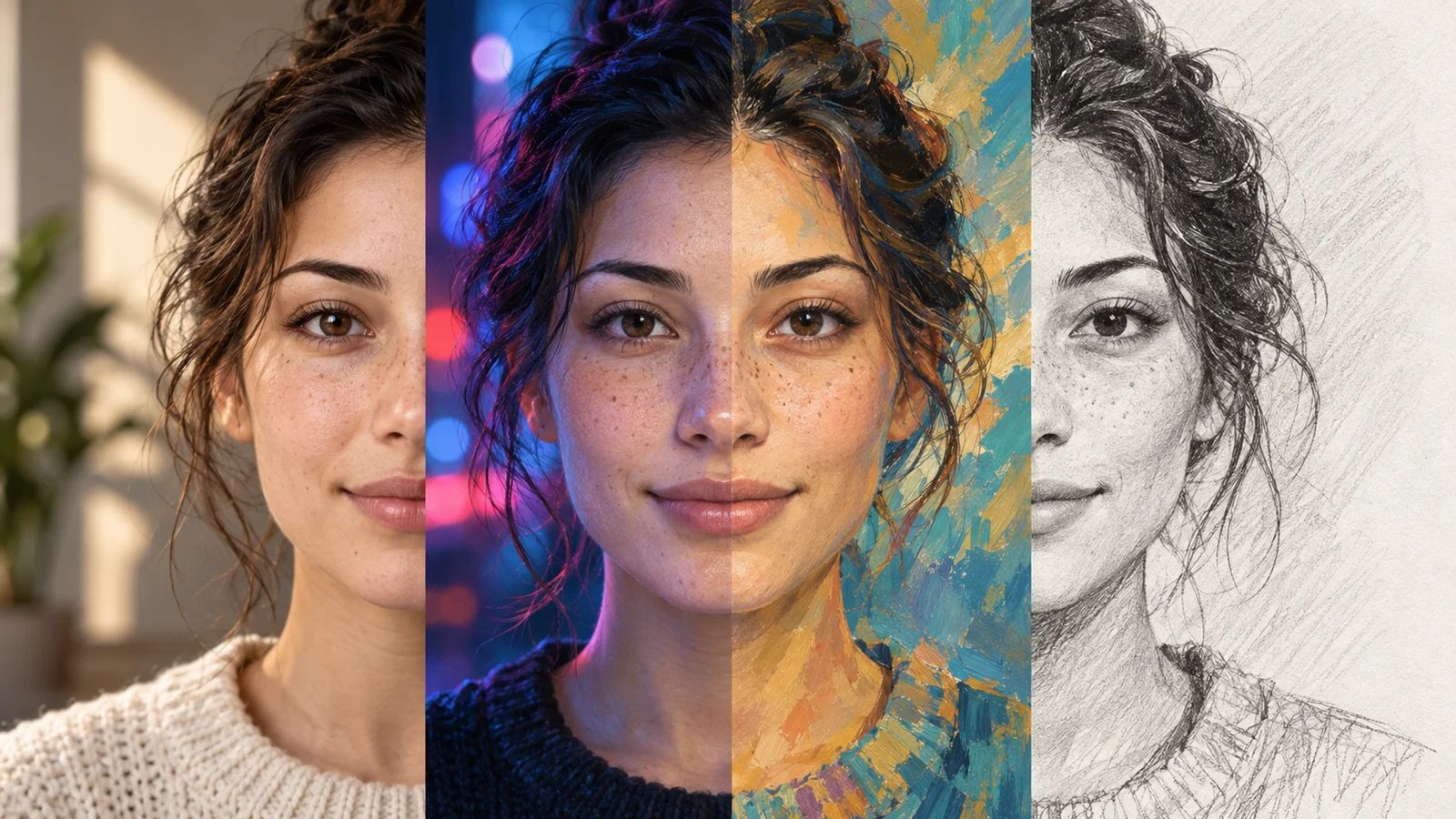
Google reports stronger character consistency during conversational editing. For a campaign featuring a recurring person, the useful question is whether successive revisions preserve the subject while changing the setting or layout. This is an evaluation target, rather than a measured result from this article.
Compared With Nano Banana 2
| Decision factor | Nano Banana 2 | Nano Banana 2.1 |
|---|---|---|
| Search grounding and wide ratios | Already supported | Retained capabilities, rather than first-time additions |
| High-resolution panoramas | Supported wide formats | Explicit tiling fix at 2K and 4K |
| 512px output | Supported | Not supported; migrate to 1K, 2K or 4K |
| Text and iterative editing | Existing capabilities | Google reports further improvements |
| Gemini API model lifecycle | Previous stable ID is deprecated | New GA ID is the recommended migration target |
The earlier model also offered 4K output. Resolution alone is therefore insufficient reason to switch. Consider 2.1 when typography, panoramas, instruction adherence or repeated edits are the actual source of rework.
API Access and Migration
The new identifier is gemini-nano-banana-2.1. The October 6 Gemini API release notes deprecate gemini-3.1-flash-image and recommend migration, with no shutdown date announced. They separately record the older preview ID's June 2026 shutdown; do not use the preview identifier as a current access link.
Use the official image-generation guide for request examples. Migration planning should cover the model identifier, requested dimensions and any model-specific configuration; a new identifier alone does not establish compatibility with every old request.
For the Gemini Enterprise Agent Platform, the model reference explicitly rejects seed, topK, logprobs, temperature and topP. These restrictions are documented for that platform; Gemini API integrations should use their own current API reference.
The 2.1 reference lists 1K, 2K and 4K outputs. Google's image-generation guide explicitly states that 512px (0.5K) is not supported on Nano Banana 2.1, so workflows that depend on 512px must change output size before migrating. API specifications do not establish identical controls, quotas or access across consumer interfaces.
Who Should Upgrade / Who Should Wait
- Evaluate 2.1 now if text placement, infographic structure or high-resolution panoramic artifacts are causing revisions to your campaign assets.
- Plan API migration now if your integration uses the deprecated stable Flash Image identifier. The missing shutdown date leaves scheduling uncertainty, rather than a reason to assume indefinite availability.
- Keep Pro in consideration for complex visual tasks: Google's model-selection guide continues to distinguish its premium creative-control role from the efficient 2.1 workhorse.
- Wait on an automatic workflow switch if it relies on 512px output, because Nano Banana 2.1 does not support 512px; change the requested size first. For platform-specific sampling controls, verify the target platform's current API reference separately before switching.
Known Limitations
The 2.1 documentation describes up to 14 reference images, with consistency guidance for four characters and ten objects. Reference-image count is not a guarantee of equally strong preservation of every subject. Google's earlier launch described different subject counts; these statements are not a controlled comparison proving a regression.
This page provides no independently measured speed, failure-rate or cost comparison. The release notes retain the Flash efficiency positioning, but they do not establish that every workflow has unchanged latency or billing. No subscription or per-image price is assigned to this release here.
Sources
Last verified: October 7, 2026. Source-based research; no hands-on testing was performed for this update.