
8 Best Freed AI Alternatives (2026): Real Pricing, EHR Fit & Free Tiers
Looking beyond Freed AI? Compare 8 AI medical scribe alternatives—from $0 (Heidi Health, Doximity Scribe) and $49/mo unlimited (Twofold) to Sunoh.ai, Nabla, Abridge, DeepScribe, and Suki.

On this page
Freed AI is one of the fastest ways for an independent clinician to start using an AI medical scribe—there is no sales call, you get a 7-day no-card trial, and Starter starts at $39/mo (annual). Yet clinicians regularly outgrow Freed or look for alternatives when three practical bottlenecks hit:
First, Freed leaves an awkward pricing gap for busy solo clinicians: once the 7-day trial ends, Starter ($39/mo annual) caps you at 40 notes/month, Core jumps to $79/mo for unlimited notes, and EHR push plus ICD-10/CPT coding requires Premier ($104/mo annual or $119/mo monthly). Second, Freed's EHR push relies on a browser extension rather than native bi-directional EHR APIs—smooth on modern web EHRs, but fragile on Citrix-hosted or locked-down desktop charts. Third, multi-site groups and specialty practices eventually need deeper HCC/E/M coding, centralized SSO, or institutional Epic "Linked Evidence" auditability.
If you are evaluating a switch—or comparing options before committing—here is how the 8 strongest Freed AI alternatives cover every price tier from $0 and $49/mo unlimited up to enterprise Epic deployments. (For a broader market overview, see our best AI medical scribes guide.)
Quick Comparison: Freed AI vs Top 8 Alternatives
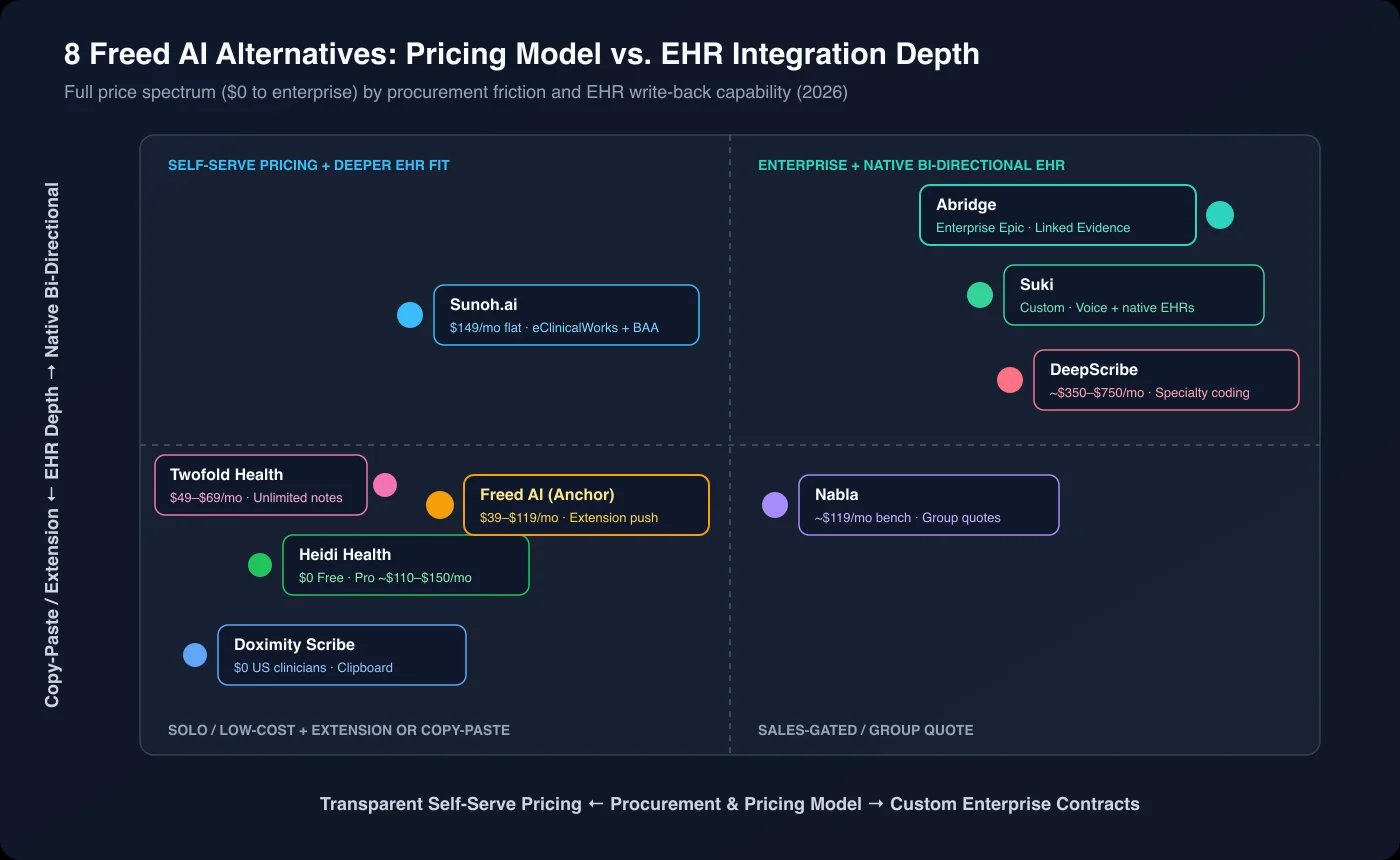
| Tool | Starting Price | Free Plan / Trial | EHR Integration Style | Best Alternative For |
|---|---|---|---|---|
| Freed AI (Anchor) | $39/mo annual (40 notes); $79 Core; $104–$119 Premier | 7-day trial (no ongoing free plan) | Browser extension EHR push (Premier+) | Fast self-serve solo setup |
| Heidi Health | $0 Free; Pro ~$110–$150/mo; Together ~$99–$119+/user/mo | Free tier (unlimited basic notes, 10 Pro actions/mo) | Copy-paste on standard Pro; deeper EHR on Team/Enterprise | Solo clinicians wanting a $0 tier |
| Doximity Scribe | $0 (free for verified U.S. clinicians) | Permanent $0 (US verification required) | Clipboard copy-paste inside Doximity workflow | Verified U.S. MDs/DOs/NPs/PAs wanting $0 |
| Twofold Health | $49/mo annual ($69/mo monthly), unlimited notes | Free trial available | Copy-paste into standard or web EHRs | High-volume solo clinicians & therapists on a budget |
| Nabla | ~$119/mo individual benchmark; custom group quotes | Trial access available | Chrome extension + health-system EHR integrations | Telehealth & ambulatory groups |
| Sunoh.ai | $149/user/mo (promo; no long-term lock-in) | Demo / onboarding trial | Strong eClinicalWorks ecosystem + cross-EHR web tools | Flat-rate outpatient clinics + Azure BAA |
| Abridge | Custom enterprise (~$200–$800/provider/mo est.) | Enterprise pilot only | Deepest native Epic integration ("Linked Evidence") | Large hospitals & Epic health systems |
| DeepScribe | Custom quote (~$350–$750+/provider/mo est.) | Demo-gated | Deep bi-directional write-back (Epic, NextGen, etc.) | Specialty groups needing E/M & HCC coding |
| Suki | Custom clinic/enterprise quote | Demo-gated | Native Epic, Cerner, athenahealth integrations | Clinicians wanting voice commands + ambient notes |
Detailed Breakdown: Real Trade-Offs Behind Each Alternative
1. Heidi Health — Best Free-Tier Alternative to Freed AI
If Freed AI's 7-day trial feels too short—or Starter's 40-note cap pushes you into $79–$119/mo before your workflow is proven—Heidi Health is the cleanest off-ramp. Its Free plan gives solo clinicians unlimited basic AI clinical notes alongside 10 Pro Actions per month to test custom templates and clinical evidence lookups.
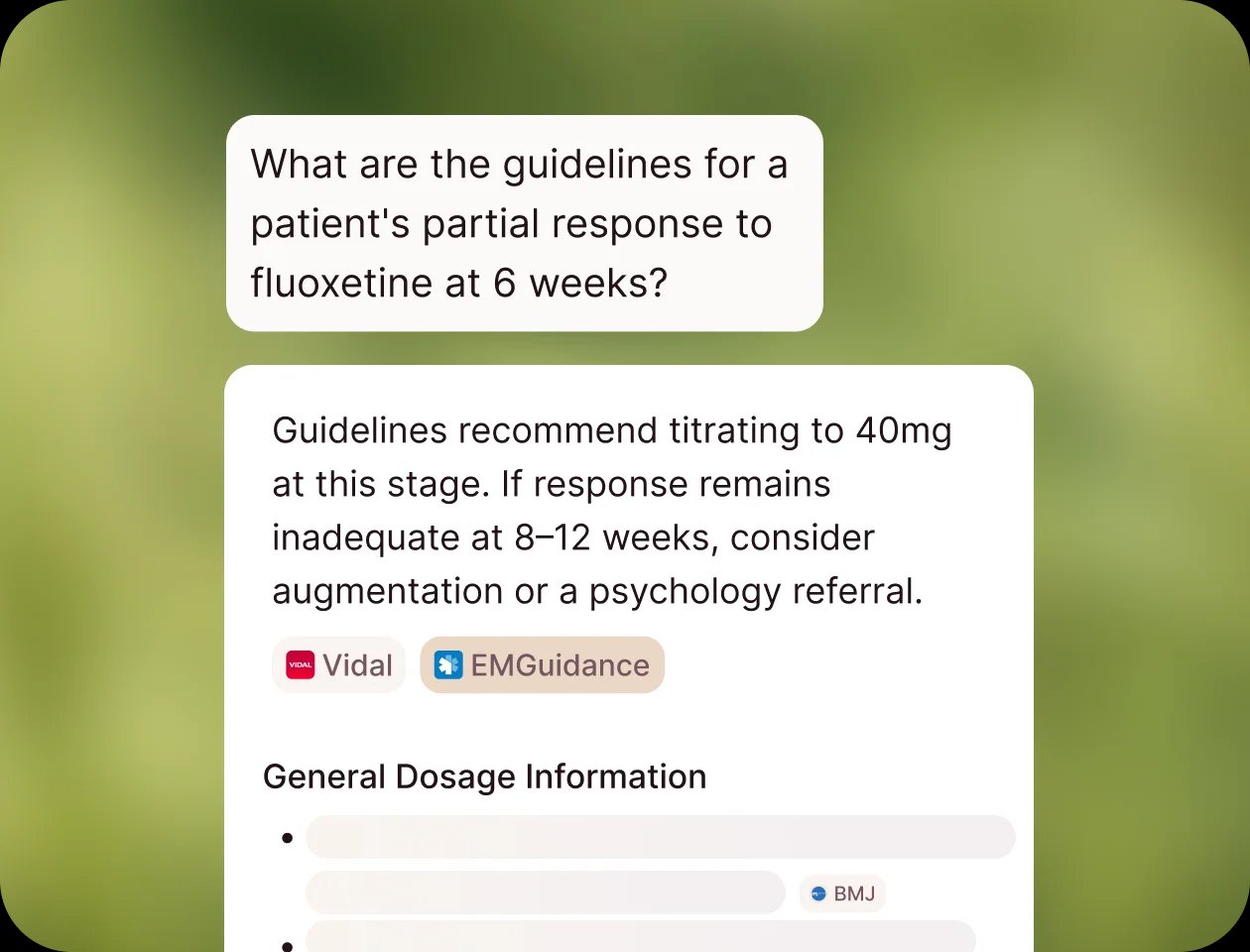
Together, ~$99–$119+/user/mo) or Enterprise integrations. In practice, that makes Heidi unbeatable for part-time or budget-conscious solo clinicians who don't mind two extra clicks per chart, while Freed Premier ($104–$119/mo) remains more convenient if browser-extension EHR push already works smoothly in your browser-based EHR.2. Twofold Health — Best Budget Unlimited Alternative ($49–$69/mo)
One of the most common complaints on clinician forums is Freed's gap between Starter ($39/mo, capped at 40 notes) and Core/Premier ($79–$119/mo). Twofold Health targets that exact gap with flat $49/mo annual ($69/mo monthly) pricing, unlimited notes, treatment plans, and built-in coding support without gating unlimited volume behind a higher tier.
Like Heidi's lower tiers, Twofold relies on a copy-paste workflow rather than deep bi-directional EHR APIs, and its template library leans heavily toward primary care, psychiatry, and behavioral health therapists. If you see 15–25 patients a day, don't want per-note anxiety, and already copy-paste into SimplePractice, Jane, or a web EHR, Twofold cuts $30–$50/month off Freed Core/Premier without sacrificing volume.
3. Doximity Scribe — Best $0 Option for Verified U.S. Clinicians
For U.S.-licensed physicians, NPs, and PAs already using Doximity for telehealth dialer or secure faxing, Doximity Scribe removes subscription cost altogether ($0 for verified U.S. providers, HIPAA-compliant).
You give up the granular template engineering, multi-speaker tuning, and Chrome-extension field mapping of paid tools like Freed Premier or DeepScribe—Doximity Scribe is built around straightforward recording and clipboard copy-paste. Still, as a zero-budget baseline or backup scribe when testing whether ambient AI actually saves you charting time, it is hard to beat.
4. Nabla — Best for Telehealth & Ambulatory Clinics
Nabla competes closely with Freed AI in outpatient clinics and virtual care, pairing fast ambient SOAP generation with a lightweight Chrome-extension workflow for individual providers and deeper EHR hooks for larger organizations.
Where Nabla diverges from Freed is commercial packaging. Freed publishes transparent self-serve tiers all the way up to Premier ($104–$119/mo), whereas Nabla increasingly routes multi-clinician groups through custom sales quotes (with historical individual benchmarks around $119/mo). If you run a multi-provider telehealth or ambulatory group that needs coordinated onboarding rather than individual credit-card sign-ups, Nabla is worth scoping—just confirm in writing whether BAA coverage applies at your exact entry tier before testing with live PHI.
5. Sunoh.ai — Best Transparent Flat-Rate Outpatient Alternative
Independent outpatient clinics often hit an awkward middle ground: Freed Group requires custom enterprise negotiation, while hospital scribes demand six-figure IT rollouts. Sunoh.ai fills that gap with a flat $149/user/month promotional rate (down from $199/mo), month-to-month flexibility without long-term lock-in, and a Microsoft Azure-backed Business Associate Agreement (BAA).
Its sharpest advantage is ecosystem fit for practices already running eClinicalWorks, alongside web tools and mobile capture that work across other outpatient EHRs. At $149/mo, it costs $30–$45/mo more per clinician than Freed Premier, so the upgrade makes sense when predictable multi-provider billing, 24/7 support, and eClinicalWorks alignment outweigh saving a few dollars per seat.
6. Abridge — Best Enterprise Epic Alternative
Abridge is not a self-serve Freed AI replacement—it is the institutional benchmark for large hospitals and academic health systems such as Mayo Clinic, UPMC, and Kaiser Permanente, typically contracted at enterprise scale (~$200–$800/provider/month estimated depending on volume and Epic scope).
What separates Abridge from solo scribes isn't just native Epic integration; it is clinician sign-off trust. Through Linked Evidence, every clinical assertion in a draft note links directly back to the exact moment in the encounter audio and transcript, cutting the time physicians spend verifying whether the AI hallucinated a negative finding or medication dose. If you are a solo practitioner, Abridge is off-limits due to hospital IT procurement; if you are migrating a health system off pilot tools onto Epic, it is the primary contender.
7. DeepScribe — Best for Specialty Practices & Automated Coding
When clinics leave Freed AI over documentation depth rather than price, it is usually because general-purpose SOAP notes fall short in high-complexity specialties like oncology, cardiology, or urology. DeepScribe focuses specifically on those specialty groups, combining customized clinical logic with E/M, ICD-10, and HCC coding and true bi-directional EHR write-back (Epic, NextGen, and peers).
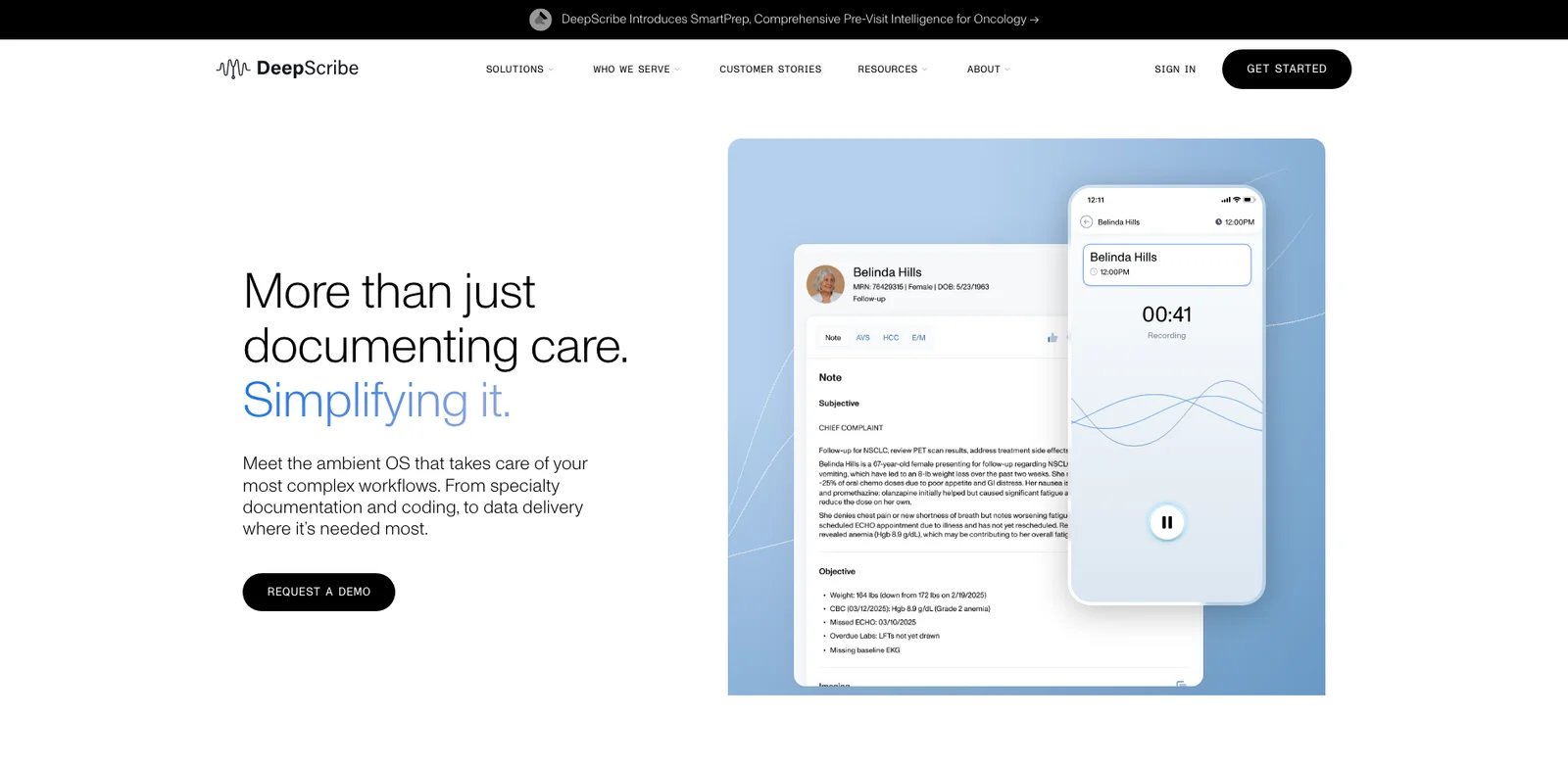
That depth comes with enterprise economics: DeepScribe is quote-based (commonly estimated at ~$350–$750+/provider/month on annual contracts, often with $500–$1,000 implementation fees). It makes zero financial sense for a low-volume primary care solo practice, but for specialty groups where missed HCC/E/M capture costs far more than the software seat, bi-directional coding automation can pay for itself.
8. Suki — Best for Voice Commands + Ambient Scribing
Suki takes a hybrid approach: instead of acting solely as a passive ambient listener that hands you a note after the patient leaves, it pairs ambient scribing with active voice commands inside native Epic, Cerner, and athenahealth integrations. Clinicians who already dictate rapidly—and want to issue voice edits or chart navigation commands hands-free—often adapt faster to Suki than to purely passive ambient tools, though like DeepScribe and Abridge it requires custom clinic scoping.
How to Decide: Stay on Freed AI or Switch?
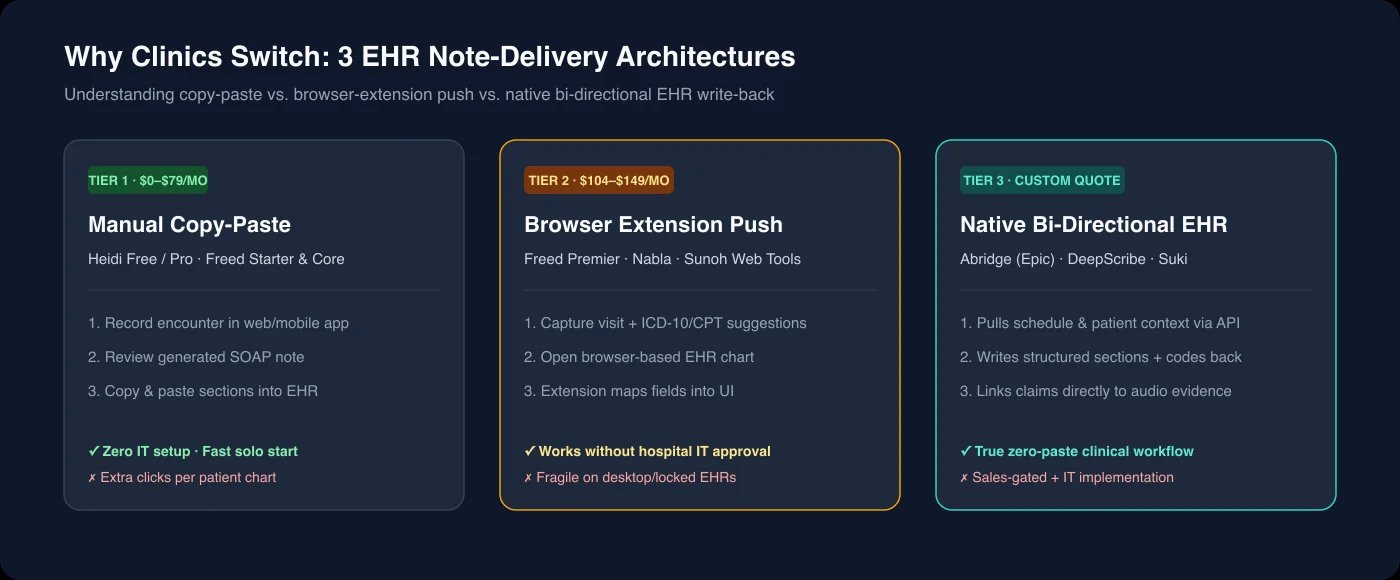
The smartest way to choose between Freed AI and these eight alternatives is to match your monthly visit volume and EHR environment, rather than chasing the longest feature checklist:
| Practice Scenario | Freed AI Cost | Stronger-Fit Alternative | Practical Impact |
|---|---|---|---|
| Part-Time Solo (≤40 visits/mo) | $39/mo annual (Starter) | Heidi Health Free ($0/mo) or Doximity Scribe ($0 US) | Save $39/mo ($468/yr) with zero cap |
| Busy Solo / Therapist (150+ visits/mo) | $79–$119/mo (Core / Premier) | Twofold Health ($49/mo annual, unlimited) | Save $30–$70/mo if copy-paste works |
| Full-Time Solo Needing EHR Extension Push | $104–$119/mo (Premier) | Freed Premier vs Nabla (~$119/mo bench) | Keep Freed if web EHR push already works |
| 5-Provider Outpatient Clinic (BAA + eCW) | Custom Group quote | Sunoh.ai ($149/user/mo = $745/mo total) | Predictable flat rate, Azure BAA, no annual lock-in |
| Specialty Group (Oncology / Cardiology) | Not built for deep HCC/E/M | DeepScribe (~$350–$750+/provider/mo est.) | Higher seat cost, offsets billing/coding leakage |
Real-World Day-1 Friction: Telehealth, Languages & Consent
Even when pricing looks right, three operational details trip up clinics during their first week off Freed AI. First is telehealth audio routing: if you run Zoom or Doxy.me visits on a laptop with headphones, make sure the scribe captures system/tab audio cleanly rather than forcing you onto speakerphone (browser-integrated tools like Nabla and desktop apps like Heidi handle dual-channel virtual visits more reliably than mobile-only capture). Second is bilingual visits: practices serving Spanish-speaking or multilingual patients should test code-switching accuracy directly, as Heidi Health and Abridge explicitly prioritize multi-language consultation support. Third is patient consent: keep a one-sentence verbal script at check-in ("I use an encrypted clinical scribe that deletes audio after drafting your note—is it okay if we record today's visit?") so ambient capture never creates exam-room friction.
HIPAA, BAA & Audio Retention Reality Check
Before migrating patient encounters to any new scribe, verify two compliance details that marketing pages often bury: when encounter audio is deleted and whether a Business Associate Agreement (BAA) covers your exact tier. Freed AI is HIPAA-compliant with a BAA available (incorporated in terms, with signed copies on request and org-wide on Group); audio is processed on encrypted Azure servers and auto-deleted by default, retained only up to 14 days when needed to troubleshoot failed captures. Heidi Health likewise acts as a HIPAA Business Associate for US covered entities and deletes consultation audio immediately after transcript generation (with 1–90 day configurable auto-deletion for notes), though clinics with strict compliance audits generally prefer paid Pro/Together tiers for centralized admin controls. Doximity Scribe is HIPAA-compliant for verified U.S. providers, Sunoh.ai includes an Azure-backed BAA on flat-rate plans, Nabla ties BAA scope to your plan tier (verify before live PHI), and Abridge and DeepScribe include enterprise BAAs and SSO as standard contract terms.
10-Minute Side-by-Side Test Before You Cancel Freed AI
Do not cancel Freed AI on the strength of a marketing demo. Keep your current Freed workspace open for one week and run three de-identified mock encounters side by side in your shortlist candidate: a complex multi-problem primary care follow-up (testing pertinent negatives and medication reconciliation), a narrative behavioral health or chronic-care check-in (testing tone and paragraph structure), and a telehealth visit with headphones. Paste the output into your actual EHR template—if you spend more than 45 seconds reformatting headers or fixing missed negatives, the cheaper subscription will cost you more in evening charting time.
Explore more options in our AI Medical Scribe directory or read our AI medical scribe complete guide.
Frequently Asked Questions
Is there a free alternative to Freed AI?
Yes. Heidi Health offers a $0/month Free plan with unlimited basic AI clinical notes and 10 Pro Actions per month, and Doximity Scribe is free ($0) for verified U.S. clinicians. Freed AI only provides a 7-day free trial before requiring a paid plan ($39/mo annual Starter for up to 40 notes).
What is the best affordable unlimited alternative to Freed AI?
Twofold Health ($49/month billed annually or $69/month monthly) offers unlimited clinical notes and coding support with no per-note cap, making it a popular middle ground between Freed Starter ($39/mo for 40 notes) and Freed Core/Premier ($79–$119/mo).
Which Freed AI alternative works best with Epic?
For large health systems, Abridge has the deepest native Epic integration (including Linked Evidence). For mid-to-large specialty practices needing bi-directional write-back and coding, DeepScribe and Suki also support native Epic integrations.
Is Heidi Health or Freed AI better for solo clinicians?
Choose Heidi Health if you want a permanent free tier for basic notes. Choose Freed AI ($79/mo Core or $104–$119/mo Premier) if you want built-in browser-extension EHR push and ICD-10/CPT coding assistance without upgrading to an enterprise team plan.
Get ToolWorthy Weekly
New AI tools, practical guides, and selected AI signals in one weekly brief.
Related Posts
- 8 Best AI Medical Scribes for Doctors (Nov 2026) — Notes, EHR & Pricing
Compare 8 HIPAA-compliant AI medical scribe software tools for doctors and clinical notes — verified November 2026 pricing, EHR integration, and practice fit.
- AI Medical Scribe Complete Guide 2026
A comprehensive guide to AI medical scribes covering how they work, benefits, limitations, regulations, and how to decide if they're right for your practice.
For AI tool founders
Built a tool that belongs in this decision set?
Request an editorial evaluation for possible inclusion in ToolWorthy.
Submit your tool for reviewPaid submission does not guarantee a ranking, recommendation, inclusion, or editorial outcome.