Overview
GPT-5.5 Instant is the new default model in ChatGPT, announced and rolled out on May 5, 2026 to replace GPT-5.3 Instant as the daily-driver chat model used by hundreds of millions of people. Where the mainline GPT-5.5 release in April leaned into agentic coding and long-horizon professional work, this update tunes the fast Instant lane that handles everyday questions—aiming for fewer hallucinations on high-stakes topics, tighter responses, and meaningfully better personalization through past chats, files, and connected Gmail. It is the default for every ChatGPT user and is exposed in the API as chat-latest.
What's New
Sharply Reduced Hallucinations on High-Stakes Topics
In OpenAI's internal evaluations, GPT-5.5 Instant produced 52.5% fewer hallucinated claims than GPT-5.3 Instant on high-stakes prompts covering medicine, law, and finance—the domains where everyday users are most likely to make decisions based on the answer. On user-flagged conversations that previously contained factual errors, GPT-5.5 Instant cut inaccurate claims by 37.3%. OpenAI illustrated the change with a math example where the older Instant prematurely concluded "no real solution," while GPT-5.5 Instant noticed its own algebra error mid-answer, recovered to the correct quadratic, and arrived at a valid root.
Tighter, More Direct Responses
OpenAI says GPT-5.5 Instant responses are generally tighter and more direct; in one published communication-advice example, the GPT-5.5 Instant answer used 30.2% fewer words and 29.2% fewer lines than GPT-5.3 Instant while keeping a practical, conversational tone. The model uses fewer unnecessary follow-up questions, drops gratuitous emojis, and avoids the heavy bullet-and-bold scaffolding that made earlier replies feel cluttered. OpenAI's released side-by-side examples (advice on talking to a chatty coworker, tea-shop recommendations) show shorter answers that still cover the same ground—useful for chat sessions where people skim rather than read line by line.
Stronger STEM, Vision, and Web-Search Judgement
Beyond hallucination cuts, GPT-5.5 Instant scores higher on visual reasoning, math, and science evaluations than GPT-5.3 Instant, and is "more capable across everyday tasks, including improvements in analyzing photo and image uploads, answering STEM-related questions, and deciding when to use web search to provide a more useful answer." The web-search routing change is notable for users who relied on prompting tricks to force or suppress browsing—Instant now makes the call more reliably on its own.
Personalization From Past Chats, Files, and Gmail
GPT-5.5 Instant is "more effective at using context from past chats, files, and Gmail, if you have it connected." It "intelligently decides when a response can be improved with additional personalization and is faster at searching past conversations to find the right context, so you don't have to repeat yourself as often." OpenAI's published example—tea-shop recommendations tailored to the user's known preference for Asha Tea House and clean Taiwanese tea—shows the model reaching past surface-level location personalization to draw on stated taste preferences from earlier chats.
Memory Sources for Visibility and Control
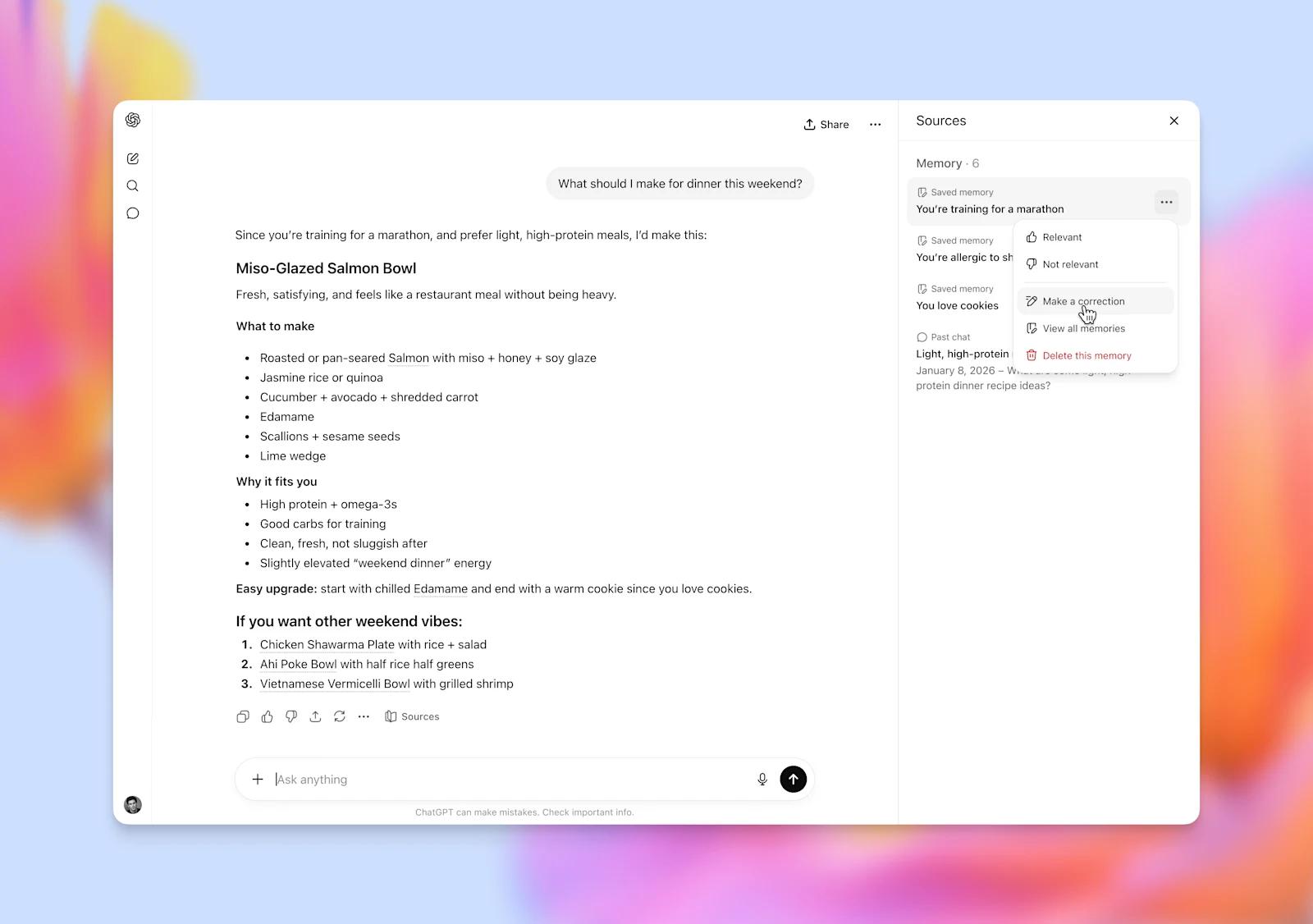
Alongside the model upgrade, OpenAI introduced memory sources across all ChatGPT models. When a response is personalized, users can see what context shaped it—saved memories, past chats, connected files—and delete or correct anything that's outdated. Memory sources are not displayed when a chat is shared with others. The view is not exhaustive (it surfaces the most relevant items rather than every searched chat) but lands as the most concrete answer yet to user complaints that ChatGPT's personalization felt opaque.
Availability & Access
GPT-5.5 Instant is rolling out starting May 7, 2026 to all ChatGPT users, replacing GPT-5.3 Instant as the default model on Free, Plus, Pro, Business, and Enterprise plans. In the API it is exposed as chat-latest. For paid users, GPT-5.3 Instant remains available for three months through model configuration settings before being retired, giving teams a window to verify behavior changes against existing prompts and evals.
The enhanced personalization layer—drawing on past chats, files, and connected Gmail—is rolling out first to Plus and Pro on the web, then expanding to mobile and to Free, Go, Business, and Enterprise in the following weeks. Availability of specific personalization sources may vary by region. Memory sources ship across all ChatGPT consumer plans on the web, with mobile coming soon.
Pricing & Plans
ChatGPT subscription tiers stay unchanged at this release; the change is a default-model swap rather than a plan repricing. In the US, paid consumer access starts with ChatGPT Go at $8/month, followed by Plus and Pro.
- ChatGPT Free — $0/month. Limited access to GPT-5.5 Instant as the default model.
- ChatGPT Go — $8/month in the US, with localized pricing in some markets. More access to GPT-5.5 Instant, messages, uploads, image creation, memory, and context than Free.
- ChatGPT Plus — $20/month. Expanded GPT-5.5 Instant access plus GPT-5.5 Thinking; GPT-5.5 Pro is not included. Plus and Pro web users are in the first wave for past-chats / files / Gmail personalization.
- ChatGPT Pro — From $100/month. Same Instant default; access to GPT-5.5 Pro and higher usage limits, with broader memory and context capacity.
- ChatGPT Business / Enterprise — Seat-based and custom pricing. GPT-5.5 Instant default included; personalization features expanding in the coming weeks.
- API (
chat-latest) — Points to the latest Instant model currently used in ChatGPT and may update over time. For production API workloads, OpenAI recommends using stable GPT-5.5 model IDs rather than relying onchat-latest.
OpenAI did not announce ChatGPT plan repricing for this release. For API usage, verify the current chat-latest / GPT-5.5 rates on OpenAI's API pricing page rather than implying a separate GPT-5.5 Instant price.
Best For
- Free ChatGPT users who get the upgrade automatically and see the biggest jump from GPT-5.3 Instant's heavier hallucination profile.
- Casual users who ask everyday questions about health, money, or legal topics and want fewer confidently-wrong answers.
- Plus and Pro web users ready to lean on past-chats, files, and Gmail context for tailored answers without re-explaining themselves.
- Privacy-conscious users who want to audit and correct what personal context the model is drawing on via Memory sources.
- Mobile-first ChatGPT users waiting for the personalization layer to land—they get the smarter, tighter Instant model now even before the full memory rollout reaches mobile.
- Teams testing ChatGPT-like API behavior through
chat-latestand willing to accept rolling model changes; production workloads should prefer stable model IDs.
FAQ
Is GPT-5.5 Instant the same as the mainline GPT-5.5 release from April?
No. The mainline GPT-5.5 release on April 23, 2026 introduced agentic coding, computer use, and professional knowledge-work gains and is selectable as a Thinking-tier model. GPT-5.5 Instant is the everyday default chat model in the same family—optimized for fast, accurate, concise answers on the high-volume questions people actually send. They share branding but target different use cases.
Will Free users actually get GPT-5.5 Instant?
Yes. OpenAI explicitly states the rollout reaches "all ChatGPT users," replacing GPT-5.3 Instant as the default. Personalization features (past-chats, files, Gmail context) are gated to Plus and Pro web first, but the underlying Instant model upgrade is universal.
How do I keep using GPT-5.3 Instant if my prompts depend on it?
Paid users can switch to GPT-5.3 Instant through model configuration settings for three months after launch, after which it will be retired. The API exposes pinned gpt-5.3-* snapshots for the same window. Use that period to update prompts and evals against the new default.
What are Memory sources and where do I see them?
When a response is personalized, ChatGPT shows the saved memories, past chats, or files it drew from. Click into the memory source view from the response, and you can delete or correct anything outdated. They aren't shared when you share a chat, and the list isn't fully exhaustive—it surfaces the most relevant items, not every searched item.
Are the hallucination reductions independently verified?
Not yet. The 52.5% (high-stakes prompts) and 37.3% (user-flagged conversations) figures come from OpenAI's internal evaluations against GPT-5.3 Instant. Independent benchmarks haven't replicated them at launch, so treat the numbers as direction-correct rather than absolute.
How does this affect ChatGPT API users?
chat-latest points to the latest Instant model used in ChatGPT and now reflects the GPT-5.5 Instant rollout. If your application depends on prior GPT-5.3 Instant behavior, verify currently available legacy or snapshot model IDs in the API docs; do not assume the ChatGPT three-month model-picker window applies to API snapshots. Pricing through chat-latest is unchanged at this release.