ChatGPT icon

ChatGPT GPT-5.5 Instant

GPT-5.5 InstantVerified

Get smarter answers with 52.5% fewer hallucinated claims than GPT-5.3 Instant on high-stakes prompts in medicine, law, and finance, plus 37.3% fewer inaccurate claims on user-flagged challenging chats Read more concise, on-point responses; in OpenAI's communication-advice example, GPT-5.5 Instant used 30.2% fewer words and 29.2% fewer lines, alongside stronger STEM, vision, and web-search judgment Get tailored help as Instant becomes ChatGPT's default model for everyone, drawing on past chats, files, and connected Gmail with new memory source controls to see and edit what shaped each answer

Reviewed by ToolWorthy Editors·updated 2 months ago

Pricing:Free + from $20/mo
Visit Site
Newer version available·View latest
Jump to section
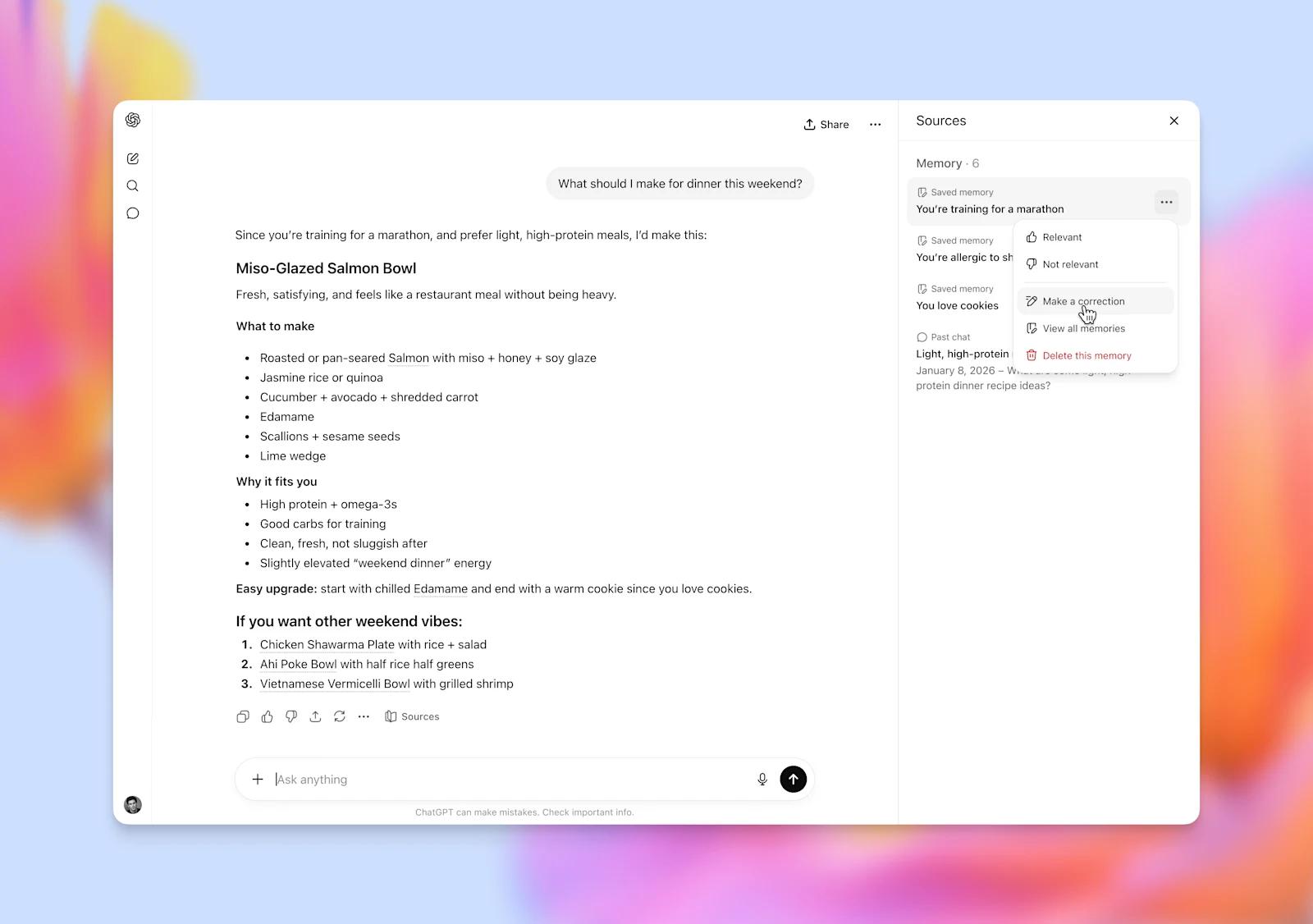
ChatGPT interface showing GPT-5.5 Instant generating personalized meal recommendations using saved memory and connected apps

Featured alternatives

MakersClaw icon

MakersClaw

TypingMind icon

TypingMind

Doubao icon

Doubao

Z.ai icon

Z.ai

Slashy icon

Slashy

Invoko icon

Invoko

Pros & Cons

Editor-reviewed

Pros

  • 52.5% fewer hallucinations on medicine, law, and finance prompts vs GPT-5.3 Instant—a meaningful win for the model that 100M+ casual users rely on.
  • 30.2% shorter responses without losing substance—less skimming friction in everyday chat.
  • Better photo, image, and STEM handling for non-technical users who don't think to switch to a Thinking model.
  • Smarter web-search routing—the model decides when to browse rather than relying on user prompt tricks.
  • Personalization with visibility—Memory sources let users see and edit what context shaped a personalized answer.
  • Free for everyone—new default applies to Free as well as paid plans, no upgrade required.

Cons

  • Personalization rollout is uneven—web Plus/Pro first, mobile and Free/Go/Business/Enterprise follow over weeks; regions vary.
  • Three-month deprecation window for GPT-5.3 Instant—teams pinning to default behavior need to migrate within the window.
  • Memory sources view is not exhaustive—surfaces "some of the most relevant past chats" rather than every chat searched.
  • Hallucination gains are internal-eval claims—not yet replicated on independent public benchmarks at launch.
  • No agentic-coding or long-horizon improvements—this is a chat-default upgrade; teams needing the gains from mainline GPT-5.5 (Terminal-Bench, OSWorld) should still pick that variant.

Overview

GPT-5.5 Instant is the new default model in ChatGPT, announced and rolled out on May 5, 2026 to replace GPT-5.3 Instant as the daily-driver chat model used by hundreds of millions of people. Where the mainline GPT-5.5 release in April leaned into agentic coding and long-horizon professional work, this update tunes the fast Instant lane that handles everyday questions—aiming for fewer hallucinations on high-stakes topics, tighter responses, and meaningfully better personalization through past chats, files, and connected Gmail. It is the default for every ChatGPT user and is exposed in the API as chat-latest.

What's New

Sharply Reduced Hallucinations on High-Stakes Topics

In OpenAI's internal evaluations, GPT-5.5 Instant produced 52.5% fewer hallucinated claims than GPT-5.3 Instant on high-stakes prompts covering medicine, law, and finance—the domains where everyday users are most likely to make decisions based on the answer. On user-flagged conversations that previously contained factual errors, GPT-5.5 Instant cut inaccurate claims by 37.3%. OpenAI illustrated the change with a math example where the older Instant prematurely concluded "no real solution," while GPT-5.5 Instant noticed its own algebra error mid-answer, recovered to the correct quadratic, and arrived at a valid root.

Tighter, More Direct Responses

OpenAI says GPT-5.5 Instant responses are generally tighter and more direct; in one published communication-advice example, the GPT-5.5 Instant answer used 30.2% fewer words and 29.2% fewer lines than GPT-5.3 Instant while keeping a practical, conversational tone. The model uses fewer unnecessary follow-up questions, drops gratuitous emojis, and avoids the heavy bullet-and-bold scaffolding that made earlier replies feel cluttered. OpenAI's released side-by-side examples (advice on talking to a chatty coworker, tea-shop recommendations) show shorter answers that still cover the same ground—useful for chat sessions where people skim rather than read line by line.

Stronger STEM, Vision, and Web-Search Judgement

Beyond hallucination cuts, GPT-5.5 Instant scores higher on visual reasoning, math, and science evaluations than GPT-5.3 Instant, and is "more capable across everyday tasks, including improvements in analyzing photo and image uploads, answering STEM-related questions, and deciding when to use web search to provide a more useful answer." The web-search routing change is notable for users who relied on prompting tricks to force or suppress browsing—Instant now makes the call more reliably on its own.

Personalization From Past Chats, Files, and Gmail

GPT-5.5 Instant is "more effective at using context from past chats, files, and Gmail, if you have it connected." It "intelligently decides when a response can be improved with additional personalization and is faster at searching past conversations to find the right context, so you don't have to repeat yourself as often." OpenAI's published example—tea-shop recommendations tailored to the user's known preference for Asha Tea House and clean Taiwanese tea—shows the model reaching past surface-level location personalization to draw on stated taste preferences from earlier chats.

Memory Sources for Visibility and Control

Alongside the model upgrade, OpenAI introduced memory sources across all ChatGPT models. When a response is personalized, users can see what context shaped it—saved memories, past chats, connected files—and delete or correct anything that's outdated. Memory sources are not displayed when a chat is shared with others. The view is not exhaustive (it surfaces the most relevant items rather than every searched chat) but lands as the most concrete answer yet to user complaints that ChatGPT's personalization felt opaque.

Availability & Access

GPT-5.5 Instant is rolling out starting May 7, 2026 to all ChatGPT users, replacing GPT-5.3 Instant as the default model on Free, Plus, Pro, Business, and Enterprise plans. In the API it is exposed as chat-latest. For paid users, GPT-5.3 Instant remains available for three months through model configuration settings before being retired, giving teams a window to verify behavior changes against existing prompts and evals.

The enhanced personalization layer—drawing on past chats, files, and connected Gmail—is rolling out first to Plus and Pro on the web, then expanding to mobile and to Free, Go, Business, and Enterprise in the following weeks. Availability of specific personalization sources may vary by region. Memory sources ship across all ChatGPT consumer plans on the web, with mobile coming soon.

Pricing & Plans

ChatGPT subscription tiers stay unchanged at this release; the change is a default-model swap rather than a plan repricing. In the US, paid consumer access starts with ChatGPT Go at $8/month, followed by Plus and Pro.

  • ChatGPT Free — $0/month. Limited access to GPT-5.5 Instant as the default model.
  • ChatGPT Go — $8/month in the US, with localized pricing in some markets. More access to GPT-5.5 Instant, messages, uploads, image creation, memory, and context than Free.
  • ChatGPT Plus — $20/month. Expanded GPT-5.5 Instant access plus GPT-5.5 Thinking; GPT-5.5 Pro is not included. Plus and Pro web users are in the first wave for past-chats / files / Gmail personalization.
  • ChatGPT Pro — From $100/month. Same Instant default; access to GPT-5.5 Pro and higher usage limits, with broader memory and context capacity.
  • ChatGPT Business / Enterprise — Seat-based and custom pricing. GPT-5.5 Instant default included; personalization features expanding in the coming weeks.
  • API (chat-latest) — Points to the latest Instant model currently used in ChatGPT and may update over time. For production API workloads, OpenAI recommends using stable GPT-5.5 model IDs rather than relying on chat-latest.

OpenAI did not announce ChatGPT plan repricing for this release. For API usage, verify the current chat-latest / GPT-5.5 rates on OpenAI's API pricing page rather than implying a separate GPT-5.5 Instant price.

Best For

  • Free ChatGPT users who get the upgrade automatically and see the biggest jump from GPT-5.3 Instant's heavier hallucination profile.
  • Casual users who ask everyday questions about health, money, or legal topics and want fewer confidently-wrong answers.
  • Plus and Pro web users ready to lean on past-chats, files, and Gmail context for tailored answers without re-explaining themselves.
  • Privacy-conscious users who want to audit and correct what personal context the model is drawing on via Memory sources.
  • Mobile-first ChatGPT users waiting for the personalization layer to land—they get the smarter, tighter Instant model now even before the full memory rollout reaches mobile.
  • Teams testing ChatGPT-like API behavior through chat-latest and willing to accept rolling model changes; production workloads should prefer stable model IDs.

FAQ

Is GPT-5.5 Instant the same as the mainline GPT-5.5 release from April?

No. The mainline GPT-5.5 release on April 23, 2026 introduced agentic coding, computer use, and professional knowledge-work gains and is selectable as a Thinking-tier model. GPT-5.5 Instant is the everyday default chat model in the same family—optimized for fast, accurate, concise answers on the high-volume questions people actually send. They share branding but target different use cases.

Will Free users actually get GPT-5.5 Instant?

Yes. OpenAI explicitly states the rollout reaches "all ChatGPT users," replacing GPT-5.3 Instant as the default. Personalization features (past-chats, files, Gmail context) are gated to Plus and Pro web first, but the underlying Instant model upgrade is universal.

How do I keep using GPT-5.3 Instant if my prompts depend on it?

Paid users can switch to GPT-5.3 Instant through model configuration settings for three months after launch, after which it will be retired. The API exposes pinned gpt-5.3-* snapshots for the same window. Use that period to update prompts and evals against the new default.

What are Memory sources and where do I see them?

When a response is personalized, ChatGPT shows the saved memories, past chats, or files it drew from. Click into the memory source view from the response, and you can delete or correct anything outdated. They aren't shared when you share a chat, and the list isn't fully exhaustive—it surfaces the most relevant items, not every searched item.

Are the hallucination reductions independently verified?

Not yet. The 52.5% (high-stakes prompts) and 37.3% (user-flagged conversations) figures come from OpenAI's internal evaluations against GPT-5.3 Instant. Independent benchmarks haven't replicated them at launch, so treat the numbers as direction-correct rather than absolute.

How does this affect ChatGPT API users?

chat-latest points to the latest Instant model used in ChatGPT and now reflects the GPT-5.5 Instant rollout. If your application depends on prior GPT-5.3 Instant behavior, verify currently available legacy or snapshot model IDs in the API docs; do not assume the ChatGPT three-month model-picker window applies to API snapshots. Pricing through chat-latest is unchanged at this release.

Version History

GPT-5.6

Released on July 9, 2026

View Update
+What's new
3 updates
  • Complete demanding coding, knowledge-work, science, and security tasks with GPT-5.6 Sol, OpenAI's new flagship model and its configurable reasoning effort
  • Choose Sol, balanced Terra, or lower-cost Luna across ChatGPT, Codex, and the API, matching capability and cost to each workflow
  • Build multi-agent API workflows with Programmatic Tool Calling and beta multi-agent support while using explicit cache breakpoints for more predictable costs

GPT-5.5 Instant

Current Version

Released on May 5, 2026

+What's new
3 updates
  • Get smarter answers with 52.5% fewer hallucinated claims than GPT-5.3 Instant on high-stakes prompts in medicine, law, and finance, plus 37.3% fewer inaccurate claims on user-flagged challenging chats
  • Read more concise, on-point responses; in OpenAI's communication-advice example, GPT-5.5 Instant used 30.2% fewer words and 29.2% fewer lines, alongside stronger STEM, vision, and web-search judgment
  • Get tailored help as Instant becomes ChatGPT's default model for everyone, drawing on past chats, files, and connected Gmail with new memory source controls to see and edit what shaped each answer

GPT-5.5

Released on April 23, 2026

View Update
+What's new
3 updates
  • Automate agentic coding and computer-use tasks with GPT-5.5, scoring 82.7% on Terminal-Bench 2.0 and 78.7% on OSWorld-Verified while using fewer tokens than GPT-5.4
  • Complete professional knowledge work across 44 occupations with 84.9% on GDPval, and accelerate early scientific research workflows spanning data analysis, bioinformatics, and multi-step planning
  • Run Codex workflows more efficiently as GPT-5.5 delivers better results with fewer tokens than GPT-5.4 for most users, with API pricing planned at $5/M input and $30/M output

GPT‑5.4 mini and nano

Released on March 17, 2026

View Update
+What's new
3 updates
  • GPT-5.4 mini scores 54.4% on SWE-Bench Pro and 72.1% on OSWorld-Verified—outperforming GPT-5 mini by a wide margin while running 2x faster, and is now available to ChatGPT Free users via the Thinking feature
  • GPT-5.4 nano launches as OpenAI's cheapest API model at $0.20 per 1M input tokens, optimized for subagent classification, data extraction, and ranking tasks
  • Codex can now delegate simpler reasoning tasks to GPT-5.4 mini subagents, enabling cost-efficient multi-model agentic pipelines

GPT-5.4

Released on March 5, 2026

View Update
+What's new
3 updates
  • Complete professional work more accurately with GPT-5.4—matching or exceeding industry professionals in 83.0% of GDPval comparisons (wins or ties), with 33% fewer false claims and 18% fewer error-containing responses than GPT-5.2
  • Automate complex computer workflows natively with built-in computer-use capabilities, achieving 75.0% on OSWorld-Verified and surpassing human performance—enabling agents to operate software, browsers, and desktop environments
  • Work with large tool ecosystems more efficiently using tool search, reducing token usage by 47% on MCP-heavy workflows while maintaining the same accuracy, with support for up to 1M token context windows

5.3 Instant

Released on March 3, 2026

View Update
+What's new
3 updates
  • Get more direct and helpful responses with 26.8% fewer hallucinations—GPT-5.3 Instant cuts unnecessary refusals and preachy preambles, answering questions without dead ends or caveats
  • Get better web search answers that balance online sources with model reasoning, surfacing relevant information upfront and avoiding long, loosely connected link lists
  • Write more expressive content with stronger prose generation and a smoother, more focused conversational style across everyday tasks and creative writing

5.2

Released on December 11, 2025

View Update
+What's new
1 updates
  • Solve advanced scientific and mathematical problems with enhanced reasoning capabilities, enabling researchers to analyze complex data and verify calculations with higher accuracy

5.1

Released on November 12, 2025

+What's new
1 updates
  • Get more accurate and contextually relevant responses across coding, writing, and analysis tasks with refined GPT-5 series capabilities

5

Released on August 7, 2025

+What's new
3 updates
  • Get the right balance of speed and depth automatically—ChatGPT now routes simple questions to faster models and complex problems to deeper reasoning, saving you time on every query
  • Create more reliable content with reduced errors and better instruction-following for writing, coding, and health-related tasks where accuracy matters
  • Access GPT-5 pro mode with extended reasoning capabilities for tackling research, analysis, and multi-step problems that require deeper thinking

OpenAI o3 and o4-mini

Released on April 16, 2025

+What's new
2 updates
  • Use OpenAI o3 for harder reasoning tasks that combine ChatGPT tools like web browsing, Python, image/file analysis, image generation, canvas, automations, file search, and memory
  • Solve math, coding, and visual reasoning tasks with o4-mini, a smaller faster model optimized for high-volume reasoning and strong AIME 2025 performance

GPT-4.5

Released on February 27, 2025

+What's new
2 updates
  • Explore GPT-4.5 as a research preview for more natural chat, broader knowledge, stronger instruction following, and improved creative insight without explicit reasoning
  • Use GPT-4.5 for writing, programming, and practical problem solving when you want lower hallucinations and higher emotional nuance than earlier GPT models

o1

Released on September 12, 2024

+What's new
2 updates
  • Solve advanced problems in science, mathematics, and coding with o1 models that take time to reason through complex logic before responding
  • Debug intricate code issues and verify mathematical proofs with step-by-step reasoning that breaks down difficult concepts systematically

4o

Released on May 13, 2024

+What's new
2 updates
  • Analyze images, generate visuals, and have voice conversations with GPT-4 level intelligence at speeds fast enough for real-time interaction
  • Browse the web, analyze data files, and create images without a paid subscription—advanced capabilities now available to all users

4

Released on March 14, 2023

+What's new
2 updates
  • Tackle professional-level tasks with expert performance—scoring in the top 10% on exams like the bar exam, compared to GPT-3.5's bottom 10%
  • Analyze charts, diagrams, and documents by uploading images directly, enabling visual understanding for data analysis, design feedback, and document processing

3.5

Released on November 30, 2022

+What's new
1 updates
  • Chat with AI in natural language for the first time to get answers, write content, debug code, and brainstorm ideas through back-and-forth conversation

Top alternatives

Related categories

From the blog

View all →

Track ChatGPT in ToolWorthy Weekly

Important tool updates, better alternatives, and selected AI signals in one weekly brief.

Weekly only. Unsubscribe anytime.