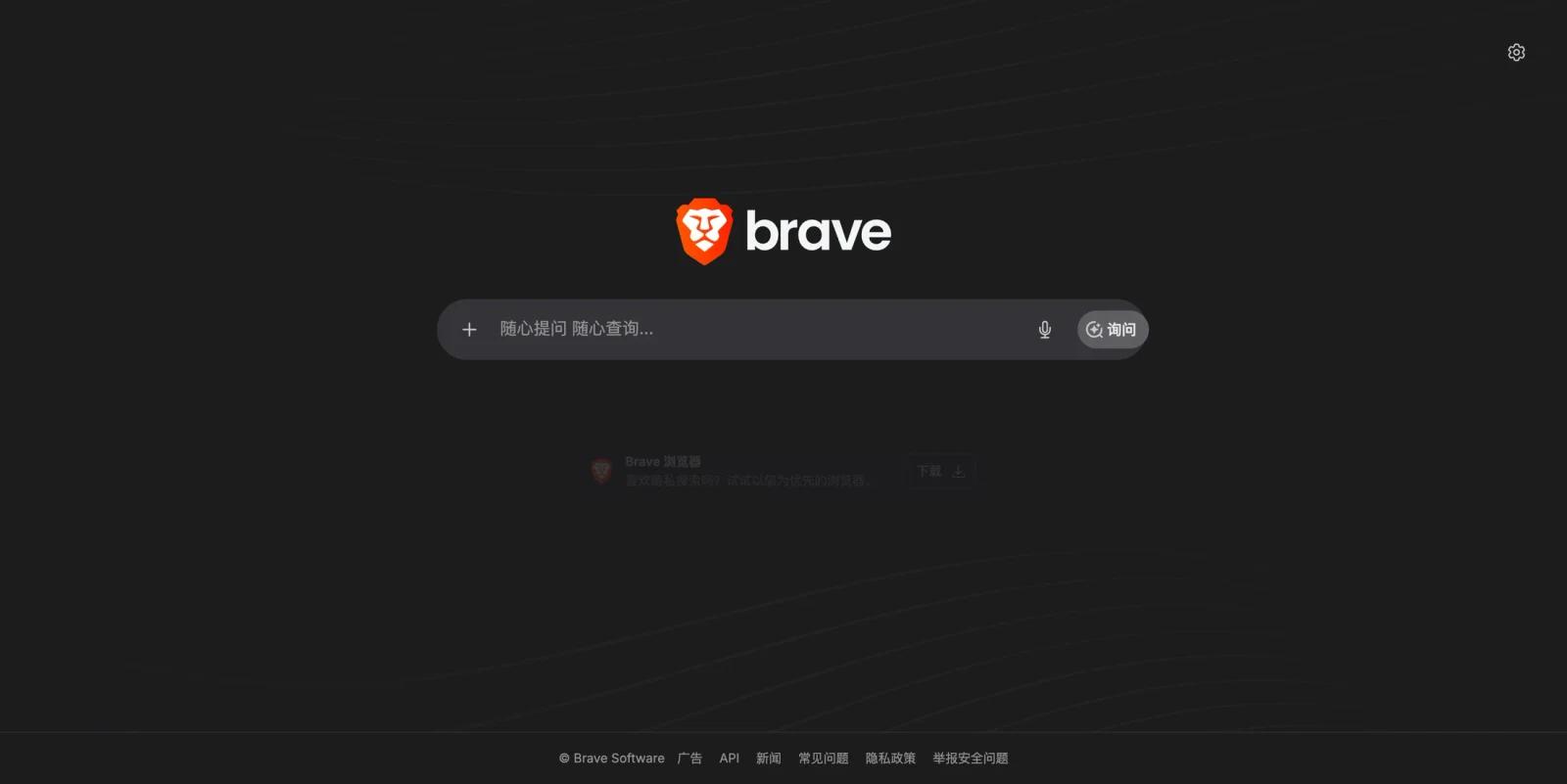

Most privacy-focused search engines compromise by using Bing or Google results under the hood, relying on the infrastructure of the companies they claim to offer an alternative to. Brave Search maintains its own independent web index — one of only three at global scale in the western world alongside Google and Microsoft — crawling more than 30 billion pages with over 100 million daily updates. Search results come from Brave's own data, not a licensed feed from a Big Tech competitor.
The AI search engine layer sits directly inside the search results page: Brave Answer synthesizes a cited summary for question-type queries using the same index, and Ask Brave provides an AI chat interface at search.brave.com/ask. For users of the Brave browser, Leo AI — Brave's in-browser assistant — can use Brave Search grounding for real-time answers, while Brave says Leo sends the latest prompt, conversation context, and any needed page context to Brave-hosted servers; Brave says chats are not retained or used for model training.
For developers, Brave Search exposes a paid API covering web search, AI answers, images, news, videos, and an LLM Context endpoint optimized for feeding large language models relevant web context. The API removed its free tier in February 2026, replacing it with a $5 monthly credit and pay-per-use pricing.
Key Features
- Independent Web Index — A proprietary crawl of 30+ billion pages updated at over 100 million pages per day, maintained independently of Google and Bing. Brave Search results are derived from this index, not licensed from Big Tech search providers, making it one of the few search alternatives that is structurally independent rather than just a privacy skin over existing infrastructure.
- Brave Answer (AI Answers) — Built-in AI-generated summaries that appear directly in search results for question-type queries. Summaries are grounded in Brave's own index and include inline citations, allowing users to verify each claim against source pages. No separate AI chat interface required — answers appear inline where the search result box normally lives.
- Ask Brave (AI Chat) — A dedicated conversational AI interface at search.brave.com/ask that synthesizes responses from billions of indexed pages. Supports multi-turn conversation and AI-synthesized answers grounded in Brave's index. As of April 2026, Ask Brave integrates Leo AI models with real-time Brave Search data.
- Leo AI Integration (Brave Browser) — For users of the Brave browser, Leo is a sidebar AI assistant that combines multiple language models (including Qwen 3 VL 30B, Claude 4.5 Haiku, Llama 3.1 8B, Llama 4 Scout, Llama 4 Maverick, and GPT-OSS 20B on the free tier) with real-time Brave Search retrieval. Brave says Leo models are hosted through Brave's own secure infrastructure; chats are not retained, not used for model training, and subscription information is unlinkable from usage.
- Brave Search API — A pay-per-use developer API providing web search data, AI-generated answers, images, news, video, and LLM Context (a structured feed optimized for language model consumption). As of February 2026, all developers receive $5 in monthly credits; usage beyond the credit is billed at $5/1,000 Search requests; Answers is billed at $4/1,000 queries plus $5 per 1M input tokens and $5 per 1M output tokens.
- Brave Ocelot (Leo Summarization) — A Brave-trained summarization model added to Leo in Brave 1.89.132 that is specialized for summarizing web content; Brave has not explicitly documented local/on-device inference for Ocelot. Designed for users who want on-device AI assistance for summarizing web content without any remote data transmission.
How It Compares
| Tool | Own Index | AI Answers | API Available | Privacy | Starting Price |
|---|---|---|---|---|---|
| Brave Search | ✅ 30B+ pages | ✅ Built-in | ✅ $5/1k requests | ✅ No tracking | Free (consumer) |
| Google Search | ✅ Dominant | ✅ AI Overviews | ✅ Custom Search API | ❌ Extensive tracking | Free (consumer) |
| DuckDuckGo | ⚠️ Partial + Bing | ✅ DuckAssist | ❌ No public API | ✅ No profiles | Free |
| Perplexity | ❌ Licensed indexes | ✅ AI-first | ✅ Perplexity API | ⚠️ Logs by default | Free / $20/mo Pro |
| Kagi | ⚠️ Partial + third-party sources | ✅ Built-in | ⚠️ Search API in closed beta | ✅ No tracking | $5/mo (100 searches) |
Brave's primary structural advantage is index independence — Perplexity uses third-party indexes and has a materially different consumer privacy model from Brave's no-profile positioning; DuckDuckGo's results are largely Bing-sourced. Kagi similarly has a partial own index but requires a paid subscription even for basic use. Google remains more comprehensive for long-tail and recency-heavy queries. Brave occupies the middle: genuinely independent, free for consumers, weaker than Google for niche queries, stronger on privacy than Perplexity or any Google-adjacent tool.
Pricing & Plans
Brave Search is free for all consumer users at search.brave.com with no account required and no subscription tier. The Brave Search API for developers uses metered billing with a monthly credit.
| Product | Cost | Notes |
|---|---|---|
| Brave Search (Consumer) | Free | No account required, no tracking, unlimited queries |
| API: Web Search | $5 per 1,000 requests | Includes Web, LLM Context, Images, News, Video, and Place Search |
| API: Answers | $4 per 1,000 queries + $5 per million tokens | AI-generated answers with source citations |
| API: Spellcheck / Autosuggest | $5 per 10,000 requests | Lightweight query correction and completion endpoints |
| Monthly credit (all API users) | $5 included | Applied automatically; covers up to 1,000 Search requests; Answers coverage depends on both query count and input/output token usage |
The API removed its free tier in February 2026. Teams that relied on the 2,000 free monthly queries or later the 5,000 free monthly queries must now budget for API costs. At $5/1,000 requests, a team using 100,000 queries/month would pay approximately $500/month before credits. Leo Premium for the Brave browser unlocks additional AI model tiers inside Leo AI; see Brave's Leo pricing for current model tiers.
Best For
- Privacy-conscious consumers who want a primary search engine that does not build ad profiles, track cross-site behavior, or route results through Big Tech infrastructure
- Developers building AI applications or RAG pipelines that need real-time web search via a paid API with independent, non-Big-Tech index results — Brave's LLM Context endpoint is specifically optimized for LLM consumption
- Brave browser users who want an AI assistant (Leo) with real-time search grounding and privacy-preserving API routing built into the browsing experience
- Teams evaluating privacy-first tooling stacks who want search that is structurally separate from Google and Microsoft, not just a tracker-blocking wrapper around their results
FAQ
Is Brave Search free?
Yes. Brave Search at search.brave.com is completely free for all consumer users with no account, no subscription, and no ads tied to a behavioral profile. The Brave Search API for developers has a $5 monthly credit and then charges at metered rates ($5 per 1,000 web search requests). Leo Premium — Brave's browser AI assistant — has paid tiers for access to additional AI models beyond the free tier.
Does Brave Search have its own index?
Yes. Brave Search maintains a proprietary web index covering 30+ billion pages with more than 100 million daily page updates. It is one of only three independent, global-scale search indexes in the western world alongside Google and Microsoft Bing. This means Brave Search results are not licensed or sourced from Google or Bing infrastructure. For some queries — particularly niche, long-tail, or localized searches — Google's index depth still produces more comprehensive results.
What happened to the Brave Search API free tier?
Brave removed the free API tier on February 12, 2026. Previously, developers received 2,000 free queries per month (later raised to 5,000). The current model provides all API users with $5 in monthly credits — approximately 1,000 Web Search requests or 200 Answer requests — after which usage is billed at metered rates. See Brave's API pricing page for current rates.
What is Brave Leo AI and how does it differ from Brave Search?
Leo is Brave's in-browser AI assistant, available as a sidebar in the Brave browser. It combines multiple language models (Llama 3.1 8B, Claude Haiku, Qwen 3 14B, and GLM 4.7 Flash on the free tier) with real-time Brave Search integration for up-to-date, citation-backed answers. Unlike Brave Answer (which appears inline in search results) or Ask Brave (a standalone chat at search.brave.com/ask), Leo is only available inside the Brave browser. Leo models are hosted through Brave's own secure infrastructure; Brave says conversations are not stored or logged after a response is generated, not used for training, and personal data such as IP address is not retained. See best AI chatbots for a broader comparison of AI chat tools.
How does Brave Search compare to Perplexity for AI answers?
Both Brave Search and Perplexity provide AI-generated answers grounded in web results, but they differ in index ownership and privacy model. Brave uses its own independent index; Perplexity relies on licensed third-party indexes. Brave Search's consumer product has no usage caps and no account requirement; Perplexity's free tier has daily query limits. Brave's privacy model explicitly prohibits building user profiles; Brave's privacy model explicitly prohibits building user profiles; Perplexity's consumer privacy approach is materially different from Brave's no-profile positioning. For developers, Brave's API is metered without a monthly subscription minimum; note that Perplexity's Sonar API also documents zero data retention for API usage.
What is the Brave Search LLM Context API?
LLM Context is an endpoint in the Brave Search API specifically designed to provide language models with structured, relevant web content. Rather than returning raw HTML or generic search snippets, it returns processed web results formatted to minimize irrelevant content and maximize LLM readability, making it more suitable for RAG (retrieval-augmented generation) applications than a generic web search endpoint. It is priced under the Web Search plan at $5 per 1,000 requests. Brave reports the LLM Context API is powering over 22 million answers per day in Brave Search's own AI answer features.