Overview
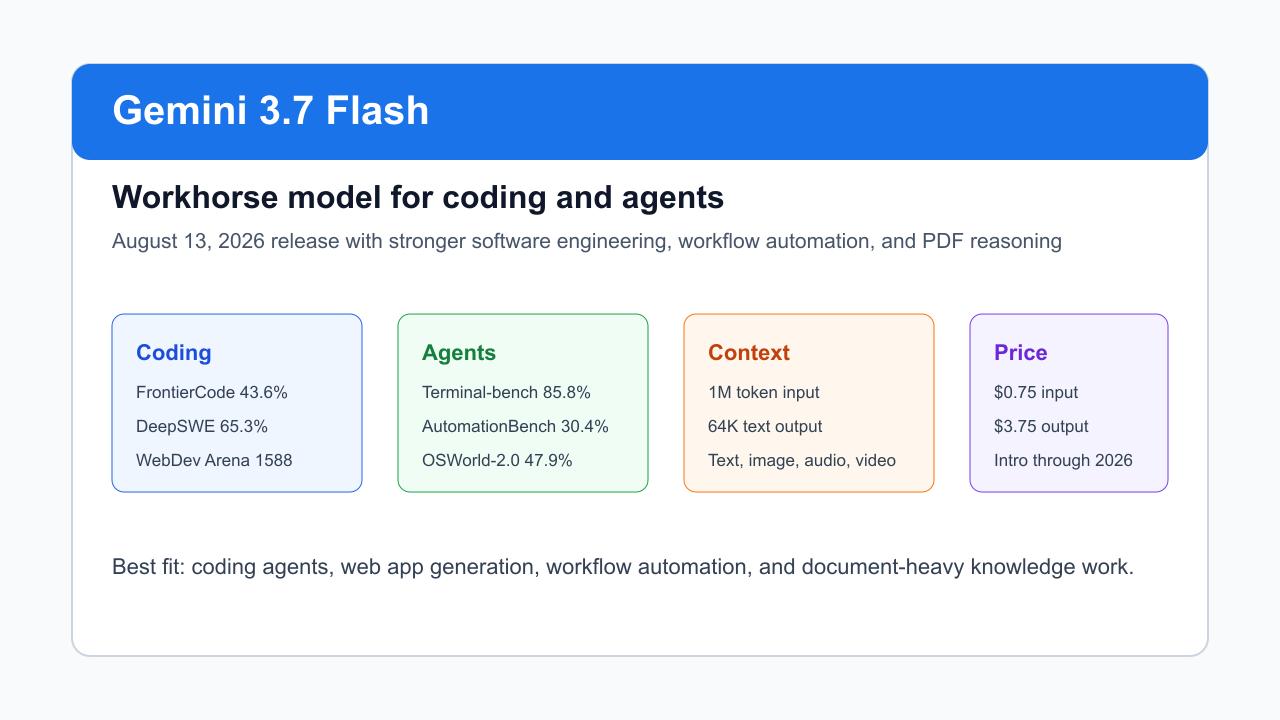
Gemini 3.7 Flash is Google's August 13, 2026 update to the Gemini 3 Flash line. Google calls it its most intelligent workhorse model for coding and agents, released three weeks after Gemini 3.6 Flash with improvements across software engineering, web development, knowledge work, PDF comprehension, and enterprise workflow automation.
The release is best understood as a targeted Flash upgrade rather than a new product. It keeps the 3.6 Flash foundation, 1M-token multimodal input context, 64K-token text output limit, and configurable thinking behavior, then improves agentic reliability and coding quality. For buyers comparing AI agent models, the key question is whether 3.7 Flash reduces retries enough to justify routing more production coding and workflow traffic through Google's stack.
What's New
Stronger coding and agent workflows
Google positions Gemini 3.7 Flash around practical agent work: debugging, issue resolution, web app generation, business workflow automation, and tool-heavy developer tasks. Compared with Gemini 3.6 Flash, Google's published results show higher scores on:
- FrontierCode 1.1 Main: 43.6% vs 34.4% for production code quality
- DeepSWE v1.1: 65.3% vs 49.0% for long-horizon software engineering
- WebDev Arena: 1588 Elo vs 1538 for web development
- Terminal-bench 2.1: 85.8% vs 78.0% for agentic terminal coding
- AutomationBench: 30.4% vs 17.0% for enterprise workflow automation
These are Google-published benchmark results, so teams should still validate against their own repositories and tool-use traces. The practical signal is clear enough: 3.7 Flash is intended to make Flash-tier agents less brittle on multi-step coding and workflow tasks.
Better developer experience
Google says 3.7 Flash adapts better to roadblocks, clarifies intent when needed, follows instructions more reliably, and puts more effort into multi-step planning and tool calls. This matters for production agents because retries and manual supervision often cost more than the raw model call.
The model is also used in Gemini Spark, Google's personal agent for Google AI Pro and Ultra subscribers in supported countries. That gives the update a consumer workflow surface as well as developer API relevance.
Improved knowledge and document work
Gemini 3.7 Flash improves over 3.6 Flash on knowledge-dense and document-heavy tasks. Google's model card lists GDP.pdf at 34.0% vs 22.0% for 3.6 Flash, and GDPVal-AA v2 at 1525 Elo vs 1422. The model is also positioned for finance, law, biosciences, and complex PDF-to-interactive-data-story workflows.
Performance Benchmarks
Google and DeepMind published a broad model-card benchmark table for Gemini 3.7 Flash. The most selection-relevant metrics are below:
| Benchmark | Gemini 3.7 Flash | Gemini 3.6 Flash | Why it matters |
|---|---|---|---|
| FrontierCode 1.1 Main | 43.6% | 34.4% | Production code quality |
| DeepSWE v1.1 | 65.3% | 49.0% | Long-horizon software engineering |
| WebDev Arena | 1588 Elo | 1538 Elo | Web development quality |
| Terminal-bench 2.1 | 85.8% | 78.0% | Agentic terminal coding |
| Terminal-bench 3.0 | 14.9% | 5.4% | General agent capabilities |
| AutomationBench | 30.4% | 17.0% | Enterprise workflow automation |
| GDP.pdf | 34.0% | 22.0% | Expert PDF document comprehension |
| OSWorld-2.0 | 47.9% | 33.8% | Agentic computer use |
| HLE-Verified | 53.6% | 51.2% | Multidisciplinary expert reasoning |
Use these numbers as vendor-published selection evidence, not a substitute for an internal eval. For production buyers, the strongest takeaway is the repeated improvement over 3.6 Flash on coding, agent, workflow, and PDF-heavy tasks.
Availability & Access
Gemini 3.7 Flash is distributed across Google's consumer, developer, and enterprise surfaces:
| Surface | Access path |
|---|---|
| Gemini API / AI Studio | Build with the Gemini API and Google AI Studio |
| Google Antigravity | Agent-first developer workflows |
| Android Studio | Developer integrations |
| Gemini Enterprise Agent Platform | Enterprise agent deployment |
| Gemini Enterprise app | Enterprise end-user workflows |
| Gemini Spark | Personal agent for Google AI Pro and Ultra subscribers in supported countries |
The DeepMind model card lists text, image, audio, and video inputs with up to a 1M-token context window. Outputs are text with a 64K-token output limit. There is no required local hardware because the model is distributed through Google's hosted services and APIs.
Compatibility Notes
Gemini 3.7 Flash is based on Gemini 3.6 Flash. It supports customizable thinking configurations, which let developers trade off quality, latency, and cost. If you already migrated to Gemini 3.6 Flash, this should be evaluated as a model-routing and prompt-behavior update rather than a full platform migration.
For production use, test these areas before switching traffic:
- Tool-call reliability on your real function schemas and agent traces
- Cost per completed task, not only cost per token
- Multi-turn behavior with
previous_interaction_idor equivalent conversation state - Prompt sensitivity in coding tasks that previously depended on 3.6 Flash behavior
- Latency and timeout behavior on long documents, large repository context, and tool-heavy runs
Pricing & Plans
Gemini 3.7 Flash uses introductory Gemini API pricing through the end of 2026:
| Period | Input | Output |
|---|---|---|
| Introductory pricing through Dec 31, 2026 | $0.75 / 1M tokens | $3.75 / 1M tokens |
| Standard pricing from Jan 1, 2027 | $1.50 / 1M tokens | $7.50 / 1M tokens |
Google says the introductory price is half the original 3.6 Flash cost per million tokens. This creates a temporary window where teams can evaluate 3.7 Flash at a lower rate, but budgets should model the January 1, 2027 price increase before committing high-volume production agents.
Consumer access through Gemini Spark depends on Google AI Pro or Ultra subscriptions and supported-country availability. Enterprise usage may follow Google Cloud or Gemini Enterprise contract terms rather than the public Gemini API rate card.
Safety & Limitations
The DeepMind model card describes Gemini 3.7 Flash as having the general limitations of foundation models, including hallucinations, occasional slowness, and timeout issues. It also states the model ships with strengthened mitigations around Frontier Safety areas including CBRN and cyber offense.
Knowledge cutoff is nuanced: the model card lists March 2026 as the cutoff while noting some domains may behave closer to January 2025, in line with the Gemini 3 family. For current facts, pricing, legal analysis, or market data, teams should use retrieval, grounding, or tool access rather than relying on model memory.
Best For
- Engineering teams running coding agents that need better issue resolution and debugging than 3.6 Flash
- Product teams building web app generation, UI prototyping, or interactive data-story workflows
- Enterprise automation teams using Google Cloud or Gemini Enterprise Agent Platform
- Knowledge-work products that process PDFs, financial reports, legal documents, or bioscience materials
- Developers already using Google Antigravity or Gemini API who can compare cost per completed task during the introductory pricing window
FAQ
What is Gemini 3.7 Flash?
Gemini 3.7 Flash is Google's August 2026 Flash model update for coding, agents, web development, knowledge work, and enterprise workflow automation. It is based on Gemini 3.6 Flash and adds algorithmic improvements to the core reasoning foundation.
What is the model ID for Gemini 3.7 Flash?
Google's launch blog points developers to the Gemini API and developer guide, while the model card names the model as Gemini 3.7 Flash. Before production integration, confirm the exact API model string in Google AI Studio or the current Gemini API models page.
How much does Gemini 3.7 Flash cost?
Introductory Gemini API pricing is $0.75 per 1M input tokens and $3.75 per 1M output tokens through December 31, 2026. Starting January 1, 2027, Google says $1.50 per 1M input tokens and $7.50 per 1M output tokens will apply.
How is Gemini 3.7 Flash different from Gemini 3.6 Flash?
It is based on 3.6 Flash but improves coding, web development, agentic terminal tasks, workflow automation, PDF comprehension, and computer-use benchmarks in Google's published results. It also keeps configurable thinking behavior for quality, latency, and cost tradeoffs.
Where can I use Gemini 3.7 Flash?
Google lists Gemini API, Google AI Studio, Android Studio, Google Antigravity, Gemini Enterprise Agent Platform, Gemini Enterprise, and Gemini Spark as access surfaces. Consumer Spark access requires Google AI Pro or Ultra in supported countries.
Is Gemini 3.7 Flash open source?
No. Gemini 3.7 Flash is a hosted Google model distributed through Google's services and APIs. The model card does not describe an open-weight or local deployment option.