



Overview
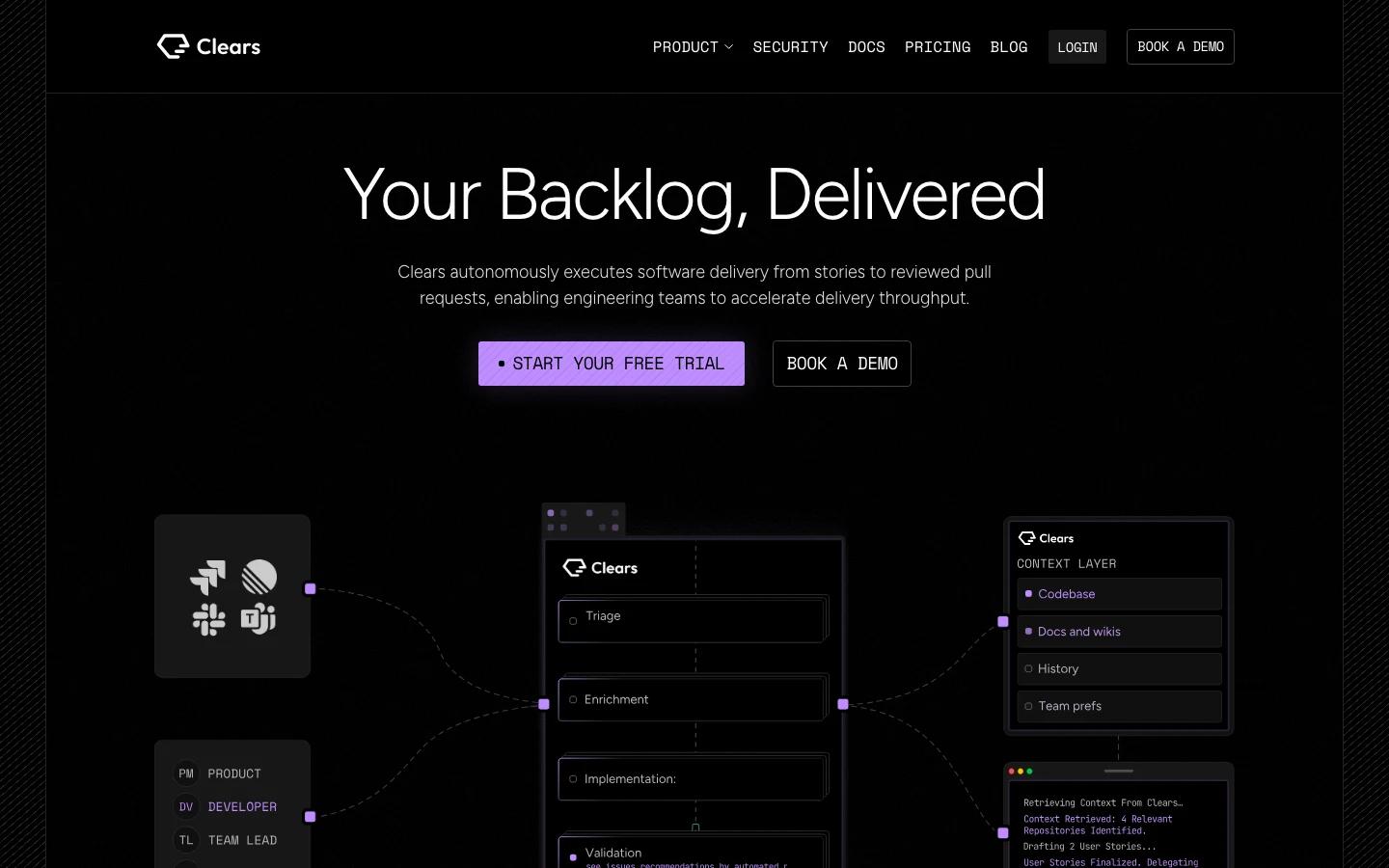
Clears is an agentic software delivery platform for engineering organizations that want AI to affect throughput, not only code-writing speed. The product takes backlog items, enriches them with codebase and organizational context, delegates work to AI agents or humans, and drives execution toward reviewed pull requests.
That positioning matters because the bottleneck in AI-assisted engineering is often no longer typing code. It is clarifying requirements, collecting context, splitting work, running tests, fixing CI failures, reviewing implementation risk, and tracking whether a task is actually ready to merge. Clears is built around that wider software delivery loop.
For teams comparing AI code generator tools, Clears is not another editor autocomplete feature. It is closer to an execution layer for the SDLC: requirements become agent-ready tasks, agents run in parallel, CI and review feedback flow back into the loop, and engineering leads can watch or steer work from a board or MCP-enabled workflow.
Key Features
- Contextual requirement enrichment - Clears indexes codebase context, delivery history, roadmap information, documents, and previous decisions so backlog items are clearer before execution starts.
- Agentic workflow orchestration - Work can be decomposed and delegated to coding agents or humans based on complexity, context, and risk.
- Backlog-to-PR execution - The platform is designed to move stories and tasks toward reviewed pull requests rather than stopping at code suggestions.
- Continuous validation - Clears checks execution against requirements, builds, tests, CI feedback, and business intent so completion is not only a status update.
- Visible task board - Each task can be tied to a live agent session, letting teams monitor parallel work and intervene when needed.
- MCP workflow support - Clears describes MCP access so coding agents and terminal workflows can use Clears context, start tasks, and track work.
Integration Guide
Clears is most relevant when it connects to the systems where engineering context already lives. The Product Hunt discussion and official site describe context from repositories, Confluence, Notion, previous AI sessions, code reviews, CI results, Q&A, and prior decisions. That context layer is central to the product because agentic delivery fails when every task starts cold.
A practical setup should begin with one product area and one class of work: routine bug fixes, test improvements, small feature requests, migration tasks, or backlog cleanup. Define what "ready for review" means, connect the relevant repositories and requirements sources, then compare Clears output against your normal AI code checker, CI, and human review process.
Pricing & Plans
Clears does not publish a public price table at the time of review. The official site offers a free trial and demo request path, which suggests sales-led packaging for R&D organizations.
| Pricing Item | What to Verify |
|---|---|
| Trial access | Whether the free trial includes real repositories, CI integration, and agent execution |
| Seats and agents | Whether pricing is based on human users, agent sessions, tasks, repositories, or usage |
| Context sources | Which integrations are included for repositories, docs, issue trackers, and CI systems |
| Security review | Whether SOC 2 documentation, private deployment options, or custom controls affect plan level |
| Support model | Whether onboarding, workflow design, and implementation support are included |
Teams should evaluate Clears with a real backlog sample, not a generic demo. The value depends on whether the platform can reduce coordination work and produce pull requests that pass your existing quality gates.
How It Compares
Clears sits above individual coding assistants. Cursor, Claude Code, Codex, and similar tools help generate and edit code. Clears is aimed at the management layer around those tools: deciding what should run, gathering context, coordinating agents, validating output, and tracking work across the backlog.
Compared with Checksum AI, Clears has a broader execution scope. Checksum focuses on maintained testing and quality loops. Clears focuses on moving work through the SDLC from requirement to PR. Compared with Prelint, Clears is more execution-oriented, while Prelint reviews whether a PR matches product decisions.
Best For
- Engineering organizations already using coding agents but not seeing proportional delivery throughput
- R&D leaders who want to turn backlog items into parallel agentic execution lanes
- Teams with clear tickets, codebase context, docs, and CI systems that agents can use
- Companies that need visibility, validation, and human steering around autonomous software work
- AI platform teams building a governed AI productivity stack for engineering
FAQ
What does Clears do?
Clears helps engineering teams move backlog items through agentic software delivery. It enriches requirements, orchestrates agents, validates results, and moves work toward reviewed pull requests.
Is Clears just an AI coding assistant?
No. Clears is broader than an editor assistant. It focuses on execution across the SDLC, including context, task decomposition, agent orchestration, validation, CI feedback, and review.
Does Clears create pull requests?
The official positioning emphasizes moving from stories to reviewed pull requests. Product Hunt discussion from the team also describes unit tests, builds, CI feedback, and PR review loops.
How much does Clears cost?
Clears does not publish a public price table. The official site offers a free trial and demo path, so buyers should confirm packaging directly with the vendor.
What context can Clears use?
Clears describes context from code repositories, documentation, delivery history, previous runs, code reviews, CI results, and prior decisions. Exact integrations should be verified during evaluation.
Is Clears secure enough for enterprise codebases?
The official security page says Clears is SOC 2 Type II compliant, encrypts data in transit and at rest, and runs infrastructure in a private AWS VPC. Teams should still perform their own security review.
Who should use Clears?
Clears is best for teams where AI coding has increased output but delivery remains constrained by clarification, coordination, validation, and review.
Who should skip Clears?
Solo builders or early prototypes that only need direct coding assistance may not need an SDLC execution platform yet. Clears is more useful when backlog coordination and review throughput are real constraints.