
7 AI Incident Response Tools 2026 — Page, Coordinate or Investigate
Compare AI incident response tools by paging, coordination and investigation. Check telemetry needs, paid AI boundaries and a practical pilot before buying.
On this page
An incident tool can write a useful summary and still fail to tell you why checkout is down. Another can identify a suspicious deployment but leave paging, ownership and customer updates to your existing system. Buy for the gap in your response workflow, rather than the broadest AI label.
For SRE and engineering teams, start with PagerDuty when alert routing and your existing response backbone matter most; incident.io, Rootly or FireHydrant when coordination is the bottleneck; ResolveAI for a cross-tool AI SRE evaluation; Datadog Bits Investigation when the investigation evidence already lives in Datadog; and Sentry Seer for application-error and code investigation. These routes overlap, but they are not interchangeable replacements.
This guide concerns production availability and application incidents, rather than SOC malware response or employee help-desk tickets. It uses official sources checked November 6, 2026. It is desk research, not a hands-on accuracy, speed or reliability benchmark. Vendor root-cause claims are capabilities to evaluate, not verified diagnoses.
Already using Grafana Cloud or AWS CloudWatch? First evaluate the native investigation routes below. Their included/free boundaries can remove the need for another AI investigation product, while paging and incident ownership remain separate jobs.
AI incident response tools at a glance
| Tool | Start here when | First reason to rule it out |
|---|---|---|
| incident.io | You want incident coordination with an investigation route alongside it | You budgeted ordinary response seats as the full AI SRE price |
| Rootly | You want response workflows and a separately scoped AI SRE | You need AI SRE without the required Incident Response product |
| PagerDuty | You need a paging backbone or want to extend an existing deployment | Your quote does not identify the platform, AI allowance and overage model |
| FireHydrant | Coordination, runbooks and post-incident work are your main gap | You require AI on its published Pro price alone |
| ResolveAI | You need an AI SRE across existing infrastructure and observability tools | You cannot authorize the necessary connectors or define safe action scopes |
| Datadog Bits Investigation | Your relevant telemetry is already in Datadog | You need a standalone replacement for paging and incident command |
| Sentry Seer | You need to investigate instrumented application errors with code context | Your requirement is fleet-wide incident coordination, or your code host is unsupported |
Compare the evidence and the work you keep
Read this table within your lane. Comparing Seer with PagerDuty as if both were complete on-call platforms would hide the most important difference.
| Tool | Investigation context or AI role | Workflow you still need to plan | Main evaluation boundary |
|---|---|---|---|
| incident.io | Investigations correlates telemetry, code changes and incident history | Connect relevant evidence; decide whether to add or retain on-call | Its stated systems-change route is a PR you review and merge |
| Rootly | AI SRE investigates alongside the Incident Response product | Scope response, paging and AI SRE separately | Prove the proposed cause from source evidence, not the summary alone |
| PagerDuty | Platform AI agents plus alert processing and response workflows | Reconcile existing services, escalation policies and the quoted offer | Legacy Incident Management and PD Reliability Platform have different commercial boundaries |
| FireHydrant | Enterprise AI supports incident summaries, transcripts and retrospective work | Configure runbooks, responder roles and alert-volume costs | AI coordination assistance is not proof of autonomous root-cause investigation |
| ResolveAI | AI SRE connects observability, infrastructure, code and other tools | Authorize connectors and define which actions may run | Validate each required integration and read/write scope on your stack |
| Datadog Bits Investigation | Investigates alerts using Datadog telemetry | Retain or separately procure the surrounding paging/command workflow | Data coverage and AI-credit consumption shape the value |
| Sentry Seer | Issue analysis and fixes using Sentry telemetry and connected code | Keep your incident commander and paging system | GitHub.com / GitLab.com support; useful code context must be available |
Sources: incident.io AI SRE, Rootly AI SRE, PagerDuty platform pricing, FireHydrant product, ResolveAI integrations, Datadog Bits Investigation, and Seer documentation.
If pages go unanswered, fix ownership and escalation first. A more fluent investigation cannot compensate for nobody receiving the incident. If responders already arrive promptly but lose time collecting evidence, pilot an investigation tool while preserving the working paging path. If handovers and updates are the problem, start with coordination rather than buying a second telemetry platform.
Compare what you actually have to buy
| Tool | Public commercial boundary | Ask before committing |
|---|---|---|
| incident.io | Pro response lists $25/user/month; On-call adds $20/user/month; Investigations requires Response and is a separately priced add-on, documented on Pro | Confirm eligible plan and billing cadence; $45 is not an all-in AI quote |
| Rootly | Incident Response $20/user/month; On-Call separately $20/user/month; AI SRE is quoted and requires Incident Response | Which responders need each product, and what is the AI usage allowance? |
| PagerDuty | PD Reliability Platform Starter lists $2,800/year; legacy Professional lists $21/user/month annually | Which offer, included seats, event/AI limits and additional credits apply to your account? |
| FireHydrant | Pro $25/responder/month billed annually; AI is listed on custom-priced Enterprise | Confirm AI access, Signals alert-volume charges and SMS/voice costs |
| ResolveAI | Credit-based work model; request a quote | What consumes credits, what minimum applies, and what happens when usage grows? |
| Datadog Bits Investigation | AI credits start at $500 per 500 credits/month billed annually; on-demand $1.30/credit | Include existing Datadog data-product costs; investigation usage varies |
| Sentry Seer | Paid Sentry subscription plus $40/active contributor/month | Count contributors in enabled repositories, rather than only responders using the UI |
These are public USD offers checked November 6, 2026, not equivalent total-cost estimates. Taxes, region, contract terms and billing cadence can change the quote; cadence is only specified where the source establishes it. Sources: incident.io pricing and Investigations add-on guidance, Rootly pricing, PagerDuty pricing, FireHydrant pricing, ResolveAI pricing, Datadog AI credits, Sentry billing explanation.
Two meters deserve extra attention. Datadog currently estimates approximately four credits per autonomous investigation, but explicitly says actual consumption varies. Its credits reset monthly without rollover, and excess usage is automatically billed at the on-demand rate. Seer's active contributor means a person opening two or more PRs/MRs in a month in a Seer-enabled repository/project; its documentation supports GitHub.com and GitLab.com cloud integrations. Neither is simply a price per incident commander.
For PagerDuty, avoid using an old seat-price comparison as your purchasing model. The current PD Reliability Platform includes AI allowances; the legacy Professional offer lists AIOps and Advance separately. Included amounts changed on November 3, 2026, and older accounts can have different entitlements. Obtain the account-specific allowance and overage terms rather than assuming either “all AI is extra” or “AI is unlimited.”
Check native investigations before adding another vendor
The seven detailed choices cover response platforms and investigation products. For the following existing stacks, evaluate the native option first; this is a reuse decision, not a claim that either is a complete replacement for the response platforms above.
| Existing stack | Native investigation route | Limit to check first |
|---|---|---|
| Grafana Cloud | Assistant Investigations follows telemetry and documents hypotheses | Free includes 40M tokens per user/month and a separate shared 25M system-initiated pool; it is not unlimited |
| AWS CloudWatch | CloudWatch investigations proposes telemetry-linked hypotheses | No additional investigation feature charge in supported regions; underlying services and account/concurrency limits still apply |
For Grafana Cloud, check current investigation allowances and billing rules. Manually started investigations use the user's allowance; automatic investigations draw from the shared system pool. Other AI features also consume these pools. On Free, exhausted allowances block new investigations until the next period; paid usage can incur token charges. Verify the applicable plan rather than assuming an open-source Grafana installation includes this cloud service.
For AWS, CloudWatch investigations works with AWS telemetry and permissions. AWS's GA announcement establishes the no-additional-feature-charge offer; that does not make logs, queries or other underlying services free (see the current cost documentation). Configured investigation groups currently allow two concurrent active investigations and 150 enhanced investigations per account/month. Confirm region, cross-account access and collaboration setup before the replay.
The seven workflow choices
incident.io
Best for: teams wanting a shared incident workflow with an investigation product alongside it.
Its Investigations product connects telemetry, code changes and prior incidents, returning hypotheses with sources. The useful distinction is between coordinating responders and actually supplying investigation context. Buying the response workflow does not automatically establish the latter.
Skip if: you need Investigations without incident.io Response, or treat response and on-call list prices as its full cost. The buying guidance describes Investigations as a Pro add-on requiring Response; confirm eligibility and the separate quote before the replay.
First elimination test: replay a resolved incident with a relevant deployment and a distracting unrelated change. Ask the agent to show evidence for its hypothesis and what evidence would falsify it. A plausible story without accessible sources fails the test. Its official action boundary says the only change Investigations can make to your systems is a pull request you review and merge; check that this matches the workflow you want.
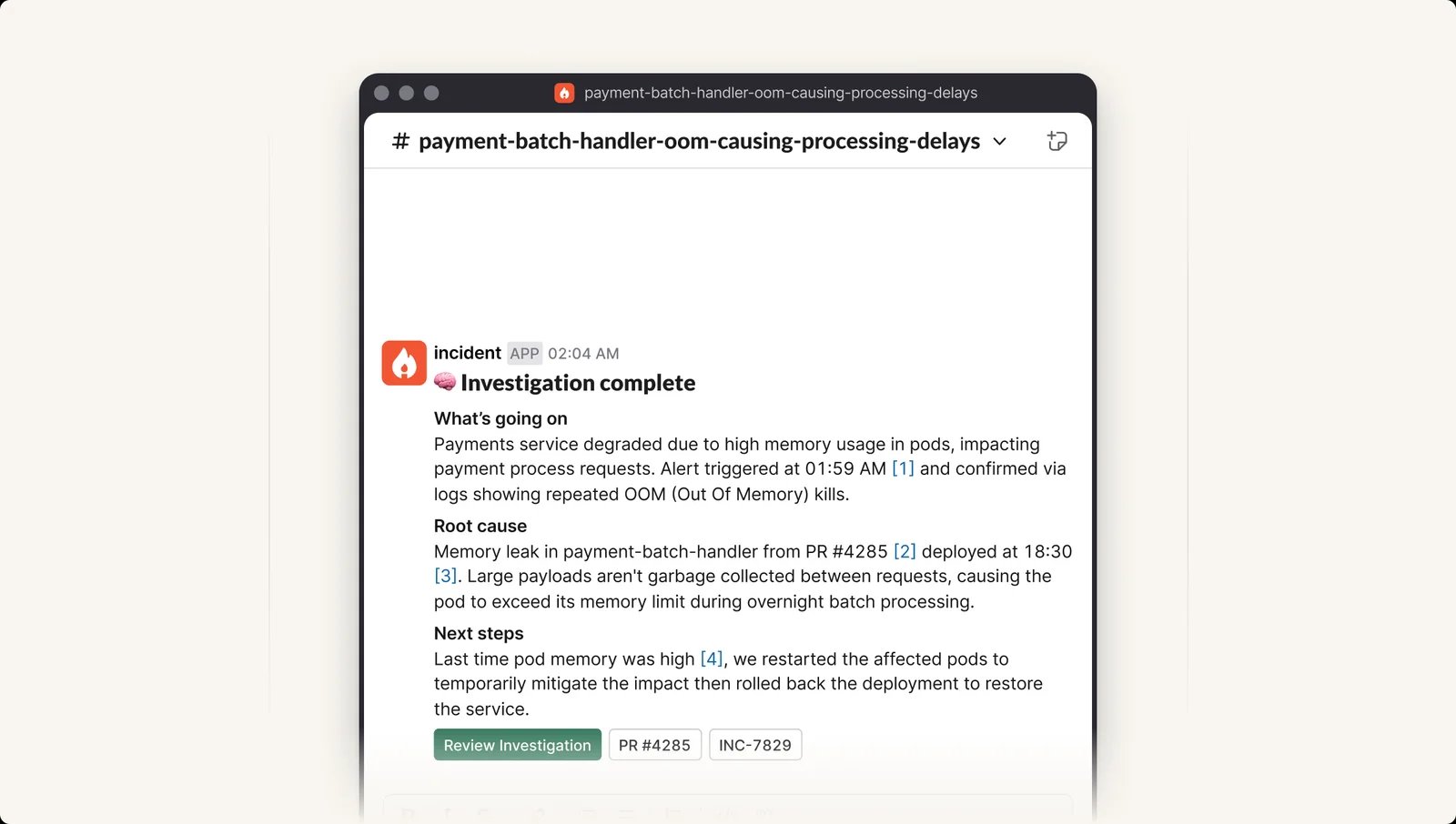
Vendor-provided product example from incident.io, not an incident tested by ToolWorthy. The references illustrate what to inspect in your own pilot.
Rootly
Best for: teams evaluating incident orchestration and a separately purchased AI SRE together.
Rootly's pricing distinguishes Incident Response, On-Call and AI SRE. That makes a useful procurement checklist: response automation, receiving the page and investigating the cause are separate scopes, even inside one vendor relationship.
Skip if: you need the quoted AI SRE independently of Incident Response; the published requirement is that Incident Response is present.
First elimination test: give the pilot a service incident whose evidence spans a code change and an observability system. Verify that the proposed cause cites both, then inspect the permissions required for any proposed fix. Also have a second responder take over: useful reasoning should survive beyond the original chat participant. Ask for the exact paid feature access in the pilot.
PagerDuty
Best for: teams whose first requirement is dependable alert routing and service ownership, especially when PagerDuty already anchors the response process.
Its current offering combines platform-level AI features and allowances with incident workflows. An existing customer should first inspect their account's entitlements before assuming migration is necessary. A new buyer should compare the PD Reliability Platform quote with the legacy Incident Management offer, rather than mixing their prices and features.
Skip if: a quote leaves event volume, AI Actions and additional credits undefined. A cheap-looking seat line does not establish the cost of the desired workflow.
First elimination test: use a non-production service to trigger an alert, acknowledge it, exercise escalation and hand over ownership. Only then evaluate the AI investigation or summary capability included in the exact quoted edition. Keep your current paging route until the replacement has passed the same drill. Current plans identify the two offers separately.
FireHydrant
Best for: teams losing time on incident coordination, runbooks, updates and retrospective follow-through.
The product and pricing pages distinguish a free response entry point, Pro and Enterprise. Enterprise explicitly lists FireHydrant AI. Evaluate its assistance with the response record and post-incident work, rather than assuming that an AI-generated retrospective proves the cause of an outage.
Skip if: your purchasing ceiling is the published Pro seat price and AI is mandatory. Confirm Enterprise access and the alert/telephony quote before a pilot.
First elimination test: supply a resolved incident with a corrected early hypothesis. Check whether the resulting summary and follow-ups preserve the final verified cause rather than repeating the first confident message. Ask a responder who missed the incident to reconstruct the decisions from the record. This targets coordination quality, not an invented root-cause accuracy score.
ResolveAI
Best for: teams seeking AI SRE across existing observability, infrastructure and code tools.
ResolveAI's integration catalog lists systems such as Datadog, Grafana, Kubernetes, GitHub and AWS. Its commercial model is credit-based work, covering activities such as chats, triage and investigations. A listed integration is a starting point, not proof that the deployment topology and permissions you need are supported.
Skip if: you cannot approve the necessary data access or define which operational actions may run. A broad autonomy claim is not a sufficient access-control design.
First elimination test: choose a historical failure whose decisive evidence is split across two of your existing systems. Require source-linked findings and an explicit list of every read/write permission. Start the evaluation with human approval for changes; assess any greater autonomy separately after observing the failure modes. Have sales map that exact replay to the credit model.
Datadog Bits Investigation
Best for: teams with the relevant monitoring evidence already in Datadog.
Bits Investigation investigates alerts using the platform's telemetry. Its attraction here is the relationship to existing data, rather than a claim that every responder should migrate their monitoring stack. Missing logs, traces or deployment context remain missing evidence.
Skip if: you want one standalone purchase to replace paging, incident command and telemetry collection. Price and evaluate the surrounding products separately.
First elimination test: replay an incident where one service has good telemetry and another has a known gap. Check whether the investigation distinguishes evidence from uncertainty. Record actual credits consumed for both a useful investigation and an inconclusive one, then apply the current billing rules to your expected volume. Do not turn an estimated four-credit average into a guaranteed cost per incident.
Sentry Seer
Best for: application teams investigating Sentry issues with connected repository context.
Seer uses application telemetry and code for issue analysis and suggested fixes. That is a narrower buying job than coordinating every infrastructure outage. The same product also offers code-review capabilities; this guide selects it for investigating an observed application issue, not for replacing your PR review process.
Skip if: you need an incident-command system, or require the documented repository integration for a self-hosted code service: current setup guidance names GitHub.com and GitLab.com cloud versions only.
First elimination test: select an already resolved application error and check whether the connected source and event context support the proposed explanation and patch. Make a developer review the patch against the real failure. Before enabling repositories broadly, estimate active contributors across them; the bill is not limited to the person who opened the investigation.
Run one pilot before replacing your response process
Use a resolved incident with a known answer, a plausible false lead and enough retained context to reproduce the investigation. Do not paste customer secrets into a generic chat as a substitute for an approved integration.
- State the missing job. Pick missed pages, slow coordination or slow investigation. Write down the present workflow and its known limitation.
- Map the evidence. List service ownership, alert source, deployments, logs/traces and repository access. Check data retention and permissions before connecting the pilot.
- Replay with the false lead intact. Require links to the underlying evidence and a distinction between observation and hypothesis. Ask what happens when the source is unavailable.
- Exercise the human workflow. Try acknowledgement, escalation, a responder handover and a corrected incident update. An investigation tool can pass its part while your separate paging system handles the rest.
- Price observed use and preserve rollback. Record seats/contributors, events, AI credits/actions and required add-ons. Keep the current alert route active until a separately planned cutover is verified.
Judge the replay by useful, supported decisions: can a responder verify the hypothesis, reject the false lead and understand the next action? This guide does not assign accuracy or MTTR scores because it has not run those tests. One successful replay is a screening result, not evidence of production reliability.
Existing platforms and candidates outside this shortlist
If your team already operates Jira Service Management, evaluate the Rovo incident workflow before adding another command layer. Its Incident Command Center is currently early access on Premium and Enterprise, so confirm availability and terms rather than treating every demonstration as generally available. Keeping an existing service-management workflow can be more practical than migrating it merely to acquire AI.
Opsgenie is not a new-purchase recommendation. Atlassian ended new sales on June 4, 2025 and schedules shutdown for April 5, 2027. Existing users should follow their official migration path, inventory schedules and escalation policies, and verify the replacement before cutover. This guide is not a promise of migration parity.
A security investigation is a different job: use our AI security tools comparison for that buying context. For issues before deployment, see AI code review tools. If the issue is a failing API integration, the Postman alternatives guide addresses reproducing requests and preserving test behavior rather than coordinating an outage.
FAQ
Which AI incident response tool should a small engineering team start with?
Start with the missing job. If nobody owns or receives the page, establish ownership and escalation first. If paging works but incident updates are scattered, evaluate coordination. Add investigation only when the relevant evidence and permissions are available. A low-cost response plan is not necessarily a low-cost AI SRE plan.
Can AI SRE replace PagerDuty or an on-call engineer?
Not as a general rule. An investigation can propose a cause while another system handles paging and an engineer approves mitigation. Check the particular product and edition. Keep a human owner for the incident and define the permitted actions explicitly; a vendor's autonomy claim does not establish a safe cutover for your system.
Is there a free AI incident response option?
Yes: Grafana Cloud includes AI investigations within Free usage allowances, while CloudWatch investigations has no additional feature charge in supported AWS regions. Underlying telemetry costs and usage limits still matter; neither establishes a complete free on-call and command workflow. See the native investigation comparison.
Free coordination or on-call entry plans from other vendors do not by themselves establish free AI investigation. FireHydrant lists AI on Enterprise, Rootly quotes AI SRE separately, and incident.io treats Investigations as an add-on. Ask for the exact feature and duration included in a pilot rather than inferring access from a Free or Trial label.
Should a Datadog or Sentry customer buy another AI SRE tool?
First evaluate what the existing platform can do with the data already collected. Bits Investigation targets Datadog investigations; Seer targets Sentry issues and code context. Consider another product when important evidence spans other systems or coordination remains the bottleneck. Compare the added access, integration work and usage cost against that specific gap.
How do we tell a useful root-cause hypothesis from a convincing summary?
Replay a known incident with a false lead. Ask for source-linked observations, the causal explanation, conflicting evidence and a safe next step. Verify those against the original records. A fluent recap of messages is not the same as evidence that a deployment caused the failure.
Get ToolWorthy Weekly
New AI tools, practical guides, and selected AI signals in one weekly brief.
Related Posts
- 4 Postman Alternatives 2026: Keep Your API Tests Working
Choose a Postman replacement by what must survive the move: scripts, environments, Git workflows and team access. An imported collection is only the beginning.
- Best Text-to-Speech APIs in 2026: Choose by Workload, Not Demo Voice
Compare 10 text-to-speech APIs by realtime protocol, voice control, pricing meter, language coverage, cloud fit, and private-deployment needs.
- 10 Best Web Scraping APIs in 2026: Choose the Right Contract
Choose among 10 web scraping APIs by the contract you actually need: raw page requests, structured extraction, crawling, managed datasets, or a platform runtime.
For AI tool founders
Built a tool that belongs in this decision set?
Request an editorial evaluation for possible inclusion in ToolWorthy.
Submit your tool for reviewPaid submission does not guarantee a ranking, recommendation, inclusion, or editorial outcome.