



Overview
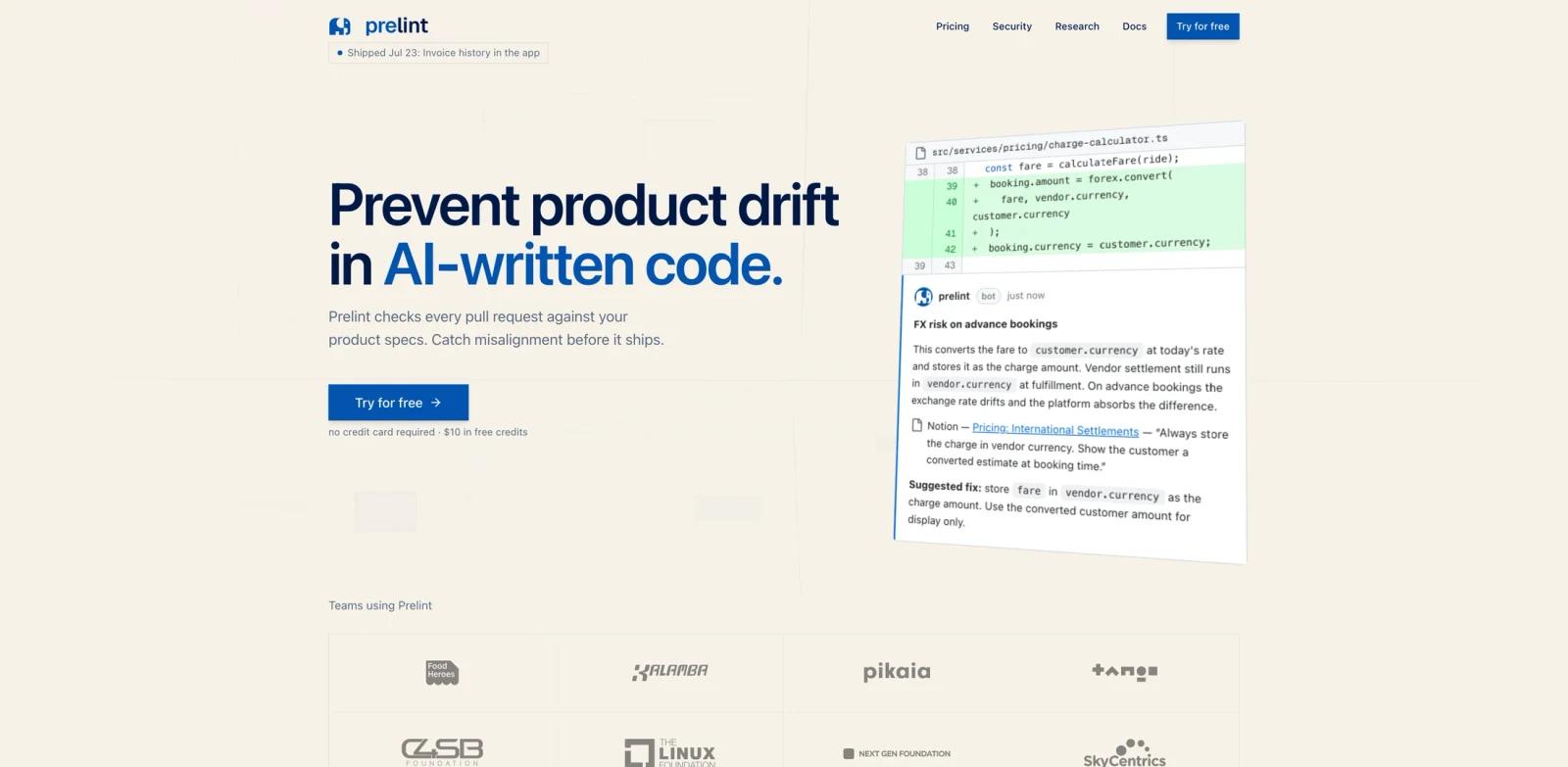
Prelint is a product review layer for teams using AI coding agents. Instead of asking only whether a pull request compiles, passes tests, or follows code style, Prelint checks whether the change matches the product specs, ADRs, business constraints, compliance rules, and prior decisions that define what the team actually intended to build.
This is a useful distinction for AI-assisted development. A coding agent can write technically valid code while quietly changing pricing logic, adding an unapproved dependency, inventing a public API, or drifting away from a roadmap decision. Prelint connects to GitHub or GitLab, reads product context from the repository, and comments on the PR before that drift reaches production.
For teams building with AI code generators, Prelint is best viewed as a product-intent guardrail. It complements technical code review tools by focusing on whether the code should exist in the first place.
Key Features
- Product-intent PR review - Prelint reviews each pull request against specs, ADRs, compliance rules, business constraints, and previous product decisions.
- AI drift detection - It flags cases where AI-written code changes pricing, scope, terminology, data handling, tooling, or roadmap assumptions without an explicit decision.
- Spec-grounded explanations - Review comments cite the relevant product context, helping developers understand what was contradicted and how to fix it.
- GitHub and GitLab workflow support - Prelint is designed to fit into normal pull request workflows rather than forcing a separate review process.
- Product Q&A from repository context - Non-engineers can ask why a feature or rule works a certain way and get answers grounded in actual specs.
- Security-oriented architecture - The official site says organizations run in isolated tenant environments, code is not used to train models, and data is encrypted in transit and at rest.
How to Get Started
Prelint is built around repository-based specs. A practical setup looks like this:
- Install the GitHub or GitLab integration.
- Point Prelint at the spec files, ADRs, or product decision documents in your repo.
- Open or update a pull request.
- Review Prelint's comments alongside your technical code review.
- Fix the drift, clarify the spec, or explicitly approve the product decision.
Teams with strong written product decisions will get the most value immediately. Teams with weak or scattered documentation can still use Prelint, but the value compounds as specs, decisions, and constraints become more explicit.
Pricing & Plans
Prelint uses usage-based pricing.
| Plan | Price | Included Usage | Best For |
|---|---|---|---|
| Free credits | $0 to start | $10 in free credits, no credit card required | Testing Prelint on real pull requests |
| Usage-based | $1 per completed review | Pay only for completed PR reviews | Teams reviewing AI-written code regularly |
| Open source | Free | Free use for open-source projects | Public repositories and community projects |
| Startup program | Program-based | Startup support is advertised on the official site | Early teams with high AI coding velocity |
There are no seat-based subscriptions listed on the public site. The key cost driver is the number of completed reviews, so teams should estimate monthly PR volume rather than user count.
Best For
- Engineering teams using Claude Code, Codex, Cursor, or other coding agents for real product work
- Product-led teams that maintain ADRs, specs, product rules, or compliance constraints in the repository
- Startups where AI-generated pull requests are moving faster than human product review
- Teams that already use technical code review tools and need a separate product-intent layer
- Organizations treating product decisions as part of AI data governance
FAQ
What does Prelint review?
Prelint reviews product intent. It checks whether a pull request aligns with specs, business rules, compliance constraints, tooling decisions, and prior product choices.
Is Prelint a normal code review tool?
No. Normal code review tools focus on implementation quality, bugs, style, and security. Prelint focuses on whether the change matches the product direction and constraints.
How much does Prelint cost?
Prelint lists $1 per completed review. New users receive $10 in free credits, and open-source projects are free.
Does Prelint support GitHub?
Yes. The official site says Prelint works with GitHub and GitLab.
What files can Prelint use as product context?
Prelint can work with specs written in Markdown, YAML, or other structured formats that live in the repository.
Is Prelint useful without perfect documentation?
It can still provide value, but stronger written specs make the review more accurate. The tool is most useful when product decisions are explicit enough for a reviewer to enforce.
Does Prelint train on my code?
The official site says customer code is not used to train models, and each organization runs in isolated infrastructure.
Who should skip Prelint?
Solo projects or early prototypes without PR workflows, specs, or repeated AI-generated changes may not need Prelint yet.