



Overview
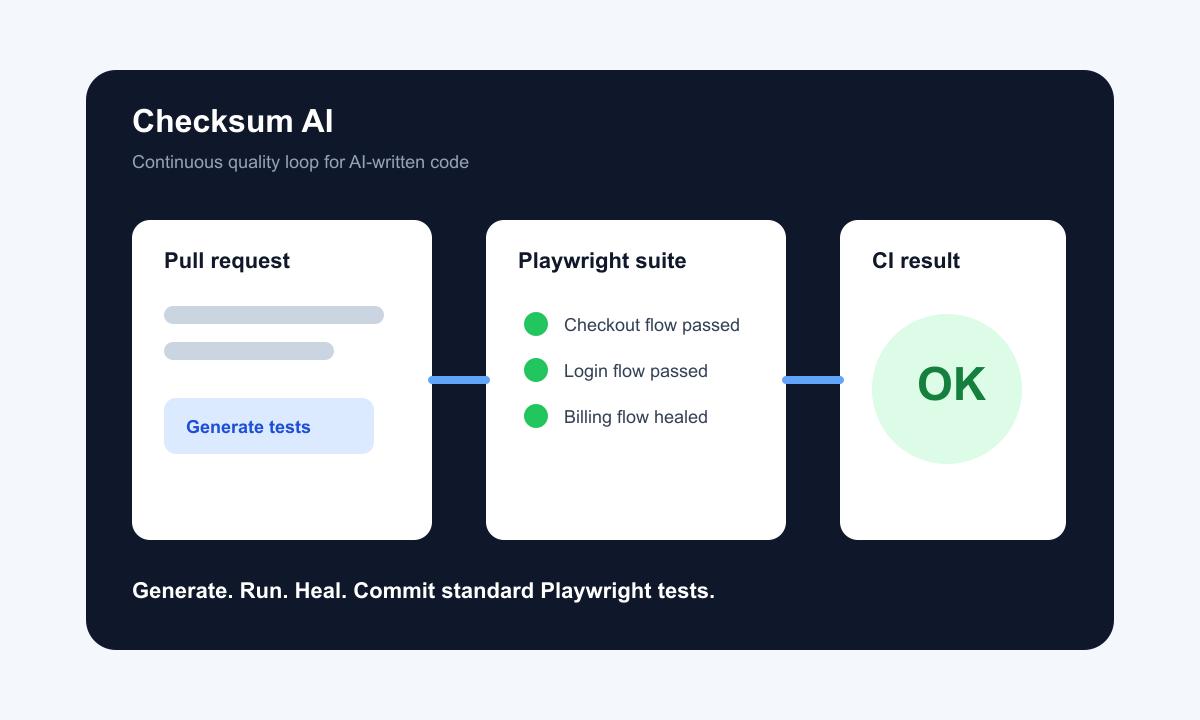
Checksum AI is a continuous quality platform for engineering teams that are shipping with AI coding tools. Its core premise is simple: if AI agents accelerate code generation, teams need a verification layer that can keep up. Checksum generates end-to-end and API tests, runs them through CI, repairs broken tests as the app changes, and delivers the test code back to the customer's repository.
The product is strongest for teams that want more than an on-demand test generator. Checksum positions itself as an always-on quality loop connected to GitHub, CI pipelines, and MCP workflows. The official launch material says the system can generate, execute, and maintain tests when a pull request opens, with sharded execution and autonomous healing.
For teams evaluating AI code checker products, Checksum is closer to a testing operations layer than a static reviewer. It complements code review by producing executable Playwright tests that verify browser behavior and application flows.
Key Features
- Playwright test generation - Checksum creates production-ready Playwright tests for end-to-end flows and delivers them as code into your repository.
- Autonomous maintenance - When selectors, UI paths, or flows change, Checksum can heal tests and open reviewable updates.
- CI and GitHub integration - The platform connects test generation and execution to pull requests and CI pipelines, so verification happens before merge.
- MCP-ready quality loop - Checksum's 2026 release highlights MCP integration, making it more useful in agentic developer workflows.
- API testing for larger teams - Enterprise plans include an API testing agent that can chain calls and verify state changes across systems.
- Human engineer verification option - The pricing page describes Results as a Service with human engineer final verification for ready-to-merge tests.
How to Get Started
Checksum is most useful when you can identify the workflows that matter most to the business. A practical rollout starts with a small set of high-value journeys: signup, login, checkout, billing, onboarding, settings, admin exports, or other paths where regressions hurt users.
The public docs describe a workflow where Checksum analyzes the app, generates tests, runs them locally or in CI, and then maintains them as the product evolves. Teams already using AI code generator tools should treat Checksum as the verification counterpart to code generation: the coding agent may write the change, but Checksum helps prove that the change still works in a real browser flow.
Pricing & Plans
Checksum does not publish simple per-seat prices. Its public pricing page says pricing is based on the number of workflows Checksum maintains, with unlimited test runs, unlimited auto-healings, and unlimited users. Each plan includes a free 30-day trial or proof-of-value path.
| Plan | Public Packaging | Best For |
|---|---|---|
| Emerging | 50 CI/CD-ready E2E workflows maintained | Teams building their first serious test suite |
| Scaling | 200 CI/CD-ready E2E workflows maintained, custom style guides, infrastructure integration, parallel execution support | Growing engineering teams shipping frequently |
| Enterprise | 400+ workflows, API testing agent, custom SLA and security review support | Larger teams with broad coverage and compliance needs |
The important cost driver is workflow volume, not seats or test runs. Teams should ask how Checksum defines a workflow for their app, which flows are included in scope, and whether API testing is needed.
How It Compares
Checksum is different from a basic AI test generator because it is built around maintaining the tests over time. A coding assistant can generate a Playwright test once, but teams still have to triage flaky tests, update selectors, run the suite, and decide whether a failure is product code or test drift. Checksum tries to own that loop.
Compared with Replay QA, Checksum emphasizes maintained Playwright test code and CI/CD coverage. Replay QA emphasizes autonomous app exploration and runtime recordings for root-cause debugging. Compared with Prelint, Checksum focuses on whether the software works, while Prelint focuses on whether a pull request matches product intent.
Best For
- Engineering teams using Claude Code, Codex, Cursor, or similar agents to produce more pull requests
- SaaS teams that need CI-ready browser tests but do not want to maintain every selector manually
- Startups moving from almost no E2E coverage to a serious quality gate
- QA teams that want to spend less time on test upkeep and more time on exploratory testing
- Teams building an AI productivity stack around coding agents, PR review, and continuous validation
FAQ
What does Checksum AI do?
Checksum AI generates, runs, and maintains Playwright tests for web applications. It is designed to keep testing coverage moving as AI-written code changes the app.
Does Checksum replace Playwright?
No. Checksum uses Playwright as the test format. The value is in generating, maintaining, healing, and integrating those tests into the development workflow.
Do I own the tests Checksum writes?
Yes. The official pricing page says tests are standard Playwright code committed to your repository, so you can keep and run them even if you leave.
How does Checksum pricing work?
Checksum prices by the number of workflows it maintains, not by seat count or test-run volume. Public plans are Emerging, Scaling, and Enterprise.
Is there a free trial?
Yes. The public pricing page lists a free 30-day trial or proof-of-value path for the plan tiers.
Does Checksum support API testing?
Yes. The public pricing page lists an API Testing Agent on Enterprise plans, including chained API calls and downstream state verification.
Is Checksum only for AI-written code?
No. It can help any team that needs maintained E2E coverage. It is especially timely for teams using AI coding because code output often grows faster than test coverage.
Who should skip Checksum?
Very early prototypes with no stable user flows may not need a maintained E2E suite yet. Checksum becomes more valuable once repeated workflows and CI gates matter.