



Overview
TWOFORM designs packaging and then makes it. Bring a concept from ChatGPT, Midjourney, or a designer — or start from a brief — and the tool maps it onto a real, manufacturable dieline for the specific structure you're producing: boxes, mailers, pouches, or labels.
The distinction it's built around is the one that sinks most AI packaging output. General image models produce a rendering — a picture of a box. Production needs a dieline: the flat cutting-and-folding template a printer actually runs, with bleeds, safe zones, and fold allowances in the right places. A beautiful render that ignores those is not a file a factory can use, and the gap between the two is where the work usually gets redone from scratch — the fault line running through the whole AI packaging design category. TWOFORM maps AI-generated artwork onto real production dielines generated by its structural engine, so the output can proceed to print without rebuilding the package structure.
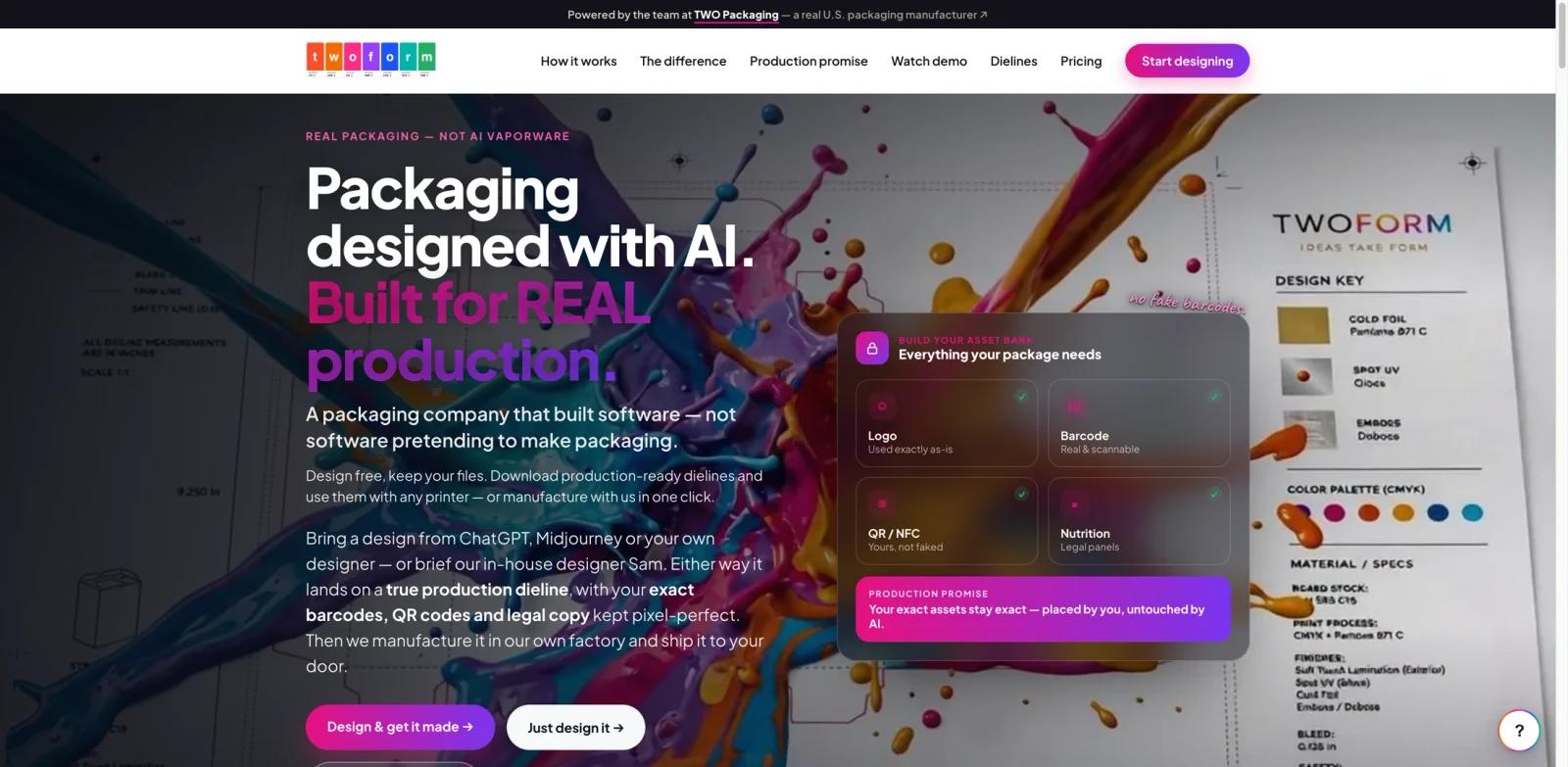
The second design decision is about what the AI is not allowed to touch. Barcodes, QR codes, nutrition panels, and legal copy are placed by the user, not generated — the site's phrasing is "placed by you, pixel-perfect, untouched by AI," and, more bluntly, "no fake barcodes. ever." Anyone who has watched a generative model invent a plausible-looking UPC will recognize why that boundary exists: a hallucinated barcode is not a cosmetic flaw, it's an unscannable product and a recalled print run. TWOFORM keeps those compliance-critical assets outside AI redraws entirely, preserving the exact user-supplied barcode, code, nutrition, and legal content.
Key Features
- AI concepts mapped to production dielines — Generates up to four directions per brief, each placed on the actual cutting template for your structure, so the design and the manufacturing file are the same artifact rather than two things to reconcile.
- Compliance elements placed by you, not the AI — Barcodes, QR and NFC codes, nutrition panels, and legal copy are positioned manually and left untouched by generation, preventing those exact or scannable assets from being AI-redrawn.
- Print-ready output with bleeds and safe zones — Exports print-ready PDFs with fold allowances and margins already accounted for, which is the difference between a file a printer accepts and one they send back.
- Pantone matching, spot colors, foils, and finishes — Supports the specification layer that separates a mockup from a print order, so brand colors survive the trip to press.
- 3D preview before committing — Renders the flat dieline as a folded package, letting you judge proportion and panel layout before spending a download or a print run.
- Multiple structure types — Covers boxes, mailers, pouches, and labels rather than a single box template, so the tool follows a product line as it expands.
- In-house manufacturing — Approved designs can go directly to TWO Packaging for manufacturing; the studio shows door-to-door shipping as a separate live-priced line item, and TWOFORM states that finished packaging ships anywhere in the U.S.
How It Works
The flow runs in six steps, and step five is the one that distinguishes it.
- Bring or brief a design. Upload something from ChatGPT, Midjourney, or a designer, or brief TWOFORM's in-house AI designer, Sam, from scratch.
- Get up to four concepts. Each is mapped onto an actual production dieline for your structure, not a generic mockup.
- Pick a direction. Choose the concept worth developing.
- Refine. Iterate until the design is approved. Rounds draw down AI credits, so plans are effectively sized by how much iteration you expect.
- Place your own assets. You add barcodes, QR codes, nutrition and legal panels yourself. The AI does not regenerate them.
- Manufacture or download. Send it to the factory to be produced and shipped, or take the print-ready file to your own printer.
Sam is TWOFORM's in-house AI packaging designer — the official FAQ and product pages identify Sam as AI, not a human designer. Design rounds consume AI credits, which is worth knowing when you're budgeting for a project that needs many revisions.
Pricing & Plans
Designing itself is free and uncapped: you can self-design unlimited packages on real production dielines and order them from the factory without a plan. Subscriptions add monthly AI credits and dieline file downloads; standalone credit packs also fund Sam's AI work but cannot download dieline files. Annual plans bill once per year at ten times the monthly price (two months free), with allowances refreshing monthly.
| Plan | Price | Dieline downloads | AI credits | Iteration budget |
|---|---|---|---|---|
| Free (self-design) | $0 | — | — | Unlimited self-design, factory ordering |
| Starter | $19.99/mo | 2/mo | 437/mo | ~11 design rounds, 15 edits, or 48 references |
| Studio (most popular) | $49/mo | 5/mo | 1,097/mo | ~28 rounds, 37 edits, or 121 references |
| Agency | $99/mo | 15/mo | 2,319/mo | ~59 rounds, 79 edits, or 257 references |
| Enterprise | Custom | — | — | — |
Pay-as-you-go credit packs are also available without a subscription: $15 for 150 credits, $30 for 300, and $50 for 500.
All paid plans include a commercial license for downloaded designs and unlimited self-designed packages. Manufacturing is available on any plan or no plan, but physical production is priced and purchased separately. Studio and Agency add a dedicated packaging specialist.
The number to watch when choosing a tier is dieline downloads, not credits. Starter's 437 credits cover a reasonable amount of exploration, but two downloads a month means two finished SKUs — comfortable for a single product, tight for a brand shipping a range. Credits tend to be the number people compare; downloads are the one that usually binds first.
Best For
- Direct-to-consumer brands launching one to three SKUs who need production files, not concept art
- Small teams without an in-house packaging designer and without budget for an agency
- Founders who already have a visual direction from ChatGPT or Midjourney and need it turned into something a printer will accept
- Brands that want design and manufacturing handled in one place instead of coordinating a designer and a separate factory
- Anyone who has had an AI-generated packaging concept rejected by a printer for missing dielines or invented barcodes
It's a narrow tool by design. Teams needing broader creative output — brand marks, social assets, sales collateral — will still want general AI graphic design tools alongside it, and brands shooting catalog and marketplace listings usually pair packaging work with a product image generator.
FAQ
Is TWOFORM free to use?
Partly, and the free part is permanent rather than a trial. You can self-design unlimited packages on real production dielines and order them from the factory without any plan. Your first AI generation is free; ongoing AI work can use subscription credits or standalone credit packs. Paid subscriptions start at $19.99/month, and only an active paid plan unlocks production-file downloads.
Will the AI change my barcode or nutrition panel?
No. Barcodes, QR codes, NFC codes, nutrition information, and legal copy are placed by you and left untouched by the AI. This is the product's central design constraint, described on the site as "no fake barcodes. ever."
What packaging types does it support?
Boxes, mailers, pouches, and labels, each mapped to real production structures rather than a single generic template.
Can I download the files and use my own printer?
Yes. Paid plans include dieline downloads and print-ready PDF export, so you can manufacture through TWOFORM's factory or take the files elsewhere. Download volume is capped by tier — 2 per month on Starter, 5 on Studio, 15 on Agency.
How is this different from using an AI image generator?
An AI image generator produces a picture of packaging. TWOFORM produces the cutting-and-folding template a printer runs, with bleeds, safe zones, and fold allowances in the correct positions. The first is a visual; the second is a manufacturing file.
What are AI credits and how fast do they run out?
Credits meter AI work, measured in design rounds, edits, and reference images. Starter's 437 credits cover roughly 11 rounds, 15 edits, or 48 references; Studio's 1,097 cover about 28 rounds; Agency's 2,319 about 59. Heavy iteration consumes them faster than exploration does.
Is there a minimum order quantity for manufacturing?
Most custom formats start at 100 units; labels and poly mailers are quoted live in the studio. TWOFORM's manufacturing page says finished packaging ships anywhere in the U.S., with shipping shown as a separate live-priced line item; public lead times are not stated.
Do I get commercial rights to the designs?
Yes. Paid subscriptions include a commercial license for the designs you download; TWOFORM's terms separately state that you retain ownership of final designs you create and the brand assets you upload.
Is TWOFORM a good fit for a full product line?
It can be, but check the download quota first. Producing many SKUs in a single month runs into the per-tier dieline download cap sooner than it runs into the credit allowance, which usually points toward Studio or Agency rather than Starter.


