



Overview
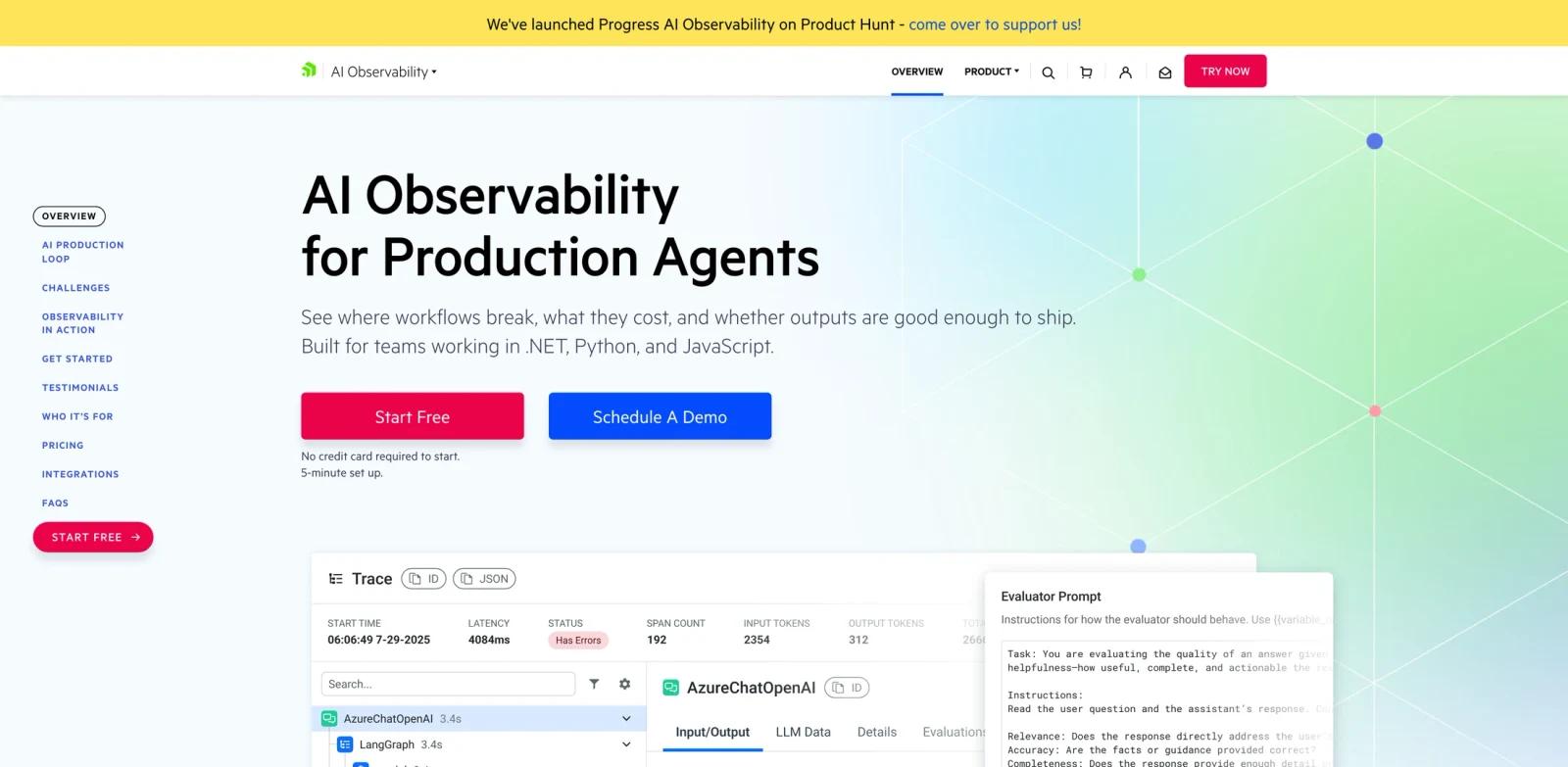
Progress AI Observability is a platform from Progress Telerik for monitoring AI agents and LLM applications. It helps teams trace agent runs, log prompts and requests, inspect costs and tokens, run LLM-as-a-Judge evaluations, detect anomalies, and debug production behavior across development and live environments.
This tool matters because more companies are moving from simple prompt prototypes to production AI systems. Once agents start calling tools, chaining steps, and touching customer workflows, teams need visibility into what happened, what it cost, which model responded, and whether the output passed evaluation criteria.
Progress AI Observability fits ToolWorthy's AI data governance, AI data analysis, and AI agent categories. It is less about building the agent and more about operating it responsibly once real users, costs, and quality risks enter the system.
Key Features
Agent Trace Explorer - Gives teams a way to inspect agent runs, LLM calls, prompts, outputs, and request flow instead of debugging through scattered logs.
Prompt and request logging - Captures the details needed to reproduce failures, compare behavior, and understand why an agent made a decision.
Cost attribution - Tracks cost by agent, model, and total usage, which is important when teams run multiple AI workflows in production.
LLM-as-a-Judge evaluations - Supports evaluations, datasets, and experiments so teams can monitor quality beyond manual spot checks.
Anomaly detection and alerting - Adds production monitoring signals for unusual behavior, cost spikes, and quality changes.
Stack integrations - The product page lists .NET, Python, JavaScript/TypeScript SDKs, plus integrations with AI frameworks and providers such as Semantic Kernel, LangChain, LlamaIndex, AutoGen, Azure OpenAI, OpenAI, and Anthropic.
Pricing & Plans
Progress publishes clear pricing for the AI Observability Platform.
| Plan | Price | Key details |
|---|---|---|
| Free Forever | $0/month | 10,000 units, 7-day retention, trace explorer, prompt logging, basic cost/token visibility, basic evaluations |
| Starter | $29/month | 200,000 units, 30-day retention, cost attribution, real-time and historical evaluations, anomaly detection, alerting |
| Pro | $299/month | 1,000,000 units, 60-day retention, SSO included |
| Enterprise | From $3,000/month | Custom trace volume, infinite retention, governance, audit logs, access controls, SLA commitments, BYOS data residency options |
Overage pricing on the public page is $8 per additional 100,000 units for Starter and Pro. Teams should define what a unit means for their usage profile before estimating cost.
Best For
- Teams shipping production AI agents and needing trace-level debugging
- Engineering leaders tracking LLM cost by model, agent, and workflow
- AI teams running evaluation datasets, experiments, and LLM-as-a-Judge checks
- Enterprises that need audit logs, access controls, SLA commitments, and data residency options
- Developers comparing AI data governance tools for agent operations
FAQ
What is Progress AI Observability?
It is an observability platform for AI agents and LLM applications. It helps teams trace agent runs, log prompts, inspect costs, run evaluations, detect anomalies, and monitor production behavior.
Who makes Progress AI Observability?
The product is published by Progress Telerik as part of Progress's AI observability offering.
How much does Progress AI Observability cost?
The Free Forever plan is $0/month. Starter is $29/month, Pro is $299/month, and Enterprise starts at $3,000/month according to the official pricing section.
What does the free plan include?
The free plan includes 10,000 units, 7-day retention, Agent Trace Explorer, prompt logging, basic cost and token visibility, basic LLM-as-a-Judge evaluations, SDKs, and integrations.
Which stacks does it support?
The product page lists .NET, Python, JavaScript/TypeScript, Semantic Kernel, LangChain, LlamaIndex, AutoGen, Microsoft Agent Framework, Azure OpenAI, OpenAI, Anthropic, and other model providers or frameworks.
When should a team use AI observability?
Use it when an AI system is moving beyond a prototype and you need to explain failures, watch cost, evaluate output quality, detect anomalies, or satisfy governance requirements.