

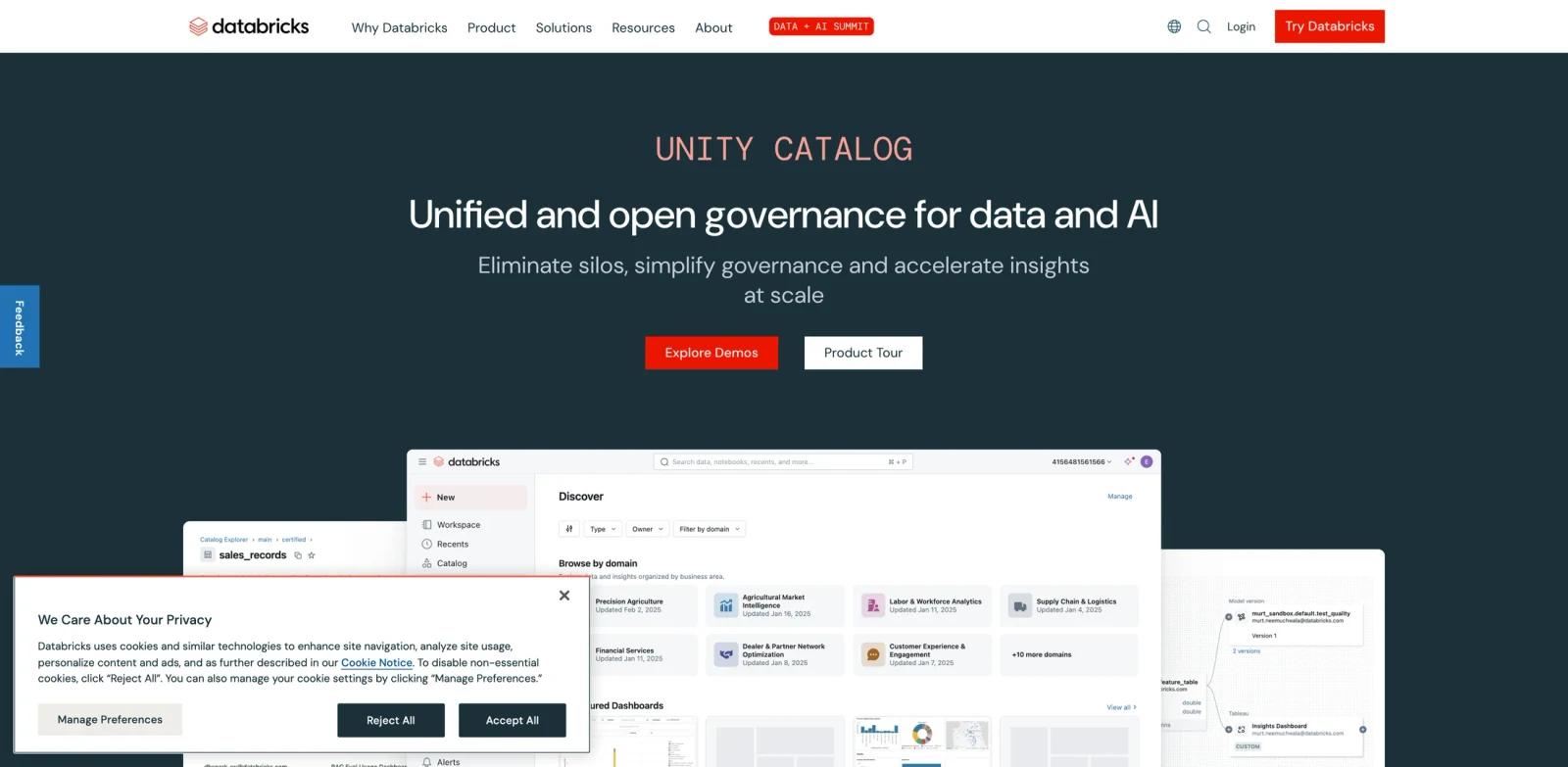


Overview
Databricks Unity Catalog is the unified governance layer for data and AI assets on the Databricks platform. It provides centralized access control, discovery, lineage, auditing, data quality monitoring, and secure sharing for tables, files, models, functions, dashboards, and other governed objects.
The official Databricks documentation describes Unity Catalog as a single place to manage permissions and metadata across a three-level namespace of catalog, schema, and object. It applies governance through securable objects, access privileges, storage credentials, external locations, connections, shares, managed tables, external tables, and volumes. This makes it a core part of the AI data governance stack for teams already using Databricks.
Unity Catalog is not a general-purpose standalone catalog in the same sense as OpenMetadata, Alation, or Atlan. Its strongest fit is Databricks-native governance: controlling who can access assets, tracing lineage, sharing data securely, and making features, models, and tables discoverable across workspaces.
Key Features
- Unified access control - Manage permissions for tables, files, models, functions, and other Databricks objects from a single governance layer.
- Data and AI asset discovery - Users can search and understand governed assets through metadata, tags, descriptions, and Catalog Explorer.
- Automated lineage tracking - Unity Catalog tracks how data flows from source to downstream views, dashboards, feature tables, models, notebooks, jobs, and endpoints.
- Auditing and compliance visibility - Maintains records of data access and system activity to help teams meet security and regulatory requirements.
- Data quality monitoring - Helps track the health of data assets with profiling and alerts for anomalies before they affect downstream users.
- Secure data sharing - Supports live data sharing across organizations and clouds using Delta Sharing without copying data through custom ETL.
Pricing & Plans
Unity Catalog pricing depends on how your organization uses Databricks. The governance layer is part of supported Databricks platform tiers, while compute, SQL warehouses, storage, and platform usage are billed through Databricks and the underlying cloud provider. Databricks also offers an open source Unity Catalog implementation.
| Option | Pricing | Best fit |
|---|---|---|
| Unity Catalog on Databricks | Included with supported Databricks platform usage | Teams governing Databricks data, AI assets, tables, models, and workspaces |
| Open source Unity Catalog | $0 software license | Engineering teams evaluating open governance patterns outside commercial Databricks features |
| Databricks platform usage | Usage-based Databricks and cloud billing | Production analytics, AI, SQL, ML, and lakehouse workloads |
Check the current Databricks pricing page and workspace tier requirements before planning a rollout.
Best For
- Data teams standardizing governance across Databricks workspaces
- Lakehouse teams managing tables, files, models, feature tables, and functions
- Security teams enforcing least-privilege access in Databricks
- Analytics and AI teams that need lineage and auditability for governed assets
- Organizations comparing Databricks-native governance with broader AI data analysis tools
FAQ
What is Databricks Unity Catalog?
Unity Catalog is Databricks' unified governance solution for data and AI assets, including access control, discovery, lineage, auditing, quality monitoring, and sharing.
Is Unity Catalog only for tables?
No. Unity Catalog governs many asset types, including tables, files, volumes, functions, models, feature tables, and other Databricks objects.
Does Unity Catalog track lineage?
Yes. Databricks documentation describes automated lineage tracking for data flows and downstream assets.
How is Unity Catalog priced?
Unity Catalog is part of supported Databricks platform usage, while Databricks compute, SQL warehouses, and cloud resources are billed separately. An open source implementation is also available.
Who should use Unity Catalog?
It is best for teams already using Databricks that need centralized governance, lineage, access control, and auditability across data and AI assets.
Does Unity Catalog replace an enterprise data catalog?
It can be the primary catalog for Databricks-native assets, but organizations with many non-Databricks systems may still use a broader enterprise catalog alongside it.

