

Overview
Moescape AI is a browser-based roleplay and generation platform from the team behind Yodayo. It puts character chat, image generation, and a community model library behind a single account and a single currency. The chat side, called Tavern, works like a public character catalogue: you pick a character, pick a model, and talk. The generation side is closer to a community art site, with user-uploaded checkpoints and LoRAs you can apply to your own prompts.
Moescape and Yodayo share accounts. According to Moescape, a Moescape login works on Yodayo, where the same balance is shown in YoBeans rather than Mochi. YoBeans can no longer be bought through Yodayo directly, so top-ups go through Moescape's payment page. The two sites also share a documentation site and a Discord community.
What separates it from most character-chat sites is the amount of control exposed per conversation. Instead of one house model, Moescape offers a roster of more than forty chat models priced individually per message, alongside per-conversation controls for response length, temperature, system prompt, persona, scenario, and lorebook.
The trade-off is a metered economy. Almost everything is denominated in Mochi, the platform currency, and understanding which models cost what is the main thing standing between a new user and a predictable bill.
This review covers Tavern and character chat, the model roster and its pricing, content settings, image generation, and the Model Hub. The sidebar also carries Video Gen, Music Gen, Voice, and Image Tools, which we did not test; nothing below makes a claim about them.
Key Features
- Forty-plus chat models with per-message pricing — Each model shows its own cost per message, free regeneration count, and context window before you commit, so you can trade quality against spend on a per-conversation basis.
- Per-conversation model and sampling controls — Response length (short, standard, long), temperature from 0 to 2, system prompt, and presets are all adjustable inside the chat, which is unusual for a catalogue-style character site.
- Tavern character library with persona, scenario, and lorebook slots — Public characters come with configurable persona and worldbuilding attachments, letting you carry your own setup across different characters rather than rewriting it each time.
- Model Hub for community image models — A Civitai-style library of user-uploaded checkpoints and LoRAs, branded as Spells, spanning base families including Illustrious, NovelAI, Anima, SDXL, PonyXL, and Seedream, with usage counts in the millions for the most popular entries.
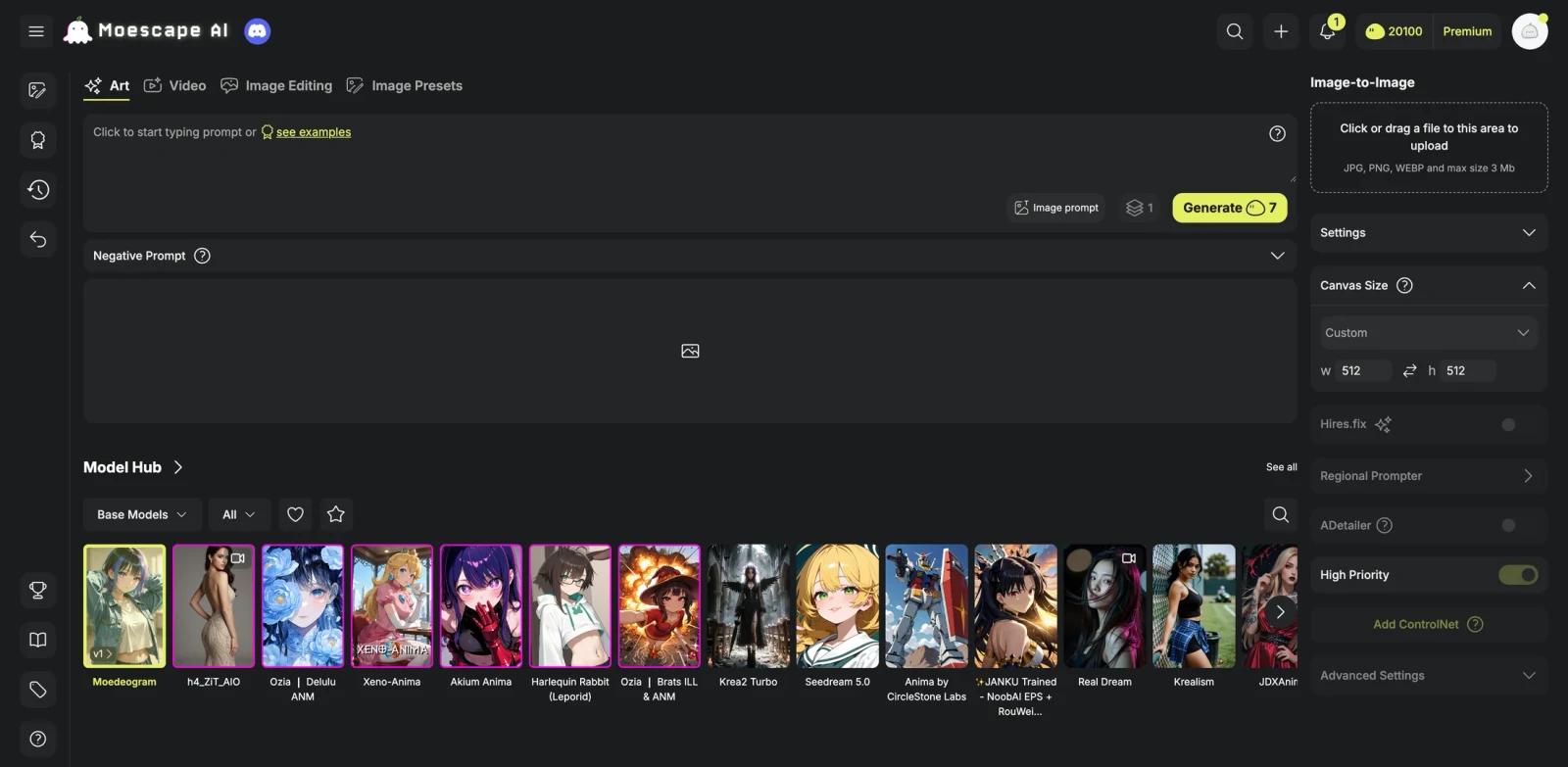
- Image generation inside the conversation — The chat toolbar carries an Image control, so pictures can be generated without leaving the roleplay thread. The standalone workspace is a full AI image generator surface with negative prompts, canvas size, Hires.fix, ADetailer, Regional Prompter, and ControlNet, and each generation shows its Mochi cost on the Generate button.
- Content ratings with an opt-in 18+ setting — PG and PG-13 toggles measurably change what the character feed surfaces. A separate account setting, off by default, asks users to confirm they are 18 or older and states that enabling it disables chat filters.
Pricing & Plans
Moescape runs a freemium model. According to the pricing page, new accounts receive 100 Mochi plus 50 daily Mochi to claim. Every paid plan adds a monthly Mochi grant, removes ads and advertises better memory in chats. From Pro upward, plans also add unlimited chat on a set of models and a higher output-token cap for longer replies.
| Plan | Monthly | Annual (per month) | Mochi per month | Unlimited-chat models | Output tokens | One-time purchase bonus |
|---|---|---|---|---|---|---|
| Plus | $9.99 | $7.50 | 1,400 | None listed | Not listed | +10% |
| Pro | $14.99 | $11.25 | 1,250 | Includes DeepSeek V4 Flash, Ultra, Elune and Apollo 70B | 700 | +15% |
| Premium | $29.99 | $22.50 | 2,500 | Pro models plus Athena, DeepSeek V3.2, DeepSeek R1 and Nephra 70B | 900 | +20% |
| Platinum | $39.99 | $29.99 | 6,250 | Same as Premium | 1,000 | +20% |
Annual billing is marked as a 25% saving. Mochi can also be bought outright, from 550 Mochi for $5 up to 85,000 Mochi for $500. Those two end points work out to roughly 110 Mochi per dollar at the bottom and 170 at the top, so the largest pack is about 35% cheaper per Mochi than the smallest.
Three details are easy to miss:
- The Mochi allowance does not rise monotonically with price. Plus gives 1,400 Mochi at $9.99 while Pro gives 1,250 at $14.99. What Pro adds instead is unlimited chat on a set of models and a 700-token output cap. Platinum lists the same model access as Premium; the step up buys more Mochi and a longer output cap.
- Some models cannot be paid for with free Mochi. Models from third-party labs, including the Claude, GPT, Kimi K3, and Aion families, carry an asterisk meaning they require purchased Mochi. Accumulating a free balance will not unlock them.
- Continuing a response is billed separately. Each model lists a second, usually lower, price for continuing a truncated reply.
Message costs span a wide range. On our paid reviewer account, about a dozen models showed no per-message cost, a lightweight model like SkyLark Pro cost 2 Mochi per message, mid-tier models clustered around 6 to 15, and the most expensive Claude Opus tiers reached 55 Mochi per message with no free regenerations. Several of the zero-cost models are ones the pricing page lists as unlimited on paid plans, so a free account may see different costs for them; we did not test a free account.
Community & Ecosystem
The Model Hub is closer to a community art platform than a vendor model list. Users upload and share checkpoints and LoRAs, the latter branded as Spells, organised across categories including style, character, concept, background, clothing, and negative embeddings. Base model families include Illustrious, NovelAI, Anima, SDXL, PonyXL, and Seedream.
Scale is visible in the usage counters: the most popular checkpoints report generation counts in the millions, with the largest above nine million. Accounts can publish their own models and manage a personal Spell collection, so the library grows from its user base rather than from vendor curation alone.
For readers comparing this against other AI image generators, the practical consequence is that Moescape's image quality ceiling is set by community contributions rather than by a single in-house model.
Best For
- Roleplay users who want to pick a different model per conversation instead of accepting one house model.
- Users who already pay separately for anime image generation and character chat and want them on one bill.
- People comfortable learning a credit system in exchange for finer cost control.
- Prompt-focused creators who want community checkpoints and LoRAs without running local inference.
- Readers evaluating Character.AI alternatives who care most about choosing the model behind each conversation.
- Anyone shopping the broader AI chatbots category who specifically wants roleplay rather than a general assistant.
FAQ
Is Moescape free to use?
You can start without paying. According to the pricing page, new accounts receive 100 Mochi plus 50 daily Mochi to claim, and Mochi pays for chat messages and generation. Paid plans add a monthly Mochi grant, remove ads, and from Pro upward add unlimited chat on a set of models. Our testing used a paid account, so we cannot say which models a free account can use at no per-message cost.
What is Mochi and what does it pay for?
Mochi is the platform currency. Chat messages, image generation, and chat summarisation all draw from the same balance. Each chat model displays its own per-message cost, continuing a truncated response is billed as a separate and usually cheaper action, and summarising a conversation costs 10 Mochi.
Can I use the Claude and GPT models with free Mochi?
No. Models from third-party labs, including the Claude, GPT, Kimi K3, and Aion families, carry an asterisk, and the note under the model list says those models cannot be used with free Mochi. Reaching them takes purchased Mochi, which comes either from a subscription grant or from a one-time pack.
How much conversation history do the models remember?
Almost every model on the roster lists a 64k context window. The exceptions run in both directions: one lightweight model is limited to 8k, and one is listed at 128k. Paid plans advertise better memory in chats without saying what changes, and none lists a larger context window. Beyond the window, Moescape offers chat summarisation: you press Summarize and each summary costs 10 Mochi. A separate Advanced Memory toggle is marked beta, and we did not test it.
Does Moescape allow adult content?
It has an opt-in 18+ setting, and its published rules still set limits. PG and PG-13 ratings are both on by default, and the default character feed contains a substantial amount of suggestive material at the PG-13 level. A separate account setting, off by default, asks users to confirm they are 18 or older and states that enabling it disables chat filters. Moescape describes its Moedark model as intended for uncensored 18+ chat. Its published content policy still lists only PG and PG-13, prohibits pornographic content in both chat and art, and prohibits sexualised depictions of minors. We did not enable the 18+ setting.
Can I bring my own characters and worldbuilding?
Yes. Tavern includes tabs for your own characters and for lorebooks, and each conversation has persona, scenario, and lorebook slots that can be configured independently of the character you are talking to.
What is the Model Hub?
It is a community library of image generation models and LoRAs, the latter called Spells. Users upload checkpoints across base families including Illustrious, NovelAI, Anima, SDXL, PonyXL, and Seedream, and you can apply them to your own prompts or publish your own.
How does Moescape compare with other character chat platforms?
Its closest structural match is Yodayo, which comes from the same team and offers the same combination of an anime art community and Tavern-style character chat. The two share accounts: according to Moescape, a Moescape login works on Yodayo, where the same balance appears as YoBeans rather than Mochi. YoBeans can no longer be purchased on Yodayo directly, and the two also share a documentation site and a Discord community. Against the general-purpose assistants covered in our best AI chatbots comparison, and against character platforms built around a single house model, Moescape trades simplicity for choice: you get a much larger model roster and per-conversation controls, at the cost of learning a credit economy.