
17 Best Character.AI Alternatives 2026 — After Pipsqueak 2 and Free-Tier Changes
Character.AI still offers unlimited standard messaging, but ads and feature limits changed the free experience. Compare 17 alternatives on memory, filters, and price.
On this page
In April 2026, Character.AI announced Pipsqueak 2 as a replacement for the existing Pipsqueak model, rolling out first to C.AI+ users and then to free users in early May. Community users then reported that several legacy model options — Meow, Nyan, Roar — disappeared from their accounts, including chats they had built years around. Around the same period, Character.AI officially acknowledged more ad placements for free users and usage limits on some features. That does not mean standard chat became universally metered: Character.AI's c.ai+ FAQ, updated September 14, still says free standard messaging is unlimited for all users. Add the under-18 chat phase-out from November 2025, age verification rolling out through Q1 2026, and the long-running memory and filter complaints, and there are still substantial reasons to compare alternatives without overstating what changed.
This guide groups 17 Character.AI alternatives into three shapes: direct character-chat replacements (Janitor AI, Crushon, SpicyChat, Chai, Kindroid, Replika, PolyBuzz, JoyLand, Yodayo, Moescape, DreamGen) for users who want the same RP loop with different trade-offs; paradigm shifts (Claude Projects, ChatGPT Custom GPTs, Poe) for users whose real ask is "better memory and writing, not a public bot library"; and escape paths (SillyTavern + local LLM, NovelAI, AI Dungeon) for advanced or fiction-oriented users. For the broader chatbot landscape outside the character-RP niche, see our AI chatbots category. Reddit threads cited inline preserve the community-reported history behind each pain point; current product and pricing claims were refreshed against first-party pages in September 2026. Where vendors hide pricing behind login, App Store billing, or in-app membership flows, this guide labels the uncertainty rather than guessing.
| Tool | Best For |
|---|---|
| Janitor AI | Custom RP workbench with external model and community character library |
| Crushon AI | Adult-oriented roleplay with more permissive content posture and structured paid tiers |
| SpicyChat | Paid unlimited messages and adult character library with subscription speedups |
| Chai | Mobile-first quick character chat with large bot library |
| Replika | Long-term AI companion focused on emotional bonding, not bot library |
| Kindroid | Long-term memory, voice and image, multi-Kindroid social |
| PolyBuzz | Large public character library with free unlimited basic chat |
| JoyLand | Anime, game, and story-driven character chat |
| Yodayo | Anime art community and Tavern character chat in one stack |
| Moescape | Per-conversation model choice across a 40+ model roster, plus anime image generation |
| DreamGen | Long-form story, scene, and multi-character creative writing |
| Claude Projects | Persistent context for long narrative work over public bots |
| ChatGPT Custom GPTs | Build your own persona instead of using a public catalog |
| Poe | Multi-model entry point for comparing RP behavior across LLMs |
| SillyTavern + Local LLM | Maximum control with self-hosted or third-party model backends |
| NovelAI | Long-form novel and creative writing, not chat-style RP |
| AI Dungeon | Interactive text-adventure narrative instead of one-on-one character chat |
Why People Are Leaving Character.AI in 2026
These seven pain points map to seven distinct Reddit clusters, not one general "C.AI is bad" sentiment. Lump them and you'll pick the wrong alternative. The first two are recent 2026 changes: Character.AI officially acknowledged usage limits, more ad placements, age restrictions, and Pipsqueak 2; Reddit threads show how strongly parts of the community reacted.
1. Ads and feature-specific limits squeezed the free experience (March 2026 →)
Through March and April 2026, free-tier users reported in-chat ads, swipe caps, "go on" limits, and other thresholds. From a late-March thread (2026-03-20): "forcing everyone onto c.ai+... in chat ads? Metering?" A user tested the limits explicitly on 2026-04-22: "I am hitting the limits daily... zero changes." By May 23, another community post called the experience "METERING LIMITS since march 2026." These are historical, community-reported observations about specific actions and account experiences, not proof that every standard message was capped. Character.AI's April update separately confirmed usage limits on some features and more ads for free users, while its September 14 c.ai+ FAQ continued to describe standard messaging as free and unlimited for all users.
2. Pipsqueak 2 shipped and the legacy models started disappearing (May 2026 →)
The model churn is the second fresh-news shock. From May 8: "Pipsqueak 2 ruined the entire app... Now it's unusable." When the team announced PSQ2 Yap testing on May 15, the community response was "We dont want a variant of PSQ2, we want the OLD MODELS." By May 26, users were reporting missing legacy model options: "Meow is gone, nyan is gone, roar is gone." Treat this as community-reported availability, not a formal Character.AI deprecation notice. Two days later, May 28: "all my roleplays turned to trash thanks to pipsqueak." This isn't "the model is different" — it's "the chats I built over years now sound like a different character speaking with the same name."
3. Filter trips kill mature and emotional scenes mid-flow
The filter has been the dominant complaint since 2024, but the texture changed in 2025-2026. From a bug update thread (2025-06-20): "chats have NOTHING to do with anything wrong... It ruins everything." On October 2025: "I don't think it's necessary to be under such strict PG restrictions." By January 2026: "that stupid block hits and ruins the whole mood." And on April 18, a paid-tier user wrote: "C.AI+ should have an 18+ mode." The pattern: even subscribers expect mature options, and the filter trips on non-explicit moments — emotional intimacy, conflict, even violence in fiction.
4. Memory loss makes long arcs feel like Groundhog Day
Memory is the second-most-cited pain after filters. From September 2025: "The memory is terrible. You can say something in one message" and the character forgets by the next. On February 2026: "Then the memory got way way worse, it got facts wrong." As recently as May 12: "characters tend to lose consistency or forget important details." And April 25: "Zero memory on the free version." Those are community reports, not current plan specifications. Character.AI launched Lorebook in beta on July 24, with creation and Lore-linked chats available to c.ai+ subscribers first; it is now a real early-access feature rather than merely an announced roadmap item.
5. Characters drift into generic, OOC, template-shaped replies
Distinct from memory: even within a single session, characters increasingly default to the same kissy-romantic register or formulaic responses regardless of who the character is. From August 2025: "they lose their way so quickly and just default." On March 10: "responses were becoming too repetitive and just very out of character." And May 14: "replies become super generic... lose the character personality." On May 8: "this ruins all immersion honestly." This pattern survives even when memory is technically present — the character knows the lore but speaks like a stranger.
6. Age verification and under-18 chat offboarding narrowed access
Character.AI's November 2025 community update announced "phasing out open-ended chat for users under 18." The age verification rollout hit in Q1 2026: March 18: "I'm not 18 yet... no government ID... I can't do anything." And the over-18 flag turned out to be unreliable — April 5: "We're limiting it to 18+ now... I'm 25" — i.e., a 25-year-old was flagged below 18 and locked out. The May 26 retrospective called it the dividing line: "age verification requirement... even access the messaging feature."
7. Updates keep breaking the basics — stuck loads, ad bugs, restart loops
The seventh complaint is the one that's hardest to summarize but easiest to feel daily. From July 2025: "chats just get stuck loading and never continue." On August 9: "Every update somehow manages to make the site worse." By February 12: "ads are buggy and I literally need to restart the app." On May 21: "new features... prevent the chatting aspect from evolving." Quality regression isn't a single bug; it's a slope.
Top 17 Character.AI Alternatives Compared
Quick Compare. Anchor first; alternatives are grouped for practical comparison. "Score" is our editorial composite (relevance to Character.AI users + pricing confidence + memory/filter posture + migration effort + community signal), not a benchmark. Tools with checkout-dependent or third-party-only pricing aren't fully price-verified — treat their figures as approximate.
| Tool | Pricing Shape | Predictable Cost? | Form Factor | Migration Effort | Score |
|---|---|---|---|---|---|
| Character.AI (anchor) | Free unlimited standard messaging; ads and some feature limits; C.AI+ | 🟡 Standard chat is unlimited, but feature limits and ads vary | Mobile + web, public bot catalog | — | — |
| Janitor AI | Free with JLLM; Pro ~$9.99/mo; BYO API extra | 🟡 BYO API cost is variable | Web, customizable RP workbench | Medium (export chats manually) | 8.7 |
| Kindroid | Free; Web $13.99/mo or App $15.99/mo; quarterly and annual options | 🟢 Published channel-specific prices | App-first, single companion focus | Medium (lore re-entry) | 8.6 |
| SpicyChat | Free; Get a Taste $5.95, True Supporter $19.95, I'm All In $29.95/mo | 🟢 Current checkout lists unlimited messages on all paid tiers | Web + app, adult-leaning catalog | Low (similar bot model) | 8.5 |
| Crushon AI | Free; Standard $5.99, Premium $14.99, Luxe $39.99, Elite $89.99, Imperial $199.99/mo | 🟢 Current first-party plan ladder | Web + app, adult-oriented | Low | 8.4 |
| DreamGen | Free; Starter ~$7.83/mo; Pro ~$48.30/mo | 🟢 Flat | Web, long-form RP and story | High (different format) | 8.4 |
| Chai | Free to start; Chai Pro $9.99/wk or $159.99/yr | 🟡 Weekly tier is steep | Mobile-first | Low | 8.3 |
| PolyBuzz | Free basic chat; paid Basic / Premium / Ultimate memberships from $9.90/mo | 🟡 Ad-free is a membership benefit | Web + app, large catalog | Low | 8.3 |
| Replika | Free Use; paid Pro / Ultra / Platinum, with store-specific pricing | 🟡 Platform/region variance | App-first, single companion | High (different shape) | 8.2 |
| JoyLand | Free; Standard ~$9.99/mo; Premium ~$19.99/mo | 🟢 Flat | Web + app, anime/story focus | Low | 8.2 |
| Yodayo | Free daily YoBeans; top-ups and plans through Moescape's payment page (shared account) | 🟡 YoBeans system non-obvious | Web, anime + Tavern combo | Medium | 8.1 |
| Moescape | Free daily Mochi; Plus $9.99/mo up to Platinum $39.99/mo, with unlimited chat on select models from Pro; Mochi packs from $5 | 🟡 Per-message Mochi pricing with non-obvious rules | Web, 40+ model roster plus anime art community | Medium | 8.1 |
| Claude Projects | Free; Pro $20/mo ($17 annual); Max from $100/mo | 🟢 Standard SaaS pricing | Web/desktop, project-based context | High (no bot catalog) | 8.4 |
| ChatGPT Custom GPTs | Free; Go $8/mo (US); Plus $20/mo; Pro from $100/mo | 🟢 Tiered; $200 Pro is closed to new sign-ups for now | Web, persona authoring | High | 8.2 |
| Poe | Free; paid subs from ~$4.99/mo with credits | 🟡 Credits + model pricing | Web + app, multi-model entry | Medium | 8.0 |
| SillyTavern + Local LLM | Free open-source frontend; model/API/hardware extra | 🔴 Cost depends on backend | Local desktop, advanced | High | 8.0 |
| NovelAI | Tablet $10/mo; Scroll $15/mo; Opus $25/mo | 🟢 Flat | Web, story writing focus | High (writing, not chat) | 8.0 |
| AI Dungeon | Free Wanderer; Journey $14.99, Legend $29.99, Mythic $49.99, Ultimate $99.99 | 🟡 Action credits non-obvious | Web + app, text-adventure | High (game frame) | 8.0 |
Detailed Reviews
Janitor AI
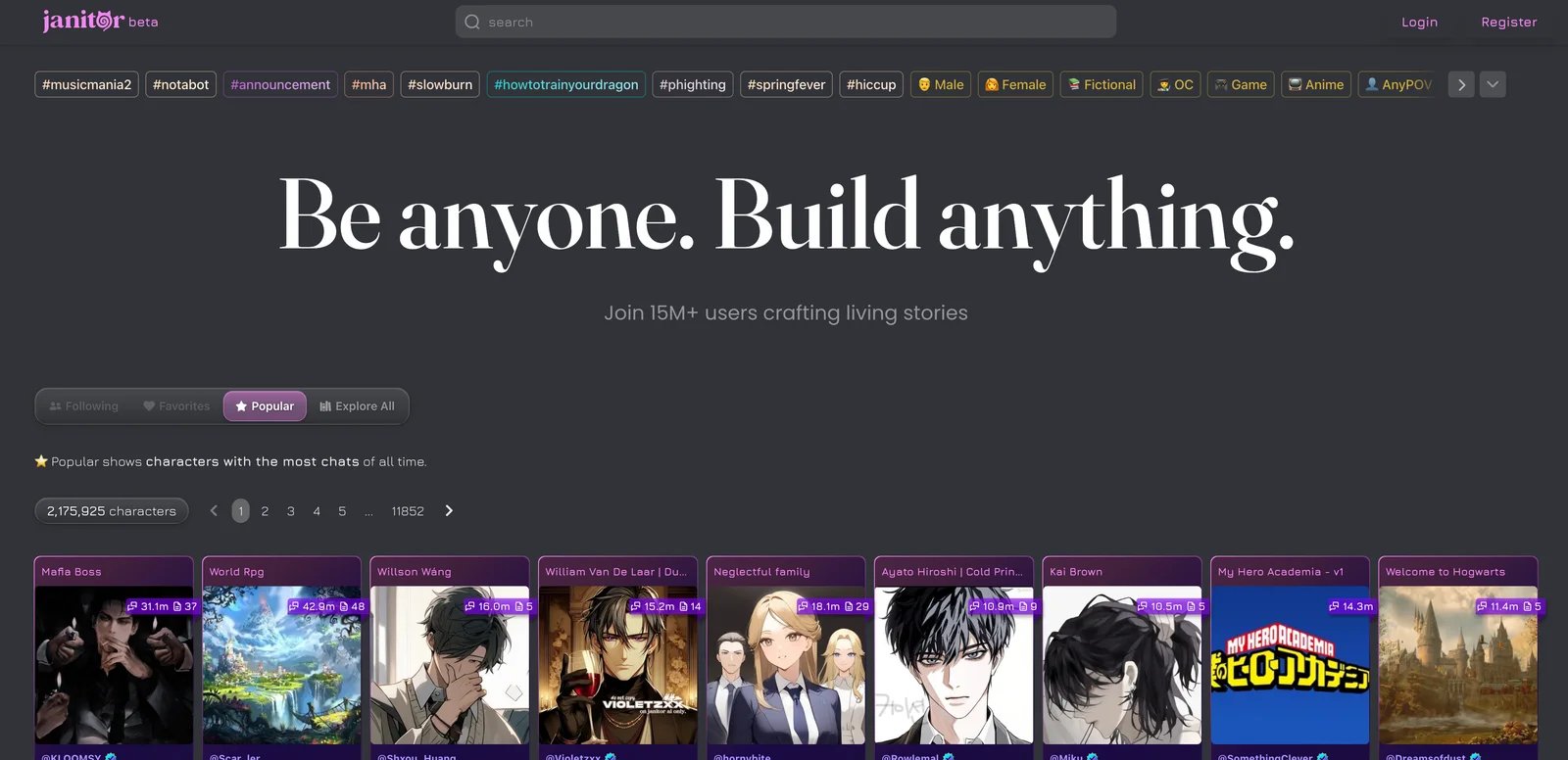
Janitor AI is a community character-chat platform with a large public character library and support for multiple model backends, including its own JLLM and external providers. Less a finished product and more a customizable RP workbench: the default JLLM has free limits, but the moment a chat matters you'll point it at Claude, GPT, or a Mistral derivative via OpenRouter or a direct key.
What Janitor AI solves vs Character.AI:
- Filter behavior depends on Janitor AI's platform rules plus the selected model/provider — Claude-via-Janitor behaves differently from OpenRouter-mistral-via-Janitor, and the model layer carries most of the content posture
- Character creation and editing is open and forkable, with public character cards covering every genre Character.AI's filter blocks
- Memory and persona depth depend on the model you connect; with a high-context Claude or Gemini key, long arcs hold together far better than C.AI's default
Pricing vs Character.AI: Free JLLM tier (with limits and queues), Pro reported around $9.99/mo for higher caps and ad removal. The real cost is the external model: a casual Claude Haiku key might cost a few dollars per month for light use, while heavy BYO-API usage can vary widely by provider, model, context length, and message volume — model your real usage before assuming a monthly figure. Character.AI keeps standard messaging free and unlimited while using ads and feature limits to differentiate c.ai+; Janitor combines its own tier limits with any pay-as-you-go cost imposed by the selected external provider.
Limitations: The mobile and onboarding experience is worse than Character.AI — you'll set up an API key, debug rate limits, and pick a character preset before your first message lands. Janitor has gone through outages and policy churn of its own. And the open character library means quality is uneven — finding a well-tuned bot takes browsing.
Best for: Users who left Character.AI specifically because of the filter or PSQ2 model churn and want full control over which model talks to their characters. Not the right fit if you wanted Character.AI's polished mobile UX, or if "connect an API key" sounds like work.
Get started with Janitor AI
Crushon AI
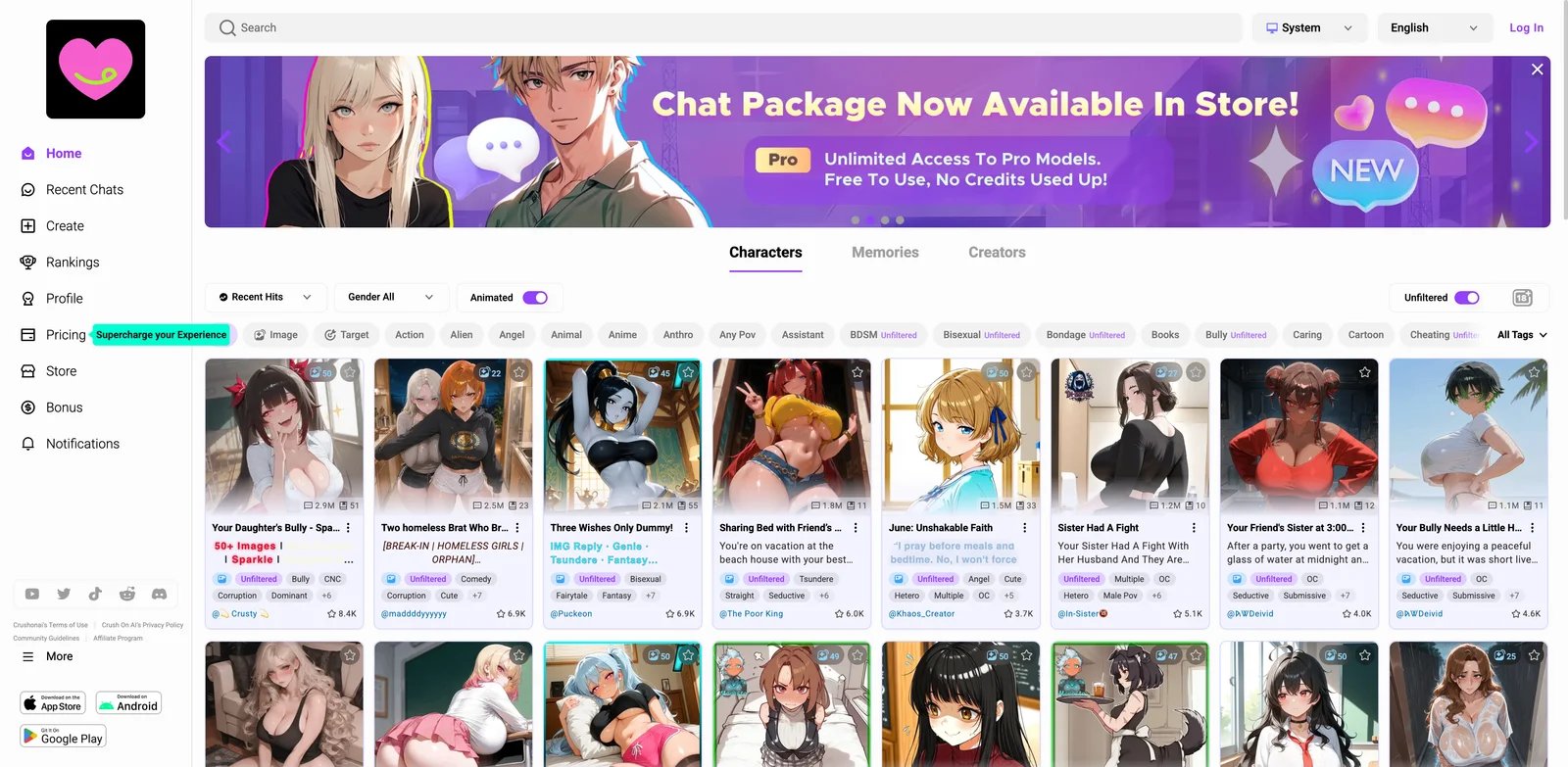
Before features, the warning: Crushon AI is an adult-oriented AI character chat platform, and that positioning shapes everything else about it. If you arrived here looking for a softer-filter Character.AI clone, Crushon is the closest direct answer; if you wanted a family-friendly C.AI, this is the wrong fit. Describe content posture using its current Terms and community guidelines rather than the blanket phrase "no filter."
Where Crushon solves Character.AI's pain:
- More permissive than Character.AI for adult-oriented roleplay, subject to Crushon's current Terms — adult RP, mature themes, and conflict scenes are less likely to trigger the mid-message block that defines the C.AI filter experience, though platform rules and model/provider constraints still apply
- Subscription tiers publish defined monthly prices and credit allowances, making the base commitment easier to compare even though premium actions can still consume credits
- The character catalog is built for the specific audience Character.AI keeps pushing away, with consistent moderation around the platform's own terms
Pricing vs Character.AI: Crushon's current first-party page lists five paid monthly tiers: Standard $5.99, Premium $14.99, Luxe $39.99, Elite $89.99, and Imperial $199.99. Benefits and credits scale sharply across that ladder, so compare the current checkout allowance rather than treating each tier as a simple message upgrade. The ladder is much broader than C.AI+'s single standard subscription. Cost stack reality: model credits, image generation, voice, and other premium actions can have tier-specific allowances, so confirm what your selected tier covers before heavy use.
Limitations: Adult content moderation has its own boundaries that differ from C.AI — read Crushon's terms before assuming any RP genre is welcome. Quality of memory and persistence trails the high end (Kindroid, DreamGen) for long-running arcs. And the brand positioning means you wouldn't open it on a work laptop without thinking about it.
Best for: Users whose primary reason for leaving Character.AI was the filter blocking mature or emotional content, and who want a hosted, no-config alternative. Not the right fit if you're under 18, if your workplace cares, or if you wanted broad SFW RP coverage.
Get started with Crushon AI
SpicyChat
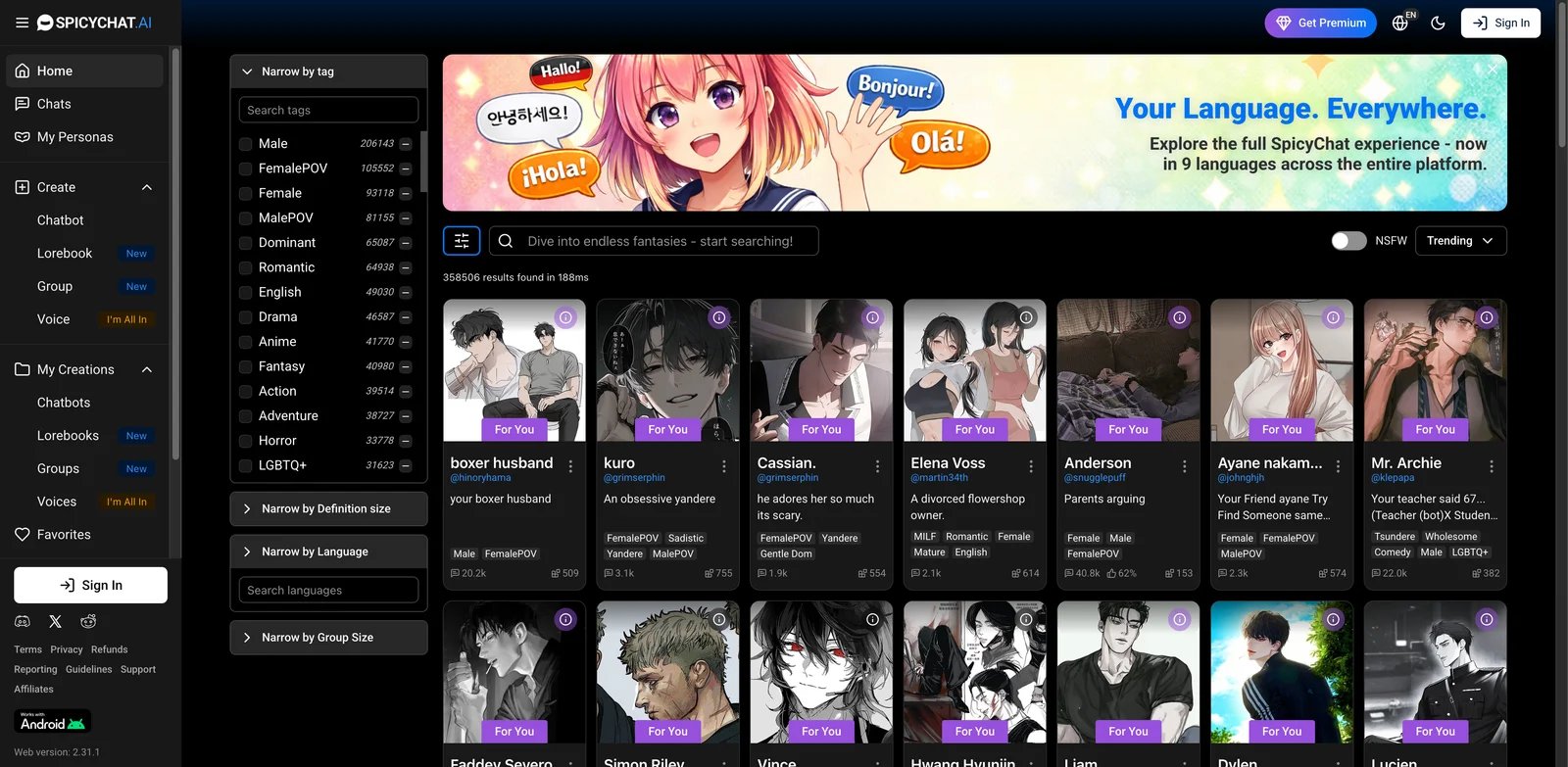
SpicyChat positions itself around a large adult-leaning character library and three paid plans that remove common free-tier friction. Its current subscription matrix explicitly lists unlimited messages for all three paid tiers; the plans differ more on context, memory, models, images, voice, and queue priority than on basic message count.
What SpicyChat solves vs Character.AI:
- All three current paid tiers list unlimited messages — Get a Taste also removes ads and waiting lines, while the higher tiers add more context, semantic memory, models, images, voice, and priority generation
- Adult character library covers RP genres C.AI's filter blocks, with creator-side controls for tagging and filtering
- Subscription speedups (priority response, faster swipes) match the use case of users who left C.AI specifically for free-tier degradation
Pricing vs Character.AI: The current monthly checkout lists Get a Taste at $5.95, True Supporter at $19.95, and I'm All In at $29.95. The same page marks unlimited messages, unlimited character creation, no ads, and queue skipping as included across all three paid plans. Get a Taste remains the low-cost test; True Supporter adds 8K context, semantic memory, longer responses, images, and more models; I'm All In adds the largest context, best models, voice, and priority generation. Annual billing can differ, so these are the monthly figures shown at review time.
Limitations: Memory depth lags Kindroid and DreamGen for multi-month character arcs. The UI is more catalog-and-chat than character-as-companion — you'll switch between bots rather than deepen one. And adult-leaning branding means the same workplace-context caveat as Crushon.
Best for: Users who want a flat paid plan with unlimited messages and an adult-leaning catalog, starting at $5.95/mo. Not the right fit if your main complaint was memory or character drift over long arcs; the larger context and semantic-memory features start on higher tiers.
Get started with SpicyChat
Chai
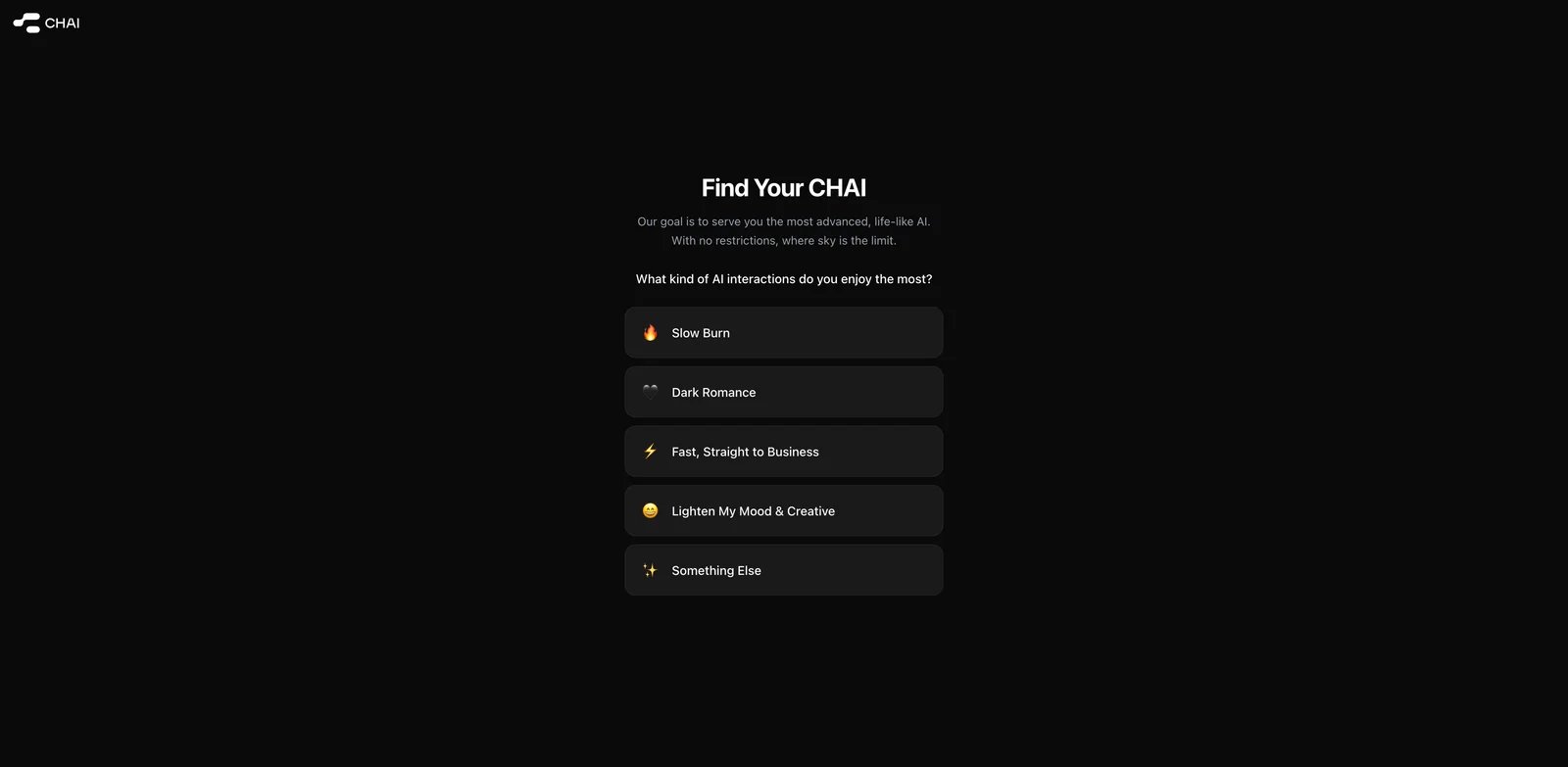
Chai has a large mobile audience, an official plan page advertising access to 25M characters, and a fast-tap chat flow — the mobile-first answer for users who used Character.AI primarily on a phone and want a familiar character-chat loop on a different platform. The desktop experience is thinner; this is a mobile app first, web second.
What Chai solves vs Character.AI:
- Mobile-native UX with large character library — the closest mobile-first match for a Character.AI user who never opened it on desktop
- Tip-based and weekly subscription options let users dial commitment week-to-week, useful when testing whether a switch sticks
- Lower filter friction on common RP scenes (varies by character and model) without the strict mid-message blocks
Pricing vs Character.AI: Chai is free to start with a free 24-hour trial shown in the official FAQ. Chai Pro is listed at $159.99/year or $9.99/week. The weekly tier is unusual — it lets users pay for one-week of heavy use without locking into annual commitment. Compared to C.AI+ at $9.99/mo, Chai annual ($159.99/yr = $13.33/mo) lands higher; the weekly option is meaningfully more expensive for sustained use ($9.99/wk = ~$520/yr).
Limitations: Desktop and web client is less polished than the app. Character quality varies widely — the top of the catalog is good, the long tail less so. Memory and lore tooling are minimal compared to Kindroid or DreamGen. And the weekly pricing is a trap for users who forget to cancel.
Best for: Users who used Character.AI predominantly on a phone, want a fast switch, and accept variable character quality in exchange for mobile-first UX. Not the right fit if you need a desktop-first long-form RP environment.
Get started with Chai
Replika
Replika is older than Character.AI — the original AI companion product, founded by Eugenia Kuyda in 2017 around a single use case: one person, one AI companion, designed for emotional bonding over time. That history shapes the product. Replika is not a public bot library; it's one Replika that becomes yours.
What Replika solves vs Character.AI:
- Single-companion model with persistent persona — you're not switching between bots; you're deepening one relationship
- Memory and emotional continuity are the product's whole pitch, with explicit tools for memory recall and "diary" entries
- Voice calls, AR companion, and mood tracking are first-party features rather than add-ons
Pricing vs Character.AI: Replika says chatting remains free under its Free Use program; we found no current first-party basis for a specific daily text-message limit. The present subscription structure is Free Use, Pro, Ultra, and Platinum. Pro adds relationship and media features, Ultra adds smarter conversations, emotional intelligence, reflections, and saved memories, and Platinum adds advanced video and training features. Replika directs users to the app or relevant store for current pricing, so the exact charge varies by platform and region rather than resolving to one stable public price.
Limitations: It's not a roleplay platform in the C.AI sense — you can't load a public Goku character and chat with it. Replika went through its own filter controversy in 2023-2024 when "erotic roleplay" was removed and partially restored, and the trust scar from that hasn't fully healed. Platform tier pricing variance can surprise users.
Best for: Character.AI users whose actual use case was emotional companionship — talking to one consistent persona over months, not browsing characters. Not the right fit if you wanted the catalog-browsing pattern, or if Replika's 2023 ERP rollback is a red line.
Get started with Replika
Kindroid

Kindroid leans into specs that map directly to Character.AI's most-cited pain. Long-term memory: persistent, structured, and editable. Voice: real-time TTS in a range of voices. Image: companion-generated portrait and scene images. Multi-Kindroid: more than one companion, interacting with each other. The product reads like a checklist of "everything C.AI users wished worked."
What Kindroid solves vs Character.AI:
- Long-term memory: structured persistent memory across sessions; the feature exists at a first-party level, not bolted on. Users on r/CharacterAI specifically cite Kindroid memory as the migration win
- Voice calls and image generation in-product, no external integration needed
- Multi-Kindroid lets you build a small cast and have them interact, useful for ensemble roleplay
- Lore book, scene framing, and personality editing tools surface what C.AI keeps behind feature flags
Pricing vs Character.AI: Kindroid's July 7 subscription page lists web billing at $13.99/mo, $37.99 for three months, or $139.99/yr. Purchases through Google Play or the iOS App Store are $15.99/mo, $42.99 for three months, or $159.99/yr. Compared with C.AI+ at $9.99/mo, Kindroid's base subscription costs more, but the web annual option ($139.99/yr = $11.67/mo) closes most of that gap while adding its first-party memory, voice, and image features.
Limitations: Public character catalog is smaller than C.AI's — you'll spend more time building your Kindroid than browsing. Companion-focus means group roleplay genres are less native than purpose-built RP platforms. And the polish of voice and image is good but not best-in-class compared to specialist tools.
Best for: Users who left Character.AI specifically because memory or character drift broke their long-running arc, and who're willing to spend setup time on a deeper companion. Not the right fit if you wanted to browse a public character library without building.
Get started with Kindroid
PolyBuzz
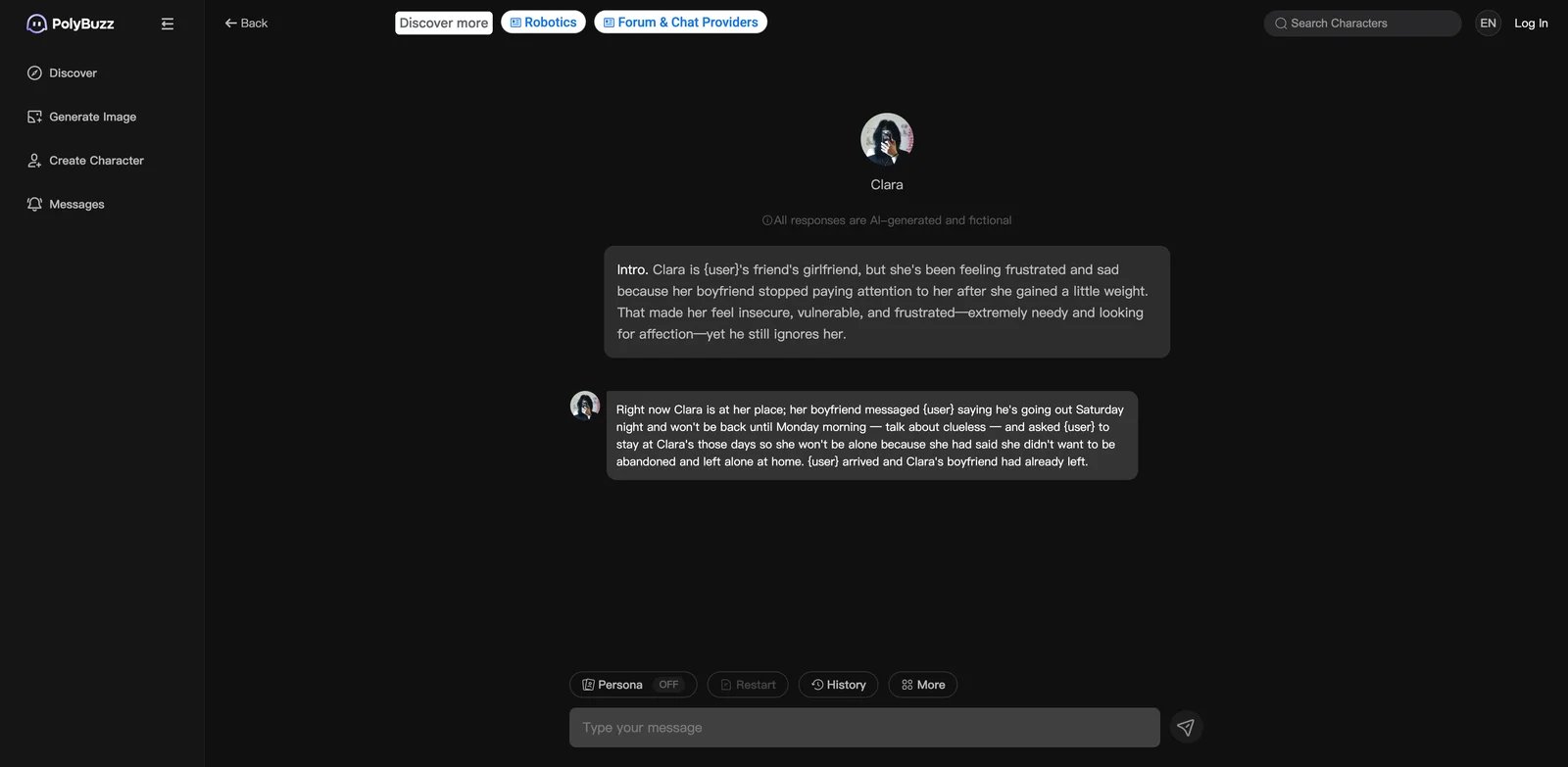
PolyBuzz's pitch is built around free unlimited basic chat and a large public character library. For users who want a second free catalog while Character.AI adds ads and limits some features, PolyBuzz is a direct alternative — but not an ad-free one unless you pay for membership.
What PolyBuzz solves vs Character.AI:
- PolyBuzz promotes free, private, unlimited basic character chat — ad status, daily caps, and throttling behavior should be verified in the current app before assuming "no metering"
- Large public character library covering most C.AI catalog genres
- Basic, Premium, and Ultimate memberships layer in models, memory, faster responses, and other benefits; the official membership matrix lists ad-free as a paid benefit
Pricing vs Character.AI: PolyBuzz promotes free, private, unlimited basic chat. Its current membership page names the paid tiers Basic, Premium, and Ultimate, with Basic shown at $9.90/mo or $99/year at review time. Compared with Character.AI's unlimited standard messaging, PolyBuzz is an alternative catalog and product experience rather than a way to escape a universal message cap. Expect ads and feature gates on free: the official membership matrix presents ad-free access, premium models, longer memory, voice benefits, and priority as membership value.
Limitations: Character quality varies — the catalog approach inherits the long-tail problem. Memory depth on the free tier is shallower than Kindroid or DreamGen paid. Some genres specifically blocked by C.AI's filter aren't more permissive here. And "unlimited" on the free tier is best-effort; expect feature gates and occasional throttling under load.
Best for: Character.AI users who want another large catalog with vendor-promoted free unlimited basic chat and can tolerate ads or upgrade for the ad-free benefit. Not the right fit if your reason for leaving was the filter or memory depth.
Get started with PolyBuzz
JoyLand
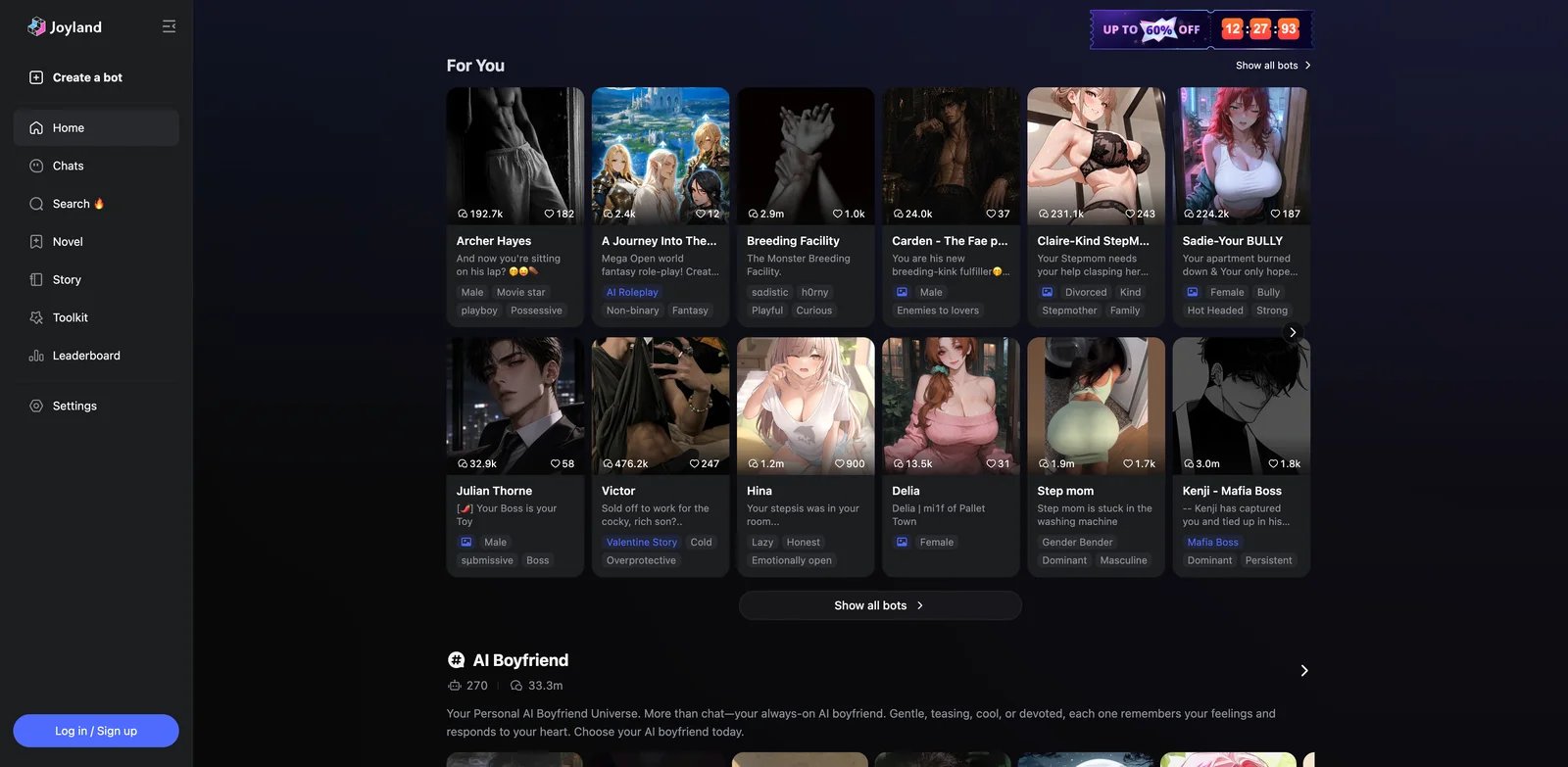
JoyLand reads less like a Character.AI clone and more like a story platform with characters as the entry point. If your C.AI use was about scenarios — a specific anime universe, a game world, a continued narrative — JoyLand's framing is closer to home than a generic catalog. Characters here are story containers more than chat targets.
What JoyLand solves vs Character.AI:
- Anime, game, and scenario-driven character library oriented toward story continuation
- Scene framing and narrative tools surface the storytelling context C.AI keeps implicit
- JoyLand's story and roleplay positioning may feel less restrictive than C.AI for some narrative use cases, though specific content posture for violence, conflict, and mature themes should be verified against JoyLand's current Terms
Pricing vs Character.AI: Free tier available; Standard ~$9.99/mo and Premium ~$19.99/mo reported. Standard tier matches C.AI+ pricing; Premium is double. For users whose use case is scenario continuation rather than chat-counter optimization, the pricing trade reads as fair.
Limitations: Mobile UX is functional but trails Chai for fast-tap quick chat. Character quality variance is comparable to other catalog platforms. Memory and lore depth lag specialist tools (Kindroid, DreamGen).
Best for: Character.AI users who used the platform primarily for anime, game, or scenario-driven roleplay and want a similar feel with less filter friction. Not the right fit if your use was generic 1:1 character chat or strict SFW genres.
Get started with JoyLand
Yodayo
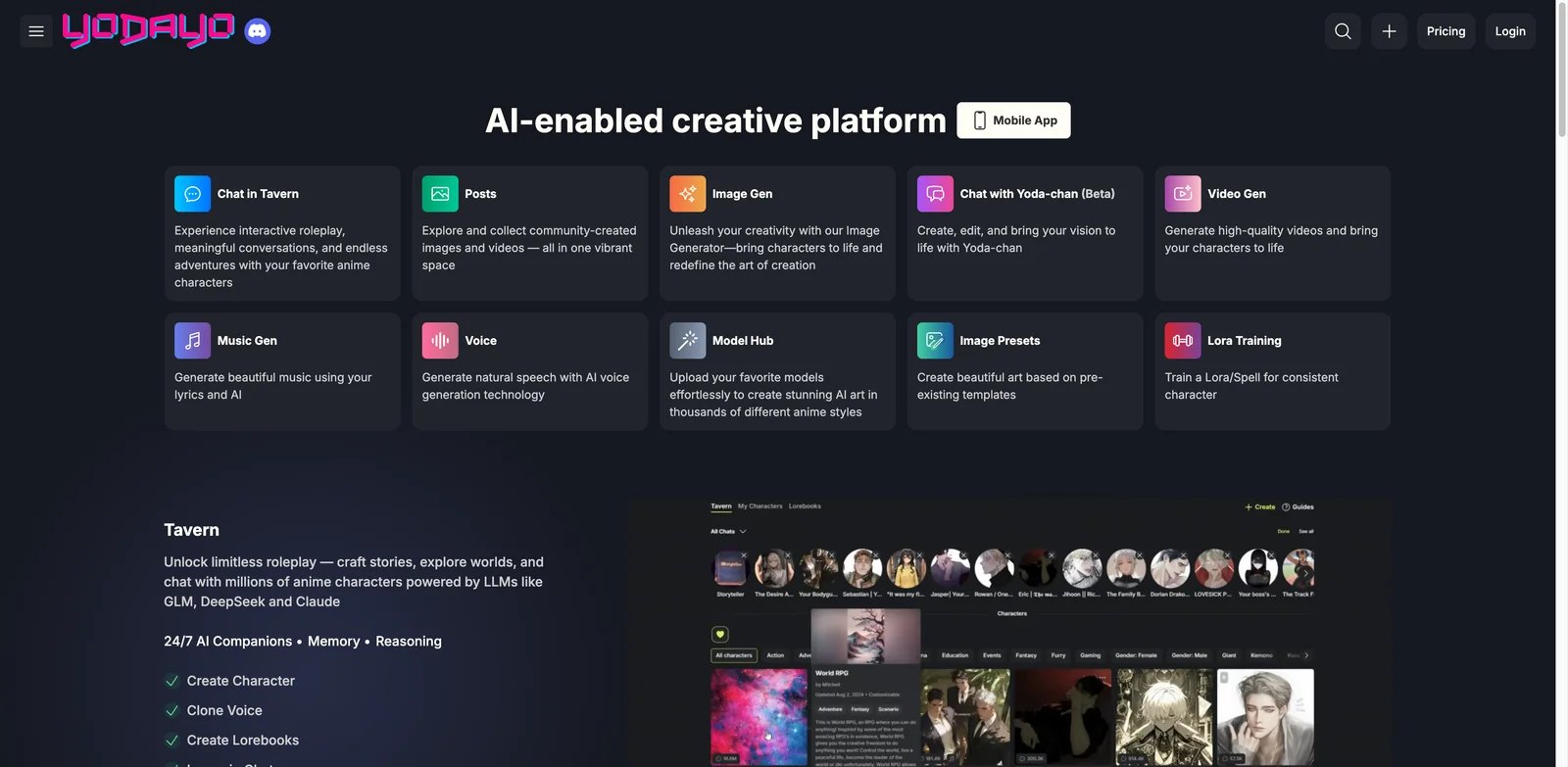
Yodayo sits in a niche neither C.AI nor most alternatives occupy: an anime AI art community on one side, a Tavern-style character chat platform on the other, both billed in one shared currency (beans). For users whose C.AI use coexisted with art generation, the combined stack is more useful than two separate subscriptions. It shares accounts with Moescape, from the same team: according to Moescape, the same login works on both sites and the same balance shows as YoBeans here and Mochi there.
What Yodayo solves vs Character.AI:
- Tavern integration brings SillyTavern-style character cards and lore handling into a hosted environment, without local setup
- Combined billing across art and chat: free daily YoBeans can be claimed and used across eligible Yodayo features, but Tavern message costs and expiration rules should be checked in-app
- Anime-leaning character library and community curation match a specific aesthetic niche C.AI doesn't optimize for
Pricing vs Character.AI: Yodayo offers free daily YoBeans, and Tavern/chat usage has historically consumed beans per message. YoBeans can no longer be bought on Yodayo directly: because the account is shared with Moescape, top-ups and plans go through Moescape's payment page, where the same balance is sold as Mochi. The beans model is non-obvious for new users — light chat usage is comfortably within free daily allowance, but heavy use can burn through faster than expected.
Limitations: The beans economy makes cost prediction harder than a flat subscription. Tavern integration is a positive for some users (control) and a negative for others (configuration overhead). Western mobile presence trails the web product.
Best for: Anime and aesthetic-driven Character.AI users whose creative work spans chat plus image generation, and who can navigate a beans-based pricing model. Not the right fit if you want flat monthly cost or SFW-genre-only chat.
Get started with Yodayo
Moescape
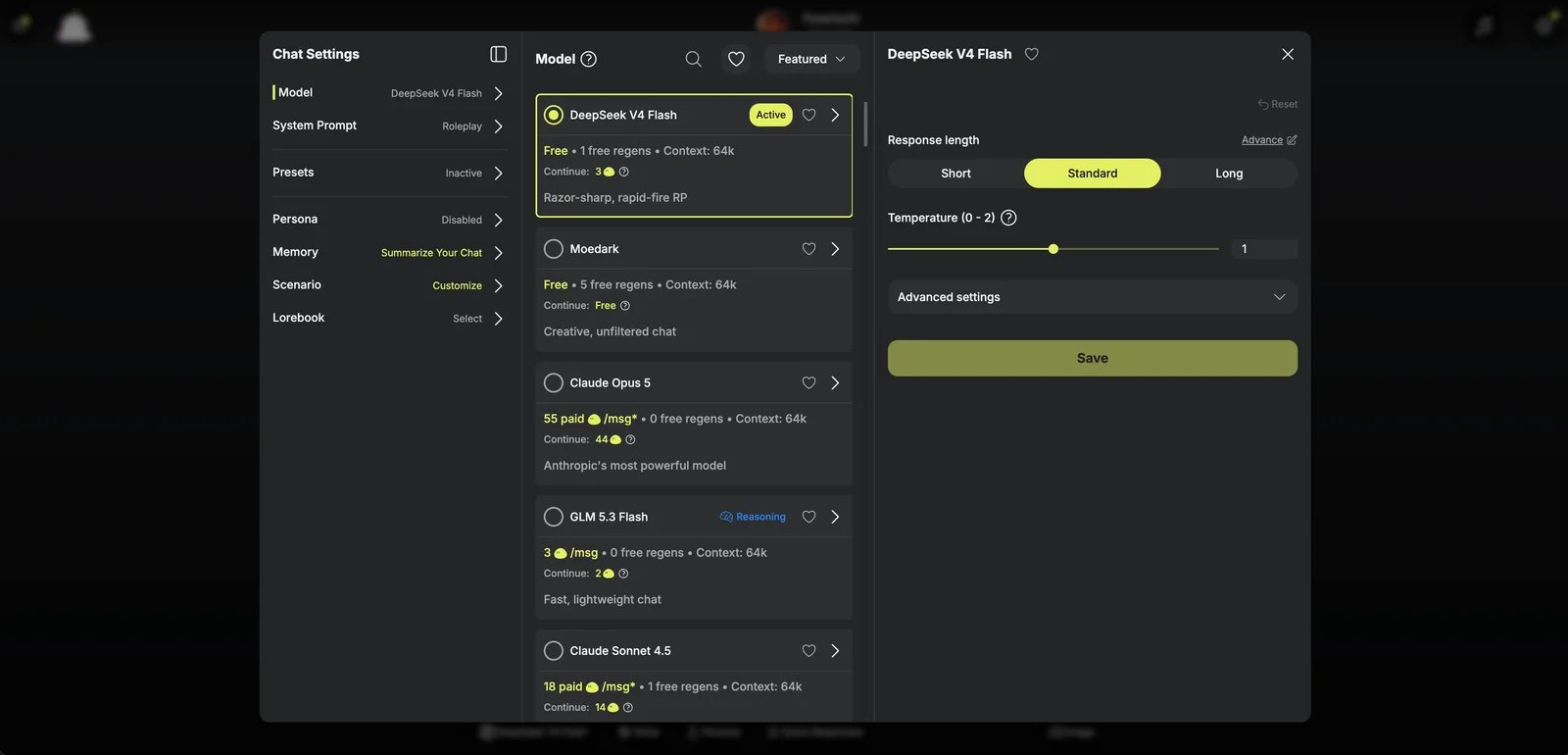
Moescape comes from the team behind Yodayo and covers the same ground: an anime art community alongside a Tavern-style character chat platform. The two share accounts — according to Moescape, the same login works on both, with the balance shown as Mochi here and YoBeans on Yodayo. Where Moescape diverges from most character sites is depth of model choice. Instead of one house model, it exposes a roster of more than forty chat models, each showing its per-message cost, context window, and free regeneration count before you commit to it.
What Moescape solves vs Character.AI:
- Per-conversation model selection across 40+ options, which is the direct answer to the Pipsqueak 2 complaint: if a model changes or disappoints, you switch it yourself instead of waiting for the platform to restore something
- Exposed sampling controls. Temperature (0-2), response length, system prompt, and presets are editable inside the chat rather than fixed by the platform
- An opt-in 18+ account setting that, by Moescape's own description, disables chat filters, which speaks directly to users who left C.AI over filtering; the published content policy still sets limits, covered below
Pricing vs Character.AI: New accounts get 100 Mochi plus a daily Mochi allowance. Subscriptions run Plus $9.99, Pro $14.99, Premium $29.99, and Platinum $39.99 per month, with annual billing marked 25% off; Mochi packs start at $5 for 550. Every paid plan removes ads, and from Pro upward plans add unlimited chat on a set of models, starting with DeepSeek V4 Flash, Ultra, Elune and Apollo 70B. Three rules catch new users. The monthly allowance is not monotonic, since Plus grants 1,400 Mochi while the pricier Pro grants 1,250 and spends the difference on that unlimited model access. Continuing a truncated reply is billed as a separate, cheaper action. And models from third-party labs (Claude, GPT, Kimi K3, Aion) are flagged so they cannot be paid for with free Mochi at all.
Limitations: Context is listed at 64k across nearly the whole roster, and no plan lists a larger window; paid plans advertise better memory without saying what it covers. Summarising older history is a manual action at 10 Mochi a time, and an Advanced Memory beta toggle exists that we did not test. The strongest third-party models stay out of reach on free Mochi no matter how much you accumulate. Filtering is harder to predict than on platforms that state an adult policy plainly: PG and PG-13 are both on by default and the default feed carries a substantial amount of suggestive material, an opt-in 18+ account setting says it disables chat filters, and yet the published content policy still lists only PG and PG-13 and prohibits pornographic content in chat. We tested on a paid account and did not enable the 18+ setting, so free-account model costs and the 18+ experience are not covered here. Free models can queue, and the wait before the first token was noticeably longer than the generation itself once it started.
Best for: Character.AI users who want to pick the engine per conversation, tune temperature, and keep anime image generation on the same bill. Not the right fit if you need a flat predictable monthly cost, a context window beyond 64k, or content rules you can predict from the published policy.
Get started with Moescape
DreamGen
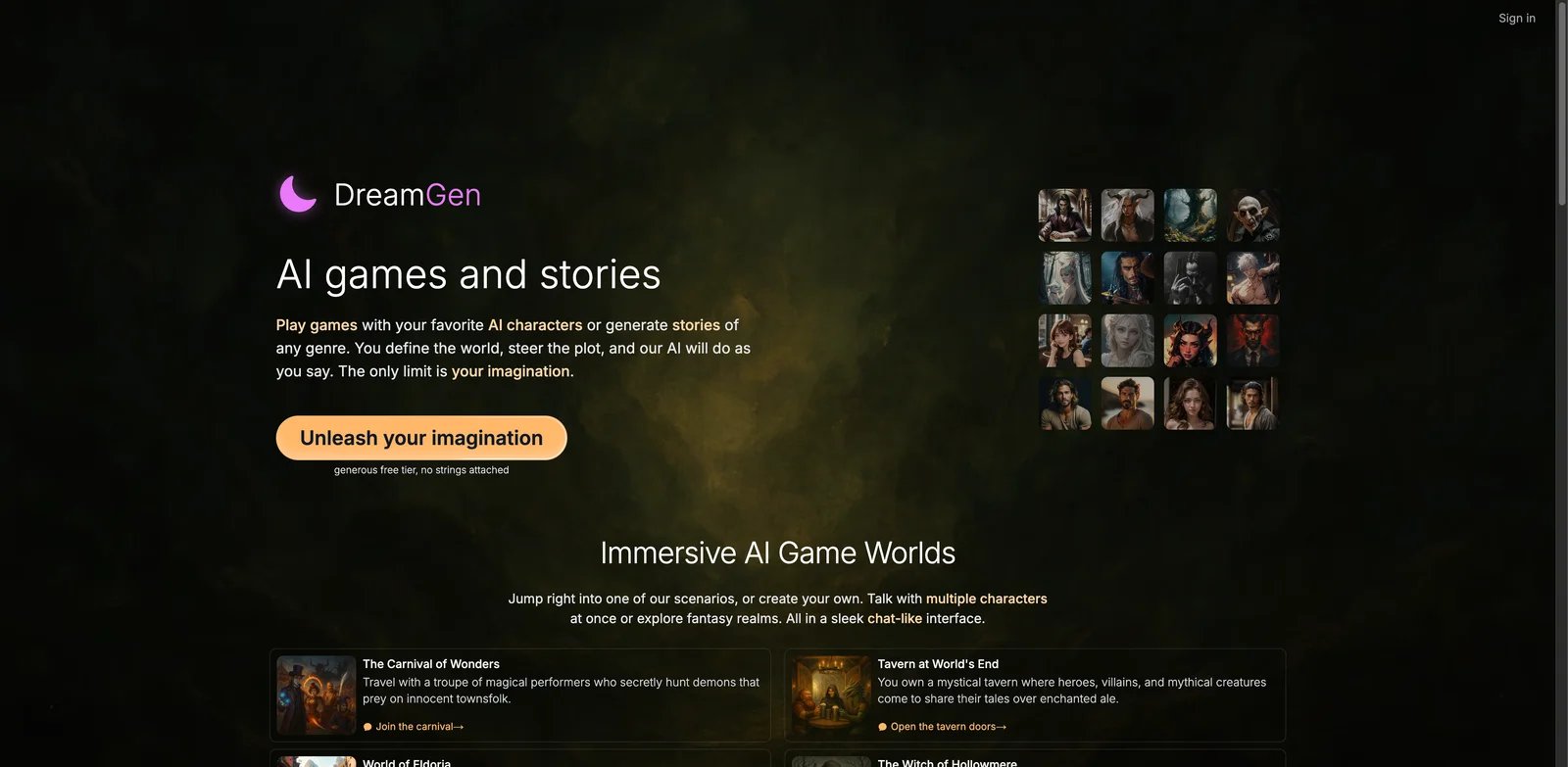
DreamGen's pitch is precise: $7.83/mo Starter, $19.35/mo Advanced, $48.30/mo Pro — three tiers built around long-form story and scene writing, not catalog chat. If your Character.AI use was really "writing a novel one chat at a time," DreamGen is the format-aligned product.
What DreamGen solves vs Character.AI:
- Long-form scene and story format — chats are framed as scenes with multiple characters, not single bot conversations, so multi-character RP and narrative continuity have first-party tooling
- Memory and lore handling are built around long-running arcs, with explicit world-building and persona persistence
- DreamGen is positioned for roleplay and story generation, including long-form scenes and mature creative writing where allowed by its Terms — confirm specific content scope against the current policy before depositing creative work
Pricing vs Character.AI: Free tier available; Starter ~$7.83/mo, Advanced ~$19.35/mo, Pro ~$48.30/mo (discounts may apply). Compared to C.AI+ at $9.99/mo, DreamGen Starter is cheaper, Advanced is double. The Pro tier is positioned for heavy creative writers who treat the platform as their primary writing tool.
Limitations: UX learning curve is the steepest in this list — DreamGen is closer to a scene-writing IDE than a chat app. Character library is smaller than C.AI or PolyBuzz. Mobile experience trails desktop. And the scene-based interaction model is unfamiliar enough that some users bounce before getting value.
Best for: Users whose Character.AI usage was actually long-form fiction writing dressed as chat, and who're willing to invest a few hours learning a different format. Not the right fit if you wanted casual fast chat or were never building extended narratives.
Get started with DreamGen
Honorable Mentions
Six tools worth knowing about even though they're not direct character-chat replacements. Each occupies an adjacent niche that picks up specific Character.AI use cases the direct alternatives don't.
Claude Projects
Claude.ai's project feature gives you a persistent project context (system prompt, knowledge files, custom instructions) that survives across chats. For C.AI users whose real use was long narrative writing, character consistency, or world-building, Claude with a project setup can provide persistent instructions and uploaded context for long arcs — though it's a writing/reasoning tool, not a character-chat catalog, and shouldn't be framed as a direct Character.AI memory replacement. Pricing: Free tier; Pro $20/mo ($17 annual); Max from $100/mo. Best for: users whose deeper goal was "consistent persona over long arcs" rather than "browse public characters." Try Claude Projects
ChatGPT Custom GPTs
Custom GPTs let you author a persona — instructions, knowledge files, conversational style — and reuse it. For C.AI users tired of public characters drifting OOC, a self-built Custom GPT is a tighter persona contract than any catalog character can offer. Pricing: Free tier; Go $8/mo in the US, Plus $20/mo, and Pro from $100/mo. OpenAI temporarily paused new sign-ups and upgrades to the $200 Pro plan on September 10, 2026, while the $100 Pro plan remains purchasable. Custom GPT creation and expanded GPT/project features are primarily tied to paid plans; availability and limits may vary by region, plan, and workspace settings. Best for: users whose top complaint was character drift and who'd rather author one stable persona than pick from a library. Try ChatGPT Custom GPTs

Poe is a multi-model platform: one subscription, access to Claude, GPT, Gemini, and dozens of specialty models with bot-authoring on top. For users hit by C.AI's Pipsqueak 2 churn whose actual question is "which model writes my character best," Poe is the cheap A/B testing ground. Pricing: Free tier; paid subscriptions from ~$4.99/mo with credit-based model access. Best for: users who want to compare how different LLMs voice the same character before committing to one. Try Poe
SillyTavern + Local LLM
SillyTavern is a free open-source character chat frontend for advanced users. With a fully local model running on your own hardware, it offers maximum control without a hosted model provider changing its access rules. SillyTavern can also connect to paid cloud APIs; those setups still inherit the provider's policies, moderation, availability, logging, and pricing risk. The trade-off is real setup work — model selection, hardware sizing, prompt tuning — and output quality depends on the backend you choose. Best for: technically capable users who can run fully local for maximum control or consciously choose a hosted provider's trade-offs. Try SillyTavern

NovelAI is built for fiction writing, not chat — long-form story continuation, world-building, and creative writing with explicit prose tooling. For C.AI users whose "chat with a character" was really "co-write a novel," NovelAI is format-honest where C.AI was format-hacked. Pricing: Free trial; Tablet $10/mo, Scroll $15/mo, Opus $25/mo. Best for: writers using C.AI as an unconventional novel-drafting tool. Try NovelAI

AI Dungeon frames every session as an interactive text adventure. For C.AI users whose "RP" was really co-creating a branching narrative game, AI Dungeon's frame fits better. Pricing: Free Wanderer tier; current public membership tiers list Journey at $14.99/mo, Legend at $29.99/mo, Mythic at $49.99/mo, and Ultimate at $99.99/mo. Best for: users whose C.AI use leaned into game-like narrative rather than character chat. Try AI Dungeon
Migrating from Character.AI — A Practical Guide
Data and Account Migration
Character.AI's data export is limited. There's no official one-click migration of chat history to any of these alternatives; the workflows that exist are manual. Practical steps:
- Chat history: copy chats you want to preserve manually. Some users use browser extensions to bulk-export to text, but these break with each C.AI UI update. For high-value arcs, copy-paste the key turns and save them as a lore document you can hand to your new platform.
- Character cards: if you've created characters on C.AI, copy persona description, greeting, definition tags, and example dialogue into a text file. Most alternatives (Janitor AI, SillyTavern, Kindroid) accept similar fields, so the manual port is straightforward.
- Account closure: if leaving entirely, request account deletion via Character.AI's privacy settings. Note that the under-18 phase-out from November 2025 changed account state for affected users — if your account was flagged, expect a different deletion workflow.
- Subscription cancel: cancel C.AI+ before testing alternatives so you're comparing free-tier-to-free-tier, then re-subscribe to your new platform only after a two-week trial.
Learning Curve by Alternative
- Near-zero curve (open and use): Chai, PolyBuzz, JoyLand, Crushon AI, SpicyChat, Replika, Yodayo. Same catalog-chat model as Character.AI.
- Medium curve (some setup): Janitor AI (API key), Kindroid (persona authoring), Moescape (Tavern, lorebooks, and a per-message credit economy), DreamGen (scene model), Claude Projects (project setup), ChatGPT Custom GPTs (persona authoring), Poe (model selection), AI Dungeon (text-adventure framing), NovelAI (writing tooling).
- High curve (real engineering): SillyTavern + Local LLM (hardware + model selection + prompt tuning).
Pricing Brackets vs Character.AI C.AI+ ($9.99/mo)
- Cheaper than C.AI+: PolyBuzz free basic chat, SpicyChat Get a Taste $5.95, Crushon AI Standard $5.99, DreamGen Starter $7.83, ChatGPT Go $8, Poe $4.99.
- Free open-source + BYO cost: SillyTavern (free frontend, you pay model cost separately), Janitor AI free tier (with model API cost on top).
- Same broad range as C.AI+: Chai annual ($13.33/mo equivalent), Kindroid web $13.99, JoyLand Standard ~$9.99, PolyBuzz Basic $9.90, Moescape Plus $9.99, NovelAI Tablet $10, Claude Pro $17/mo on annual billing.
- More expensive than C.AI+: Kindroid app $15.99, SpicyChat True Supporter / I'm All In at $19.95 / $29.95, Crushon AI Premium / Luxe / Elite / Imperial at $14.99 / $39.99 / $89.99 / $199.99, JoyLand Premium ~$19.99, Replika's paid plans at current store pricing, NovelAI Scroll / Opus $15-25, DreamGen Advanced / Pro $19.35 / $48.30, ChatGPT Plus / Pro from $20 / $100, AI Dungeon paid tiers, and Chai weekly ($43/mo equivalent).
Best Character.AI Alternatives by Use Case
If Your Reason Is "I want uncensored long-form roleplay without filter trips"
You want the filter pain to stop, not the chat pattern to change. Start with Janitor AI, where content posture is jointly determined by Janitor's platform rules and the selected JLLM or external provider, then test Crushon AI and SpicyChat as hosted alternatives with their own current rules. If your scenes are creative-writing scale rather than chat scale, DreamGen is the format-aligned option; confirm each service's current content policy before moving an archive.
If Your Reason Is "I want better memory for long-running relationships and lore"
Memory is what Character.AI keeps promising and not quite delivering. Kindroid ships persistent structured memory as a first-party feature. DreamGen handles multi-character long-arc memory through scene framing. For users whose deeper need is narrative writing rather than chat, Claude Projects with a configured project gives you stronger long-context behavior than any catalog tool.
If Your Reason Is "I miss the old C.AI model feel after PSQ2 and the legacy model removals"
The fresh-news pain. There's no perfect 1:1 reproduction of the deprecated Meow/Nyan/Roar feel, but Chai and PolyBuzz keep the catalog-chat mobile pattern intact; Janitor AI plus a comparable model (Claude Haiku or Mistral) lets you pick a model with character drift behavior closer to what you remember. Poe is the lowest-cost way to A/B test multiple LLMs against your character to find the closest feel. Moescape runs the same A/B test without leaving a roleplay interface, because model choice sits inside each conversation rather than in a separate app.
If Your Reason Is "I want a free or cheaper casual character chat app"
Character.AI still provides unlimited standard messaging, so compare the surrounding experience rather than assuming every message is capped. PolyBuzz promotes free unlimited basic chat, but ad-free access is a paid membership benefit. SpicyChat currently lists unlimited messages on all paid plans, starting with Get a Taste at $5.95/mo. Crushon AI starts at $5.99/mo. JoyLand and Chai free tiers remain options for light use; avoid Chai's weekly tier unless you are certain about one-week heavy use.
If Your Reason Is "I want characters to stay in character instead of generic replies"
Character drift is the OOC complaint. Kindroid and DreamGen hold persona better because they're built around persistent character profiles rather than session-level prompts. ChatGPT Custom GPTs lets you author the persona contract yourself, eliminating the catalog quality variance. Yodayo with Tavern integration gives lore-book-level persona persistence if you're willing to configure.
If Your Reason Is "I want full control with a local or BYO model setup"
The "I don't want a vendor to surprise me again" path. SillyTavern + Local LLM minimizes provider policy churn only when the model and backend are fully local; connect a hosted API and that provider's rules, availability, and prices return to the equation. Janitor AI is a hosted middle ground where both platform rules and model/provider rules matter. Poe is the lightest multi-model route, but it remains a hosted platform.
If Your Reason Is "I want AI companion features more than public roleplay bots"
This was always Replika's lane. Replika is the original AI-companion product and remains the most polished single-companion experience, despite the 2023 ERP rollback scar. Kindroid competes here with stronger memory and multi-Kindroid social features. ChatGPT Custom GPTs lets you build a custom companion if you don't want a hosted product's persona. Outside the companion niche, our best AI assistant guide covers productivity-focused alternatives.
If Your Reason Is "I want story writing or interactive fiction instead of chatroom RP"
The format-honest path. DreamGen is scene-based and built for fiction. NovelAI is long-form prose-writing with optional chat. AI Dungeon is text-adventure narrative with branching choices. Each treats "character" as a story element, not a chat target.
How to Choose the Right Character.AI Alternative
Four steps. Skip none — the diagnostic step matters more than testing.
-
Diagnose the actual reason you're leaving, then test a free tier that maps to it. Don't open all 17 alternatives. Pick the top pain (ads or feature limits / filter / memory / drift / PSQ2 churn) and the 1-2 tools above that target it directly. Spend 3-4 days, not 3-4 hours.
-
Verify the pricing model survives your actual usage. Calculate one month at your real message volume. Catalog tools (PolyBuzz, Chai) front-load cheap on free, get expensive on heavy. BYO API tools (Janitor AI, SillyTavern) front-load setup work, get cheap on heavy. Subscription tools (Kindroid, Crushon) are flat — predictable but heavier light usage.
-
Confirm content posture and age gate before depositing creative work. Crushon AI and SpicyChat are explicitly 18+; Replika has historical filter trauma; Character.AI's own filter and PSQ2 churn is the thing you're leaving. Don't move your year of arcs to a platform that might rollback in 12 months. Read the terms.
-
Migrate gradually over two weeks: parallel-use, then commit. Keep Character.AI open for the chats you can't easily port. Build new arcs on the alternative. After two weeks, ask: did the daily friction drop? If yes, cancel C.AI+; if no, try the second alternative on your list before concluding "they're all worse."
Frequently Asked Questions
What is the best free alternative to Character.AI in 2026?
What is the best Character.AI alternative with no filter?
Which Character.AI alternative has the best memory?
Which app is most similar to Character.AI on mobile?
Have Character.AI's 2026 PSQ2 and free-tier changes stabilized?
Is Janitor AI better than Character.AI for roleplay?
Is SillyTavern a real Character.AI alternative or only for advanced users?
What changed for under-18 Character.AI users?
Disclosure
Moescape is a paid placement in this article. The placement purchased inclusion, not an editorial verdict; its score, ranking, and limitations remain ToolWorthy's editorial assessment.
Get ToolWorthy Weekly
New AI tools, practical guides, and selected AI signals in one weekly brief.
For AI tool founders
Built a tool that belongs in this decision set?
Request an editorial evaluation for possible inclusion in ToolWorthy.
Submit your tool for reviewPaid submission does not guarantee a ranking, recommendation, inclusion, or editorial outcome.