



Overview
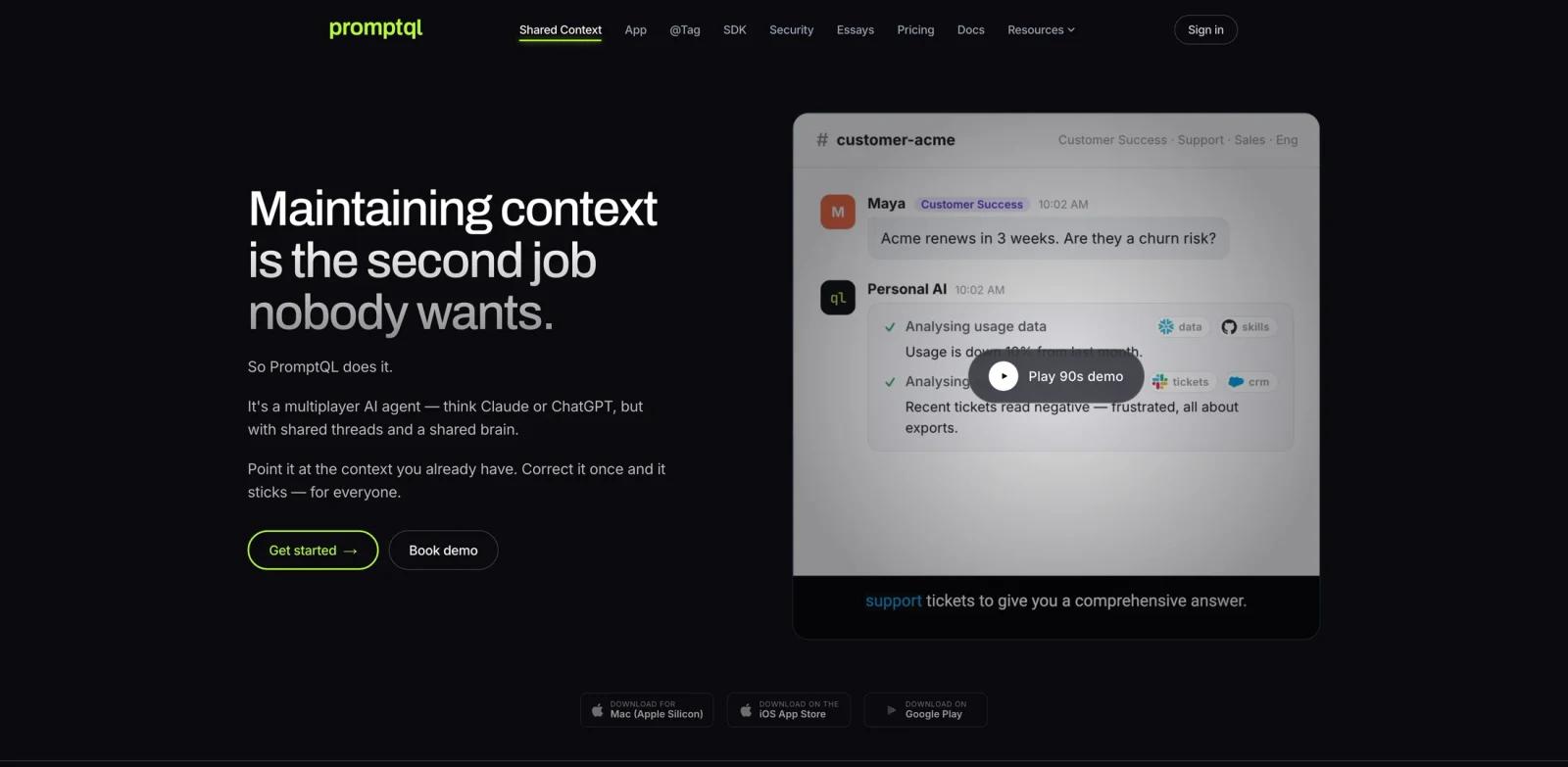
PromptQL is a multiplayer AI workspace for teams. Instead of splitting work between Slack, private ChatGPT chats, dashboards, docs, and individual coding agents, PromptQL gives teams shared AI threads where people and agents can work together with common context. The product comes from the Hasura team and launched publicly in July 2026 with strong Product Hunt traction.
The core idea is that team context should compound. PromptQL can connect databases, SaaS apps, coding agents, events, and internal tools; then it captures useful context into a shared wiki as work happens. Users can ask questions, produce artifacts such as tables and dashboards, tag teammates into a thread, and let the AI operate with the permissions of the user who invoked it.
PromptQL is best understood as an AI agent workspace rather than a simple chatbot. It competes with Slack-like collaboration tools, AI knowledge bases, and data analysis assistants, but its most distinct claim is multiplayer AI: humans preserve and correct context while agents execute tasks in shared threads.
Key Features
- Shared AI threads - Multiple teammates can collaborate in the same AI thread, review reasoning, correct outputs, and preserve context instead of losing work inside private chat histories.
- Data and SaaS connectors - Connects databases such as Postgres, Snowflake, BigQuery, and Databricks, plus SaaS tools including GitHub, Slack, Salesforce, and Google Workspace.
- Permission-aware execution - PromptQL documentation says the agent queries data where it lives and enforces per-user permissions at the data layer, so the AI should not see or do more than the current user can.
- Artifacts and dashboards - Users can ask plain-language questions and receive tables, charts, reports, and interactive dashboards, making it relevant for AI data analysis teams.
- Shared context wiki - Captures domain knowledge, business definitions, and tribal context as teams work, creating a self-improving knowledge base for future tasks.
- Coding agent delegation - Connects to coding agents such as Claude Code or Codex running on users' machines, allowing PromptQL to delegate investigation, feature development, and browser testing tasks.
Integration Guide
PromptQL is designed to sit across the tools a team already uses rather than requiring every workflow to move on day one.
For data work, teams connect warehouses and databases, then use PromptQL to generate queries, tables, charts, reports, and dashboards. For operations and go-to-market work, teams connect SaaS sources so the agent can answer questions with live context. For engineering teams, PromptQL can coordinate with coding agents such as Claude Code or Codex while preserving product and domain context in the shared thread.
The most important setup question is permissions. PromptQL supports scopes and multi-user permissions, but admins should test database row, column, and table restrictions before giving broad access to sensitive systems.
Pricing & Plans
PromptQL uses usage-based pricing around Operational Language Units, or OLUs. The public pricing page currently describes a free start with credits and a Starter plan at an introductory $0.14 per OLU, with a standard $0.20 per OLU rate.
| Plan | Price | Notes |
|---|---|---|
| Free start | Up to $100 in free credits | New projects receive credits, with additional teammate credits described on the pricing page. |
| Starter | $0.14 per OLU introductory, $0.20 standard | Pay-as-you-go usage. No minimums, prepaid balance, auto-pauses at zero, and per-user quotas. |
| Enterprise | Custom pricing | For larger teams needing enterprise support, controls, and commercial terms. |
Model choice changes OLU consumption. Open-weight models can be much cheaper than frontier models for similar tasks, while high-end reasoning models consume more OLUs. Teams should monitor usage closely when running deep investigations or long coding tasks.
Best For
- Teams tired of losing important decisions inside private AI chats
- Data-heavy organizations that want plain-language analysis across databases and SaaS apps
- Startups looking for an AI-native alternative to Slack, docs, dashboards, and ad hoc agent threads
- Engineering teams that want shared product context around AI code generation and agent delegation
- Operators who need recurring reports, charts, and shared decision history from live business systems
FAQ
What is PromptQL?
PromptQL is a multiplayer AI workspace where teams collaborate in shared AI threads, connect internal data and SaaS tools, generate artifacts, and preserve context in a shared wiki.
Is PromptQL a Slack replacement?
PromptQL is positioned as an AI-native workspace that can replace parts of Slack for deep work and shared context. In practice, many teams will likely start by connecting existing tools and moving selected workflows before a full migration.
What is an OLU?
An OLU, or Operational Language Unit, is PromptQL's normalized billing unit for model tokens, infrastructure, sandbox hosting, and orchestration. Different models consume different amounts of OLUs for the same task.
How much does PromptQL cost?
PromptQL offers free starting credits. The public Starter rate is currently listed at $0.14 per OLU introductory pricing, with $0.20 per OLU as the standard rate. Enterprise pricing is custom.
Can PromptQL connect to databases?
Yes. The official docs list connectors for databases such as Postgres, Snowflake, BigQuery, and Databricks, along with SaaS tools including GitHub, Slack, Salesforce, and Google Workspace.
How does PromptQL handle permissions?
PromptQL says it enforces per-user permissions and runs the AI with the user's available access. Admins should still test scope boundaries, database restrictions, and OAuth integrations before broad rollout.