

Overview
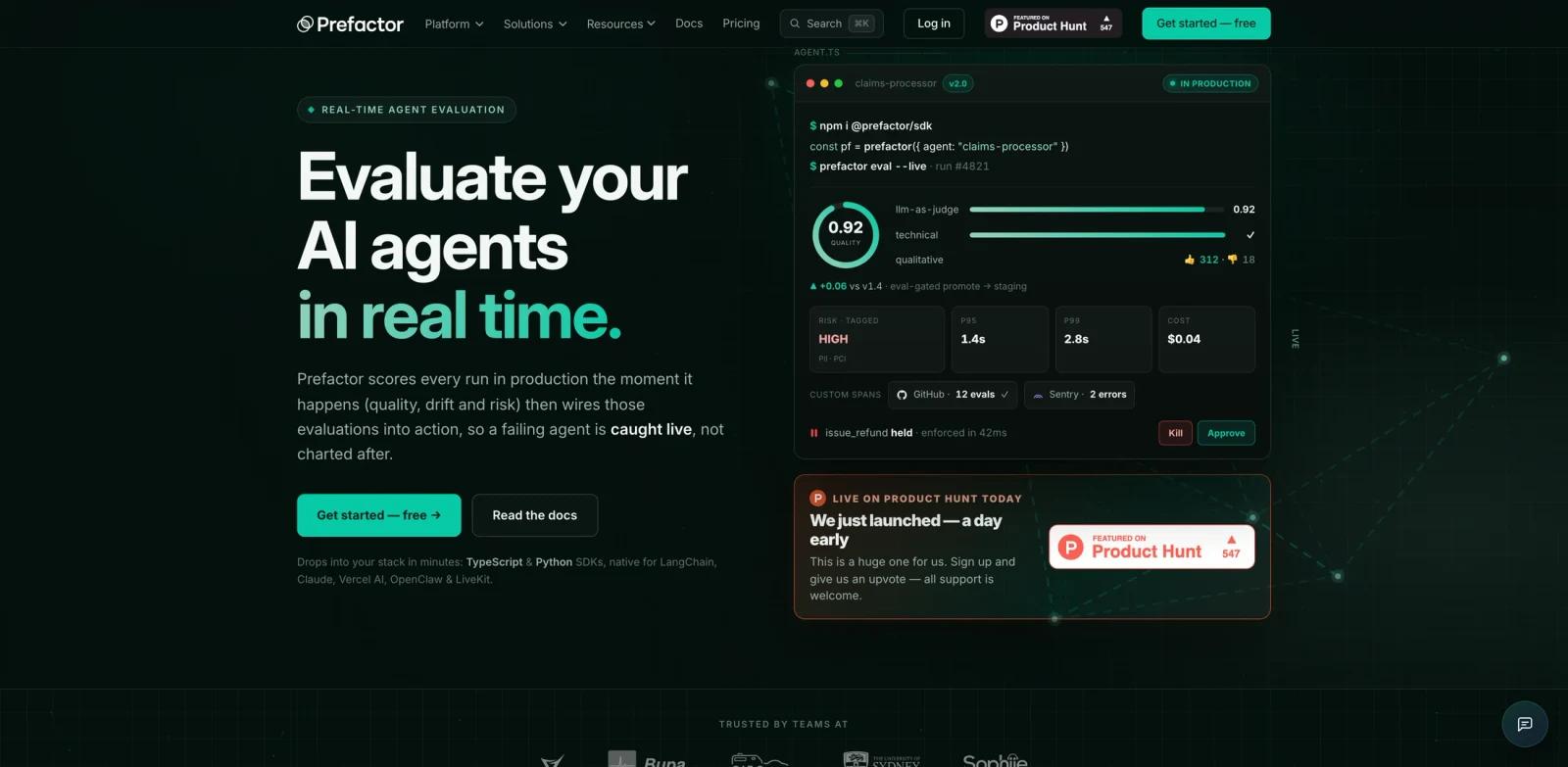
Prefactor is an AI agent evaluation and observability platform built for teams that are already shipping agents into real user workflows. Instead of evaluating prompts only in offline test sets, Prefactor scores every production run in real time, helping teams catch quality regressions, drift, unsafe behavior, and broken tool calls before they become support tickets.
The product combines telemetry, evals, and enforcement. Developers instrument an agent with TypeScript or Python SDKs, send spans from frameworks such as LangChain, Claude, Vercel AI SDK, OpenClaw, and LiveKit, then define scoring rules and actions for live traffic. When a run looks risky, Prefactor can flag it, route it to human approval, or block the action entirely.
Prefactor is best understood as a production control plane for agent quality. It is useful when simple logs are not enough and teams need a measurable, repeatable way to understand whether an agent is doing the right work.
Key Features
- Real-time agent scoring — Prefactor evaluates every agent run as it happens, so teams can detect quality drops and behavioral drift while traffic is live.
- Trace-level observability — Developers can inspect spans across prompts, tool calls, APIs, databases, and internal systems to understand why an agent made a decision.
- Action enforcement layer — Risky runs can trigger alerts, human approval, policy checks, or blocking actions instead of merely appearing in a dashboard after the fact.
- Framework-friendly SDKs — Prefactor documents TypeScript and Python instrumentation, with support for common agent stacks including LangChain, Claude, Vercel AI SDK, OpenClaw, and LiveKit.
- Custom span context — Teams can bring in GitHub, Linear, Jira, database, or internal API context so evals reflect the business workflow rather than just the model response.
Integration Guide
Prefactor is designed for engineering teams, not no-code operators. The basic setup is to install the SDK, wrap agent calls with spans, and define the signals you want to score. From there, teams can add custom evaluators for task success, policy compliance, latency, cost, drift, escalation needs, or tool-call correctness.
This makes Prefactor a strong fit for production AI agent systems where the agent touches customer data, revenue workflows, support queues, internal operations, or other workflows that need auditability. It is less relevant for simple one-off chatbot prototypes that do not yet have recurring production traffic.
Pricing & Plans
Prefactor offers a free developer tier and paid production plans based on span volume.
| Plan | Price | Included Usage | Best For |
|---|---|---|---|
| Dev | $0/month | 25,000 spans/month | Prototypes, early agent projects, and evaluation setup |
| Scaleup | From $250/month | 100,000 spans/month, then usage-based overage | Production teams running live AI agents |
| Scaleup Annual | From $9,600/year | 400,000 spans/month | Teams with steady traffic and annual budget |
| Enterprise | Custom | Custom volume and controls | Large deployments with procurement, security, or compliance needs |
Prefactor also advertises a Product Hunt launch offer for early signups, but the durable public pricing page lists the regular Dev and Scaleup tiers above. Paid plans include unlimited seats, and Prefactor states that customer data is not used to train models.
Best For
- Engineering teams shipping AI agents into production workflows
- AI infrastructure teams that need AI data governance controls around agent behavior
- Product teams monitoring quality regressions across prompt, tool, and model changes
- Startups building customer-facing agents where silent failure is expensive
- Developers comparing observability-first tools such as OpenObserve with agent-specific evaluation platforms
FAQ
What does Prefactor do?
Prefactor scores and traces AI agent runs in production. It helps teams understand whether an agent completed the right task, called the right tools, followed policy, and stayed within expected quality thresholds.
Is Prefactor only for developers?
Yes, primarily. Prefactor requires SDK instrumentation and is best suited for engineering teams building agents with frameworks, APIs, and custom application code.
Does Prefactor have a free plan?
Yes. The public pricing page lists a Dev plan at $0/month with 25,000 spans per month.
What is the starting paid price?
The regular Scaleup plan starts at $250/month and includes 100,000 spans per month, with usage-based overage after that.
Can Prefactor block risky agent actions?
Yes. Prefactor positions its action layer as a way to pause, approve, or block risky runs based on evaluation and policy signals.
Which agent frameworks does Prefactor support?
Prefactor documents TypeScript and Python SDKs and references integrations or compatibility with stacks such as LangChain, Claude, Vercel AI SDK, OpenClaw, and LiveKit.
How is Prefactor different from a normal analytics dashboard?
A normal dashboard shows what happened. Prefactor is built around agent-specific traces, scoring, drift detection, and enforcement actions, making it closer to a quality control system for AI workflows.
Who should not use Prefactor yet?
Teams that are still experimenting with simple prompts, have no production traffic, or do not have engineering resources may not get enough value from Prefactor until their agent workflows become more operationally important.