



Overview
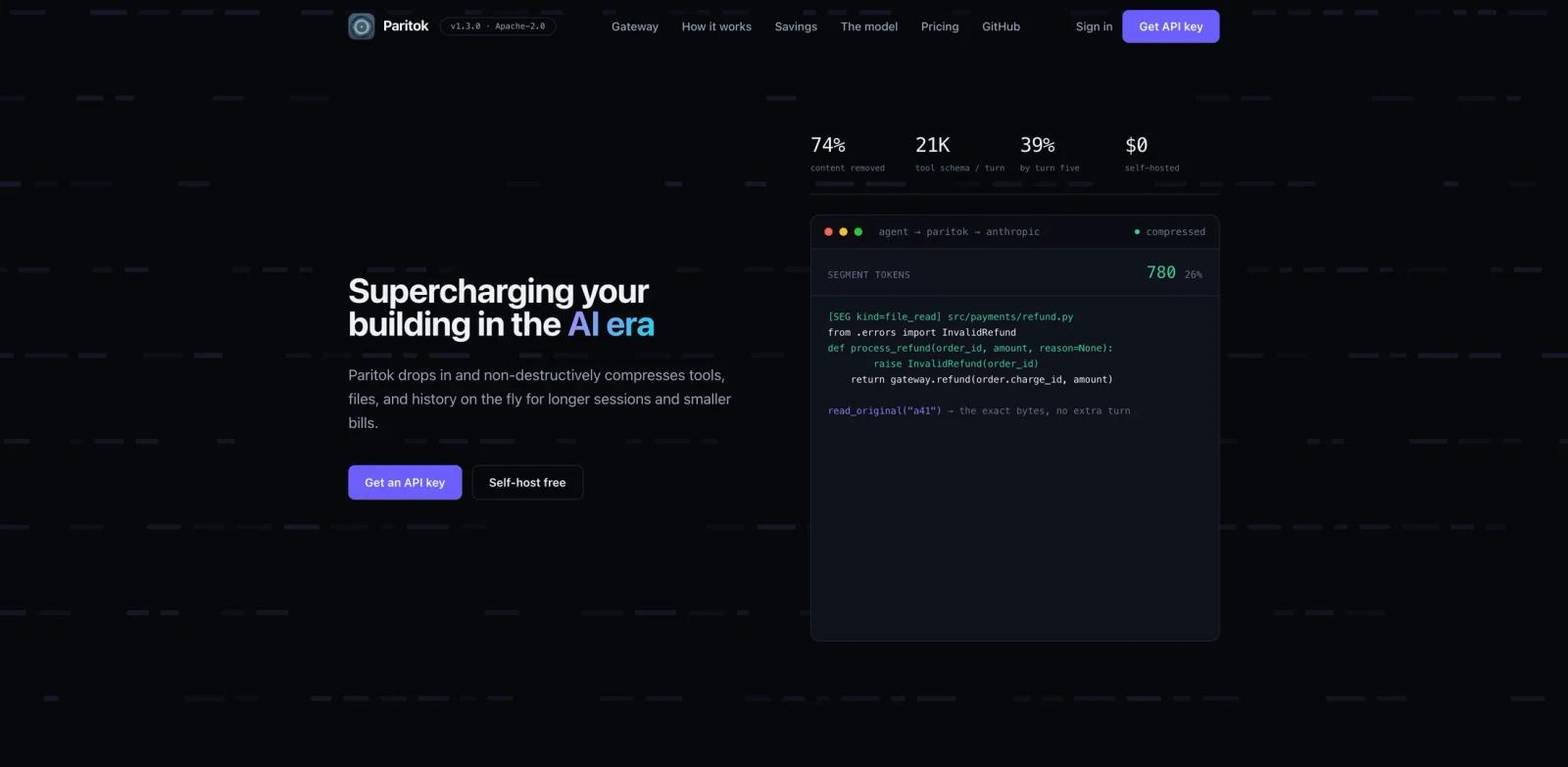
Paritok is an open-source compression gateway for AI coding agents. It sits between an agent and the upstream LLM provider, rewrites the request before it is billed, and sends the model a smaller version of tools, files, tool output, and older conversation history.
The official GitHub README describes Paritok as a non-destructive gateway: compressed segments are tagged, and the agent can call read_original to recover the exact original bytes when needed. That matters because coding agents need identifiers, paths, error strings, and file context to remain accessible even when most of the prompt is compressed.
Paritok is relevant for developers using Claude Code, Cursor, Codex, OpenHands, and other BASE_URL-compatible agents. It belongs near AI agent infrastructure rather than generic summarization tools, because its main use case is reducing token overhead in long, tool-heavy coding sessions.
Key Features
Drop-in agent proxy - Point compatible agents at Paritok instead of the provider endpoint, then forward compressed requests to Anthropic, OpenAI, or another upstream provider.
Tool-schema filtering - Semantically keeps relevant tool definitions and stubs the rest, reducing repeated tool schema blocks on every turn.
Code-native content compression - Uses a 4B compression model trained on coding-agent trajectories to shrink file reads, tool output, and stale history.
Recoverable context - Tags compressed content with references so agents can pull exact original bytes back through
read_originalwhen precision matters.Local or hosted deployment - Self-host the Apache-2.0 gateway and model, or use Paritok's hosted GPU endpoint for managed compression.
Coding-agent compatibility - Official materials mention Claude Code, Cursor, Codex, OpenHands, OpenAI-compatible agents, and BASE_URL-respecting clients.
How to Get Started
The fastest self-hosted path is the Python package. The GitHub README lists pip install "paritok[proxy]", then paritok up to pull the model and start the proxy. Users then set environment variables such as ANTHROPIC_BASE_URL=http://127.0.0.1:8080 or configure the agent's endpoint so traffic passes through Paritok.
Start with a low-risk coding session before routing production work through any proxy. Verify that the agent can call the provider, inspect /health and /stats, and test whether compressed context still preserves the files, errors, and tool results your workflow depends on.
Teams already studying MCP vs A2A protocol comparison should treat Paritok as a context and cost layer, not as a replacement for tool protocols. It helps reduce repeated prompt overhead while agents still call their normal tools.
Pricing & Plans
Paritok has two deployment paths. Self-hosting is free under Apache-2.0, including the gateway, 4B model, and training scripts. The official site says the self-hosted stack runs on the user's own hardware with no telemetry, key, or platform fee.
The hosted GPU option is listed at $0.30 per 1M tokens processed, with hosted compression free until the end of August 2026 during launch. Hosted usage removes the need to run a GPU locally but still requires users to keep their own upstream model provider accounts and API keys.
Best For
- Developers running long Claude Code, Codex, Cursor, or OpenHands sessions
- Teams with many MCP tools or large repeated tool schemas
- Engineers auditing large repositories, logs, diffs, and tool outputs with coding agents
- Cost-conscious users paying premium input-token rates
- Agent infrastructure teams that want a self-hostable context compression layer
FAQ
What is Paritok?
Paritok is a compression gateway for AI coding agents. It rewrites request context before it reaches the upstream LLM provider.
Is Paritok open source?
Yes. The official site and GitHub repository describe the gateway and 4B model stack as Apache-2.0.
Which agents work with Paritok?
Official materials mention Claude Code, Cursor, Codex, OpenHands, and any agent that respects a configurable base URL or OpenAI-compatible upstream.
How does Paritok save tokens?
It filters tool schemas, compresses file reads and tool outputs, and summarizes older history once the context budget fills.
Can agents recover compressed content?
Yes. Paritok tags compressed segments and provides read_original so the exact original bytes can be retrieved when needed.
How much does Paritok cost?
Self-hosting is free. Hosted GPU compression is listed at $0.30 per 1M tokens processed, with hosted usage free until the end of August 2026.