

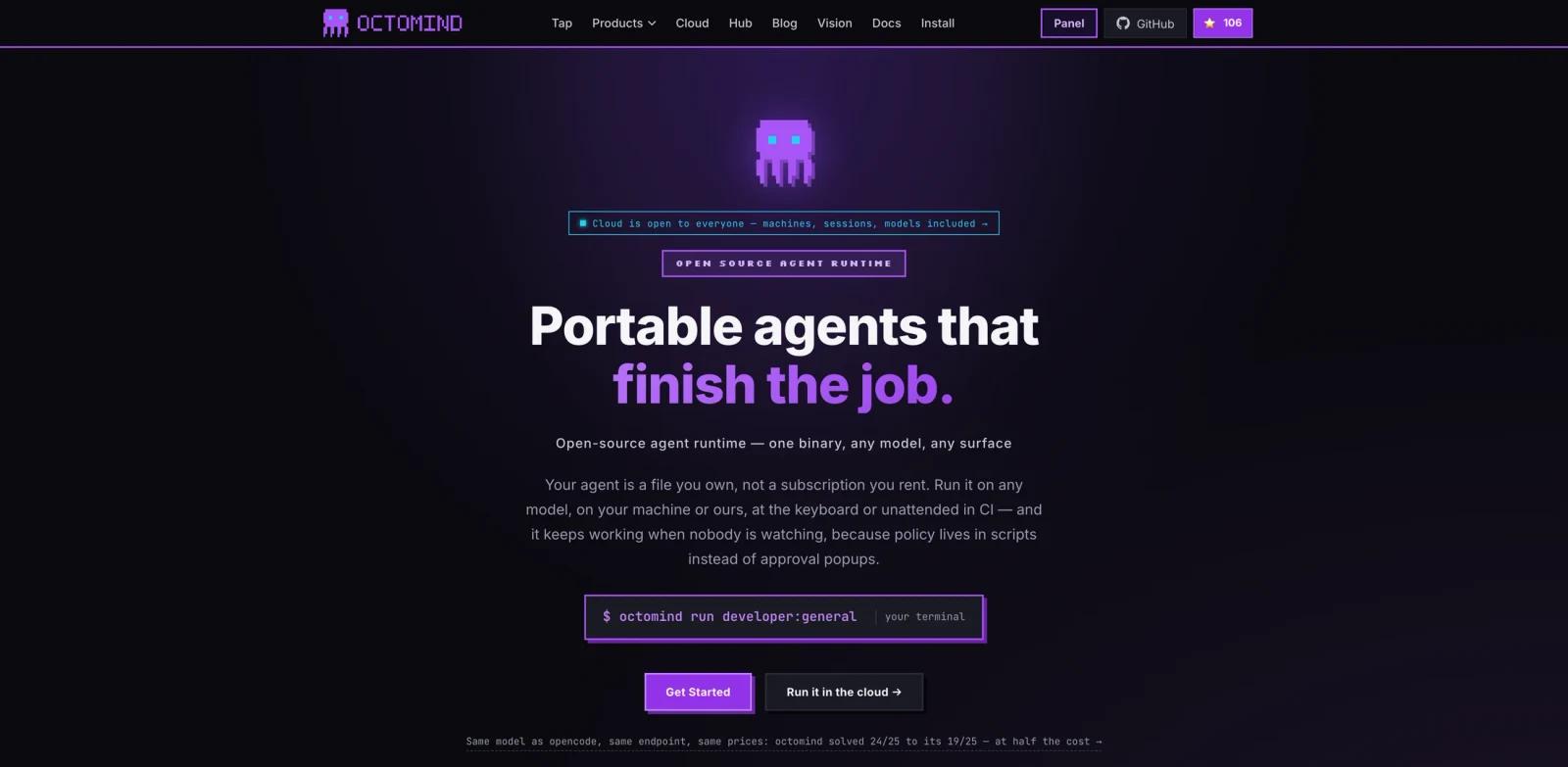


Overview
Octomind is an open-source agent runtime for running portable AI agents from the terminal, CI jobs, cloud sessions, dashboards, and other agent systems. Its core idea is that an agent should be a file you own rather than a subscription-bound chat session. The runtime packages model choice, tools, prompts, policies, and workflows into a portable setup that can move across machines.
The official site describes Octomind as Apache-2.0, one binary, any model, and any surface. Users can run an interactive terminal agent, pipe tasks through JSONL, keep a background session alive, expose a WebSocket server, or use ACP so another agent can call Octomind as a sub-agent.
For developers comparing AI code generator tools, Octomind is less about code completion and more about the harness around long-running agent work: model swapping, guardrails, budget caps, compression, session review, and repeatable agent files.
Key Features
Portable agent files - Agents are defined in TOML with models, tools, prompts, and guardrails, making them readable, forkable, and commit-friendly.
Any-model support - Official materials list providers such as OpenRouter, OpenAI, Anthropic, Google, DeepSeek, Bedrock, Cloudflare, Ollama, and more.
Mid-session model switching - Users can change models during a session when a provider is rate-limited, expensive, or not strong enough for the current step.
Guardrails as code - Policies live in TOML as pre-call guards, post-result hooks, and post-turn validators instead of relying only on approval popups.
Hard spending caps - Per-request and per-session budgets can stop, warn, or fall back before an unattended agent creates unexpected model bills.
Adaptive compression - The runtime keeps long sessions useful by preserving decisions, errors, and file references while dropping less important context.
How to Get Started
Octomind can be installed with Homebrew on macOS, an install script, Cargo, or from source. The quick path is to install the binary, run octomind login if you want hosted model access, and start with octomind run developer:general.
For a controlled first test, avoid production write access. Use Octomind to inspect a small repository, generate a review summary, draft tests, or analyze a non-sensitive issue. Then add guardrails before giving it file-write permissions, shell tools, deploy commands, or external services.
Teams that already use AI agent systems can treat Octomind as a specialized sub-agent runtime. ACP support makes it possible for a larger orchestrator to call Octomind, while local review commands make sessions easier to audit after the work finishes.
Community & Ecosystem
Octomind is Apache-2.0 and hosted on GitHub. The project also connects to the broader Muvon ecosystem, including Tap, Hub, Panel, Octocode, Octobrain, Octofs, Octolib, OctoHub, and Octoweb.
The official site highlights a registry of specialists and workflows, including developer, DevOps, legal, finance, security, research, launch, and deep-review patterns. That makes Octomind closer to a runtime plus agent library than a single-purpose coding assistant.
Users evaluating memory and context systems such as MemOS may find Octomind's file-based agent definitions and adaptive compression especially relevant, because both products treat agent state as an operational design problem.
Pricing & Plans
The Octomind runtime is open source under the Apache-2.0 license and can run standalone with your own provider keys. The official site also says Octomind Cloud is open to everyone with a free tier, no card required, machines, sessions, and models included.
| Option | Price | Best fit |
|---|---|---|
| Open-source runtime | Free, Apache-2.0 | Users running Octomind locally or self-hosting with their own keys |
| Octomind Cloud free tier | Free tier, no card required | Users who want hosted machines and models without managing keys at the start |
| Provider usage | Varies | BYO OpenRouter, OpenAI, Anthropic, Google, DeepSeek, Bedrock, Ollama, or other providers |
Because cloud and model pricing can change, teams should confirm current limits, included usage, and paid tiers directly before relying on hosted runs for production workflows.
Best For
- Developers who want portable agents that can run from a terminal, CI job, or cloud machine.
- Teams building unattended AI productivity workflows with hard budgets and auditable sessions.
- Agent infrastructure builders who care about model routing, compression, and policy-as-code.
- Users who want to compare Claude Code, Codex, OpenCode, and custom agent runtimes on real repository tasks.
- Technical teams that prefer open-source infrastructure and bring-your-own-provider control.
FAQ
What is Octomind?
Octomind is an open-source portable agent runtime. It runs file-defined agents across terminals, scripts, background sessions, cloud environments, and other agent systems.
Is Octomind open source?
Yes. The official site lists Octomind as Apache-2.0 and links to the GitHub repository.
Which models can Octomind use?
Official materials mention OpenRouter, OpenAI, Anthropic, Google, DeepSeek, Bedrock, Cloudflare, Ollama, and other providers.
Can Octomind run in CI?
Yes. Octomind supports non-interactive structured runs, background sessions, workflows, guardrails, and budget caps, which makes it suitable for CI-style automation when permissions are scoped carefully.
Does Octomind require its cloud?
No. The runtime can run standalone with your own provider keys. Cloud is an optional hosted path with a free tier according to the official site.
How is Octomind different from an AI coding assistant?
An AI coding assistant usually focuses on one interface. Octomind focuses on the runtime around agents: portable config files, provider switching, policy hooks, budgets, compression, and repeatable workflows.