



Overview
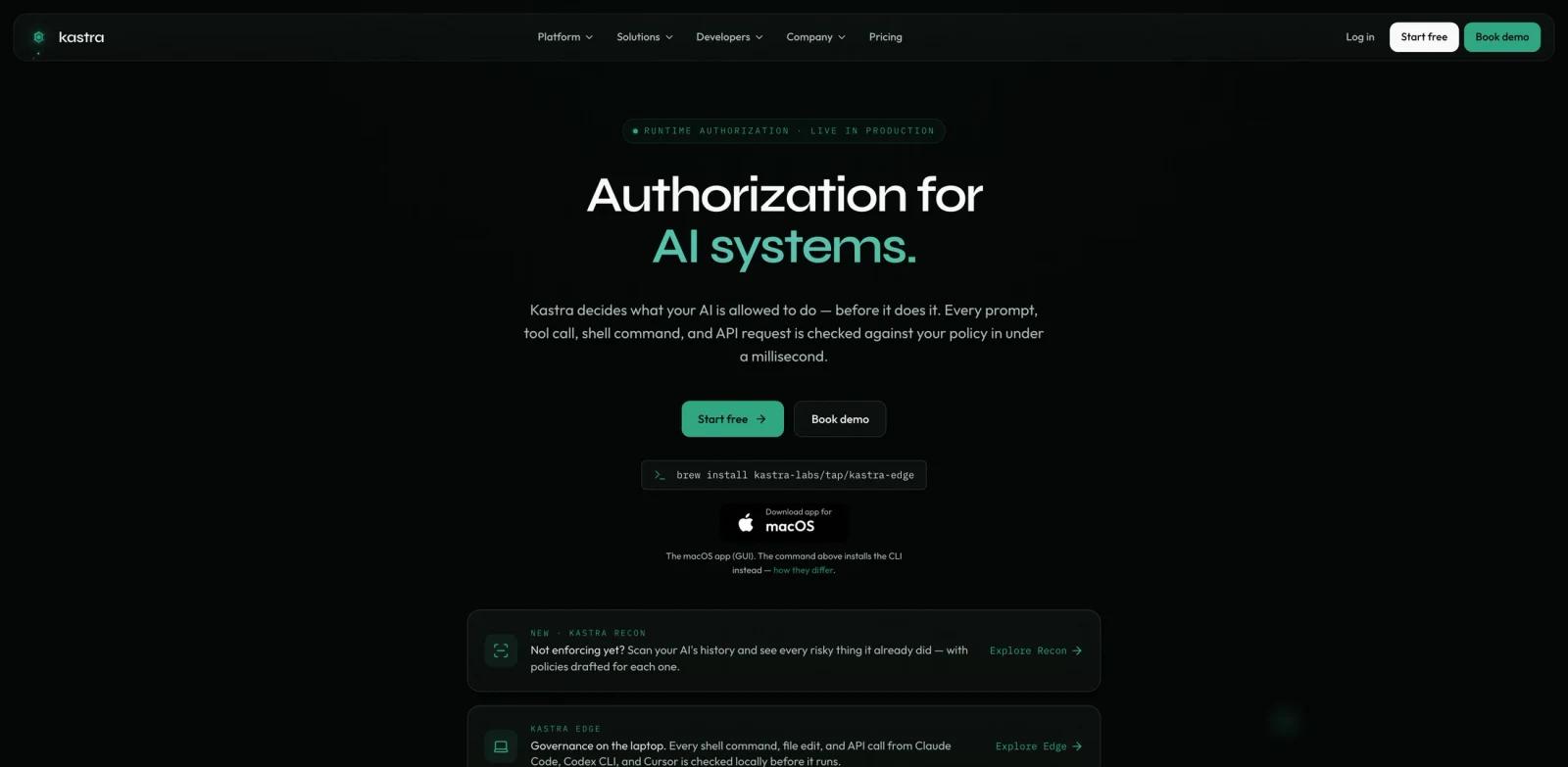
Kastra is a runtime authorization layer for AI systems. Its official site describes a simple control point: decide what agents, models, and tools are allowed to do before they do it. That makes Kastra different from observability tools that only inspect what happened after the agent has already touched files, shell commands, APIs, or production systems.
The product is aimed at teams putting AI agent workflows into real environments. Kastra can sit in front of actions from agent runtimes, AI tools, local command execution, and platform integrations, then apply policy decisions with an audit trail. Its messaging emphasizes sub-millisecond policy decisions, cryptographic audit trails, and zero implicit trust.
For ToolWorthy readers, Kastra is most relevant when coding agents, MCP-enabled tools, or internal assistants move from demos to operational workflows. A personal agent can be restarted when it makes a mistake. A team agent that can edit files, run commands, or call internal systems needs runtime policy.
Key Features
Runtime authorization - Evaluates what an agent, model, or AI tool is allowed to do before the action executes.
Local enforcement with Kastra Edge - Official materials describe local AI enforcement for actions that should not depend on a distant control plane.
Recon and policy context - Kastra includes Recon and Edge across tiers, giving teams both visibility and enforcement surfaces.
Cryptographic audit trails - Records action decisions in a way designed to support accountability and later review.
Developer integration paths - The docs describe installation and operation across CLI, API, MCP, SDKs, and platform references.
Agent governance focus - Targets AI agent security and runtime enforcement rather than general identity management alone.
How to Get Started
Start with one narrow agent workflow that already has meaningful risk. Good pilots include shell commands from a coding agent, write access through an MCP server, deployment steps, data export tools, or internal admin actions.
Define a small policy set first: which commands are allowed, which file paths require approval, which tools are blocked, and which actions require audit. Then run the workflow in observation mode, compare expected and actual decisions, and tighten the policy before giving agents wider access.
Teams comparing protocol-level tooling should also review what Model Context Protocol is and the MCP vs A2A protocol comparison. Kastra does not replace those protocols; it adds a runtime authorization layer around what the connected agents and tools are allowed to do.
Pricing & Plans
Kastra's pricing page says teams can start free, scale to team, and move to enterprise when they need dedicated infrastructure. It also says every tier includes Recon and Edge.
The public pricing page does not list a specific self-serve paid price in the materials reviewed for this page. Buyers should confirm limits, team features, dedicated infrastructure, support, and enterprise terms directly with Kastra before planning production rollout.
Best For
- Engineering teams deploying Claude Code, Codex, Cursor, OpenClaw, or similar agents into controlled environments
- Security and platform teams that need policy checks before shell, file, API, or tool execution
- Organizations adopting AI data governance practices for agentic workflows
- Teams that need auditable agent decisions rather than only prompt guidance
- Builders of internal AI workflow generator systems with sensitive downstream actions
FAQ
What is Kastra?
Kastra is an authorization layer for AI systems. It decides what agents, models, and AI tools are allowed to do before they act.
What does Kastra protect?
It is designed for agent actions such as tool use, model-driven operations, local enforcement, and workflows where AI systems can affect real resources.
Does Kastra support local enforcement?
Yes. Official materials describe Kastra Edge as local AI enforcement.
Does Kastra work with MCP?
Kastra's docs mention CLI, API, MCP, SDKs, and platform references, so MCP is part of the integration surface described publicly.
Is Kastra free?
Kastra's pricing page says users can start free. Specific public paid prices were not listed in the materials reviewed for this page.
Who should use Kastra?
Kastra is best for teams giving AI agents meaningful permissions and needing runtime policy, approval, and audit controls.