
Best AI Career Coach Tools: Choose by Career Bottleneck
Compare AI career coach tools by the career bottleneck they actually solve: exploration, a career pivot, job-search execution, market signal, or interview rehearsal.

On this page
The label AI career coach covers products that are not substitutes. One helps you decide what kind of work to pursue. Another turns a chosen target into resumes and applications. A third rehearses spoken answers. LinkedIn adds labor-market and network context that a standalone chatbot does not possess.
The useful question is therefore not “Which tool has the most features?” It is “Which career decision is blocked right now?” Start there, then choose the narrowest tool that can produce evidence for the next decision. Pricing and plan limits below were checked on September 17, 2026; verify the checkout page before paying because these are volatile.
Start With the Career Bottleneck, Not the Tool List
| Your current bottleneck | Start with | What it should produce | Do not expect it to prove |
|---|---|---|---|
| You do not know which paths fit | CareerVillage Coach or Kickresume | A shortlist of roles and questions to investigate | That a suggested career will satisfy you in practice |
| You are considering a serious pivot | Modern Compass | A constraint-aware transition hypothesis and small experiments | That leaving your current role is financially or personally safe |
| You know the target but the search is chaotic | Teal or Careerflow | A tracked pipeline, tailored materials, and follow-up actions | That generated wording is true or persuasive to a specific recruiter |
| You lack market and network signal | LinkedIn Career Insights | Current openings, connections, demand clues, and role-specific context | That platform recommendations are complete or unbiased |
| Interviews are the bottleneck | Yoodli | Repeated spoken practice and delivery feedback | That its feedback predicts interviewer judgment |
| You need reflection, drafts, or practice prompts | ChatGPT | A structured first pass using your own context | Live labor-market truth or accountable professional advice |
The lanes overlap at the edges. Kickresume can help with applications as well as exploration; Modern Compass can generate application materials; Careerflow includes mock interviews. The routing above reflects the strongest reason to buy each product, not every feature it offers.
If You Do Not Yet Know What Career to Pursue
This lane is about exploration. The output should be a set of plausible paths, the assumptions behind them, and a plan to gather real-world evidence. A long list of occupations is not a decision.
CareerVillage Coach
CareerVillage Coach organizes career readiness into more than 30 guided activities for career exploration, skill development, education planning, and job preparation. Its learner dashboard recommends modules using a learner’s stated goals and interests instead of presenting a blank chat box.
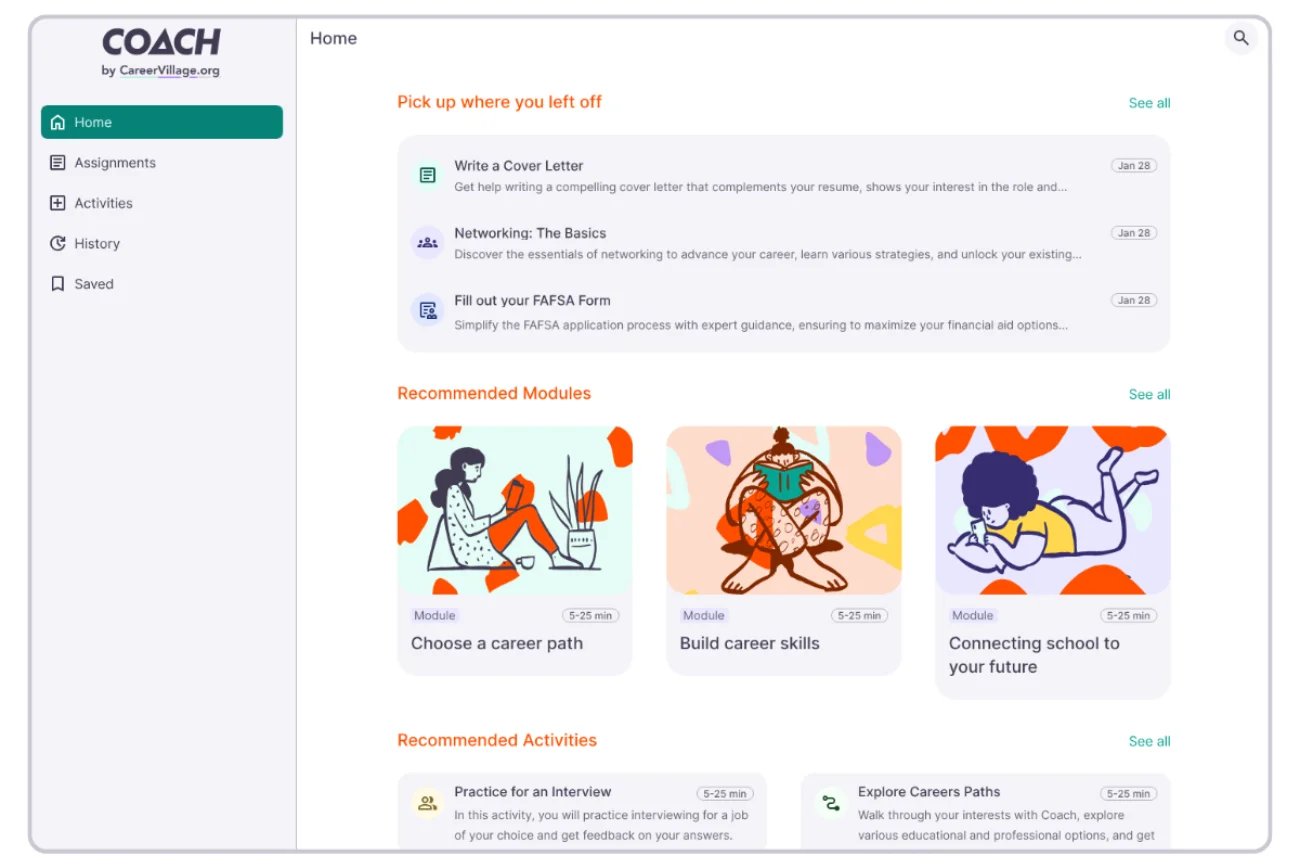
That makes it a structured starting point for students, early-career users, and access-focused programs. The product is free to try, and CareerVillage describes it as a free AI career advisor. Public materials do not specify a consumer message cap or paid individual upgrade, so the useful test is whether the activity sequence converts broad uncertainty into two or three paths worth validating.
The persistent artifact is the activity trail inside the dashboard: goals and interests influence what appears next. CareerVillage also says institutional educators can review learner chat history and progress. That can be useful for supported programs, but it changes the privacy boundary. The public documentation reviewed for this article does not establish a learner export flow or a Coach-specific deletion timeline. Avoid entering sensitive health, immigration, financial, or family details until you have checked the controls for your account or cohort.
Skip it when: you already know the role and need a high-volume application tracker, detailed networking workflow, or specialist spoken-interview analysis. Its breadth is useful for orientation, but breadth is not evidence that every recommendation fits your location, constraints, or labor market.
Learn more about CareerVillage Coach’s activity model and learner dashboard.

Kickresume takes a document-first route. Career Map starts from a resume plus a short questionnaire about goals, salary expectations, and preferred lifestyle, then shows possible roles, salary and outlook information, current and missing skills, openings, and links into application materials. Its separate Online Career Coach analyzes a resume against a target role and proposes a gap-closing plan.
Choose this exploration route when you already have work history that can anchor the map and want to move quickly into resumes, cover letters, or interview questions. Career Map offers limited free access, while full map access and the Online Career Coach sit behind Premium. Current US pricing is $24 month-to-month, $54 per quarter, or $96 per year, with a 14-day money-back guarantee. The free plan still includes four basic resume templates and unlimited downloads, so you can test the document workflow before paying for the broader career layer.
Kickresume autosaves documents in its cloud workspace and supports PDF or Word export. That makes the resume artifact portable even if the career-map logic is not. The public sources reviewed here do not establish whether Career Map reasoning, questionnaire answers, or coaching history can be exported or how those AI inputs are used beyond the general privacy policy. Verify that boundary before uploading a resume with an address, phone number, or other unnecessary personal data.
Skip it when: you need ongoing reflective coaching, market/network data, or a program administrator’s view of learner progress. A generated path is a hypothesis; validate it through conversations, current job descriptions, and a small project before investing in a major transition. Compare the application layer in the AI resume builder decision guide or browse the AI resume builder category.
Learn more about Kickresume Career Map, Online Career Coach, and current plans.
| If you are choosing between them | CareerVillage Coach | Kickresume |
|---|---|---|
| Starting input | Goals, interests, and guided career-readiness activities | Existing resume plus a career-preference questionnaire |
| Decision artifact | Activity-led exploration and questions to investigate | A role map connected to skills, openings, and application artifacts |
| Free validation | Free to try; no public individual usage cap found | Limited Career Map access plus free document creation and export |
| Payment trigger | No consumer paid trigger documented | Full Career Map and Online Career Coach access |
| Choose it when | You need structure before you have a credible shortlist | You have usable work history and want exploration to flow into applications |
For either product, the trial passes only if it narrows uncertainty. Keep the two or three paths that survive a conversation with someone doing the work and a review of five current job descriptions. Reject the tool if it only produces a larger, more flattering occupation list.
If You Need to Choose or De-Risk a Career Pivot
A pivot is not one decision. It combines identity, transferable skills, household constraints, market demand, and the cost of experimentation. The right tool should help you state those constraints and turn a vague desire to leave into testable options.
Modern Compass
Modern Compass connects an AI coaching conversation with assessments, a career profile, goals, job analysis, application tracking, and generated documents for mid-career decisions. The product says Coach Maya uses the profile, goals, job history, and applications across conversations rather than treating every prompt as a fresh session.
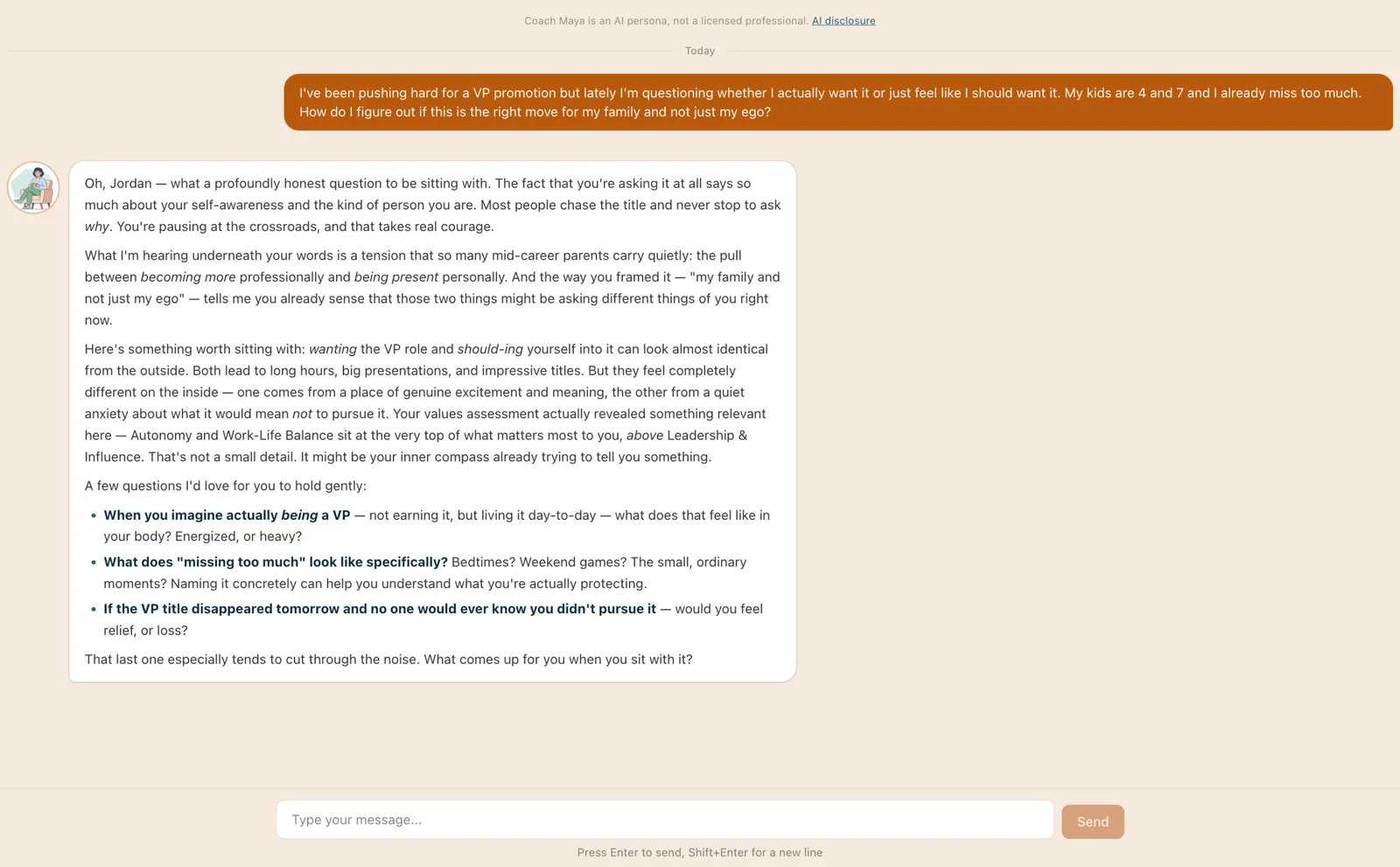
Its best fit is someone asking whether the problem is the role, environment, trajectory, skills, relationships, or compensation. The workflow moves from a five-dimension Career Quick Check and values work to goals, job analysis, and eventual application materials. That is a better match for a pivot than starting with a resume rewrite.
The free tier currently includes two resume analyses, three job-match analyses, one sample resume, 15 coaching messages per month, and up to five active goals or applications. A $5.99 one-job Application Kit bundles tailored documents and a mock-interview scorecard. Premium is $119 per year, advertised as $9.92 per month, with a five-day card-required trial and a 30-day refund policy. Pay only after the free messages show that cross-session context improves the decision rather than merely extending the conversation.
Modern Compass says data is encrypted, not sold or shared, and that its commercial Anthropic and Google API arrangements do not use conversations for model training. Those are vendor statements, not an independent security audit. The reviewed public pages do not make export of coaching history clear, so keep the pivot hypothesis and experiment plan in a document you control.
Skip it when: you mainly need current openings and warm introductions, or when the decision carries legal, mental-health, immigration, disability, or major financial stakes. Those require qualified human advice.
Learn more about Modern Compass’s mid-career workflow, connected resume workspace, and current plans.
The trial should end with a one-sentence pivot hypothesis, the assumptions that would make it fail, and one reversible experiment for the next two weeks. Interview two people in the target role, rewrite one project as a transferable-skills case study, or complete a small work sample. If the product cannot move you from reflection to external evidence, it is becoming a journaling loop.
If You Know the Target and Need Search Execution
Once the target role is reasonably stable, execution becomes the bottleneck: saving jobs, tailoring truthful materials, tracking stages, and following up. Career-exploration features matter less than workflow continuity.

Teal centers the active search around a resume builder, job tracker, browser extension, job-description analysis, contacts, and follow-up actions. Its tracker stores the full job description, notes, status, dates, contacts, and the exact resume version used for each application.
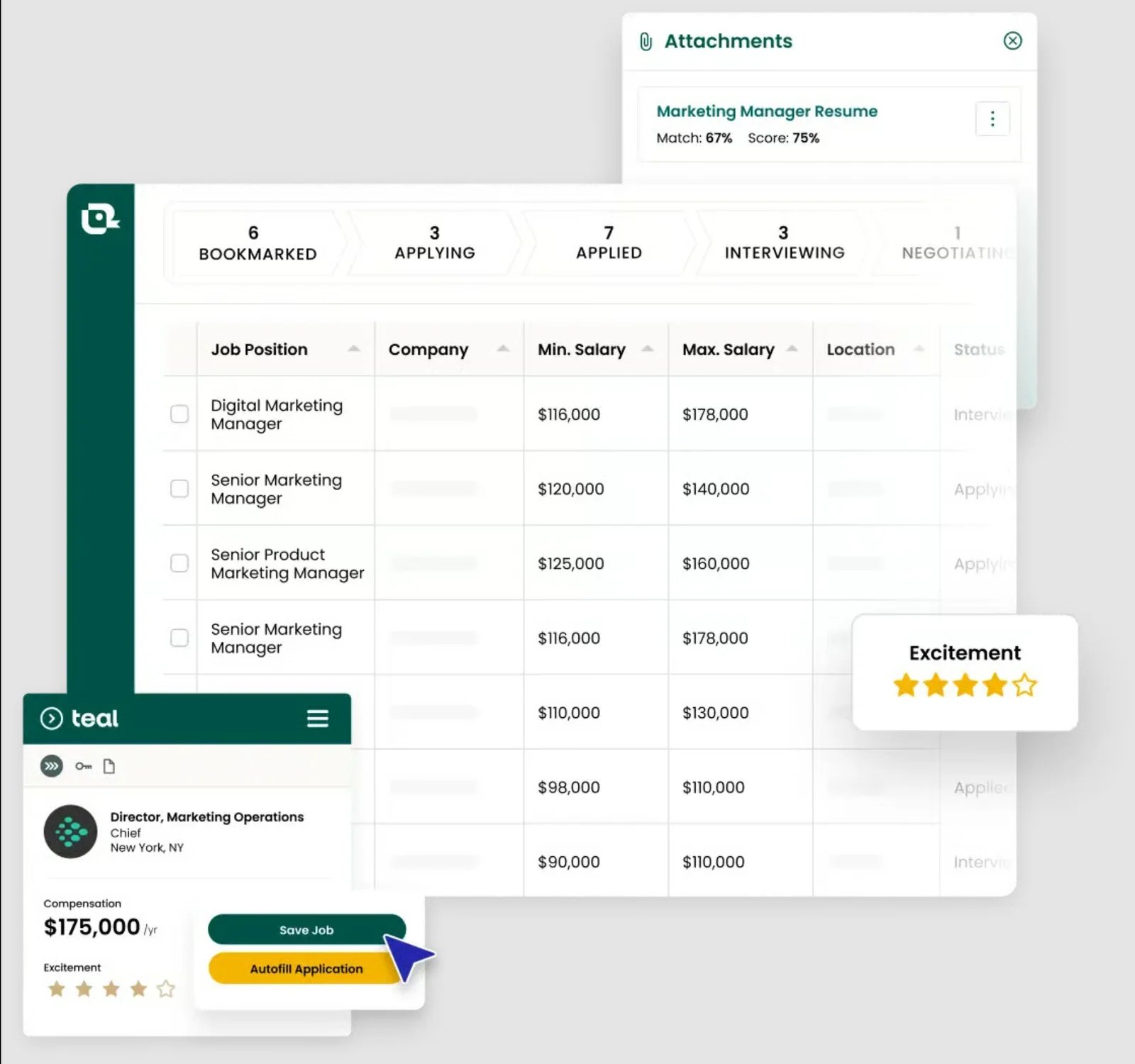
Choose Teal when you need one operating system for a search and want each saved role connected to tailored material and next actions. Free access currently includes unlimited resumes and job tracking, ten templates, basic analysis, the top five job-description keywords, and limited AI credits. Teal+ costs $13 every seven days, $29 every 30 days, or $79 every 90 days. There is no general paid-plan trial; the free credits are the evaluation route and require no card.
The payment trigger is depth and volume: unlimited keyword matching, advanced analysis, design controls, templates, email templates, and AI generation. The free tracker is enough to test the core behavioral question: will you maintain job state and follow-ups in this workspace? Teal documents tracker export, PDF resume export, user ownership of submitted content, and account deletion. Its terms say deletion or anonymization from active systems can take up to 30 days, subject to limited retention reasons.
Skip it when: you still do not know the target role, or when your main problem is networking access rather than application organization. Do not let keyword suggestions introduce skills, scope, or results that you cannot defend in an interview. The ToolWorthy Teal review provides the product-level follow-up.
Learn more about Teal’s tracker workflow, free-versus-paid limits, and data controls.
Careerflow
Careerflow combines a job tracker and networking CRM with resume, LinkedIn-profile, browser-extension, contact, and mock-interview tools. The tracker uses a Kanban-style workflow for jobs, tasks, notes, contacts, reminders, and application status.
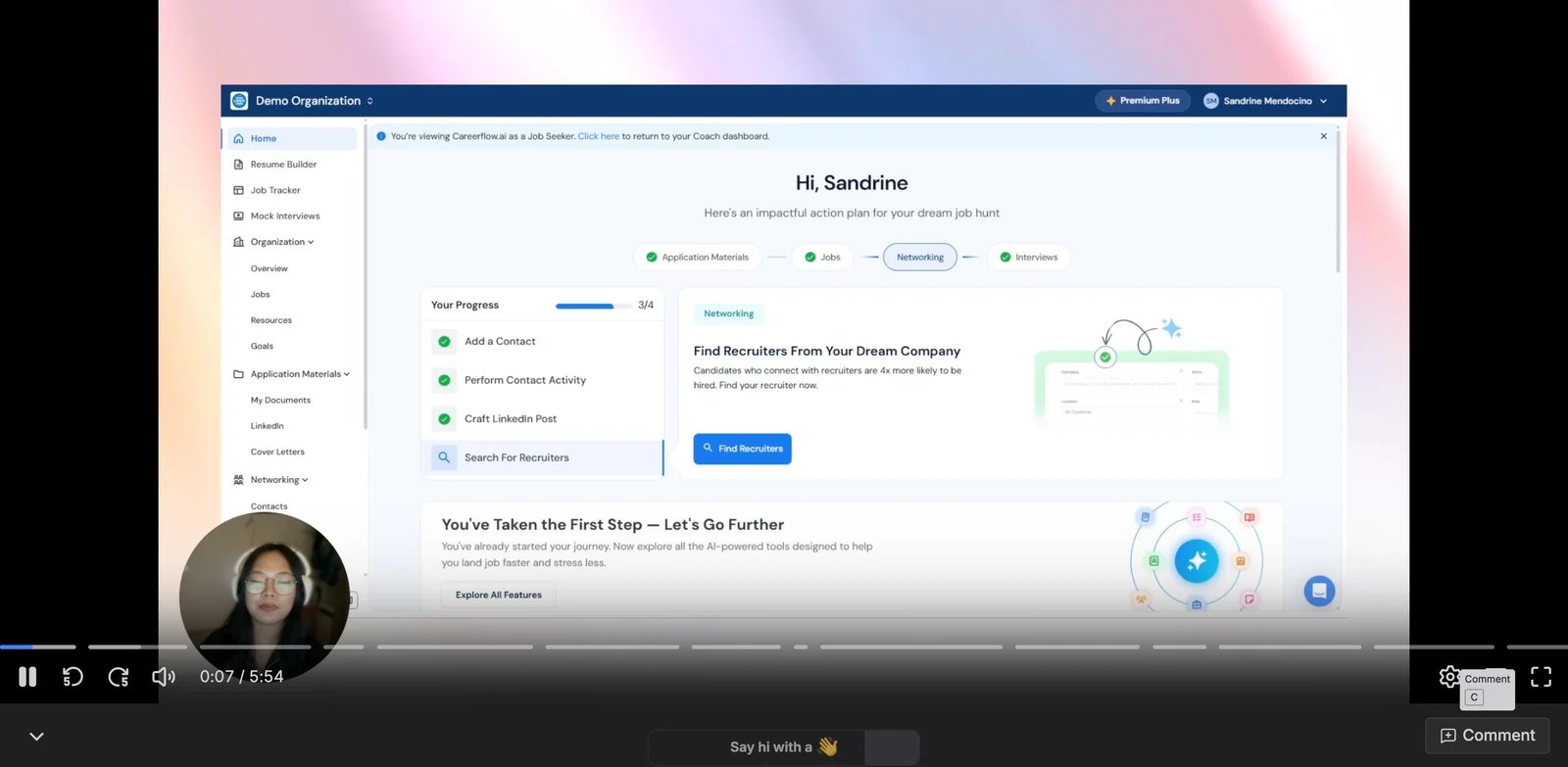
Choose it when LinkedIn positioning and networking follow-through are first-class parts of the search. Careerflow’s public Premium page lists $8.99 weekly and $23.99 monthly entry points, with quarterly and annual billing also advertised. Payment unlocks unlimited AI resumes, advanced resume and LinkedIn optimization, cover letters, and broader automation; mock interviews sit in Premium Plus.
There is one material plan ambiguity. Careerflow’s current FAQ says the free Job Tracker has no job-count limit, while its help-center comparison says free accounts track up to ten jobs and reserve networking contacts for paid plans. Treat the in-account paywall as authoritative and verify it before migrating a large tracker. That inconsistency itself is a reason to test with ten real jobs before paying.
Careerflow says resume and job-search data is encrypted in transit and at rest, is not sold, and is not shared with employers without explicit consent. It documents account deletion from settings or through support, processed within 30 days. Its help center also documents a full Job Tracker export to Excel, including titles, companies, statuses, dates, notes, and other saved details. That makes portability testable rather than an unknown, although you should still confirm the export captures any custom fields you depend on.
Skip it when: you need career exploration or a rigorous pivot decision before execution. A broad toolkit can reduce tab switching, but it cannot decide which target is worth pursuing. Compare the broader lane in the AI job application tools guide.
Learn more about Careerflow’s tracker, plan boundary, Excel export, and privacy controls.
| Execution decision | Teal | Careerflow |
|---|---|---|
| Persistent state | Jobs, stages, full descriptions, notes, contacts, follow-ups, and linked resume versions | Jobs, Kanban status, tasks, notes, contacts, reminders, resumes, and LinkedIn workflow |
| Free proof of fit | Unlimited resumes and job tracking; limited matching and AI | Free core, but official sources conflict between unlimited tracking and a ten-job cap |
| Main payment trigger | Unlimited matching, analysis, templates, email templates, and AI generation | Unlimited AI documents, advanced LinkedIn optimization, networking, and automation |
| Distinctive reason to choose | Documented job-to-resume continuity and tracker export | Networking CRM and LinkedIn positioning in the same suite |
| Exit/data boundary | Tracker report export, PDF resumes, documented deletion | Full tracker export to Excel and account deletion documented |
Run ten real roles through the free workflow. The test passes if every role has a saved description, fit rationale, correct resume, next action, and follow-up date without a parallel spreadsheet. It fails if maintaining the tool creates more switching or duplicate entry than it removes.
If Market Signal and Human Access Are Missing
Standalone coaching products can help you think, but they do not own the professional graph or the live inventory of openings. If you cannot tell where demand exists or who can interpret a role, add a market-and-network layer.
LinkedIn Career Insights
LinkedIn Career Insights can show companies with the most new postings for a role in the previous seven days, first- or second-degree connections with relevant experience, people actively hiring, courses, events, and a personalized career goal. Full lists for some insights require Premium, and availability varies by plan, language, region, and rollout. LinkedIn does not publish one stable global checkout price, so verify the price shown to your account.
This route is useful when a career hypothesis needs external signal: which companies are posting, which people may explain the work, and which skills recur. Its output is a market sample and a contact list, not a neutral census. Platform ranking can reflect LinkedIn’s inventory and personalization rather than the whole labor market.
The privacy boundary is also different from a standalone coach. LinkedIn says AI features can use profile and account context, may send query text to Bing for some web-backed results, and retain AI conversation activity while the account remains active. It provides controls to view or delete saved AI activity. Do not paste confidential employer information or private third-party details into a career query.
Skip it when: you want private reflection, an independent whole-market view, or certainty that ranking represents every opportunity. No public, stable Career Insights UI suitable for this article was available without depending on a member’s plan and rollout, so a screenshot would risk presenting an account-specific state as universal.
Learn more about LinkedIn Career Insights, AI insight data use, and generative-AI activity controls.
The trial passes if you can name three employers with current demand, two informed people to contact, and one assumption about the role that changed. It fails if you only collect recommended jobs without learning why demand or fit differs across them.
If the Interview Is the Bottleneck
Interview practice is a performance loop: answer aloud, review, revise, and repeat. Text-only coaching can help structure a story, but it cannot observe delivery from a recording.

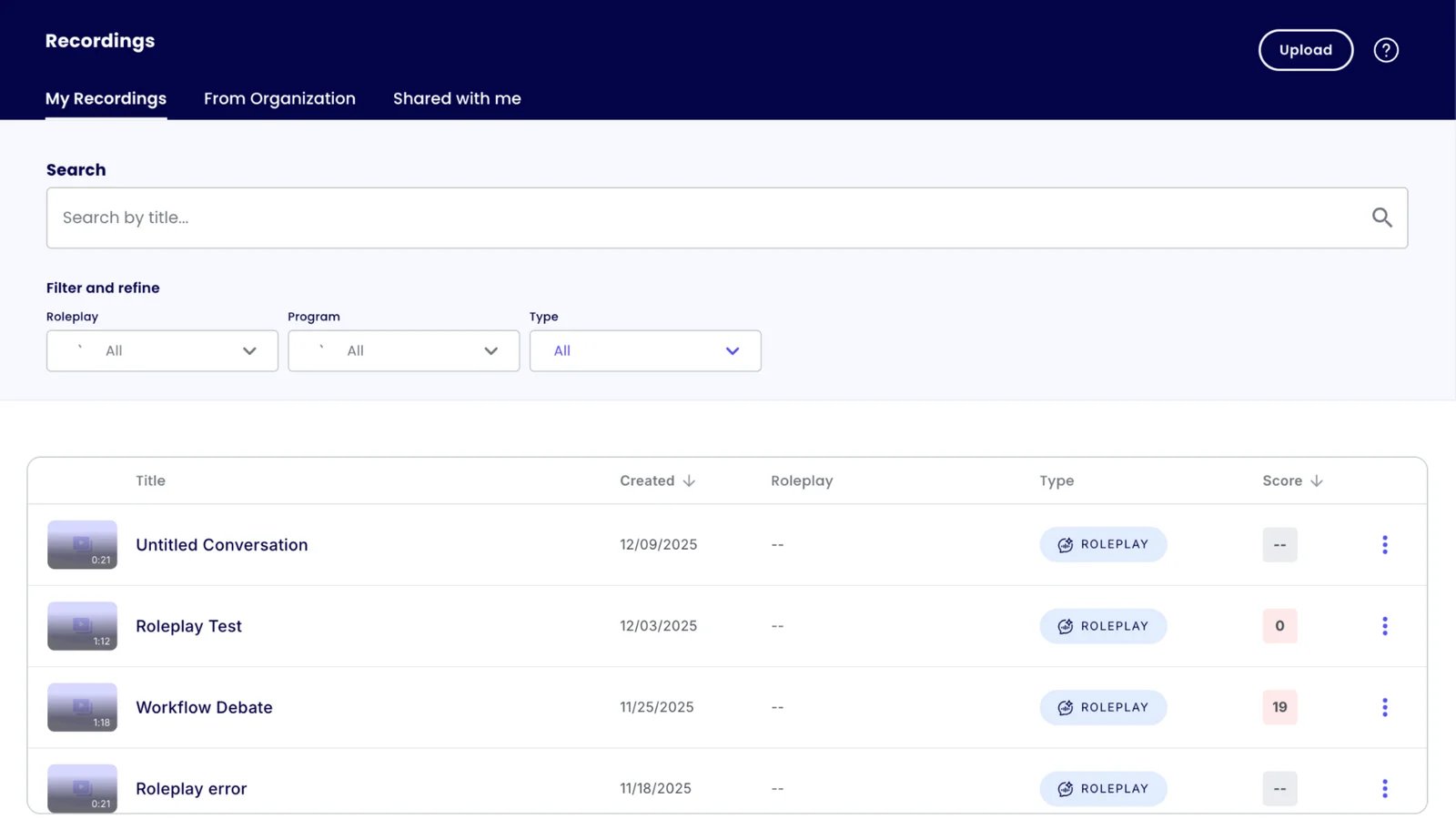
Yoodli provides interview and communication roleplays with recorded sessions, a reusable library, and feedback on spoken delivery. The practice flow lets you set the role and company, choose interviewer demeanor and questions, respond to dynamic follow-ups, then save the session by opening its analysis.
Choose it when you already receive interviews but struggle with pace, concision, filler words, or responding under pressure. The Starter plan includes five lifetime roleplays longer than 30 seconds. Pro is $8 per month when billed annually and allows up to ten roleplays per week. Advanced is $20 per month when billed annually and adds unlimited roleplays plus default exclusion of roleplay data from AI training.
That last distinction matters because recordings contain voice, face, answers, and employer context. Yoodli says Starter and Pro session data may be used to improve the platform, while Advanced, Team, and Enterprise exclude roleplay data from AI training by default. The Recording Library supports download and deletion; account deletion has a three-day grace period before permanent deletion. Automatic one-, seven-, or 30-day recording retention is plan- or organization-dependent and can keep analytics after recordings and transcripts are removed.
Skip it when: the real problem is weak role fit, missing examples, or insufficient employer research. Delivery analytics cannot repair an answer with no evidence, and a score cannot tell you whether a particular hiring panel will value the style it rewards. The ToolWorthy Yoodli review is the product-level follow-up.
Learn more about Yoodli interview practice, recording controls, and current individual plans.
Use the five free sessions as a controlled test. Record the same high-value answer at least twice. Continue only if the second attempt shows a repeatable behavioral improvement—clearer structure, less rambling, better pacing—without flattening the answer into generic phrasing. Reject the tool if only the score moves or if you spend more time gaming metrics than strengthening evidence.
When ChatGPT Is Already Enough
ChatGPT can support a useful first pass when you bring the facts and retain judgment. OpenAI’s job-seeker guidance presents it as a tool for understanding a role, linking experience to requirements, drafting truthful bullets, and practicing questions while the person or coach stays in charge.
Use ChatGPT before buying a specialist product when you need to:
- turn a messy work history into themes and follow-up questions;
- compare two already-defined career options against explicit constraints;
- draft interview questions and rehearse one answer at a time;
- create a weekly job-search checklist; or
- critique wording while you verify every factual claim.
Projects can keep related chats, files, and instructions together. Memory can retain useful context across conversations when enabled, but it is not the same as an application tracker or validated assessment. Free access is enough to test this baseline. In the US, ChatGPT Go is $8 per month and Plus is $20 per month; limits and included models change, so pay for capacity only after you identify a real usage constraint.
Career histories and resumes are sensitive. ChatGPT lets signed-in users turn off model improvement, export account data, delete chats, and use Temporary Chat. Deleted chats are scheduled for removal within 30 days subject to stated exceptions. Saved memories are stored separately from chat history, so deleting a chat alone may not remove a remembered detail; review both memory and chat controls.
Move to a specialist tool when: you need proprietary market/network context, durable application stages, a structured assessment, program administration, or recorded roleplay analytics. Move to a human when the decision needs accountability, emotional nuance, a real network, regulated advice, or judgment about a high-cost irreversible choice.
OpenAI Academy’s job-seeker guide, Projects documentation, and Memory FAQ describe that baseline.
What These Products Are Not Substitutes For
None of these tools is a licensed counselor, therapist, immigration lawyer, financial adviser, or recruiter who owes you a response. An AI coach can make options legible; it cannot accept responsibility for the outcome.
Use a qualified human when the decision includes mental-health symptoms, workplace discrimination or retaliation, visa status, disability accommodations, contractual restrictions, severance, or a financial runway that would be dangerous to estimate incorrectly. Use people in the target field to validate what the work is really like and which signals hiring managers trust.
AI tools are also weak substitutes for relationship building. A generated networking message may save time, but the value comes from a real person sharing context, opening a door, or challenging an assumption. Keep outreach specific and honest.
What Desk Research Cannot Verify
Desk research can confirm documented features, current plan shapes, public data controls, and the workflow each vendor promotes. It cannot verify which tool will improve your career outcome.
This review does not establish:
- the accuracy of a career recommendation for your background;
- resume response rates or job-offer lift;
- the quality of coaching over weeks of repeated use;
- whether assessments are valid for a specific population;
- interview-feedback agreement with human interviewers;
- bias across demographic groups, occupations, languages, or regions;
- undocumented export behavior or account-specific paywalls; or
- current reliability inside a logged-in account.
Research comparing AI and human coaching also supports keeping the scope narrow: an AI coach can form a useful working interaction, but broad professional judgment and human context remain separate questions. Treat every recommendation as a hypothesis that needs external evidence.
A peer-reviewed study comparing AI and human coaching discusses working alliance and the value of narrow coaching focus.
A Five-Day Trial Plan
Use one five-day window to test the lane you actually need. Do not run every product.
- Day 1 — Name the bottleneck and baseline. Write the decision, the evidence that would change it, and how you handle the task today.
- Day 2 — Produce the lane artifact. Create a two- or three-path shortlist, a pivot hypothesis, a ten-role tracker, a market-and-contact map, or a recorded interview answer.
- Day 3 — Test persistence. Return without rebuilding context. Check whether the tool remembers the right goals, job state, document version, or prior practice—not merely whether it retains text.
- Day 4 — Add external signal. Ask a person in the field, inspect current openings, or compare the output with an authoritative source. Remove fabricated or unsupported claims.
- Day 5 — Apply the kill criterion. Continue only if the product changed the next action: the shortlist narrowed, the pivot became falsifiable, workflow switching fell, market assumptions changed, or spoken performance improved on a repeat attempt.
Keep the artifact in a format you control. Compare a second product only after the first fails for a named reason. Encouraging conversation, a higher vendor metric, or more generated text is not enough to justify payment.
Final Decision
For broad exploration, start with CareerVillage Coach; choose Kickresume when you have a resume and want exploration connected quickly to application artifacts. For a mid-career pivot, Modern Compass offers a documented reflection-to-plan workflow, but it should earn payment by producing a falsifiable hypothesis and an external experiment.
For an active search, choose Teal for documented job-to-resume continuity and export, or Careerflow when networking CRM and LinkedIn positioning are central—after confirming its current free tracker limit and testing whether the Excel export preserves the fields you use. Add LinkedIn Career Insights when market and relationship data are missing. Use Yoodli when spoken interview performance is the bottleneck and its repeat-practice feedback changes behavior.
Start with ChatGPT when the work is still reflection, drafting, or basic rehearsal and you can supply the context yourself. Buy a specialist tool only when you can name the missing data, workflow state, portable artifact, or feedback loop it adds—and define the result that would make you stop paying.
Get ToolWorthy Weekly
New AI tools, practical guides, and selected AI signals in one weekly brief.
For AI tool founders
Built a tool that belongs in this decision set?
Request an editorial evaluation for possible inclusion in ToolWorthy.
Submit your tool for reviewPaid submission does not guarantee a ranking, recommendation, inclusion, or editorial outcome.