
6 Best Ahrefs Alternatives in 2026 — Choose by Switching Route

The best Ahrefs alternative depends on what you are actually replacing. Choose SE Ranking when you want the closest researched one-suite move and value a documented Ahrefs migration path. Choose Semrush when a broader marketing and AI-search ecosystem matters more than lowering the bill. Choose Serpstat when you still want an integrated suite at a lower entry price and can manage several usage pools. Choose Ubersuggest only for a small, bounded portfolio. Choose Screaming Frog plus Google Search Console when owned-site crawl and performance evidence matter more than third-party competitive research. Choose DataForSEO when you want to build and retain your own data layer.
Do not switch simply because another pricing page looks cheaper. First identify the Ahrefs projects, keyword lists, rank history, crawl settings, exports, reports, alerts, API jobs, and AI prompt sets that must survive. If those assets are already valuable and your real problem is a plan limit, changing the Ahrefs tier may be cheaper than rebuilding the workflow. For the anchor product's broader capabilities and commercial context, see the Ahrefs product profile.
The Short Answer
| Your actual switching job | Best path | What changes | First trial question |
|---|---|---|---|
| Preserve a suite and move rank-tracking history | SE Ranking | Direct replacement with an explicit Ahrefs migration route | Did the migrated project retain the tags, locations, and history you use in weekly decisions? |
| Replace Ahrefs with a broader marketing platform | Semrush | Direct suite, different packaging, more workspace rebuilding | Can one live project reproduce the reports and research loop your team actually uses? |
| Keep an integrated suite with a lower entry price | Serpstat | Direct suite with multiple quota pools | Do your real searches, rank checks, audits, and exports stay inside one plan? |
| Cover one small portfolio at low monthly cost | Ubersuggest | Lighter workflow with hard capacity and automation ceilings | Does a normal week fit without trimming keywords, crawls, competitors, or exports? |
| Replace only owned-site audit and performance work | Screaming Frog + Google Search Console | Workflow change; competitor databases are intentionally dropped | Can this stack answer the decisions you make most often without a third-party index? |
| Own the pipeline, storage, and interfaces | DataForSEO | Workflow change from SaaS workspace to API infrastructure | Is the engineering and monitoring burden lower than the value of the control you gain? |
These are different buying routes, not six interchangeable products. If you are still exploring the market without Ahrefs as the incumbent, the broader best AI SEO tools guide and AI SEO category own that discovery job.
Before You Leave Ahrefs, Decide What Must Survive
Ahrefs is not one feature. A mature workspace can contain competitor domains, backlink investigations, keyword lists, rank projects with tags and locations, Site Audit configuration and history, exports feeding spreadsheets, report templates, alerts, API or MCP automations, and AI-visibility prompt sets. A replacement can advertise the same feature names and still fail the switch because the saved artifacts do not move.
The current Ahrefs commercial baseline also changes by tier. Starter is $29 per month with 200 monthly credits, one unverified project, unlimited verified projects, and no additional users. Ahrefs lists Lite at $129, Standard at $249, and Advanced at $449 per month, with annual billing advertised as saving up to 17%. Lite remains credit-metered, while current Standard and higher plans use unlimited per-user credits subject to usage terms. Plan limits also vary across projects, history, tracked keywords, crawl pages, users, exports, API or MCP access, and AI-prompt checks. Check the live Ahrefs plan table, Starter terms, and credit policy immediately before purchase.
That creates three distinct reasons to stay:
- The problem is the tier, not the product. Compare the cost of a plan change with the labor and overlap period required for a migration.
- Your evidence depends on Ahrefs-specific history. Pricing pages cannot show whether another provider's backlink, keyword, or traffic estimates are equivalent for your market.
- The workspace is already an operating system. Rebuilding tags, alerts, exports, dashboards, and review routines can cost more than the subscription difference.
Run a switch only when a repeated constraint is material: credits interrupt normal research; seat-adjusted economics no longer work; Ahrefs' weekly self-serve rank tracking is too slow; required history or API access forces an expensive tier; owned-site evidence makes a large third-party index unnecessary; or an explicit migration path reduces the risk of losing rank history.
Route 1: Replace Ahrefs With One Broad SEO Suite
SE Ranking, Semrush, and Serpstat are the three direct alternatives retained after research. They cover overlapping SEO jobs, but their economics and migration paths differ enough that one global ranking would hide the decision.
| Direct suite | Current entry shape | Tracking and crawl shape | Migration reality | Best reason to shortlist |
|---|---|---|---|---|
| SE Ranking | Core $129/month; Growth $279/month | Core includes 2,000 daily tracked keywords and 250,000 audit pages per month; Growth raises both | Official Ahrefs migration covers projects, keywords, tags, locations, and ranking history; other artifacts still need validation | You want a one-suite move and rank-history continuity is material |
| Semrush | SEO $139/month; Semrush One Starter $199; Pro+ $299; Advanced $549 | 5/5/15/40 monitored websites and 500/500/1,500/5,000 daily tracked keywords across the four current tiers | Keyword-file imports are documented; a full Ahrefs project-history migration was not verified | You want a broader ecosystem and accept workspace rebuilding |
| Serpstat | Individual $497/year; Team $929/year | Individual includes 10,000 rank checks and 30,000 audit pages; Team raises limits and adds API/MCP | No Ahrefs-specific project or rank-history migration was established | You want lower entry economics and can model several quota pools |
SE Ranking: The closest researched one-suite switch
SE Ranking is the first direct route to trial when the goal is to preserve a suite rather than redesign the workflow. Its current Core plan is $129 monthly and includes 10 projects, one seat, 2,000 daily tracked keywords, 100 daily AI prompts, 250,000 audit pages per month, API credits, and MCP. Growth is $279 monthly and raises capacity, adds collaboration, and includes project-lifetime history. SE Ranking also advertises a 14-day no-card trial. The official subscription page is the authority for current limits.
The migration difference is more important than the feature list. SE Ranking documents an Ahrefs import for projects, keyword lists, tags, location settings, and ranking history, and advertises assisted migration with annual subscriptions. Its migration guide defines the documented boundary. That can preserve the evidence used in weekly rank reviews. It does not prove that Ahrefs lists, backlink-monitor history, Site Audit history, dashboards, alerts, or every report configuration will arrive intact.
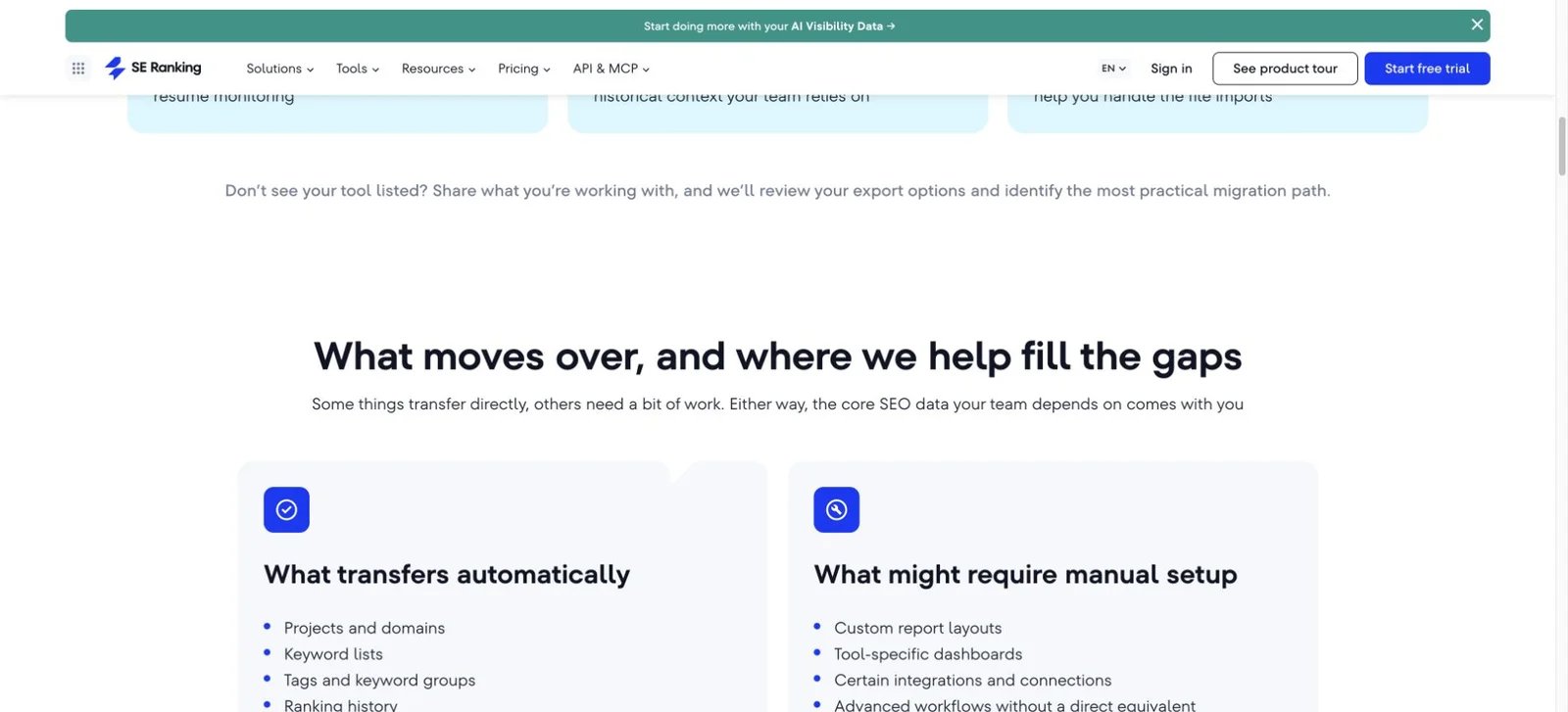
Use the SE Ranking product profile as a product-level starting point, then test one representative project. Import the project, choose a fixed keyword and location sample, and compare the historical timeline, current ranks, competitor set, crawl findings, and exports. Continue only if the migration preserves the artifacts that drive decisions, not merely the project name.
Skip SE Ranking when Ahrefs backlink or keyword coverage is decisive and you cannot run a matched parallel test. A documented migration path reduces operational risk; it does not establish database equivalence.
Semrush: For a broader ecosystem, not a cheaper clone
Semrush makes sense when the switch is toward a wider marketing platform. Its current monthly plan surface lists SEO at $139, Semrush One Starter at $199, Pro+ at $299, and Advanced at $549. Across those four tiers, it lists 5, 5, 15, and 40 monitored websites and 500, 500, 1,500, and 5,000 daily tracked keywords. Starter, Pro+, and Advanced include 50, 100, and 200 daily AI prompts respectively; API integration is listed for Advanced. A seven-day trial is advertised. Verify the current SEO plus AI plan table immediately before purchase.
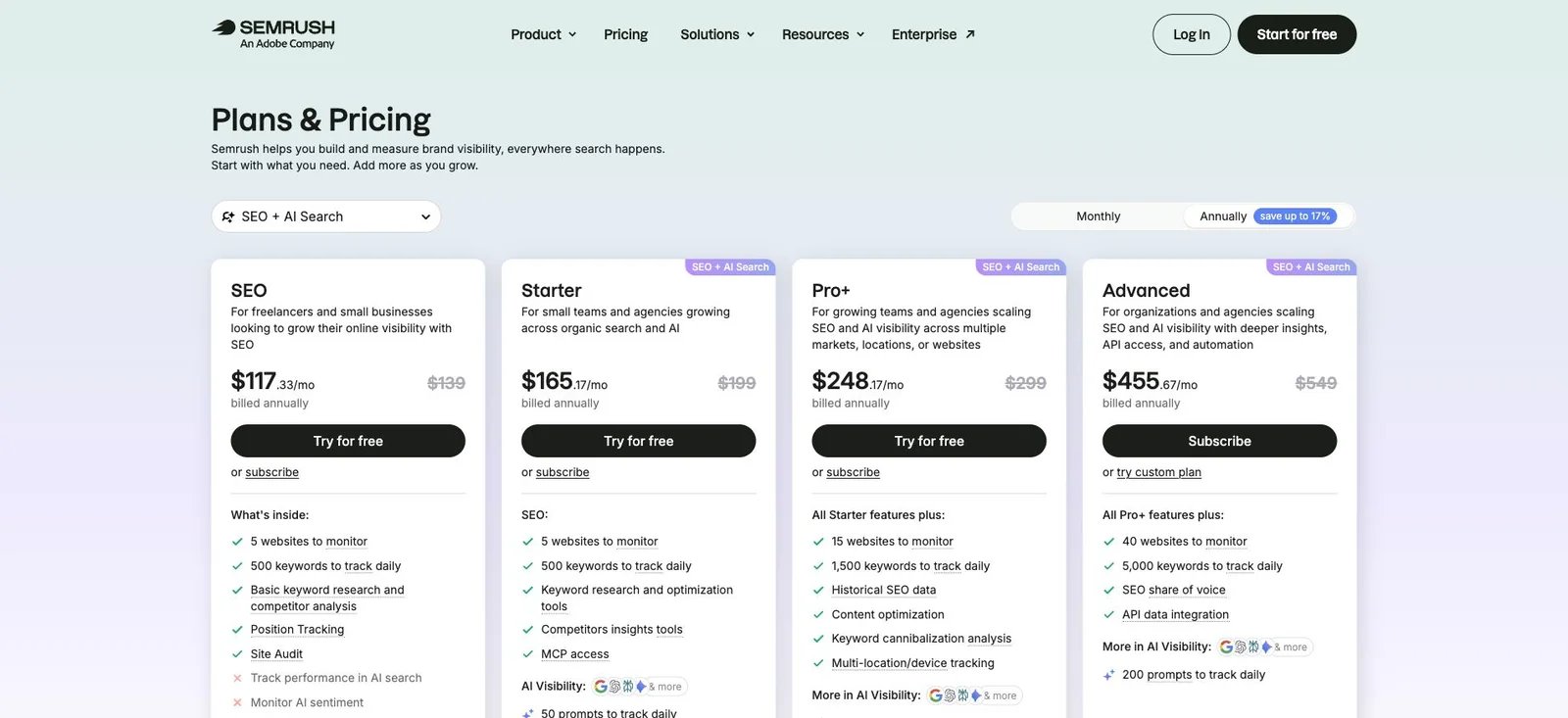
The strongest case is consolidation: competitor research, backlink work, audit, daily tracking, and a wider set of marketing tools can live in one ecosystem. The weak case is "Semrush is the cheaper Ahrefs." At comparable professional tiers, price alone may not improve, and mature Ahrefs projects still need rebuilding.
Semrush documents CSV or TXT keyword imports and tagged-keyword imports for Position Tracking. The official import instructions do not establish a complete import of Ahrefs project history, audit history, backlink monitoring, lists, or report layouts. Trial one client or business unit with a fixed weekly deliverable. If the replacement requires analysts to reconstruct too much context before each review, the wider toolkit is not an operational gain.
Skip Semrush when the only goal is a lower bill, or when full project-history continuity is a hard requirement.
Serpstat: For a lower-cost suite with quota planning
Serpstat retains the all-in-one model while lowering the advertised entry price. Annual pricing lists Individual at $497 and Team at $929. Individual includes five projects, 100 daily site, keyword, or link searches, 10,000 rank checks, and 30,000 audit pages. Team adds unlimited projects, collaboration, higher limits, API, and MCP. Serpstat's plan table defines those pools, while its API documentation covers domain, keyword-rank, backlink, and site-audit data.
The trade-off is operational: one lower headline price can conceal several independent usage pools. A consultant may fit the rank-check allowance but exhaust daily research queries; a content team may fit projects but outgrow audit pages. Before switching, map one normal month of Ahrefs activity into Serpstat's units.
The Serpstat product profile provides product context. In the trial, rebuild one project, reproduce a recurring competitor or keyword report, audit the same site scope, and export the result. Treat the migration as unproven until the project, history, tags, and outputs required by your process have been inspected.
Skip Serpstat when you need simple unlimited research, a proven history migration, or an assumption of Ahrefs-equivalent data depth without a benchmark.
Route 2: Use a Lighter Suite Only for a Bounded Portfolio
Ubersuggest: For a small, bounded portfolio
Ubersuggest is attractive when the workload is genuinely small. Monthly pricing lists Individual at $29, Business at $49, and Enterprise at $99. The product covers familiar categories such as keyword research, competitor research, rank tracking, site audit, and AI prompts, but plans impose limits on projects, tracked keywords, crawls, competitors, exports, and AI use. Its current plan matrix lists rank tracking and Site Audit on a weekly cadence. The current pricing FAQ says there is no API-access plan.
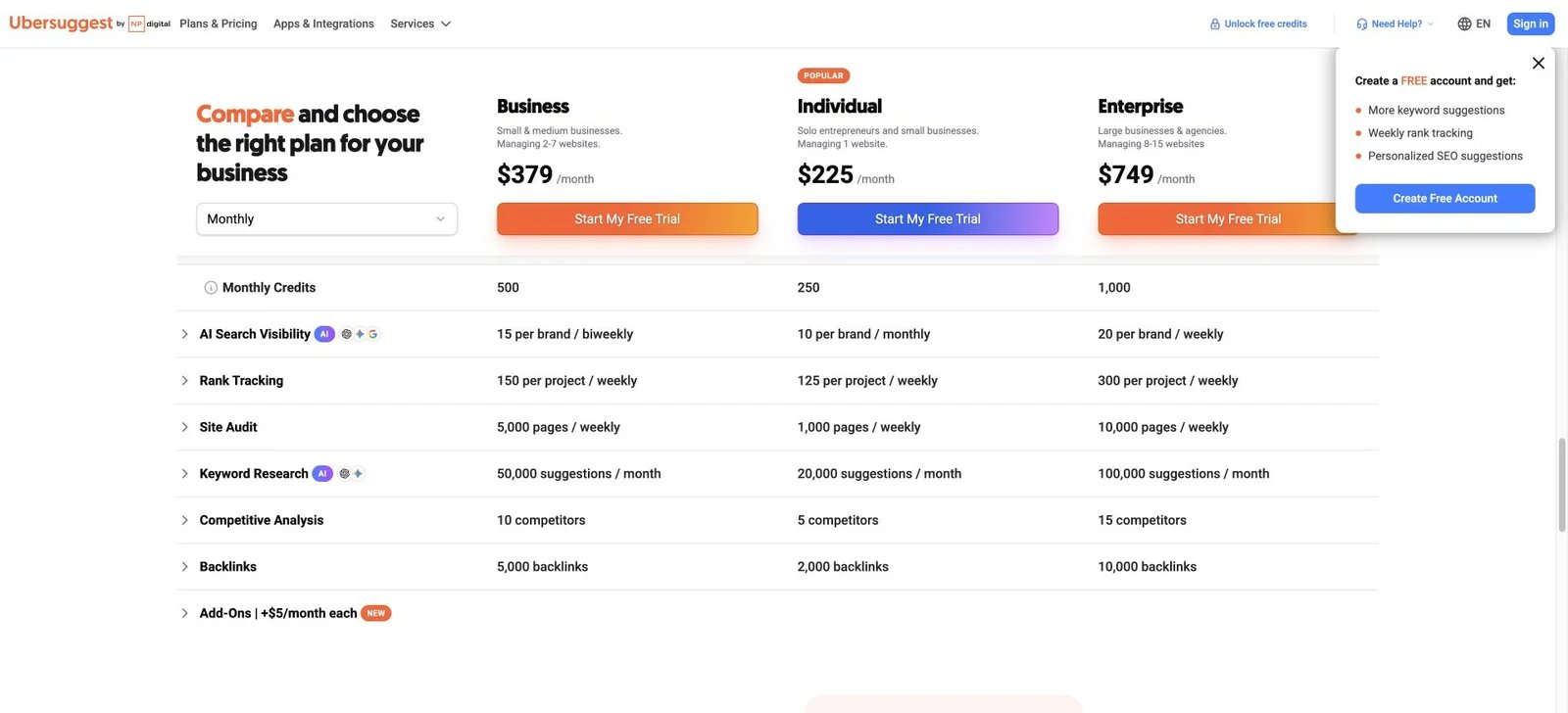
That makes Ubersuggest a near substitute, not a compressed Ahrefs clone. It can fit a solo operator running a few sites with bounded reporting needs. It becomes a poor fit when a portfolio grows, daily tracking is required, crawls are large, exports are frequent, or downstream automation depends on an API.
Trial it by replaying one ordinary week. Add the actual projects, keywords, competitor domains, crawl scope, and exports you use—not a demo-sized sample. The test passes only if the workflow fits without rationing the work that matters.
Skip Ubersuggest for multi-client operations, high-volume exports, large rank sets, large crawls, or API-driven reporting.
Route 3: Replace Only the Owned-Site Jobs
Screaming Frog SEO Spider + Google Search Console: For owned-site evidence
This route changes the job rather than replacing the suite. Screaming Frog SEO Spider handles a controlled technical crawl; Google Search Console supplies first-party clicks, impressions, queries, and pages for sites you own. Together they can cover many recurring audit and performance decisions without paying for a broad competitive-research workspace.
Screaming Frog's free version crawls up to 500 URLs. A paid license is £199 per user per year and unlocks saved crawls, custom configuration, JavaScript rendering, crawl comparisons, and integrations. Prices can render in another currency, so use the official regional pricing page for checkout. Search Console is the evidence source for verified properties, but it is not a third-party competitor keyword or backlink database; Google's performance report documentation defines its owned-property scope.
This is the right route when most decisions concern indexability, templates, internal linking, technical changes, and observed Google performance. It is the wrong sole replacement when you still need competitor keyword discovery, external backlink research, packaged market estimates, or integrated AI-search visibility.
The trial should reproduce a real monthly review: crawl the same production scope, export the issues that become tickets, retrieve the same Search Console date window, and assemble the report decision-makers receive. Price the analyst time required to join and retain those artifacts. A cheaper software stack can still be an expensive process.
Route 4: Own the Data Layer
DataForSEO: For an API-first data layer
DataForSEO is a workflow change for technical teams. It supplies SEO data through APIs with pay-as-you-go pricing and a $50 minimum payment instead of a turnkey per-seat workspace. A July 2026 pricing update removed previous $100 monthly commitments for the Backlinks and LLM Mentions APIs and moved them to pay-as-you-go access. Read the live pricing and the July 2026 change notice together.
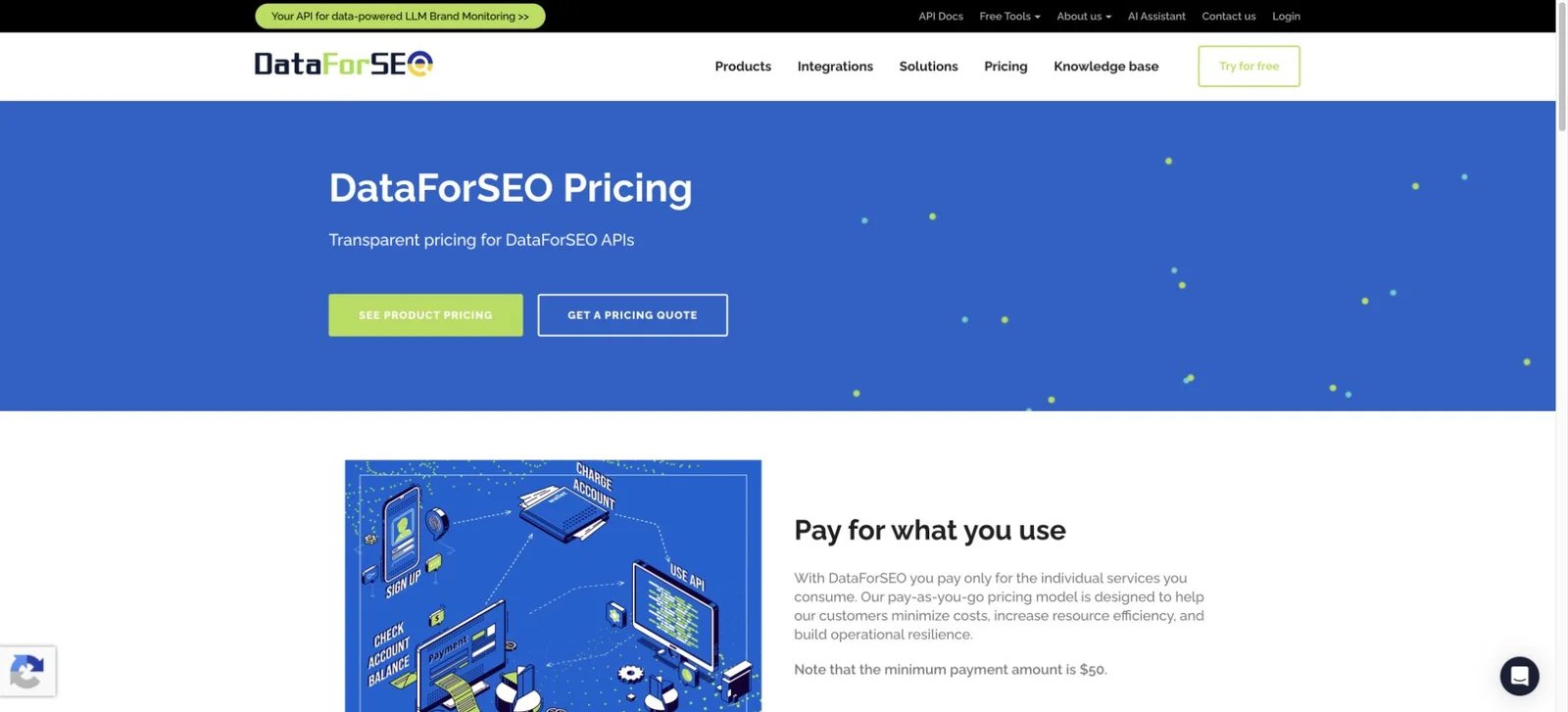
The gain is control: choose the endpoints, retention model, scheduling, database, BI layer, and interfaces; avoid per-seat workspace dependence; and keep historical snapshots in your own system. The loss is the Ahrefs application itself—projects, lists, alerts, reports, permissions, and analyst-ready interfaces must be built or assembled.
Do not compare the $50 minimum with an Ahrefs subscription and call the difference savings. Estimate endpoint volume, retries, storage, orchestration, dashboards, monitoring, engineering maintenance, and the value of the time analysts spend without a finished workspace. The trial passes when one complete recurring decision can run reliably from collection through report delivery.
Skip DataForSEO when the desired outcome is a low-effort SaaS replacement. It is an infrastructure purchase.
What Pricing Pages Cannot Tell You
Desk research can verify plans, published limits, documented capabilities, commercial terms, and migration instructions. It cannot establish that two vendors return equivalent backlink coverage, keyword volumes, freshness, traffic estimates, crawl findings, or AI-visibility results for your market.
It also cannot measure the hidden cost of interaction: how quickly analysts find the right report, whether alerts arrive at the right moment, how many exports are needed, or how much institutional memory lives in saved views. Community reports about Ahrefs credit anxiety and workflow familiarity are useful signals, but they remain attributed user viewpoints rather than universal facts.
Treat each provider's claims as hypotheses for a matched test. Hold the domain, URLs, keyword set, locations, crawl scope, export requirements, and reporting deadline constant. Record material disagreements instead of averaging them away.
Run a Two-Week Parallel Test Before Cancelling Ahrefs
- Freeze the incumbent baseline. Export the lists, projects, tags, locations, history views, reports, and alerts you use. Note which assets have no known import format.
- Choose one switching route. Do not test a direct suite, an owned-site stack, and an API build as if they were the same purchase.
- Use matched inputs. Give both systems the same domains, URLs, keywords, locations, crawl rules, competitors, and prompt set.
- Replay real decisions. Produce the weekly rank review, competitor brief, audit ticket list, backlink investigation, or client report your team normally ships.
- Track disagreement and labor. Record material data conflicts, missing history, export cleanup, analyst time, and any work that falls outside the new plan.
- Price the steady state. Include seats, overages, API use, storage, engineering, and the opportunity cost of rebuilding workflows.
- Cancel only after continuity is proven. Keep Ahrefs through one complete reporting cycle when historical evidence or client delivery is material.
The alternative wins when it improves the repeated decision at an acceptable total cost. A prettier dashboard or lower entry price is not enough.
Final Decision
Start with SE Ranking if you want the closest researched direct switch and rank-history migration matters. Choose Semrush for broader suite consolidation, not automatic savings. Choose Serpstat when lower entry economics justify active quota planning. Use Ubersuggest only when a normal week fits inside its hard ceilings. Rebuild around Screaming Frog plus Google Search Console when owned-site technical and performance evidence is the real job. Choose DataForSEO only when your team intentionally wants to own the data system.
Stay with Ahrefs when its saved history, data coverage, and workflow familiarity remain more valuable than the constraint pushing you away. The most defensible switch is the one that survives a matched parallel run with your actual inputs and outputs.
Get ToolWorthy Weekly
New AI tools, practical guides, and selected AI signals in one weekly brief.
Related Posts

Canva Alternatives 2026: What to Keep, What to Rebuild
Choose a Canva alternative without losing the workflow that matters. Compare direct replacements, specialist routes, editable-file risks, and practical first trials.

8 Jasper Alternatives in 2026 — What to Switch To
Choose a Jasper alternative by replacement distance: marketing workspace, enterprise governance, SEO/GEO operations, or a general assistant.

Best Taskade Alternatives 2026: Pick by What You Need to Preserve
Taskade alternatives are not all replacing the same thing. Choose by project depth, docs, operations data, automation rebuilds, generated app ownership, or portal delivery.
For AI tool founders
Built a tool that belongs in this decision set?
Request an editorial evaluation for possible inclusion in ToolWorthy.
Submit your tool for reviewPaid submission does not guarantee a ranking, recommendation, inclusion, or editorial outcome.
Discover More AI Tools
Browse maintained AI tool listings and source-based editorial guides, then verify current product details with the vendor for your use case.