



Overview
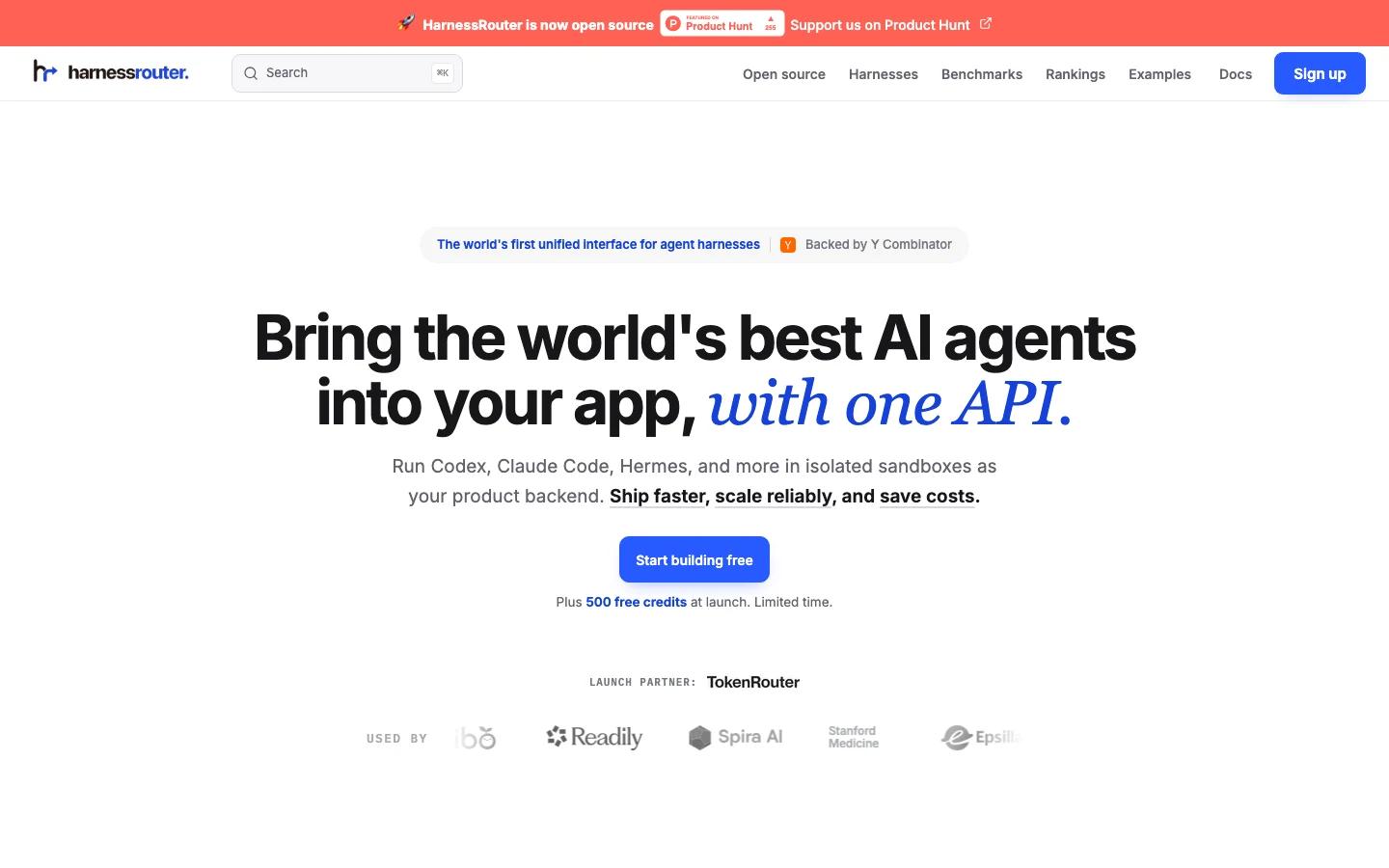
HarnessRouter is infrastructure for product teams that want to embed AI coding and task agents without wiring every harness separately. The official homepage describes the product as a way to bring the world's best AI agents into an app with one API. The named examples include Codex, Claude Code, and Hermes, each running inside isolated sandboxes with sessions, streaming, files, artifacts, and operational controls around the run.
The problem it addresses is familiar to anyone building on top of AI agent systems. Each agent runtime has a different interface, lifecycle, tool model, logging surface, and failure mode. HarnessRouter sits above those harnesses and gives application developers a common routing layer so they can trigger agent work, stream progress, retrieve artifacts, and keep the surrounding product logic consistent.
The Community Edition launch is also notable. Product Hunt positions it as an open-source unified interface for agent harnesses, and the official site frames the open-source edition around a local gateway, runner, and console. That gives teams a lower-risk way to evaluate agent orchestration before committing core product flows to a hosted service.
Key Features
- One Agent API - Integrates multiple harnesses behind a shared interface, reducing the need to build separate adapters for every agent backend.
- Support for major coding agents - The official site names Codex, Claude Code, and Hermes as supported harnesses, which makes the product relevant for teams already evaluating agentic coding workflows.
- Isolated sandboxes - Agent work runs inside sandboxed environments instead of directly against the host application, giving teams a clearer execution boundary.
- Sessions and streaming - Long-running work can be tracked as sessions, with streaming updates that fit product UIs and operational dashboards.
- Files and artifacts - Applications can collect the outputs of an agent run rather than treating the interaction as a transient chat transcript.
- Cancellation and failure recovery - Operational controls matter for embedded agents because product users expect the same reliability they expect from any other workflow.
- Open-source Community Edition - The CE path gives developers a local gateway, runner, and console for evaluating the architecture before scaling hosted usage.
How to Get Started
Start by deciding which harnesses you actually need. A team embedding Codex for repository tasks has a different evaluation path than a team embedding Claude Code for customer-specific code changes or Hermes for broader automation. Keep the first use case narrow: one agent, one sandbox profile, one artifact type, and one product workflow.
From there, evaluate three things:
- Runtime control - How the sandbox is created, what files are mounted, what tools the agent can call, and how failed runs are isolated.
- Product integration - How streaming status, logs, files, artifacts, and cancellation map into your UI.
- Cost and routing - Which harness is used by default, which model provider powers it, and when routing should change based on task type.
Teams comparing HarnessRouter with direct agent integration should include maintenance cost in the decision. Direct integration may be faster for one harness. A router becomes more valuable when you expect to support multiple AI code generation backends or switch agents as the category evolves.
Pricing & Plans
HarnessRouter has a free entry point. The official site describes account creation, card setup, and 500 free credits, with paid tiers and top-up credits for continued use. Public plan names include Developer, Production, and Scale, but the pages reviewed did not expose a single stable public monthly price suitable for quoting here.
| Plan area | What to expect |
|---|---|
| Free start | 500 free credits after account setup, according to the official site |
| Community Edition | Open-source evaluation path for local gateway, runner, and console workflows |
| Paid usage | Developer, Production, Scale, and top-up credit paths are referenced publicly |
| Variable costs | Depend on harness usage, model provider costs, run duration, sandbox resources, and support requirements |
For budgeting, treat HarnessRouter as infrastructure. The seat price is only one part of the cost. The larger variables are agent runtime, model tokens, sandbox compute, artifact storage, and how much automation you let users trigger.
Best For
- Product teams embedding coding agents into customer-facing SaaS workflows
- Developer platform teams that want one integration surface across Codex, Claude Code, Hermes, and future harnesses
- AI infrastructure teams standardizing sandbox execution, artifacts, and run observability
- Startups building agentic development products where backend choice may change over time
- Teams that want to evaluate open-source agent routing before buying a hosted platform
HarnessRouter is strongest when agent choice is strategic. If your application may need to route tasks across multiple harnesses, the unified API can reduce integration churn. If you only need a narrow internal script, the value is less obvious.
FAQ
What is HarnessRouter?
HarnessRouter is an agent harness API that lets applications run agents such as Codex, Claude Code, and Hermes behind one integration surface with sandboxing, sessions, streaming, files, and artifacts.
Is HarnessRouter open source?
HarnessRouter has a Community Edition promoted as an open-source path for running a local gateway, runner, and console. Hosted usage and production deployment options are also promoted on the official site.
Which agents does HarnessRouter support?
The official homepage names Codex, Claude Code, and Hermes. The value of the router is that teams can avoid building every harness integration separately.
How much does HarnessRouter cost?
The official site references 500 free credits and paid usage paths including Developer, Production, Scale, and top-up credits. Stable public plan prices were not visible in the reviewed official materials, so pricing should be confirmed on the vendor site before purchase.
Who should use HarnessRouter?
HarnessRouter fits teams embedding agent work into products, especially when they need sandboxed execution, streamed progress, artifacts, and flexibility across multiple agent backends.