



Overview
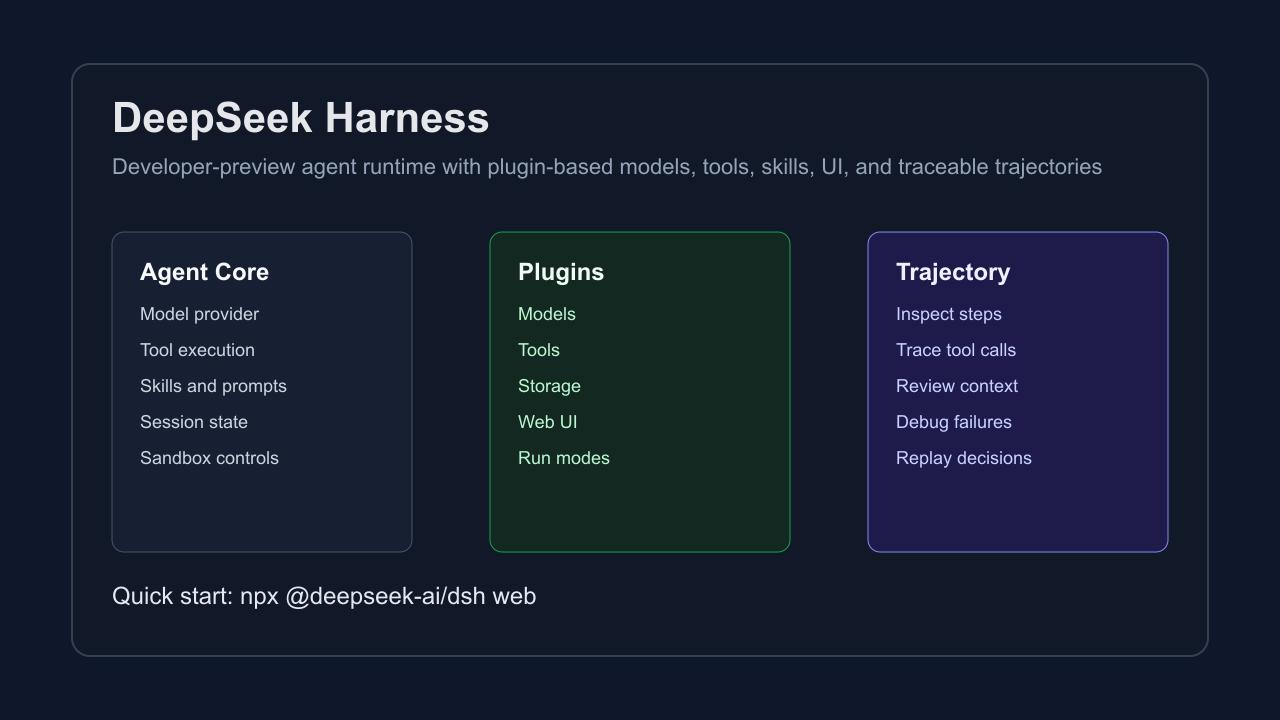
DeepSeek Harness is an open-source runtime for building and operating AI agents. DeepSeek frames the product around a simple equation: an agent is a model plus a harness. The model supplies reasoning and generation; the harness supplies tools, skills, memory, execution modes, UI, storage, sandboxing, and traceability around that model.
That distinction matters for teams comparing AI agent platforms. DeepSeek Harness is not a new DeepSeek model and it is not just a chat UI. It is a developer-preview framework for composing agent systems through plugins, running them locally, and inspecting the resulting trajectories. The official repository is MIT licensed, so developers can study, modify, and self-host the harness rather than relying only on a hosted coding-agent product.
The current release is early. The GitHub README calls it a developer preview and warns that APIs, plugins, and settings may change. Treat it as a serious evaluation target for agent builders, not as a fully stable production platform.
Key Features
- Plugin-first agent architecture - Models, tools, skills, sessions, storage, UI, and orchestration are treated as plugins, letting developers replace or extend parts of the harness without rewriting the whole runtime.
- Traceable trajectories - Agent runs can be inspected step by step, helping teams debug tool calls, context usage, intermediate reasoning flow, and failure points.
- Multiple run modes - DeepSeek documents Standard mode and PTC mode for different agent behaviors, giving builders a way to test general task execution and more structured problem-solving flows.
- Local Web UI and CLI launch - The official quick start exposes a local Web UI through
npx @deepseek-ai/dsh web, making the preview easy to try before deeper integration. - Cordis-powered extensibility - The project builds on the Cordis plugin system, which is useful for developers who want modular control over runtime services.
- Open-source MIT license - The harness can be inspected, forked, and adapted for commercial projects subject to the MIT license terms.
How to Get Started
The fastest official path is the local Web UI:
npx @deepseek-ai/dsh web
After launch, open the local URL shown in the terminal, configure a model provider, and start with a small task before testing longer agent runs. Because the project is in developer preview, keep test work isolated from critical repositories and read the current GitHub README before automating filesystem or shell access.
For deeper evaluation, review the official documentation and repository examples. The important setup questions are not just "which model do I use?" but also which tools the harness can call, how much file access it receives, where trajectory data is stored, and how easy it is to reproduce or replay a failed run.
How It Compares
DeepSeek Harness sits closer to open agent runtimes than hosted coding assistants. Claude Code gives developers a polished Anthropic-native terminal agent experience. OpenCode and Qwen Code focus on command-line coding workflows. DeepSeek Harness is broader: the pitch is a pluggable harness architecture that can host different models, tools, skills, and interfaces.
That makes it more flexible, but also less finished. Buyers looking for a managed coding product may prefer established AI code generation tools with support channels, billing, and team controls. Developers building their own agent infrastructure may value DeepSeek Harness because it exposes more of the runtime surface and keeps the system inspectable.
Pricing & Plans
DeepSeek Harness itself is free and open source under the MIT license. There is no separate subscription for the harness repository or local runtime.
Costs come from the model provider and infrastructure you attach to it:
| Cost area | What to expect |
|---|---|
| Harness | Free, MIT-licensed open-source project |
| Model calls | Depends on the selected provider, such as DeepSeek API or another compatible model endpoint |
| Local compute | Depends on whether you run hosted models, local models, or self-hosted infrastructure |
| Operations | You own security review, sandboxing, logging retention, and deployment reliability during preview |
For teams already using DeepSeek's API, the harness can be evaluated as an orchestration layer around existing token spend rather than a separate SaaS seat cost.
Community & Ecosystem
The project starts with three useful signals: an official DeepSeek launch page, a public GitHub repository under the deepseek-ai organization, and documentation that frames plugins as the center of the design. That gives developers a credible primary source to evaluate instead of relying on screenshots or social posts alone.
The ecosystem is still early. Expect breaking changes, incomplete integrations, and fast-moving plugin APIs. The right evaluation path is to build a small internal prototype, capture failure cases through trajectories, and decide whether the plugin model fits your team's agent architecture.
Best For
- Developers building custom AI agent runtimes who want plugin-level control rather than a closed hosted workflow
- AI infrastructure teams evaluating DeepSeek models inside a transparent agent execution layer
- Coding-agent researchers who need traceable trajectories for debugging long tool-use runs
- Startups prototyping internal agents before deciding whether to buy a managed agent platform
- Open-source contributors interested in model-agnostic agent orchestration, plugin systems, and local Web UI workflows
FAQ
What is DeepSeek Harness?
DeepSeek Harness is an open-source developer-preview runtime for AI agents. It provides the surrounding system around a model: tools, skills, sessions, UI, storage, plugin orchestration, and traceable execution.
Is DeepSeek Harness a new DeepSeek model?
No. It is a harness for running agents, not a model release. You still need to configure a model provider or compatible endpoint to power the agent.
Is DeepSeek Harness production-ready?
Not yet. DeepSeek labels the project as a developer preview and warns that APIs, plugins, and settings may change. It is best evaluated in isolated prototypes before production use.
How do I install DeepSeek Harness?
The official quick start uses npx @deepseek-ai/dsh web to launch the local Web UI. Check the GitHub README for the current command, supported Node.js requirements, and configuration details.
How much does DeepSeek Harness cost?
The harness is free under the MIT license. Actual costs come from model API usage, local or cloud compute, and any operational infrastructure used around the harness.
How is it different from Claude Code or OpenCode?
Claude Code and OpenCode are closer to ready-to-use coding-agent workflows. DeepSeek Harness is more of a pluggable runtime: it exposes the surrounding agent infrastructure so developers can compose models, tools, skills, UI, and execution behavior.