



Overview
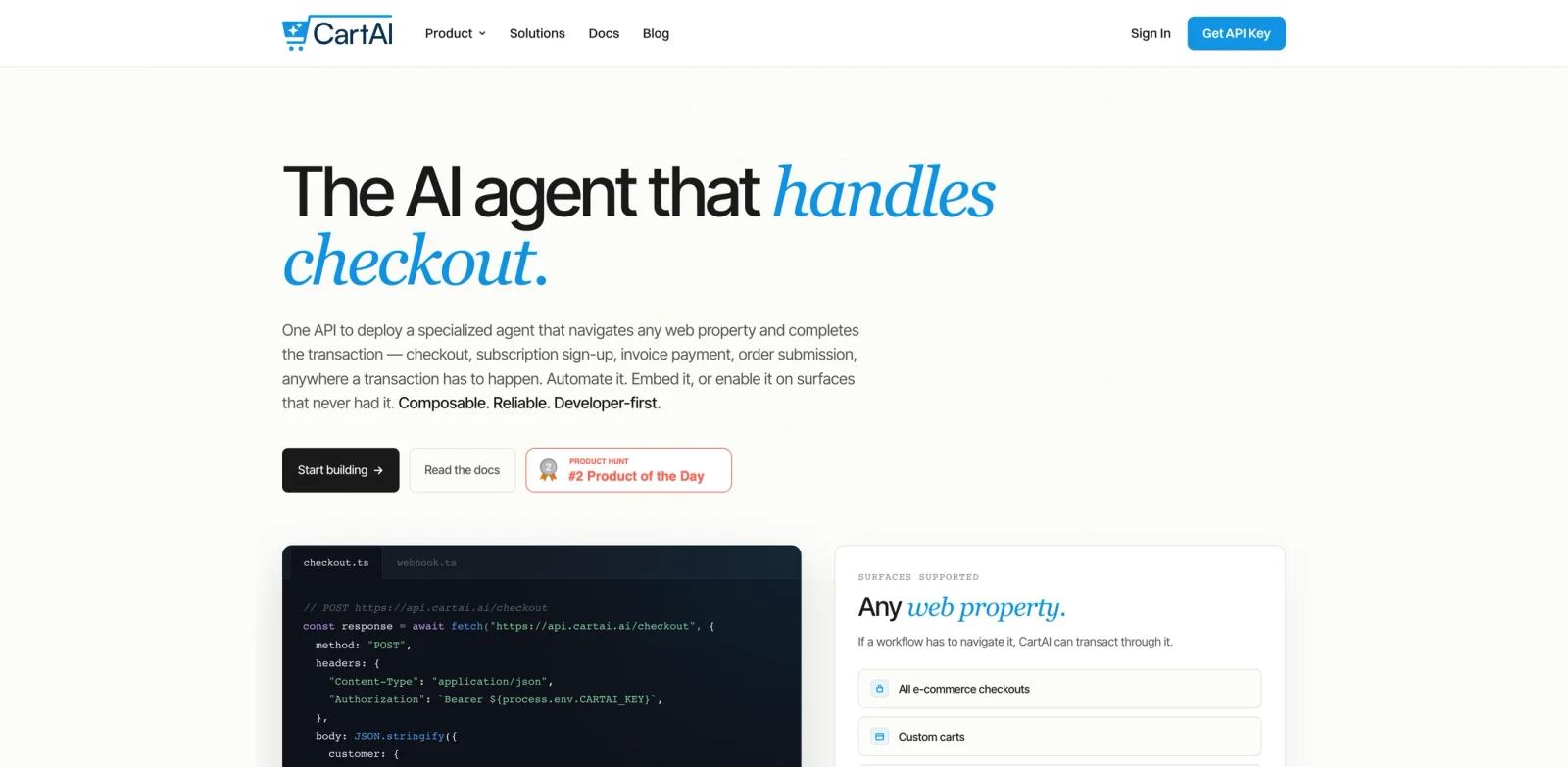
CartAI is a developer platform for agentic commerce: it gives AI agents a way to complete checkout on real merchant websites. The product addresses a common gap in shopping agents and vertical copilots. An agent can recommend products, fill a cart, or navigate a site, but payment and confirmation are where many demos stop. CartAI provides an API for product discovery, checkout execution, hosted payment sessions, order tracking, and affiliate attribution.
The platform is built around a specialized AI agent that navigates merchant surfaces, selects products and variants, submits checkout flows, and tracks the result to confirmation. CartAI says it works without requiring merchant-side integration, while cooperating with bot-detection and agent-identity infrastructure rather than trying to evade it.
CartAI is most relevant to developers building shopping copilots, procurement agents, vertical AI apps, loyalty surfaces, and marketplaces. It is not a consumer shopping app by itself; it is infrastructure for teams that want their own agent or product experience to transact reliably.
Key Features
Checkout API - Developers can create asynchronous checkout tasks through an API. CartAI validates the request, queues the task, runs the checkout in the background, and returns status through polling or webhooks.
Catalog and live pricing - CartAI's catalog layer helps search products across merchants, retrieve variants and pricing, and estimate checkout costs before the order starts.
Hosted payment sessions - The platform describes hosted, PCI-compliant payment sessions connected to Visa Intelligent Commerce and Mastercard Agent Pay, keeping sensitive payment handling outside the developer's stack.
Order tracking and webhooks - Checkout workflows can be tracked to confirmation with normalized order status and webhook events, which is essential for production AI productivity or procurement workflows.
MCP server - CartAI offers an open-source MCP server so agents in Claude Desktop, Claude Code, Cursor, VS Code, or custom hosts can search products, estimate cost, run secure payments, and execute checkouts.
Affiliate monetization - CartAI includes attribution and commission capture across a large affiliate network, helping agentic commerce surfaces monetize transactions after a merchant has been chosen.
How It Works
CartAI's checkout flow is asynchronous. A developer sends a checkout request with customer details, product URLs, quantities, variants, shipping profile, payment provider data, and optional execution controls. The API returns a task ID, then CartAI's agent runs the checkout process in the background.
For multi-product workflows, tasks can include products from one or more merchants. CartAI groups work by merchant, applies options such as partial checkout behavior, and reports progress through task status and webhooks. The documentation also supports test cards, which helps developers evaluate the flow before exposing real payment credentials.
This architecture makes CartAI different from a scraping script or a generic browser automation tool. The hard parts are not just clicking buttons; they are payment authorization, identity, variant accuracy, price changes, failure states, merchant confirmations, and post-purchase traceability.
Pricing & Plans
CartAI's Product Hunt launch is marked as payment required, and the official site positions it as developer infrastructure. Public pages reviewed do not list a simple self-serve monthly price. Expect usage-based or sales-assisted pricing depending on checkout volume, payment flow, and integration needs.
| Plan | Price | Notes |
|---|---|---|
| Developer access | Not publicly listed | Start building through the site or docs |
| Production usage | Contact CartAI | Likely depends on checkout volume, payment setup, support, and enterprise needs |
Before launching a production commerce experience, confirm API pricing, transaction fees, payment-network costs, affiliate attribution terms, refund handling, dispute workflows, and support guarantees.
Best For
- AI shopping agents that need to go beyond recommendations and actually complete purchases
- Vertical apps where transactions are embedded into a workflow, such as gifts, procurement, travel, or replenishment
- Marketplaces and loyalty products that want checkout inside their own surface
- Developers experimenting with AI agent commerce through MCP-compatible hosts
- Businesses that can evaluate payment compliance, spend grants, and dispute processes before launch
FAQ
Is CartAI a consumer shopping assistant?
Not primarily. CartAI is developer infrastructure. It gives applications and agents tools to search, estimate, pay, and complete checkout on merchant surfaces.
Does CartAI require merchant integration?
CartAI says its checkout agent can operate on live merchant surfaces without merchant-side work. It also emphasizes cooperating with bot-detection and agent-identity infrastructure rather than evading it.
Does CartAI handle payments?
CartAI describes hosted payment sessions connected to Visa Intelligent Commerce and Mastercard Agent Pay. This is designed to keep PCI scope away from the developer's own stack, but production teams should confirm payment, dispute, and compliance details directly.
Can I use CartAI from an AI agent?
Yes. CartAI provides an API and an open-source MCP server, so MCP-compatible agent hosts can search products, estimate costs, and execute checkouts.
Is there public pricing?
Public pages reviewed do not show a simple monthly price table. Product Hunt marks CartAI as payment required, so expect paid or usage-based access and confirm the current terms before building against it.
What are the biggest risks to evaluate?
The main risks are wrong variants, price or stock changes, payment authorization boundaries, failed confirmations, refunds, and customer-support handoff after purchase. CartAI addresses many of these in its workflow design, but each production use case needs testing.