



Overview
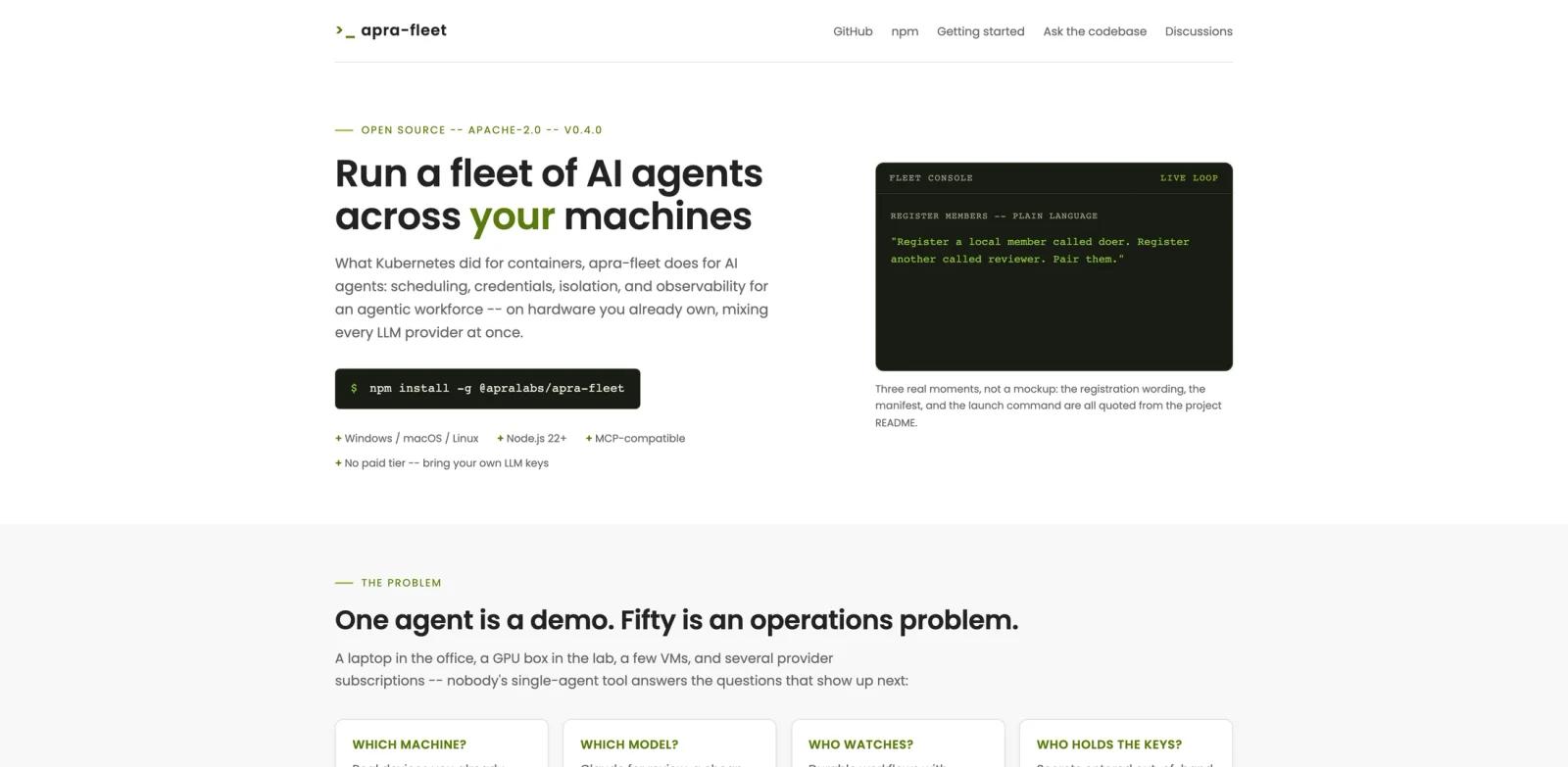
apra-fleet is an open-source MCP server and CLI for running fleets of AI agents across your own machines, providers, and workflows. Its pitch is that one AI agent is a demo, while many agents across laptops, GPU boxes, VMs, CI machines, and different LLM providers become an operations problem.
The tool lets an MCP-capable orchestrator control a fleet of registered members. A member can be a local or remote machine running a provider CLI or local model. apra-fleet can then dispatch commands, prompts, files, credentials, and workflow steps across that fleet.
For developers already using tools such as Claude Code, Codex, Gemini, Copilot, OpenCode, or Antigravity, apra-fleet is not another single-agent chat interface. It is infrastructure for scheduling, isolation, credentials, observability, and durable multi-agent work. That makes it a strong fit for the AI agent category and for teams experimenting with larger coding-agent systems.
Key Features
- MCP-compatible fleet control - apra-fleet exposes an MCP server so compatible agents can register members, inspect topology, dispatch work, and coordinate workflows.
- Cross-machine execution - Register Windows, macOS, and Linux machines locally or over SSH, then route tasks to the right device or provider.
- Multi-provider routing - The project supports provider strategies for Claude, Codex, Gemini, Copilot, Antigravity, OpenCode, and OpenAI-compatible local endpoints.
- Durable workflows - Workflows are resumable programs with execution journals, member reservations, stall detection, watchdogs, and recovery behavior for longer unattended runs.
- Out-of-band credentials - Secrets are entered outside the model context, encrypted at rest, scoped to members, and resolved server-side during execution.
- Software engineering workflow - The flagship
fleet-sprintworkflow plans, develops, reviews, tests, and harvests software work across multiple agents.
How to Get Started
- Install Node.js 22+ - apra-fleet requires a modern Node runtime.
- Install the CLI - Run
npm install -g @apralabs/apra-fleet. - Start the fleet console - Use the CLI to launch the control plane and inspect fleet state.
- Register members - Add local or SSH-accessible machines as members, then pair them with provider CLIs or local endpoints.
- Configure credentials - Enter secrets out-of-band so models do not see provider keys.
- Run a workflow - Start with a documented workflow such as
fleet-sprint, then author custom workflows as your operational pattern becomes clear.
Community & Ecosystem
apra-fleet is published under the Apache-2.0 license and is hosted on GitHub. The README lists CI, platform support for macOS, Linux, and Windows, MCP compatibility, a documentation site, and a DeepWiki codebase assistant.
The project is also dogfooded: its README states that an autonomous apra-fleet workflow plans, codes, reviews, tests, and ships the apra-fleet codebase itself. Treat that as an early-stage but useful signal that the maintainers are testing the workflow against real repository maintenance rather than only a demo script.
Pricing & Plans
apra-fleet is free and open source. The official site says there is no paid tier and that users bring their own LLM keys.
| Option | Price | Best fit |
|---|---|---|
| Open-source project | Free, Apache-2.0 | Developers and teams that want to run their own agent fleet |
| LLM/provider usage | Bring your own keys | Teams routing work across Claude, Codex, Gemini, Copilot, OpenCode, local models, or OpenAI-compatible endpoints |
Your actual operating cost depends on the machines you run, provider CLIs you connect, model tiers, and how many prompts your workflows invoke.
Best For
- Developers who want to orchestrate Claude, Codex, Gemini, Copilot, OpenCode, and local models from one control plane.
- Engineering teams experimenting with multi-agent software development workflows.
- AI infrastructure builders who need durable workflows, scheduling, credentials, and observability.
- Teams comparing AI code generator workflows and wanting to move beyond single-agent runs.
- Organizations that prefer open-source agent infrastructure over a hosted-only orchestration product.
FAQ
What is apra-fleet?
apra-fleet is an open-source MCP server and CLI for orchestrating AI agent fleets across machines, providers, credentials, and workflows.
Is apra-fleet free?
Yes. apra-fleet is published under the Apache-2.0 license and the official site states that there is no paid tier. Users bring their own LLM keys.
Which platforms does apra-fleet support?
The project documents support for Windows, macOS, and Linux machines, including local and SSH-accessible members.
Which AI agents or providers can apra-fleet use?
Public materials list Claude, Codex, Gemini, Copilot, Antigravity, OpenCode, local models, and OpenAI-compatible endpoints.
Is apra-fleet only for coding?
Software engineering is the active vertical today, especially through the fleet-sprint workflow. The workflow engine itself is designed to be domain-agnostic.
Who should skip apra-fleet?
Teams that only need one hosted coding assistant or a simple chat UI may find apra-fleet too operational. It is best for users who actually need multi-agent orchestration.