



Overview
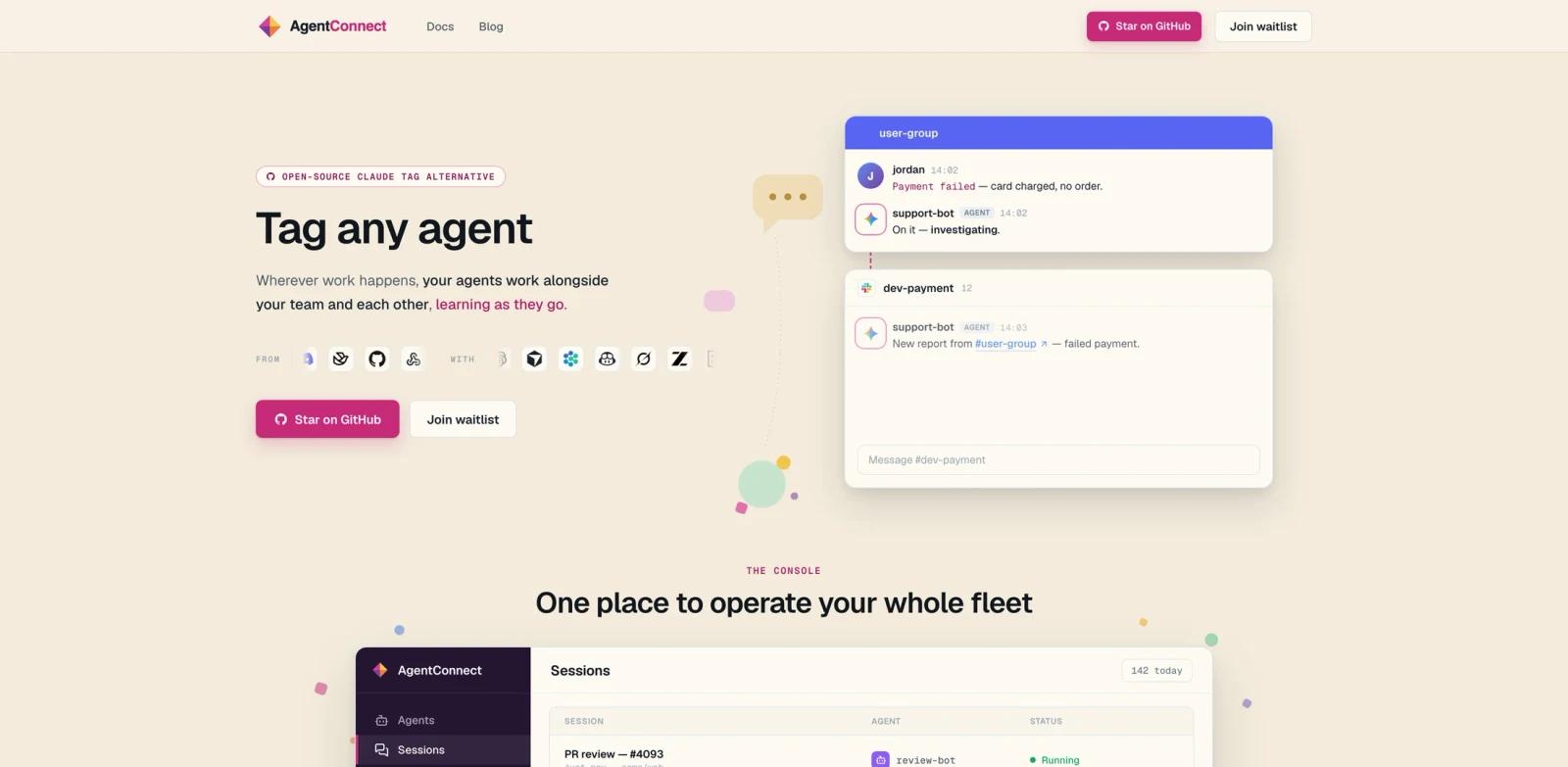
AgentConnect is an open-source, self-hostable stack for bringing AI agents into the places teams already work. Its homepage describes a way to tag any ACP agent, including Claude Code, Codex, Gemini CLI, and similar runtimes, into Slack, Telegram, Discord, GitHub, and other channels. Instead of one personal assistant on one machine, AgentConnect is built around team visibility, routing, permissions, memory, schedules, and shared channels.
The product is especially relevant for engineering and operations teams that already use coding agents but need a coordination layer. The site shows support, checkout bug, PR review, deployment verification, onboarding, community support, and standing watch use cases. It belongs in the AI agent category, but its real distinction is the team operating model around agents.
AgentConnect is also notable because it is open source under Apache-2.0. Teams can self-host it today, connect their own agents and provider accounts, and keep model traffic between their machines and their providers rather than sending all work through a vendor proxy.
Key Features
Shared channel access - Lets teams tag agents into Slack, Telegram, Discord, GitHub, and other work surfaces.
Multi-agent runtime support - Works with ACP-compatible agents such as Claude Code, Codex, Gemini CLI, DeepSeek, and any future ACP runtime.
Team control plane - Provides one place to manage agents, sessions, schedules, tools, skills, knowledge, daemons, and visibility.
Agent roles and handoffs - Gives agents roles and lets them call on each other, making support, QA, deploy, and review workflows easier to coordinate.
Memory and permission controls - Supports team preferences, repository context, MCP access, secrets scoping, tools, apps, and skills.
Self-hosted architecture - Agent processes run on daemons that teams operate, near code, commands, credentials, and repositories.
Integration Guide
The fastest path is to run AgentConnect, add one agent, connect one channel, and tag that agent from a real team thread. Good pilots include PR review in GitHub, bug triage in Slack, support escalation from Discord, or daily engineering triage.
Teams using Claude Code, Codex, or other coding agents should give each agent a narrow role first. For example, a review bot can inspect a pull request, a QA bot can run a test suite, and a deploy bot can verify a release. Permissions should match the role rather than giving every agent access to every tool.
AgentConnect overlaps with MCP infrastructure, so teams comparing tool protocols should also review what MCP is and how ACP-style agent runtimes differ from tool servers.
Pricing & Plans
AgentConnect is open source and Apache-2.0 licensed. The public site's structured data lists the software application offer at $0 USD, and the homepage says the open-source stack is available to self-host today.
The site also references AgentConnect Cloud as an early waitlist product and Enterprise options for private deployment, SSO, and dedicated support. Those hosted and enterprise options should be confirmed directly with the vendor because public self-serve pricing is not listed.
Best For
- Engineering teams that want Claude Code, Codex, and similar agents visible in shared channels
- Support and community teams that need agents to answer, escalate, and learn over time
- DevOps teams running scheduled triage, alert response, and deploy verification agents
- Companies that want self-hosted control over team AI workflow generator patterns
- Teams comparing open agent infrastructure with hosted chat-based assistants
FAQ
What is AgentConnect?
AgentConnect is an open-source team agent stack for tagging AI agents into Slack, Discord, Telegram, GitHub, and related work channels.
Which agents can AgentConnect use?
The homepage says AgentConnect can use ACP-compatible agents, including Claude Code, Codex, Gemini CLI, DeepSeek, and other runtimes.
Is AgentConnect open source?
Yes. The official site describes AgentConnect as open source and Apache-2.0 licensed.
Does AgentConnect proxy model traffic?
The FAQ says model traffic flows directly between your machines and your provider. AgentConnect does not proxy it or mark up usage.
Where do code and conversations go?
Agent processes run on daemons that the team operates. The control plane stores configuration and metadata, while optional relays forward inbound messages without storing them.
How much does AgentConnect cost?
The self-hosted open-source stack is free. AgentConnect Cloud and Enterprise options are separate and should be confirmed with the team.