

Overview
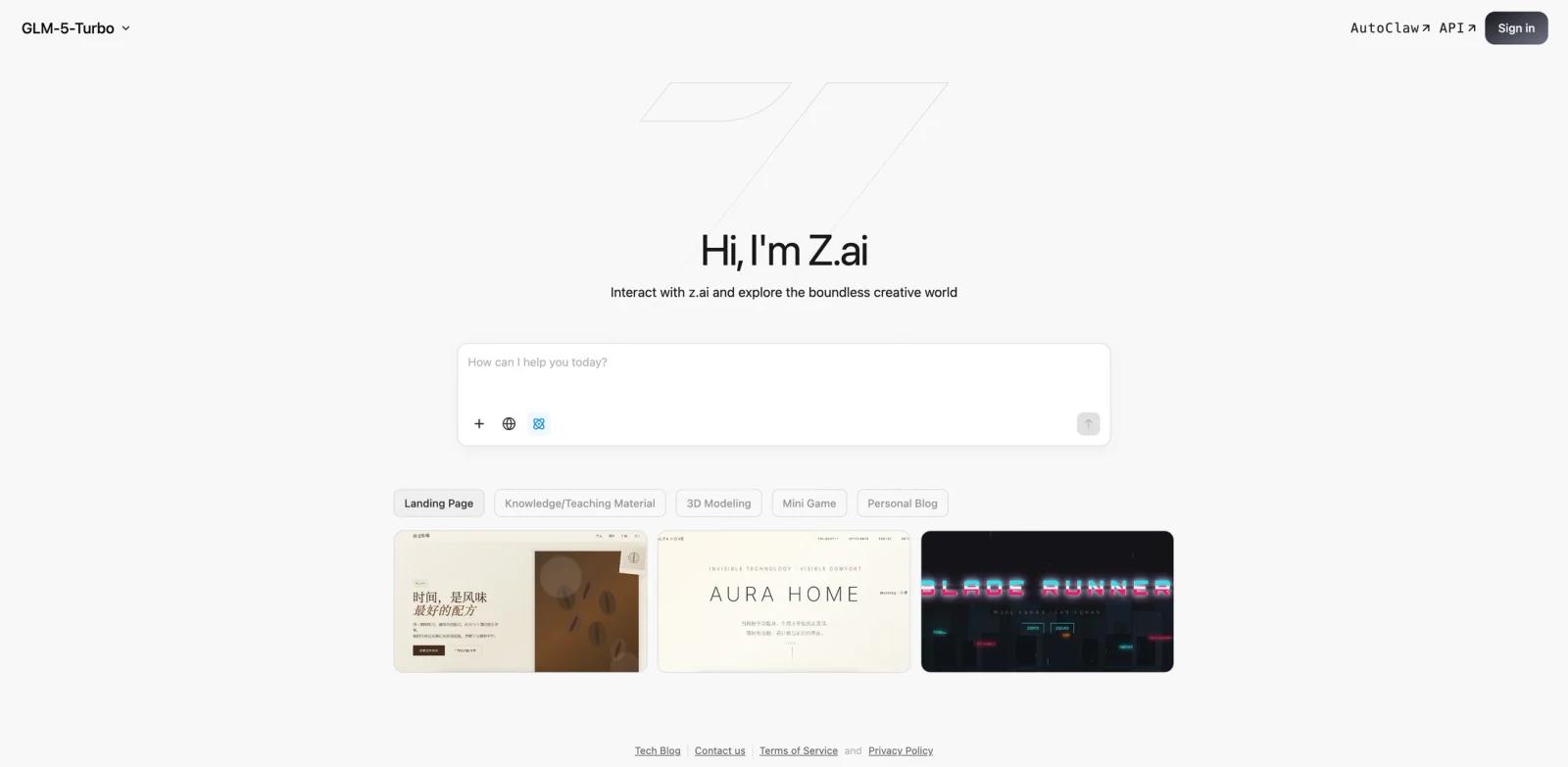
Z.ai is a bilingual AI chat, agent, and developer platform built around Zhipu AI's GLM model family. It combines a consumer web app with ZCode, GLM Coding Plan subscriptions, supported coding-tool integrations, and separately metered API services.
The platform serves developers, researchers, and everyday users who need an AI assistant for coding, writing, research, and document generation. Its August 2026 model line now pairs GLM-5.3, the heavier flagship for complex engineering, with GLM-5.3-Flash, a faster native-multimodal option for frequent coding, visual, and professional workflows.
Z.ai continues to publish major checkpoints as open weights, although availability is version-specific. GLM-5.2 and GLM-5.3-Flash have MIT-licensed weights; hosted access, model identifiers, and local deployment requirements still differ by release.
Key Features
GLM-5.3-Flash multimodal model — Combines a 1M-token context window with native image, video, chart, interface, and document understanding while using 18B active parameters for lower-cost inference.
GLM-5.3 flagship model — Builds on GLM-5.2's 1M-context base with expanded post-training for the most demanding coding, long-horizon agent, and authorized security-research workloads.
Agent mode — Converts natural language prompts into multi-step workflows, generating production-ready .docx, .pdf, and .xlsx documents directly from text instructions.
AI coding assistant — Works with Claude Code, OpenCode, ZCode, and other supported clients through the GLM Coding Plan, with model routing for flagship or higher-quota Flash workloads.
Long-horizon execution — Goal-oriented workflows can plan, edit code, run tests, inspect results, and revise strategy across extended tasks rather than stopping after a first attempt.
English and Chinese support — Official Z.ai model documentation lists both languages for the core GLM models.
Open-weight GLM ecosystem — GLM-5.2 and GLM-5.3-Flash support MIT-licensed self-hosting through current inference frameworks. Check each version separately because architecture and hardware needs vary substantially.
How Access Works
Z.ai spans several products that have different pricing and usage rules. The web app is the simplest entry point, while the Coding Plan is limited to supported coding tools and uses its own endpoint and quota system.
| Access path | Best suited to | Important limitation |
|---|---|---|
| Z.ai web app | Chat, research, writing, and agent tasks | Model availability and usage limits can change by account |
| GLM Coding Plan | Claude Code, OpenCode, ZCode, and supported development tools | Subscription quota cannot be treated as a general-purpose API allowance |
| General API | Custom applications and production integrations | Separate pay-as-you-go billing and model availability apply |
| Open weights | Private deployment, research, and customization | Availability and hardware requirements vary by model version |
Compared with ChatGPT, Claude, and Gemini, Z.ai combines English-Chinese model support, an open-weight model line, and Coding Plan subscriptions for officially supported third-party agent tools. GLM-5.3-Flash adds a lower-cost multimodal route, but benchmark leadership still varies by task and should be judged with matching harnesses and token budgets.
Pricing & Plans
Z.ai offers free web access, paid GLM Coding Plan subscriptions, and separate pay-as-you-go API billing. Current GLM Coding Plan monthly prices are:
| Plan | Monthly price | Positioning |
|---|---|---|
| Lite | $18 | Lightweight work on one small repository |
| Pro | $80 | Daily development on one or two mid-sized projects; 6× Lite usage |
| Max | $168 | Advanced work across larger or concurrent projects; 14× Lite usage |
Annual billing currently lists effective monthly rates of $12.60 for Lite, $56 for Pro, and $117.60 for Max. The Coding Plan uses credits-based quota accounting for input, cached input, and output tokens. Current rolling limits are 2,000 credits per 5 hours and 10,000 per week for Lite, 12,000 and 60,000 for Pro, and 28,000 and 140,000 for Max; 5-hour credits reset dynamically five hours after consumption, while weekly credits reset every seven days from subscription activation. Calls outside 14:00–18:00 UTC+8 on weekdays consume 50% of the standard credits. Z.ai says GLM-5.3-Flash provides three times the usable quota of GLM-5.3 within these plans.
The Coding Plan is restricted to officially supported tools and uses a dedicated coding endpoint. General API calls use separate pay-as-you-go billing; check the live model pricing page because rates and available model IDs can change independently of subscription prices.
Best For
- Developers seeking a coding assistant that can route demanding work to GLM-5.3 and frequent visual or coding tasks to GLM-5.3-Flash
- Teams needing bilingual English-Chinese AI support for cross-border collaboration
- Open-source advocates willing to use a released checkpoint such as GLM-5.2 for AI chatbots
- Researchers and students looking for a free, capable AI chatbot for daily use
- Teams processing screenshots, charts, documents, or interfaces alongside code in multimodal agent workflows
- Teams running long-horizon coding or authorized security-review workflows with explicit reasoning controls
Avoid If
- You need a single subscription that also covers unrestricted production API traffic; Coding Plan quota and general API billing are separate.
- Your procurement requires fixed model identifiers, quotas, or prices without checking the live plan pages.
- You depend on integrations outside Z.ai's officially supported Coding Plan tool list, or you do not value its open-weight and multimodal options.
Sources & Verification
- Last verified: 2026-08-27
- Evaluation scope: Current GLM-5.3 and GLM-5.3-Flash positioning, Coding Plan versus API boundary, open-weight availability, supported coding clients, and public subscription structure; model quality and benchmark claims were not independently tested.
- Method: Source-based research from the official product materials below. No hands-on testing was performed for this update.
- Official sources:
FAQ
Is Z.ai free to use?
Z.ai provides free web access, while higher-volume coding workflows use paid GLM Coding Plans. Model availability, limits, and free allowances can change, so check the live account page before relying on a specific quota.
How does Z.ai compare to ChatGPT?
Z.ai emphasizes English-Chinese model support, coding-tool integrations, and open-weight checkpoints. The better coding choice depends on the model, harness, task length, and subscription limits rather than a single headline benchmark.
What models does Z.ai support?
Z.ai runs the GLM family, including GLM-5.3 for flagship coding and agent work, GLM-5.3-Flash for lower-cost native-multimodal workflows, GLM-5.2 as an earlier downloadable 1M-context checkpoint, and specialized variants. Availability differs between chat, Coding Plan, general API, and open weights.
Can I use Z.ai for coding?
Yes. The GLM Coding Plan works with Claude Code, OpenCode, ZCode, Cline, and other supported clients. GLM-5.3 handles the heaviest long-horizon tasks, while GLM-5.3-Flash adds native visual input and three times the usable plan quota for frequent workflows. Confirm current model identifiers and reasoning settings before switching production clients.
Is Z.ai open source?
Some major GLM checkpoints are open weight, but do not assume every hosted model is downloadable. GLM-5.2 and GLM-5.3-Flash are available under the MIT License; deployment cost and runtime support vary by architecture and precision.
Does Z.ai support languages other than English?
Z.ai's official model documentation lists English and Chinese support for its core GLM models. Availability and quality can still vary by model and task.
What is the API pricing for Z.ai?
API pricing is separate from the Coding Plan. Through September 9, 2026 (24:00 UTC+8), GLM-5.3-Flash costs $0.075 per 1M input tokens, $0.015 per 1M cached-input tokens, and $0.25 per 1M output tokens; its list prices are $0.15, $0.03, and $0.50 respectively.
Is my data secure on Z.ai?
For users requiring additional data control, released open-weight GLM checkpoints can be self-hosted on private infrastructure, giving teams more control over where inference runs and data is processed; actual data-residency and compliance guarantees depend on the deployment. Check Z.ai's official documentation for current security and compliance details.