Overview
DeepSeek-V4.1-Flash is DeepSeek's September 2026 API model for reasoning, coding, agents, and native image understanding. It is the first released model in a new architecture family and replaces both DeepSeek-V4-Flash and the separate V4 Flash Vision experimental endpoint.
The practical change is broader than a benchmark update. Developers get one canonical model ID, deepseek-flash, for text and image input, lower token prices, a one-million-token context window, and up to 384K output tokens. DeepSeek's announcement is specific to the API; it does not confirm that V4.1 Flash is the model used in the consumer web or mobile app.
What's New
A new architecture with native vision
DeepSeek describes V4.1 Flash as the smallest model in its new architecture family. The company says the architecture is designed for a higher capability ceiling, faster inference, greater throughput, and scaling to larger models, but it has not published the parameter count or an open-weight checkpoint for this release.
Image understanding is now native to the current Flash model instead of living in a separate experimental variant. The API accepts JPEG, PNG, GIF, and WebP images through Chat Completions or Responses, using base64 data, external URLs, or Files API IDs.
Vision detail can be set to low, high, original, or auto. DeepSeek documents a maximum of 600 images per request, a 32 MiB limit for inline or URL images, and a 64 MiB per-file limit through the Files API. Actual usable limits also depend on total request size and image count.
One canonical API model ID
The current model name is deepseek-flash. The older deepseek-v4-flash and deepseek-v4-flash-vision-exp identifiers are temporarily accepted but now route to V4.1 Flash and use V4.1 Flash billing.
This aliasing reduces immediate breakage, but it should be treated as a migration window rather than a permanent contract. Teams should update model configuration, snapshots, cost forecasts, and regression baselines to the canonical ID.
Stronger vendor-reported agent and coding results
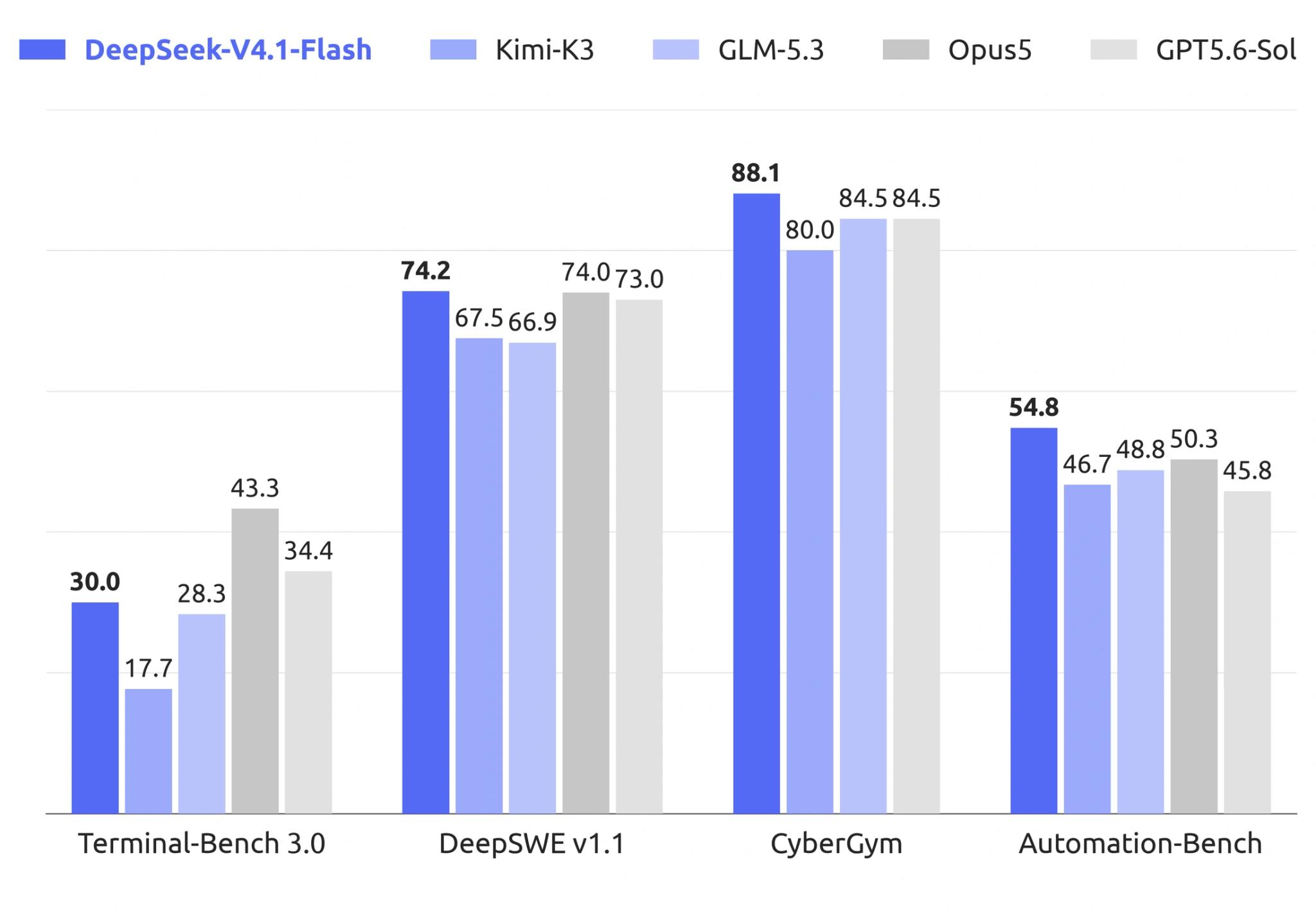
DeepSeek reports 90.9 on GPQA Diamond, a 3471 Codeforces rating, 90.6 on Terminal-Bench 2.1, 74.2 on DeepSWE v1.1, 65.4 on NL2Repo-Bench, and 88.1 on CyberGym. For tool-using evaluations, it reports 63.9 on Humanity's Last Exam with tools, 54.8 on Automation-Bench, and 31.8 on Agents' Last Exam.
These are vendor-published results. Several benchmark names or versions changed across releases, so they should guide shortlisting rather than substitute for workload-specific testing.
Compared With Previous Version
V4.1 Flash consolidates the earlier text-focused V4 Flash and V4 Flash Vision Exp into one production model. DeepSeek also says its internal testing found V4.1 Flash ahead of V4 Pro on performance, cost, speed, and total completion time, although teams should validate that claim against their own prompts and tools.
| Decision area | DeepSeek-V4.1-Flash | Earlier V4 Flash releases |
|---|---|---|
| API model ID | deepseek-flash |
deepseek-v4-flash or deepseek-v4-flash-vision-exp |
| Modalities | Text plus native image understanding | Text and vision split across separate models |
| Context / maximum output | 1M / 384K tokens | 1M / 384K tokens |
| Terminal-Bench 2.1 | 90.6 | 82.7 for V4 Flash; 83.9 for Vision Exp |
| NL2Repo-Bench | 65.4 | 54.2 for V4 Flash; 57.7 for Vision Exp |
| Agents' Last Exam | 31.8 | 25.2 for V4 Flash; 27.3 for Vision Exp |
| Pricing | Lower peak and off-peak rates | Retired pricing schedules |
Benchmark figures are from DeepSeek's release table. Differences in evaluation versions and configurations can limit direct comparability.
Availability & Access
DeepSeek-V4.1-Flash is available through the DeepSeek API under deepseek-flash. It supports thinking and non-thinking modes, JSON output, tool calls, the Responses API, Anthropic-compatible access, and native vision. Chat Prefix Completion and Fill-in-the-Middle are limited to non-thinking mode.
The release creates an important compatibility deadline. After 12:00 Beijing time on September 14, 2026, DeepSeek says requests to deepseek-v4-pro will route to V4.1 Flash and be billed at Flash rates until V4.1 Pro is released. Applications that depend on V4 Pro behavior should regression-test V4.1 Flash before that change.
Pricing & Plans
DeepSeek reduced Flash API pricing and retained time-based peak pricing. Prices below are per one million tokens.
| Token type | Off-peak | Peak |
|---|---|---|
| Cache-hit input | $0.003 | $0.006 |
| Cache-miss input | $0.15 | $0.30 |
| Output | $0.60 | $1.20 |
Peak periods are 01:00-04:00 UTC and 06:00-10:00 UTC on weekdays. Off-peak prices are half the peak rates. DeepSeek lists Flash concurrency at 2,500, but account controls and service conditions can still affect realized throughput.
Migration Notes
- Change new integrations and configuration defaults to
deepseek-flash. - Re-run text, tool-call, JSON, and image-input regression suites because legacy aliases now resolve to a different model version.
- Update token-cost forecasts for peak and off-peak traffic instead of applying one blended rate.
- Test any production workload pinned to
deepseek-v4-probefore the September 14 routing change. - Record the served model and alias in logs so behavior changes can be traced during the temporary transition.
Who Should Upgrade / Who Should Wait
Upgrade or evaluate V4.1 Flash now if:
- You need one API model for both text and image understanding.
- Agentic coding workloads are constrained by latency, tool-loop cost, or earlier Flash quality.
- You currently call either retired Flash model ID and want to remove temporary alias dependence.
- You use
deepseek-v4-proand need to validate the scheduled routing change before September 14.
Wait or keep a controlled fallback if:
- Your production outputs require exact behavioral continuity with an earlier V4 snapshot.
- You need published model weights, parameter counts, or self-hosting instructions for V4.1 Flash.
- Independent evaluation matters more than DeepSeek's launch benchmarks for your approval process.
- Your vision workload exceeds the documented image, request-size, or dimension limits.
Limitations
- DeepSeek has not published architecture size, weights, or a self-hosting license for V4.1 Flash in the cited release materials.
- Launch benchmarks are vendor reported, and not every earlier score uses an identical benchmark version or configuration.
- Legacy model aliases are temporary, so leaving old identifiers in production creates future deprecation risk.
- Native vision supports understanding images as input; the documentation does not describe image generation.
- The announced V4 Pro routing change may alter output behavior even when application code and the requested model ID do not change.
FAQ
What model ID should developers use?
Use deepseek-flash. The two older Flash identifiers currently route to V4.1 Flash, but DeepSeek describes that compatibility as temporary.
Does DeepSeek-V4.1-Flash support images?
Yes. It supports image input for visual understanding through Chat Completions and Responses. Supported formats are JPEG, PNG, GIF, and WebP.
Is V4.1 Flash available in DeepSeek's web chat?
DeepSeek's release announcement confirms API availability. It does not identify V4.1 Flash as the model behind the consumer web or mobile app.
What happens to DeepSeek-V4-Pro?
DeepSeek says deepseek-v4-pro requests will route to V4.1 Flash after 12:00 Beijing time on September 14, 2026, until V4.1 Pro launches. Those requests will use Flash pricing during the transition.