



Overview
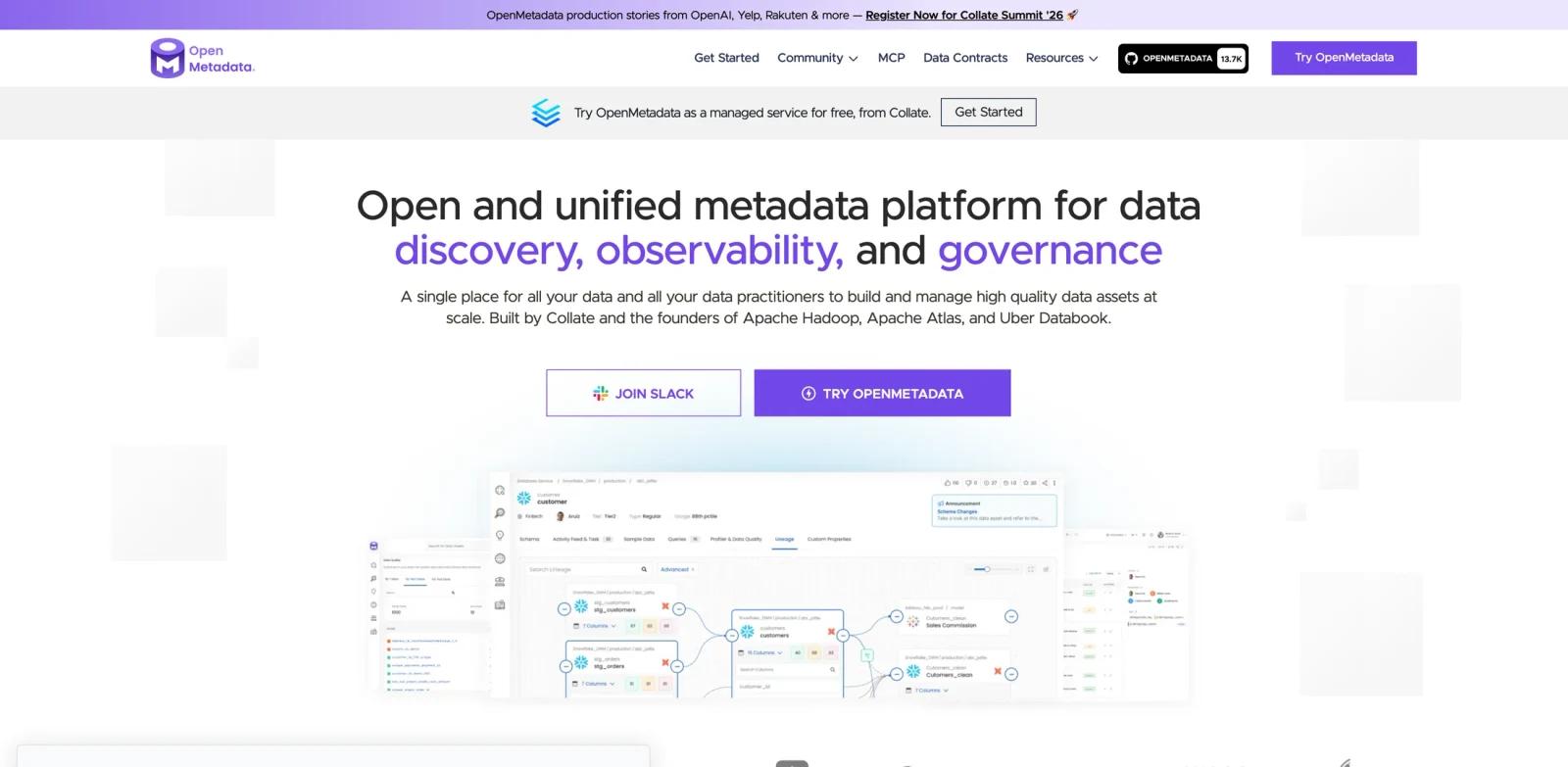
OpenMetadata is an open source metadata platform for data discovery, observability, quality, lineage, collaboration, and governance. The project describes itself as a unified metadata platform that centralizes context for data assets through a metadata graph, with 120+ connectors and an active open source community.
The platform is built for data teams that need a single place to discover datasets, understand lineage, document ownership, monitor quality, manage glossary terms, and collaborate between data producers and consumers. It belongs in the AI data governance category because trustworthy AI and analytics both depend on governed, discoverable, well-described data.
OpenMetadata's biggest differentiator is that it is open source and API/schema-first. Teams can self-host, extend metadata entities, customize relationships, and integrate metadata operations into their own data platform architecture. For organizations evaluating enterprise catalog tools such as Alation, Atlan, Collibra, or Microsoft Purview, OpenMetadata is the open source option to examine closely. Teams building governance for AI initiatives should also compare broader AI governance tools.
Key Features
- Unified metadata graph - Centralizes technical, operational, quality, lineage, and governance metadata for data assets across the stack.
- 120+ connectors - Collects metadata from warehouses, databases, dashboards, pipelines, data quality tools, and other systems.
- Data discovery and collaboration - Helps technical and business users search for assets, read descriptions, identify owners, and collaborate around trusted datasets.
- Lineage and observability - Provides lineage, quality, and observability context so teams can understand how data moves and where issues affect downstream assets.
- Governance workflows - Supports glossary terms, ownership, classifications, tags, policies, and documentation workflows that make data more trustworthy.
- Open source and extensible architecture - API and schema-first design gives platform teams control over metadata models and integrations.
Pricing & Plans
OpenMetadata is open source, so teams can self-host the core platform without a software subscription fee. Managed services and enterprise support are offered separately through Collate.
| Option | Pricing | Best fit |
|---|---|---|
| Open source OpenMetadata | $0 software license | Teams that can self-host, operate, and customize the platform |
| Managed OpenMetadata / Collate | Check Collate pricing | Teams that want hosted operations, support, and enterprise assistance |
| Enterprise services | Custom | Large organizations needing implementation, migration, or governance program support |
Self-hosted teams should still budget for infrastructure, maintenance, upgrades, and internal platform ownership.
Best For
- Data platform teams that want an open source metadata layer
- Engineering-led organizations building custom governance workflows
- Teams comparing commercial catalogs with open alternatives
- Organizations that need discovery, lineage, and quality context in one platform
- AI teams building trustworthy pipelines for AI data analysis
FAQ
What is OpenMetadata?
OpenMetadata is an open source metadata platform for data discovery, lineage, observability, quality, collaboration, and governance.
Is OpenMetadata free?
The core OpenMetadata project is open source and free to self-host. Managed service and enterprise support options are offered separately by Collate.
How many connectors does OpenMetadata support?
The homepage states that OpenMetadata has 120+ turnkey connectors.
Does OpenMetadata support data lineage?
Yes. Lineage is one of the platform's core use cases, alongside discovery, observability, quality, collaboration, and governance.
Who should use OpenMetadata?
It is best for data teams that want an open, extensible metadata platform and have the ability to operate or customize it.
How does OpenMetadata compare with commercial data catalogs?
OpenMetadata gives more open source control and extensibility, while commercial catalogs may offer more packaged onboarding, support, and managed enterprise workflows.

