
12 Best AI & Model Governance Tools for 2026
Compare 12 AI and model governance platforms by the job they actually do: compliance evidence, model risk, lifecycle controls, and shadow AI discovery.

On this page
An EU AI Act deadline, a model-risk audit, or the discovery of unapproved AI tools often triggers the same search: “Which AI governance platform do we need?” The products in the results do not all do the same job. Some are systems of record for policies and audit evidence; some are model governance tools for validation and lifecycle controls; others focus on discovering shadow AI or monitoring technical risk. Buying across those boundaries is how teams end up with an expensive platform that still leaves their main gap open.
This guide compares 12 platforms by the governance job they can own, the stack they depend on, and the evidence a buyer should demand in a proof of concept. If your immediate problem is the quality, lineage, and access controls of training data rather than the AI system itself, start with AI data governance tools. For AI-system governance, choose your starting lane before comparing vendor feature lists.
| Your primary governance job | Start with | Rule out early if |
|---|---|---|
| Policy, regulatory mapping, and audit evidence across business units | Credo AI or OneTrust AI Governance | You mainly need technical runtime monitoring |
| Model inventory, validation, and lifecycle controls in financial services | ValidMind AI Governance or ModelOp Center | You need broad shadow-AI discovery first |
| Cross-cloud governance for models and agents | IBM watsonx.governance | You need a lightweight, compliance-team-led rollout |
| Governance inside an existing enterprise platform | DataRobot AI Governance, Dataiku Govern, or ServiceNow AI Control Tower | Most AI assets live outside that platform |
| Shadow AI discovery and portfolio triage | Holistic AI | Your inventory is already complete and governed |
How We Selected and Tested
We selected these AI governance tools based on measurable criteria: coverage of the AI lifecycle (discovery through decommission), depth of compliance framework support (EU AI Act, NIST AI RMF, ISO 42001), automation capabilities, and evidence of enterprise adoption. Tools without meaningful governance workflows—basic dashboards without risk tiers, audit trails, or policy enforcement—were excluded from consideration.
Our research methodology combined multiple data sources. We analyzed official product pages, technical documentation, and publicly available pricing. We cross-referenced independent analyst reports from Forrester Wave (Q3 2025) and IDC MarketScape (2025), and reviewed product changelogs and release notes through August 2026. This multi-source approach helped surface discrepancies between marketing claims and actual platform capabilities.
Evaluation Dimensions: We evaluated each tool across six dimensions tied to the buying decision:
- AI Asset Discovery & Inventory — Ability to automatically find and register AI models, agents, and datasets across the organization
- Risk Assessment & Scoring — Depth of risk tiering, bias detection, fairness evaluation, and automated controls
- Policy-to-Evidence Coverage — Ability to translate frameworks such as the EU AI Act, NIST AI RMF, and ISO 42001 into owned controls and audit evidence
- Model & Runtime Oversight — Validation, drift, bias, performance, security, and agent monitoring where the product claims technical coverage
- Workflow Automation — Governance workflows, approval processes, and audit trail generation
- Integration Ecosystem — Connectivity with MLOps platforms, cloud providers, and enterprise systems
Note on Testing Scope: This is a source-based comparison, not a controlled hands-on benchmark. We relied on official documentation, public pricing, analyst reports, and clearly identified vendor case studies. The product and regulatory facts were refreshed in August 2026; buyers should validate discovery, integrations, evidence workflows, and total cost against their own environment.
Transparency & Limitations: All information comes from official sources and credible third-party platforms—we don't fabricate ratings, rankings, or performance claims. Pricing information is based on publicly available data; enterprise platforms without public pricing require direct vendor quotes.
12 AI and Model Governance Tools Compared
Here's a side-by-side look at all 12 platforms across the dimensions that matter most for governance teams making a buying decision.
| Tool | Best For | Compliance Frameworks | Pricing Model | AI Discovery | Open Pricing |
|---|---|---|---|---|---|
| IBM watsonx.governance | Enterprise hybrid cloud governance | EU AI Act, NIST, ISO 42001 | Usage-based and packaged plans | Yes | Partial |
| Credo AI | Responsible AI & audit reporting | EU AI Act, NIST, GDPR | Custom quote | Yes | No |
| OneTrust AI Governance | Privacy-adjacent AI compliance | OECD, ALTAI, NIST, EU AI Act | Custom quote | Yes | No |
| Holistic AI | Shadow AI discovery at scale | EU AI Act, NIST, sector-specific | Custom quote | Yes | No |
| ModelOp Center | Enterprise MLOps + governance | NIST, EU AI Act, ISO 42001 | Custom quote | Yes | No |
| DataRobot AI Governance | DataRobot-native model governance | NIST, sector-specific | Custom quote | Yes | No |
| Collibra AI Governance | Data lineage + AI governance | EU AI Act, NIST AI RMF | Custom quote / benchmark pricing available | Yes | No |
| Lumenova AI | Quantitative risk evaluation | EU AI Act, NIST, ISO 42001 | Custom quote | Yes | No |
| ServiceNow AI Control Tower | ITSM-integrated AI governance | EU AI Act, NIST, GDPR | Custom quote | Yes | No |
| Dataiku Govern | Workflow governance in Dataiku | Custom/internal | Custom / higher-tier platform licensing | Limited | No |
| ValidMind AI Governance | Model risk management for finance | SR 11-7, OCC, EU AI Act | Custom quote | Yes | No |
| Asenion | Accessible SMB AI compliance | EU AI Act, NIST, ISO 42001 | From $99/month; free trial | Yes | Yes |
Detailed Reviews
IBM watsonx.governance
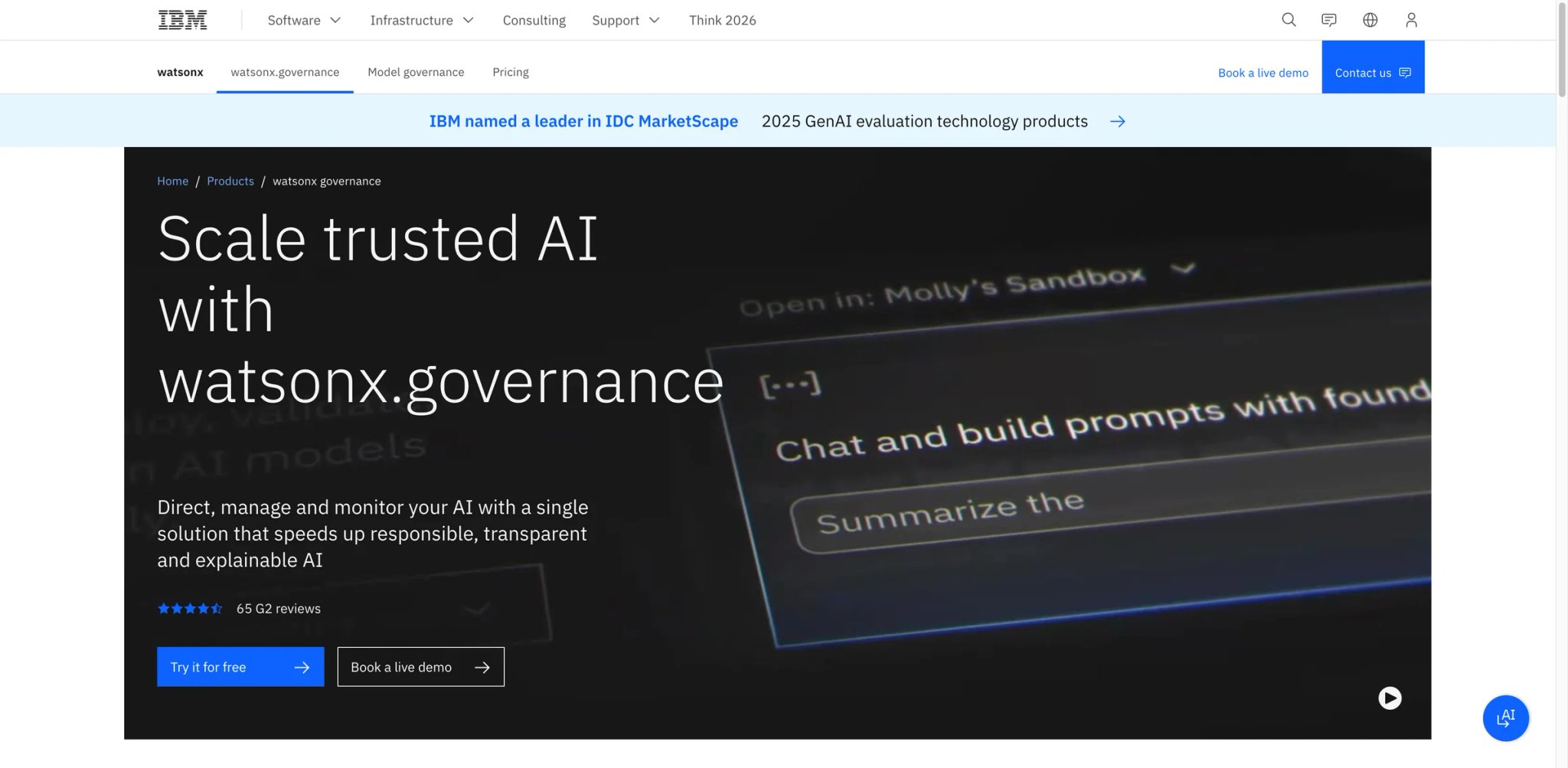
Most enterprises start governing AI with spreadsheets—until a model drift incident, a bias complaint, or an impending EU AI Act audit makes that approach untenable. IBM watsonx.governance is the platform designed to replace that patchwork before the deadline arrives. It is IBM's flagship AI governance offering, recognized as a Leader by both IDC MarketScape 2025 and Forrester Wave Q3 2025, built to govern AI assets across hybrid cloud environments regardless of where those models were originally built or deployed. For organizations managing models on AWS, Azure, OpenAI, and IBM simultaneously, this cross-platform reach is the defining differentiator.
Key Features
- Cross-Vendor Model Governance — Governs AI models and agents deployed on AWS SageMaker, Google Vertex, Microsoft Azure, and OpenAI—not just those built in IBM's own ecosystem. This is the platform's clearest differentiator: enterprises with fragmented AI infrastructure get a single governance layer without being forced to consolidate onto IBM tooling first.
- Agentic AI Monitoring — Governs AI agent inventories, monitors agent behavior in production, evaluates output quality, and applies guardrails for risks such as hallucinations. Organizations deploying AI agents should also review the best AI agent tools to understand what they will need to govern.
- Automated Compliance Documentation — Maps model characteristics to EU AI Act, ISO 42001, and NIST AI RMF requirements and generates audit-ready documentation automatically. The Enterprise Governance Accelerator (December 2025) adds automated use-case approval workflows and built-in responsible technology assessments, reducing manual review cycles.
- Integrated Risk & Security Monitoring — Connects natively with IBM Guardium AI Security for continuous vulnerability scanning alongside standard fairness, drift, and model health monitoring. Particularly relevant given IBM's 2025 finding that 63% of organizations that experienced data breaches lacked AI governance controls.
Pricing & Plans
- Free Trial: 14-day trial with access to a shared environment.
- Model Management: A limited Lite plan is free; current Essentials usage pricing starts at $0.64 per evaluation or equivalent metered unit, depending on the feature.
- Risk & Compliance: IBM publishes component prices for Essentials and Standard rather than one all-inclusive starting price. Scope the instance, solution, concurrent-user, and deployment charges required for the intended workflow.
- Software (On-Premises): Pricing is based on virtual processor cores (VPCs); contact IBM for deployment-specific pricing.
Note for CTOs: IBM separates usage-based Model Management from packaged Risk & Compliance plans, so the entry price does not describe a complete deployment. Buyers should map each required workflow to the relevant plan and request a scoped estimate for their model portfolio, integrations, and evaluation cadence.
Pros & Cons
Pros:
- Especially strong for third-party governance—models from any vendor can be governed in one place, which is uncommon among enterprise platforms
- Supports AI-agent inventory, observability, monitoring, and guardrails alongside conventional model governance
- Enterprise Governance Accelerator significantly reduces use-case approval cycle time through automated onboarding
- Built on Red Hat OpenShift, enabling deployment on IBM Cloud, AWS, Azure, or on-premises without replatforming
Cons:
- Platform breadth and multiple pricing components make proof-of-concept scoping important even when the governed assets run outside IBM
- Usage-based evaluation pricing can be difficult to forecast when evaluation frequency, message volume, and metric count vary
- Platform breadth requires dedicated governance engineering resources to configure and maintain; not self-service for compliance teams without technical support
Implementation Notes
- Typical timeline: IBM does not publish a standard implementation duration for a 20–50 model portfolio; timing depends on deployment model, integrations, portfolio complexity, and governance scope.
- Internal resources required: Cross-functional team involvement is non-negotiable—IBM's own documentation identifies app developers, MLOps engineers, and risk/compliance owners as all required roles during setup
- Watch for: As of August 2026, much of the AI Act is applicable, but the AI Omnibus moved Annex III high-risk obligations to December 2, 2027 and Annex I product-embedded high-risk obligations to August 2, 2028. Scope the proof of concept against the obligations and evidence your organization will actually face.
Best For
- Large enterprises with AI deployed across multiple cloud vendors simultaneously (AWS + Azure + IBM or similar)—this is where IBM's cross-platform governance justifies the complexity and cost
- Organizations with an existing IBM Cloud, Guardium, or Red Hat OpenShift footprint, where integration ROI is highest
- Enterprises facing concurrent regulatory obligations across EU AI Act, NIST AI RMF, and ISO 42001 that need a single compliance mapping layer
- Not the right fit if: Your governance team lacks technical support for an enterprise rollout, or a narrower compliance workflow can solve the immediate gap without the platform breadth and cost
Get started with IBM watsonx.governance
Credo AI
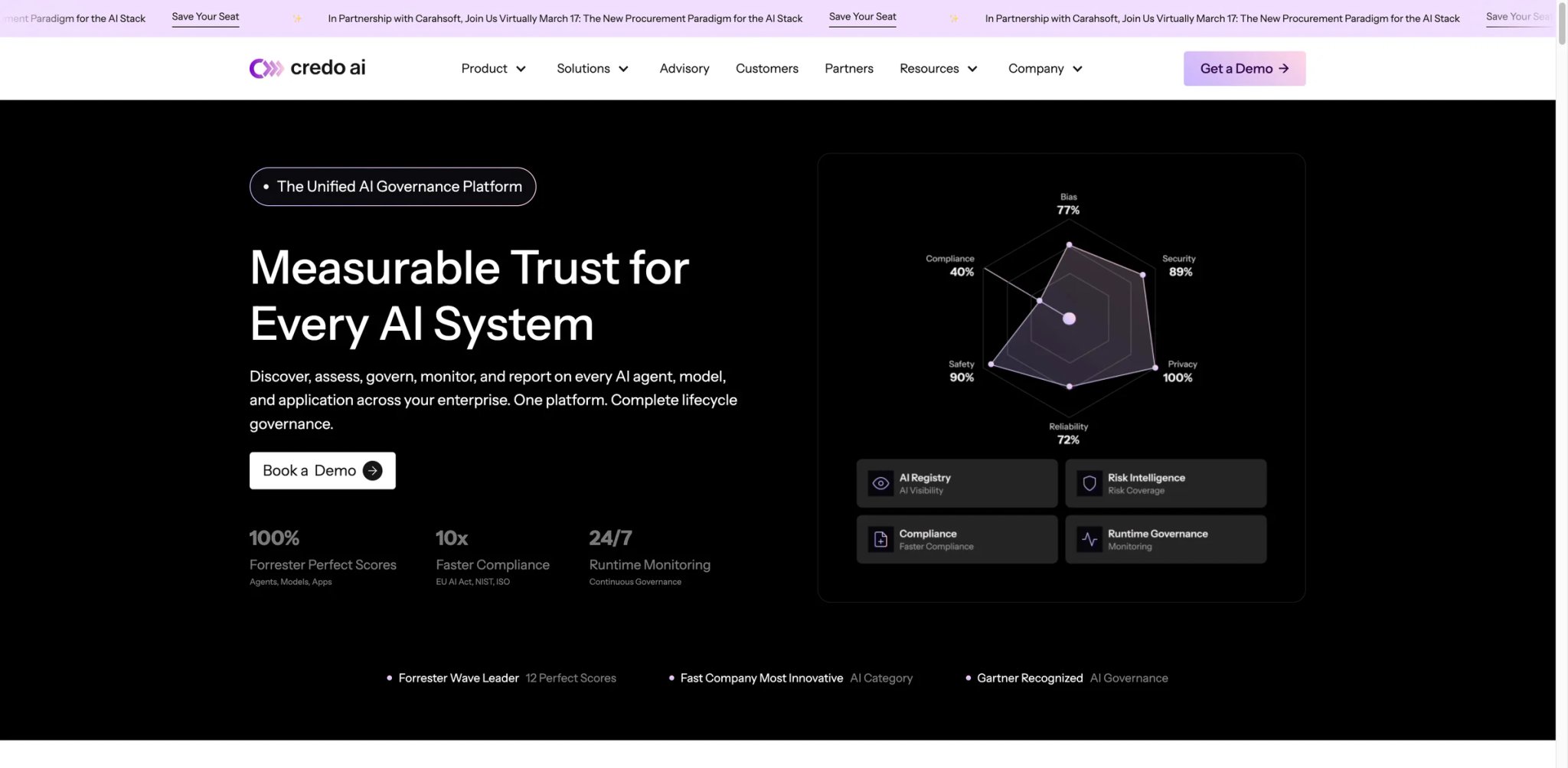
When your legal team needs a defensible audit trail and your data science team needs to move fast, most governance platforms force a trade-off. Credo AI is built to reduce that tension. It received a Forrester Wave Leader designation in Q3 2025, with the highest possible scores in 12 criteria according to Credo AI's official summary—including AI asset catalog, policy management, and regulatory compliance. Enterprises including Microsoft, Databricks, Mastercard, and Booz Allen Hamilton use it for responsible AI governance.
Key Features
- Policy-to-Evidence Compliance Engine — Maintains pre-built mappings to EU AI Act, NIST AI RMF, GDPR, and OECD AI Principles, and automatically generates evidence-backed audit reports. Credo AI reports a 60% reduction in manual time spent reviewing AI use cases through its advisory and governance engagements.
- Cross-Functional Stakeholder Reporting — Generates role-specific reports for board, legal, risk, and operational audiences from a single data source—eliminating the manual work of translating governance data into executive-readable formats. This is the feature compliance teams cite most when justifying the purchase.
- Vendor Registry & Third-Party AI Tracking — Tracks AI systems from external vendors alongside internally built models, closing a governance blind spot that becomes critical as organizations adopt more third-party AI services and agents.
- AI-Powered Governance Assistant — In design partnership phase as of late 2025, this feature brings intelligent intake workflows and context-aware guidance directly into the governance process—reducing the burden on compliance teams to manually interpret policy requirements.
Pricing & Plans
Credo AI does not publish standard pricing. All plans are custom-quoted based on organizational size, number of AI systems, and governance complexity. Also available via Microsoft Marketplace (November 2025), which can simplify procurement for Azure-heavy enterprises. Contact Credo AI for an enterprise quote.
Pros & Cons
Pros:
- Credo AI was named a Leader in the Forrester Wave Q3 2025 and received 5/5 in 12 criteria according to its official summary
- Credo AI reports a 60% reduction in manual review time through its advisory and governance engagements; buyers can use the same workflow as a proof-of-concept benchmark
- Microsoft Marketplace availability simplifies procurement for organizations standardized on Azure
- Purpose-built for compliance team workflows, not repurposed MLOps tooling
Cons:
- No public pricing and no self-serve trial—requires committing to a sales cycle before you can evaluate the platform against your actual environment
- AI Governance Assistant is still in design partnership phase; organizations evaluating this capability now are buying a roadmap item, not a shipped feature
- Credo AI does not publish a minimum portfolio-size threshold; smaller teams should validate whether its governance depth, integrations, implementation effort, and quoted cost fit their actual requirements.
Implementation Notes
- Typical timeline: Credo AI does not publish a standard deployment duration; timing depends on integrations, policy mapping, portfolio scope, and cross-functional stakeholder alignment. Legal, risk, and data science owners should align before technical configuration begins.
- Internal resources required: Compliance officer or AI governance lead to own framework mapping; technical integration support for connecting existing MLOps pipelines to the Credo AI inventory
- Watch for: The AI Governance Assistant is in design partnership—ask Credo AI directly for the GA timeline before including it in your implementation scope
Best For
- Enterprise compliance and risk teams that need board-ready governance documentation without manual reporting assembly
- Organizations deploying third-party AI services alongside internally built models who need unified vendor oversight
- Procurement teams that require third-party analyst validation (Forrester, Gartner) as part of the vendor selection process
- Not the right fit if: You need a self-serve evaluation path before engaging sales, or you need a lightweight self-serve product and Credo AI's enterprise governance scope, implementation requirements, and quoted pricing do not fit your organization
Get started with Credo AI
OneTrust AI Governance
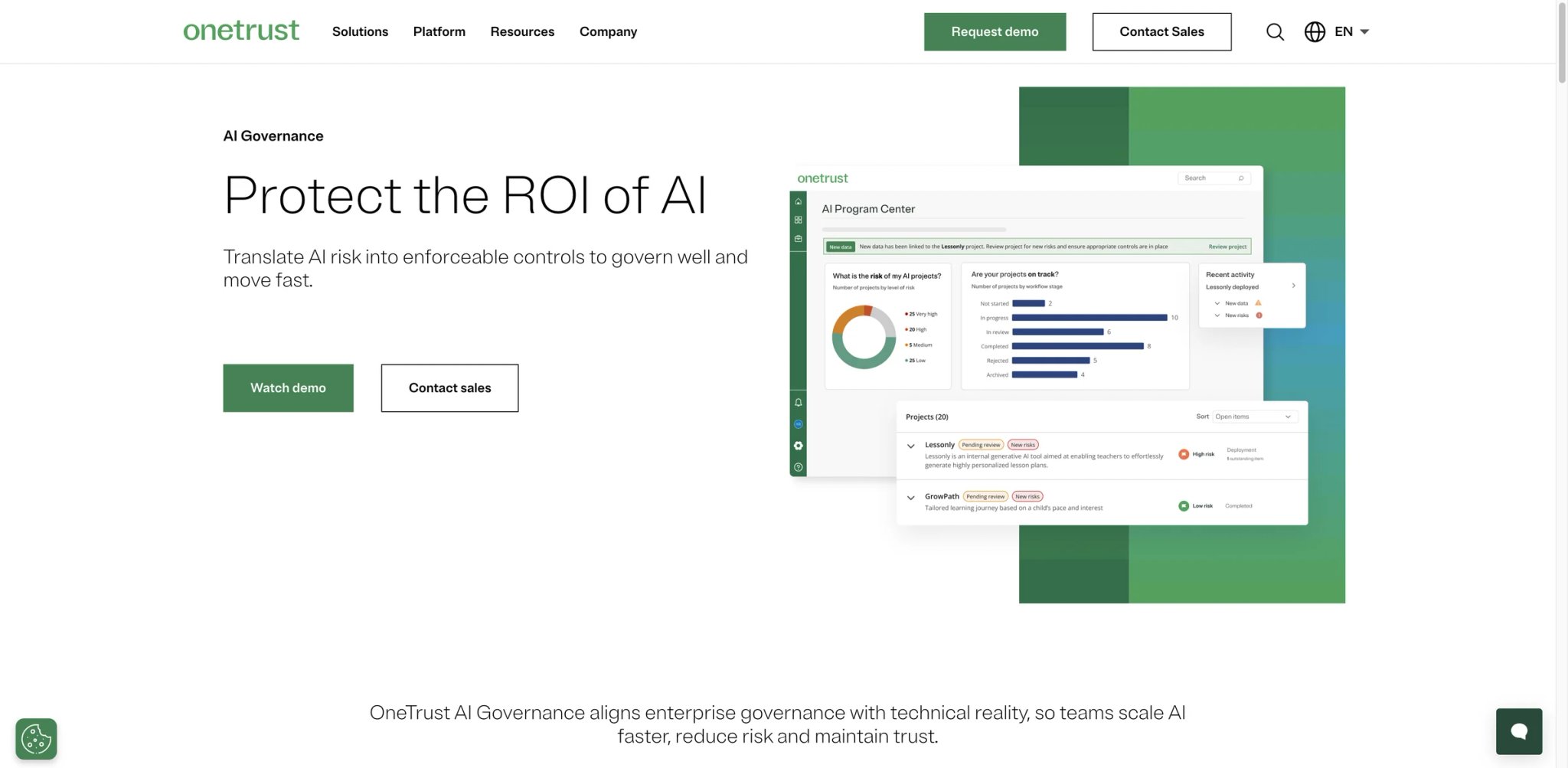
If your organization already uses OneTrust for privacy assessments, data mapping, or vendor risk—the AI Governance module is the fastest path to structured AI compliance you will find. It brings the same compliance-first philosophy to AI systems that OneTrust built its reputation on in the privacy space: centralized inventory, automated risk assessments, and workflow-driven policy enforcement. Native integrations with AWS SageMaker, Azure ML, and Google Vertex automatically sync model metadata, eliminating the manual registry updates that drain compliance team time.
Key Features
- Automated AI Inventory with Cloud Platform Sync — Discovers and registers AI models, datasets, and agents automatically. Native integrations with AWS SageMaker, Azure ML, and Google Vertex keep the inventory current without manual updates—a meaningful operational saving for teams managing models across multiple clouds.
- EU AI Act Workflow Engine — Specialized workflows for EU AI Act obligations: prohibited-use checks, high-risk system classification, and conformity assessment documentation. The AI Act is generally applicable from August 2, 2026, but the AI Omnibus moved Annex III high-risk obligations to December 2, 2027 and Annex I product-embedded high-risk obligations to August 2, 2028. Pre-built workflows can still reduce preparation effort.
- Governance Automation Rules — Trigger-based automation flags risks, routes approvals, and enforces policies without requiring developer involvement for standard configurations. Governance Automation Rules can reduce manual routing work, though actual implementation effort depends on how deeply the organization integrates OneTrust with its existing AI and data stack.
- Cross-Module Integration with OneTrust Privacy & Vendor Risk — When your GDPR/privacy assessments and AI governance share a common data layer, you avoid duplicating effort across separate tools. This integration is the platform's clearest competitive advantage over standalone AI governance alternatives.
Pricing & Plans
Custom-priced and bundled with OneTrust's broader trust intelligence platform. No standard tiers published. Organizations not already on OneTrust should factor in the base platform cost before evaluating the AI Governance module alone. Contact OneTrust sales for a quote.
Pros & Cons
Pros:
- Stands out for integration value for organizations already running OneTrust for privacy or vendor risk management
- Governance Automation Rules reduce manual compliance routing work for standard configurations
- EU AI Act workflows are production-ready, not placeholder documentation
- Gartner Peer Insights users specifically note reliability once the platform is configured
Cons:
- Interface has received criticism for being dated—older-style reports and graphs limit usability despite strong underlying functionality
- Setup requires significant technical expertise, particularly for integration configuration; not self-service for compliance teams without IT support
- Limited value as a standalone AI governance platform for organizations with no existing OneTrust investment
Implementation Notes
- Typical timeline: OneTrust does not publish a standard 8–14 or 14–20 week AI Governance deployment duration; buyers should scope timing based on existing OneTrust maturity, integrations, inventory quality, and workflow complexity.
- Internal resources required: Dedicated OneTrust administrator for integration configuration; compliance owner for framework mapping; IT support for initial SSO and cloud platform connection setup
- Watch for: Users report that undocumented limits on assets require support team intervention—ask OneTrust to provide a complete technical specification of inventory caps and API rate limits before signing
Best For
- Organizations using OneTrust for GDPR, CCPA, or vendor risk management who want to extend the same governance layer to AI without adopting a separate tool
- Compliance teams handling both data privacy obligations and EU AI Act requirements under one operational framework
- Enterprises deploying AI across AWS, Azure, and Google Cloud who need automated model inventory without manual updates
- Not the right fit if: You have no existing OneTrust deployment—standalone OneTrust AI Governance comes with high base platform cost and setup friction compared to purpose-built AI governance alternatives
Get started with OneTrust AI Governance
Holistic AI
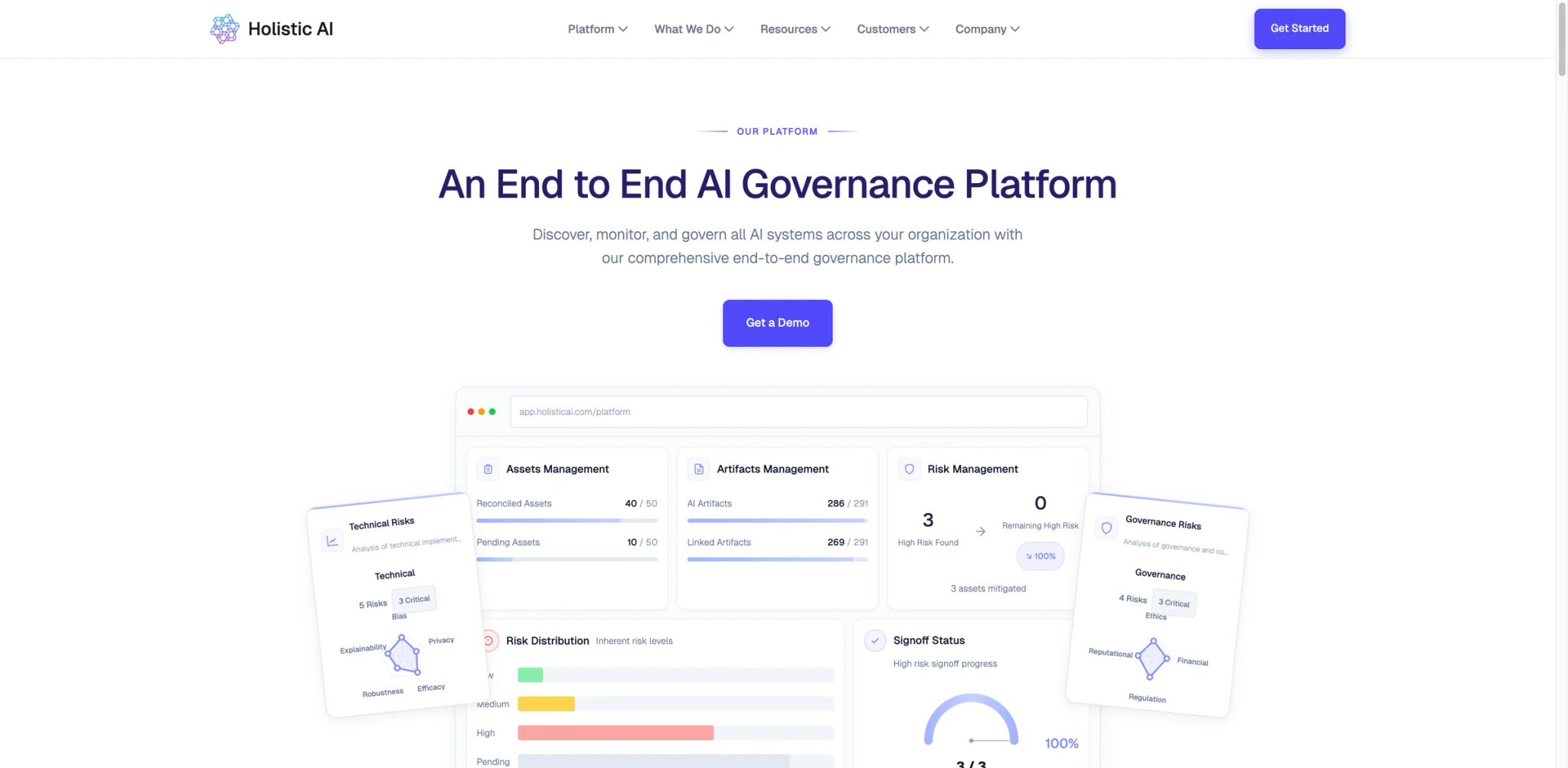
Shadow AI is the governance problem most enterprises discover too late. Business units deploy AI tools, vendors embed models into SaaS products, and data science teams spin up experiments—all outside the IT-approved inventory. Holistic AI is built specifically for organizations that suspect their actual AI exposure is significantly larger than what's officially registered. Its emphasis on automated discovery, centralized inventory, and continuous monitoring makes it a strong choice for enterprises where manual registration-based governance has already failed to capture the full AI footprint.
Key Features
- Shadow AI Discovery at Scale — Uncovers AI deployments across enterprise environments, including systems deployed without IT approval. The automated discovery approach is the platform's primary differentiator—most competitors rely on manual registration rather than proactive discovery across the organization's AI footprint.
- AI Agent-Driven Governance Automation — Holistic AI's Guardian Agents provide runtime oversight: Sentinel Agents monitor risks such as prompt injection, jailbreaks, data leakage, hallucinations, toxicity, and bias, while Operative Agents can intervene on tool access, permissions, cost, and agent identity when defined thresholds are crossed. This matters for large enterprises where manual governance processes simply don't scale to the number of systems in production.
- Quantitative Multi-Dimensional Risk Assessment — Evaluates each AI system across bias, robustness, privacy, explainability, and efficacy—with actionable mitigation recommendations for each risk dimension, not just scores.
- Global Regulatory Coverage Across 50+ Jurisdictions — Built-in framework assessments cover the EU AI Act, NIST AI RMF, ISO 42001, and NYC Local Law 144, alongside support for custom frameworks. Relevant for enterprises operating across multiple regulatory environments simultaneously.
Pricing & Plans
Custom pricing based on organizational scale and governance scope. Holistic AI does not currently publish standard platform pricing or a free governance-platform tier; buyers should request a demo and enterprise quote. Its separate free Holistic AI Tracker is a regulatory knowledge tool, not the governance platform.
Pros & Cons
Pros:
- Shadow AI discovery catches governance blind spots that self-registration-based platforms miss entirely
- AI-agent-driven automation scales governance capacity without adding headcount
- Global regulatory coverage across 50+ jurisdictions for enterprises operating across multiple regulatory environments
Cons:
- Custom pricing with no published tiers; Holistic AI does not publish a portfolio-size threshold at which its economics become unfavorable; buyers should compare quoted cost against discovery scope, regulatory coverage, integrations, and portfolio complexity.
- AI agent-driven workflows require meaningful initial configuration investment before the automation benefits materialize
- Less specialized for financial services model risk management compared to ValidMind or ModelOp Center
Implementation Notes
- Typical timeline: Holistic AI does not publish standard 6–10 week discovery or additional 4–8 week business-unit deployment timelines; obtain a scoped implementation plan for the environments and workflows being governed.
- Internal resources required: AI governance lead to own framework configuration; IT/security participation in the discovery phase to validate findings before the inventory is treated as authoritative
- Watch for: Shadow AI discovery often surfaces more systems than leadership expects—plan for an internal communication and triage process before the full inventory is shared organization-wide
Best For
- Large enterprises with decentralized AI adoption across business units who genuinely don't know the full scope of their AI deployment
- Regulated industries (finance, healthcare, insurance, government) where unregistered AI systems create regulatory and legal exposure
- Risk teams that need governance to scale with a rapidly growing AI portfolio without proportionally growing the governance team
- Not the right fit if: Your AI portfolio is small and fully registered—discovery automation provides limited value if you already have complete inventory visibility
Get started with Holistic AI
ModelOp Center
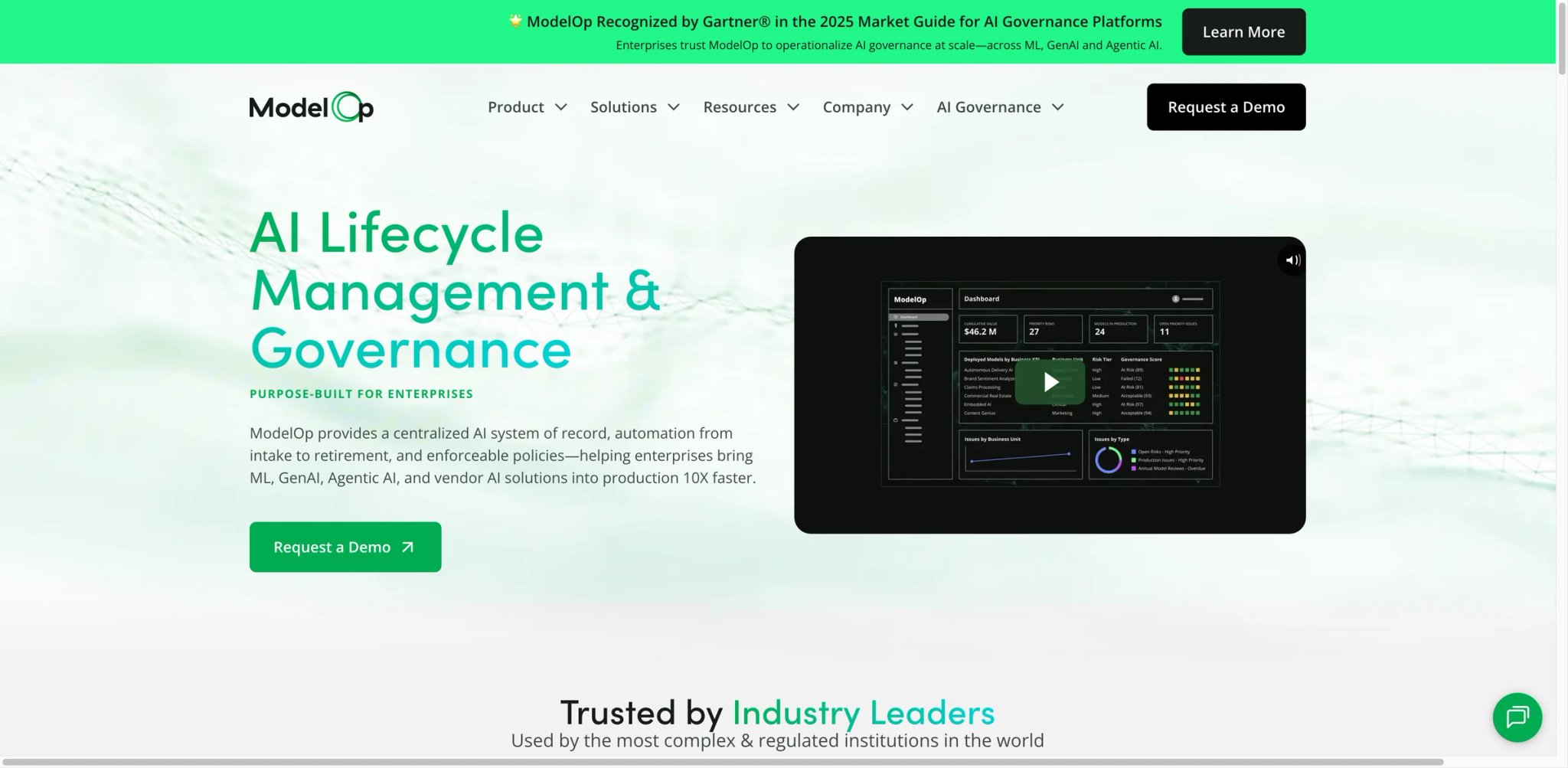
Financial institutions deploying AI face a governance challenge most platforms aren't designed for: managing traditional statistical models, machine learning models, generative AI, and third-party vendor AI systems under a single risk framework. ModelOp Center treats all four as first-class objects in one system of record. ModelOp publishes financial-services case studies reporting 50% reductions in time-to-market, including a Royal Bank of Canada Capital Markets bond-trading deployment; these are vendor-reported outcomes rather than independent benchmarks. Gartner recognized ModelOp in both its 2025 Market Guide for AI Governance Platforms and its AI TRiSM guide.
Key Features
- Unified AI Asset Registry for All Model Types — Manages traditional ML, generative AI, agentic AI, and third-party vendor AI in a single inventory. This eliminates the fragmentation problem of maintaining separate registries for legacy models and new GenAI deployments—a critical pain point for financial institutions mid-transition.
- Policy-Driven Lifecycle Automation — Configurable governance policies automate the entire AI lifecycle from intake through retirement, with risk-tiered approval routing. ModelOp attributes the time-to-market improvements in its case studies to fewer manual handoffs; buyers should test that effect against their own approval process.
- Continuous Monitoring with Automated Bias and Drift Testing — Real-time production monitoring with automated testing for bias, drift, and performance degradation. Alerts trigger governance workflows rather than just notifications—violations initiate review processes automatically.
- NIST, EU AI Act, and ISO 42001 Compliance Automation — Auto-generates required controls based on risk assessments and maintains compliance documentation continuously, not just at audit time. Available on AWS Marketplace (January 2026) and Azure Marketplace for simplified procurement.
Pricing & Plans
Custom enterprise pricing with no standard tiers published. Available through AWS Marketplace and Microsoft Azure Marketplace with flexible production pricing via private offers—useful for organizations that want to consolidate AI governance billing into existing cloud spend. Contact ModelOp for a quote.
Pros & Cons
Pros:
- ModelOp publishes financial-services case studies reporting a 50% time-to-market improvement; use that as a vendor reference point, not an independent or generally applicable benchmark
- Single system of record for all AI asset types eliminates the registry fragmentation problem at the root
- AWS Marketplace availability enables procurement through existing AWS Enterprise Discount Program
- Strong recognition in both Gartner AI Governance and AI TRiSM Market Guides
Cons:
- Pricing is not publicly disclosed; every evaluation requires direct sales engagement before a quote is available
- Implementation requires meaningful policy configuration investment; the automation benefits don't materialize without upfront governance framework setup
- Lighter on advanced GenAI security features (prompt injection, hallucination detection) compared to platforms like Lumenova AI
Implementation Notes
- Typical timeline: ModelOp does not publish a standard production deployment duration covering both traditional ML and GenAI governance. Financial-services buyers should obtain a scoped plan based on portfolio size, integrations, existing model-risk processes, and policy complexity.
- Internal resources required: Model risk officer or governance lead to own policy framework configuration; MLOps engineer for pipeline integration; legal/compliance input for regulatory mapping setup
- Watch for: ModelOp's strength is in financial services—if your use case is primarily healthcare or government AI governance, request reference customers in your sector before committing
Best For
- Financial services institutions managing a mixed portfolio of traditional models and new GenAI systems that need governance under a unified framework
- Banks and investment firms that want to test whether lifecycle automation reduces approval handoffs and model time-to-market in their own environment
- AWS or Azure-native enterprises who want AI governance procurement consolidated into existing cloud billing
- Not the right fit if: Your AI portfolio is primarily outside financial services, or you need a large established vendor for procurement committee confidence
Get started with ModelOp Center
DataRobot AI Governance
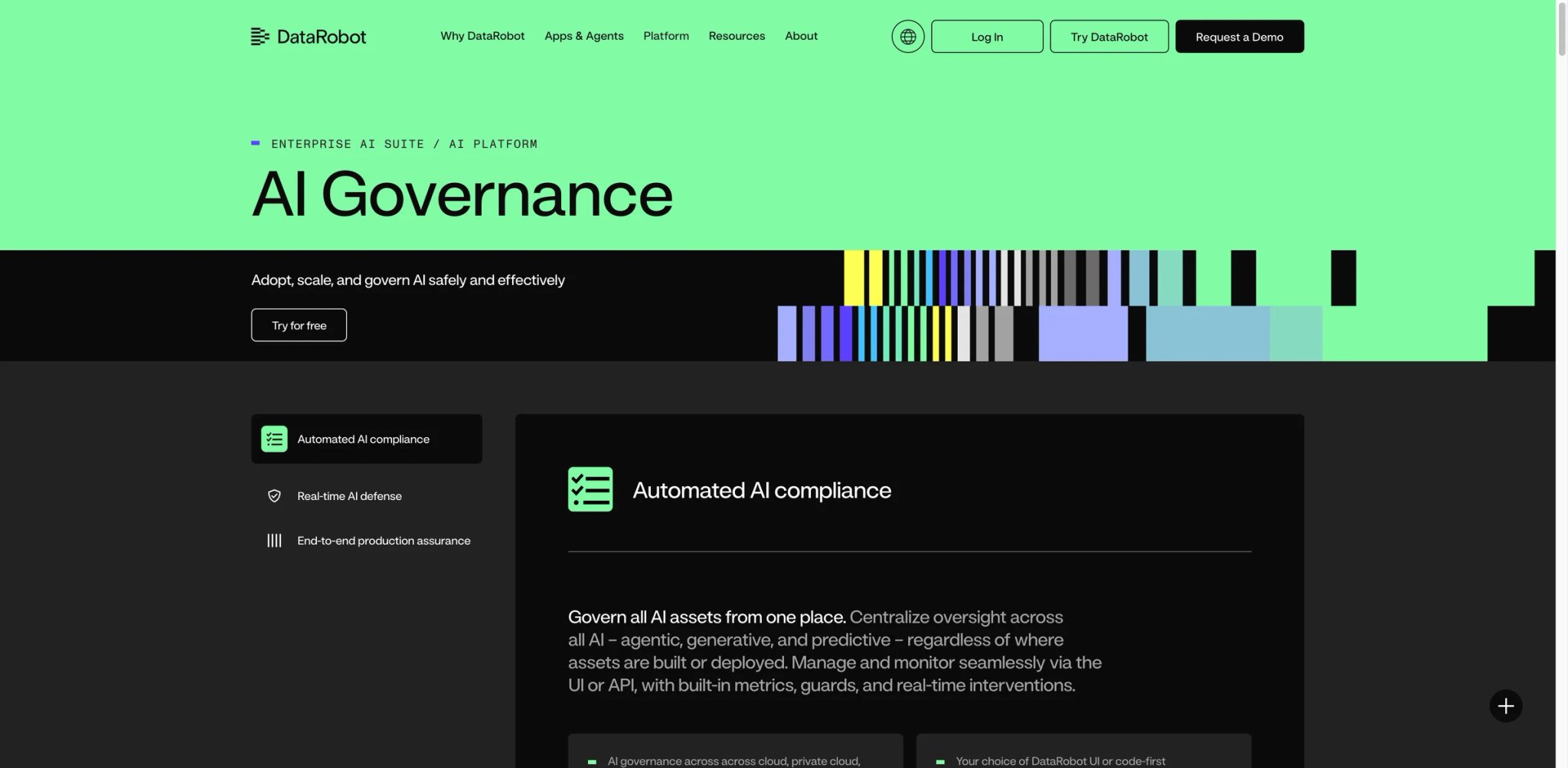
The governance problem for DataRobot users is straightforward: the models are already built there, and adding a separate governance layer creates integration overhead and duplicate metadata. DataRobot AI Governance solves this by embedding compliance testing, role-based access control, model history tracking, and production monitoring directly into the DataRobot platform—no connector configuration, no separate registry to maintain. For teams already using DataRobot as their primary ML platform, this native integration is the decisive reason to stay within the ecosystem rather than adopting a standalone governance tool.
Key Features
- One-Click Automated Compliance Documentation — Generates compliance evidence packages in a single action—the closest thing to instant audit preparation in this comparison. Particularly valuable for regulated industries where producing documentation on short notice is a recurring pain point.
- Vector Database Governance for RAG Architectures — Full visibility and activity logging for vector databases, addressing a governance gap that most platforms overlook. As RAG-based GenAI deployments proliferate, ungoverned vector databases represent a growing regulatory blind spot—DataRobot directly addresses it.
- Bolt-On Observability for Multi-Platform Deployments — Extends DataRobot monitoring to models deployed on Google Vertex, Databricks, and Microsoft Azure with minimal code changes. Teams running multi-cloud deployments get governance without requiring all models to be re-deployed within DataRobot.
- Fairness Monitoring with SR 11-7 Alignment — Continuous monitoring for model fairness across protected groups with configurable thresholds, structured to support SR 11-7 model risk requirements. Purpose-built for regulated industries where fairness evidence is required for audit and regulatory review.
Pricing & Plans
Custom-quoted based on deployment size and feature requirements. No setup fees. DataRobot does not publish standard public pricing for AI Governance. Contact DataRobot sales for a custom enterprise quote.
Pros & Cons
Pros:
- Native integration with DataRobot eliminates integration overhead entirely for existing platform users
- One-click compliance documentation is the fastest audit preparation path reviewed
- Vector database governance fills a real gap for RAG-based GenAI deployments
- No setup fees reduce the initial cost barrier compared to platforms with implementation charges
Cons:
- Value is tightly bounded by DataRobot ecosystem usage—as a standalone governance layer for models built elsewhere, it is significantly weaker than IBM, Credo AI, or Holistic AI
- External-model governance still depends on supported integrations, so vendor-neutral coverage should be tested against the buyer's actual cloud and model stack
- A 14-day self-serve trial helps with product evaluation, but it does not reveal enterprise production cost because that pricing remains custom-quoted
Implementation Notes
- Typical timeline: DataRobot does not publish standard 4–8 or 12–18 week governance implementation timelines; deployment timing depends on existing platform adoption, integrations, governed assets, and production scope.
- Internal resources required: DataRobot platform administrator; MLOps engineer for multi-platform observability setup if governing models outside DataRobot; compliance owner for fairness threshold configuration
- Watch for: Validate each external deployment target during the trial or proof of concept; multi-platform coverage depends on the specific integration and production scope
Best For
- Data science teams with DataRobot as their primary ML platform who need governance without adding a separate tool to maintain
- Organizations deploying GenAI with RAG architectures who need vector database governance alongside model governance
- Compliance teams in regulated industries who need rapid on-demand compliance documentation for audit requests
- Not the right fit if: Your models are built primarily outside DataRobot, or you need a vendor-agnostic governance layer that covers third-party AI systems at scale
Get started with DataRobot AI Governance
Collibra AI Governance
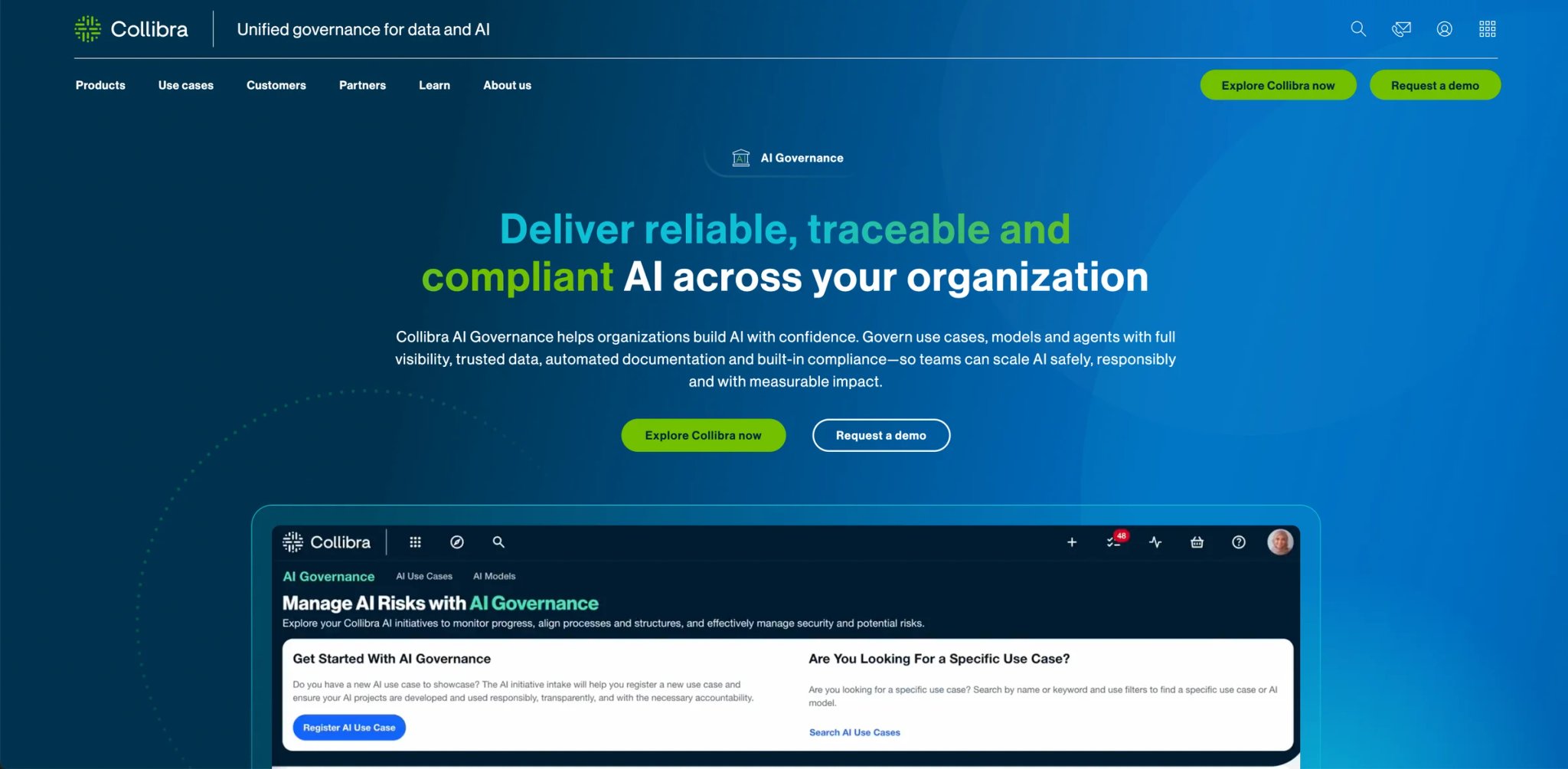
The question regulators are increasingly asking isn't just "what AI do you use?"—it's "what data was used to train it, and where did that data come from?" Collibra AI Governance answers that question better than any platform reviewed, because it was built from data governance up rather than model governance out. End-to-end lineage tracing from source dataset through training, inference, and production deployment is Collibra's defining capability. For organizations already using Collibra for data cataloging, extending governance to AI models means the same data lineage infrastructure serves both data and AI audit requirements simultaneously. User-review platforms such as PeerSpot indicate strong enterprise satisfaction for Collibra in this category.
Key Features
- End-to-End Data-to-Model Lineage — Tracks complete provenance from source datasets through model training, inference, and deployment—the deepest lineage tracing of any platform reviewed. When regulators ask to see training data provenance, this is the capability that produces defensible answers.
- Multi-Cloud AI Model and Agent Registries — Manages AI assets across AWS, Azure, Google Cloud, Databricks, SAP, MLflow, and Azure AI Foundry in a unified registry. Automated Azure AI Foundry traceability stitches lineage without manual documentation—directly reducing documentation overhead for Microsoft-heavy enterprises.
- AI Use Case Governance Workflow — Centralized intake, documentation, and approval workflows for AI use cases, with formal sign-off requirements before deployment. Collibra's AI agent registry is generally available, and the current AI Command Center provides a unified registry for AI use cases, models, and agents with lifecycle tracking and governance context.
- EU AI Act and NIST AI RMF Compliance Templates — Out-of-the-box compliance templates with configurable governance workflows adaptable to department-specific requirements—not a one-size-fits-all approach.
Pricing & Plans
Collibra does not publish standard pricing. Public procurement documents (UK government G-Cloud records) include annual subscription examples, but these are benchmarks rather than universal list prices. Buyers should request a scoped quote covering both software and implementation services; Collibra does not publish a standard services percentage.
Pros & Cons
Pros:
- User-review platforms such as PeerSpot indicate strong enterprise satisfaction for Collibra in AI governance, which is a useful signal for procurement committees
- Data-to-AI lineage is a genuine differentiator; no other platform in this list traces provenance from training data through production deployment at comparable depth
- Unlimited viewer users reduce per-seat costs for broad stakeholder reporting access
- The generally available AI agent registry places models, agents, and use cases in the same governance context
Cons:
- Total cost is among the highest in this comparison based on available benchmark data—appropriate scrutiny is warranted; this is a multi-year commitment
- Users cite documentation gaps around AI governance features and configuration complexity requiring support team intervention
- Organizations evaluating agent governance should verify the connectors and lifecycle workflows required for their specific agent stack
Implementation Notes
- Typical timeline: Collibra does not publish a standard AI Command Center implementation duration. Scope greenfield timing with Collibra or an implementation partner based on data-governance readiness and integration requirements.
- Internal resources required: Dedicated Collibra administrator, data governance lead, AI governance owner, and likely implementation-partner support; request separate software and services estimates
- Watch for: Users report that some AI governance features lack adequate documentation and require support team involvement to configure—factor in a discovery and documentation sprint before beginning technical implementation
Best For
- Enterprises already using Collibra for data governance who need AI governance under the same lineage infrastructure—this is where the cost is most defensible
- Organizations where training data provenance is a primary regulatory requirement (financial services, healthcare, EU AI Act high-risk systems)
- Azure-heavy enterprises deploying through Azure AI Foundry who benefit from automated lineage stitching
- Not the right fit if: You don't have an existing Collibra investment—the base platform cost alone makes standalone AI governance deployment difficult to justify against purpose-built alternatives
Get started with Collibra AI Governance
Lumenova AI
Most mid-size enterprises face the same governance dilemma: they need rigorous AI risk management, but broad enterprise platforms may exceed their immediate scope. Lumenova AI addresses this gap with quantitative AI risk evaluation backed by 200+ documented metrics and implementation support. Its evaluation engine covers fairness, explainability, security (prompt injection, sensitive data leakage), and performance drift. A dedicated Forward Deploy Team supports implementation. Because Lumenova AI does not publish list pricing, buyers need comparable quotes before assuming it costs less than IBM or Credo AI.
Key Features
- 200+ Metric Quantitative Risk Engine — Evaluates AI systems across fairness, explainability, security, and performance dimensions with more granular measurement than most platforms in this comparison. The depth matters when regulators ask for evidence beyond qualitative assessments.
- GenAI and AI Agent Security Guardrails — Pre-built guardrails against prompt injection, hallucination risks, and sensitive data exposure—addressing the security dimension of AI governance that compliance-focused platforms often underinvest in. Lumenova treats GenAI governance as a security problem, not just a compliance problem.
- Compliance Templates for Niche Regulations — Pre-built support for EU AI Act, NIST AI RMF, and ISO 42001, plus NYC Local Law 144 (algorithmic bias in employment decisions) and Colorado Regulation 10-1-1 (insurance AI). Relevant for US-based organizations navigating state-level AI regulations alongside federal frameworks.
- ROI and Cost Analysis Tracking — Built-in tools to quantify the business value of AI governance investments and track cost implications of AI risk decisions—helps governance teams justify spend to CFOs and boards in financial terms.
Pricing & Plans
Custom enterprise pricing. No standard tiers published. Request a demo to receive a pricing proposal tailored to organizational scale. Lumenova does not publish standard deployment timelines publicly—confirm implementation scope and timeline directly with the vendor during evaluation.
Pros & Cons
Pros:
- 200+ documented evaluation metrics provide broad quantitative coverage across fairness, explainability, security, and performance
- Forward Deploy Team accelerates implementation for resource-constrained organizations without dedicated AI governance engineers
- GenAI security guardrails extend governance into threat territory that compliance-only platforms miss
- NYC Local Law 144 and Colorado-specific compliance templates address a gap that larger platforms with global focus often ignore
Cons:
- No public pricing or self-serve trial; every evaluation requires a demo engagement
- Less established analyst recognition compared to IBM, Credo AI, or Collibra—relevant for procurement committees that weight Forrester/Gartner validation
- 200+ metrics require prioritization configuration upfront; without guidance, teams can be overwhelmed by the breadth of assessment dimensions
Implementation Notes
- Typical timeline: Lumenova AI provides a Forward Deploy Team for implementation support but does not publish a standard 4–8 week deployment duration; scope timing directly against your integrations and governance requirements.
- Internal resources required: AI governance lead for framework configuration; the Forward Deploy Team reduces but does not eliminate the need for an internal owner
- Watch for: Validate which specific metrics and compliance frameworks are pre-configured versus require custom setup before signing—"200+ metrics" is a maximum capability, not a Day 1 out-of-box configuration
Best For
- Mid-size enterprises that need quantitative risk assessment and implementation support, and can compare Lumenova's custom quote with broader enterprise alternatives
- Organizations deploying GenAI with security-sensitive use cases where prompt injection and data leakage are active concerns
- US-based organizations in sectors subject to state-level AI regulations (employment, insurance) alongside EU AI Act requirements
- Not the right fit if: Your primary requirement is analyst-validated governance credentials for procurement committees, or you're a large enterprise where the Forward Deploy Team model doesn't scale to your portfolio size
Get started with Lumenova AI
ServiceNow AI Control Tower
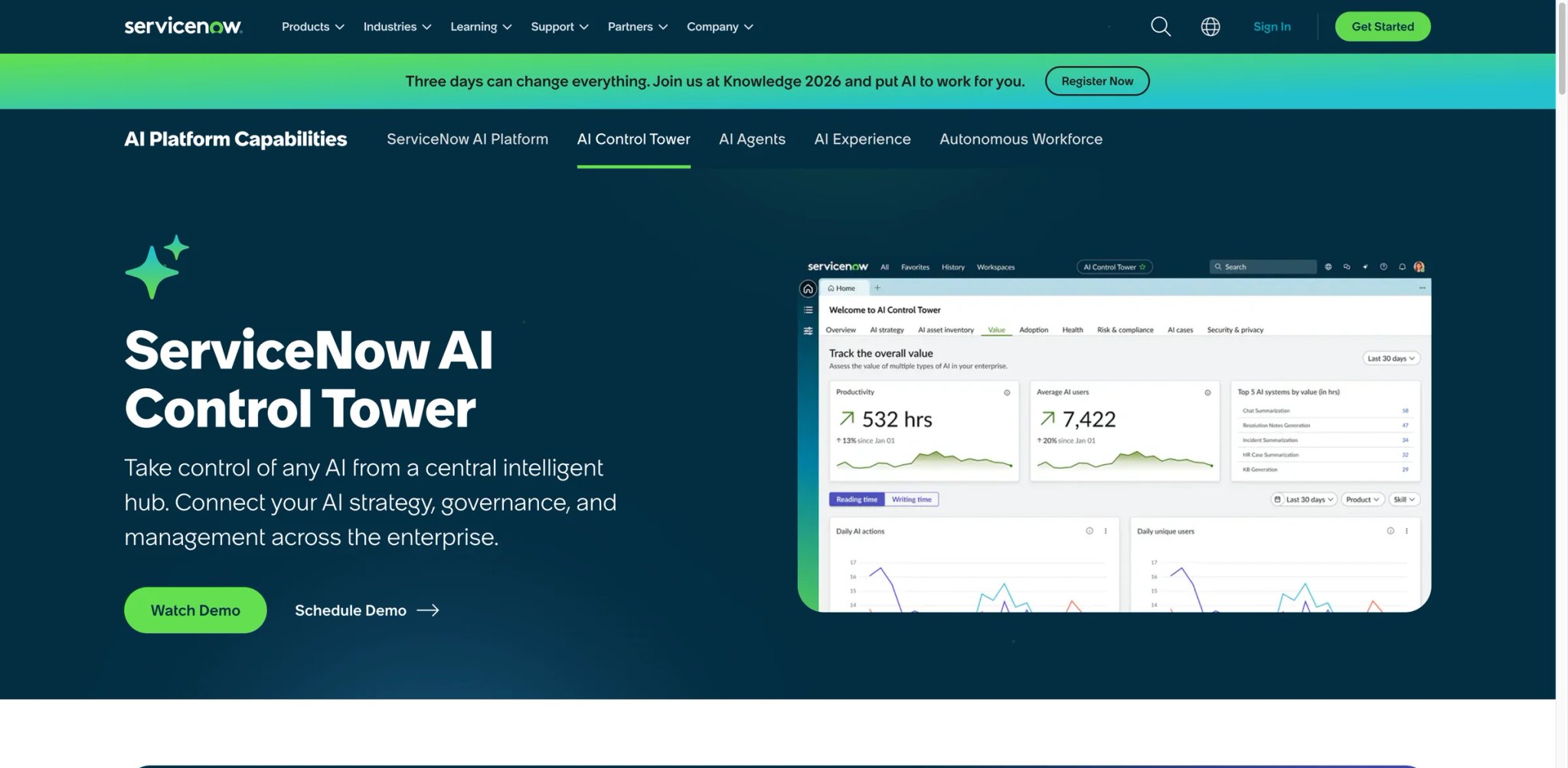
For enterprises where ServiceNow is the operational backbone, AI governance in a separate tool creates a problem: governance records, ITSM workflows, and business service dependencies live in different systems, and the connections between them have to be maintained manually. AI Control Tower, launched May 2025, solves this by embedding AI governance directly into the ServiceNow CMDB, ITSM processes, and Strategic Portfolio Management—connecting every AI asset to the business services it supports, the compliance obligations it carries, and the operational processes it touches. Chief AI Officers, CIOs, and risk leaders each get purpose-built workspaces rather than a generic dashboard.
Key Features
- CMDB-Connected AI Asset Inventory — Every AI system is registered in ServiceNow's Configuration Management Database, linked to dependent business services and operational processes. When an AI model is flagged for compliance violation, the downstream business impact is immediately visible—something no standalone governance tool can replicate without a separate integration.
- Built-In EU AI Act and NIST AI RMF Content — Pre-built compliance workflows for both frameworks, including automated mapping, bias/fairness auditing, and explainability tracking. Gartner's AI governance research projects 30% higher customer trust ratings and 25% better compliance scores for organizations using structured AI governance platforms by 2028.
- Strategic Portfolio Integration — Links AI initiatives to business strategy through Strategic Portfolio Management, enabling ROI measurement across the AI portfolio. This is the capability that CTOs and CAIOs use to answer "what business value are we getting from our AI investment?"—directly connected to governance data.
- Multi-Role Governance Workspaces — Dedicated workspaces for Chief AI Officers, CIOs, risk leaders, security teams, and AI stewards, each surfacing the governance data relevant to that role without requiring context switching across multiple tools.
Pricing & Plans
ServiceNow does not publish list prices. Under its 2026 AI-native packaging, AI Control Tower is embedded across Foundation, Advanced, and Prime. Foundation and Advanced manage ServiceNow AI assets, while Prime extends full management and assist metering to external AI assets. Confirm commercial packaging directly with ServiceNow, and factor in the base platform cost if the organization does not already use it.
Pros & Cons
Pros:
- Eliminates the governance-to-operations integration problem for ServiceNow-centric enterprises—governance, ITSM, and business services exist in the same data layer
- Multi-role workspaces designed for the actual AI governance stakeholder landscape (CAIO, CIO, risk, security, AI stewards)
- Strategic Portfolio integration directly answers board-level questions about AI investment ROI
- Built on ServiceNow's GRC capabilities, recognized by Forrester as market-leading
Cons:
- Effectively no value for organizations not running ServiceNow Enterprise—the differentiation is entirely ecosystem-dependent
- AI Control Tower adds cost on top of an already substantial ServiceNow Enterprise base; total cost requires careful scoping
- Less specialized AI risk depth than purpose-built platforms like Credo AI or IBM for organizations whose primary requirement is technical model risk management
Implementation Notes
- Typical timeline: ServiceNow does not publish a standard AI Control Tower implementation duration; timing depends on CMDB readiness, integrations, licensing tier, asset scope, and governance configuration. An incomplete or outdated CMDB adds data-quality work before the inventory can be trusted.
- Internal resources required: ServiceNow platform administrator; CMDB data owner for AI asset onboarding; AI governance lead for framework configuration; CAIO or equivalent executive sponsor to drive multi-role workspace adoption
- Watch for: The CMDB data quality dependency is the most common implementation blocker—AI governance output is only as accurate as the underlying CMDB asset data. Conduct a CMDB audit before beginning the AI Control Tower rollout
Best For
- Enterprises running ServiceNow as their primary ITSM and workflow platform who want AI governance connected to operational systems without a separate tool
- Organizations that need to link AI risk directly to business service impact in real time—the CMDB connection is the capability no standalone governance tool replicates
- Chief AI Officers and CAIOs needing a governance dashboard that speaks to business strategy alignment, not just compliance status
- Not the right fit if: ServiceNow is not your operational backbone, your CMDB is incomplete, or your primary governance requirement is deep technical AI risk management rather than IT governance integration
Get started with ServiceNow AI Control Tower
Dataiku Govern
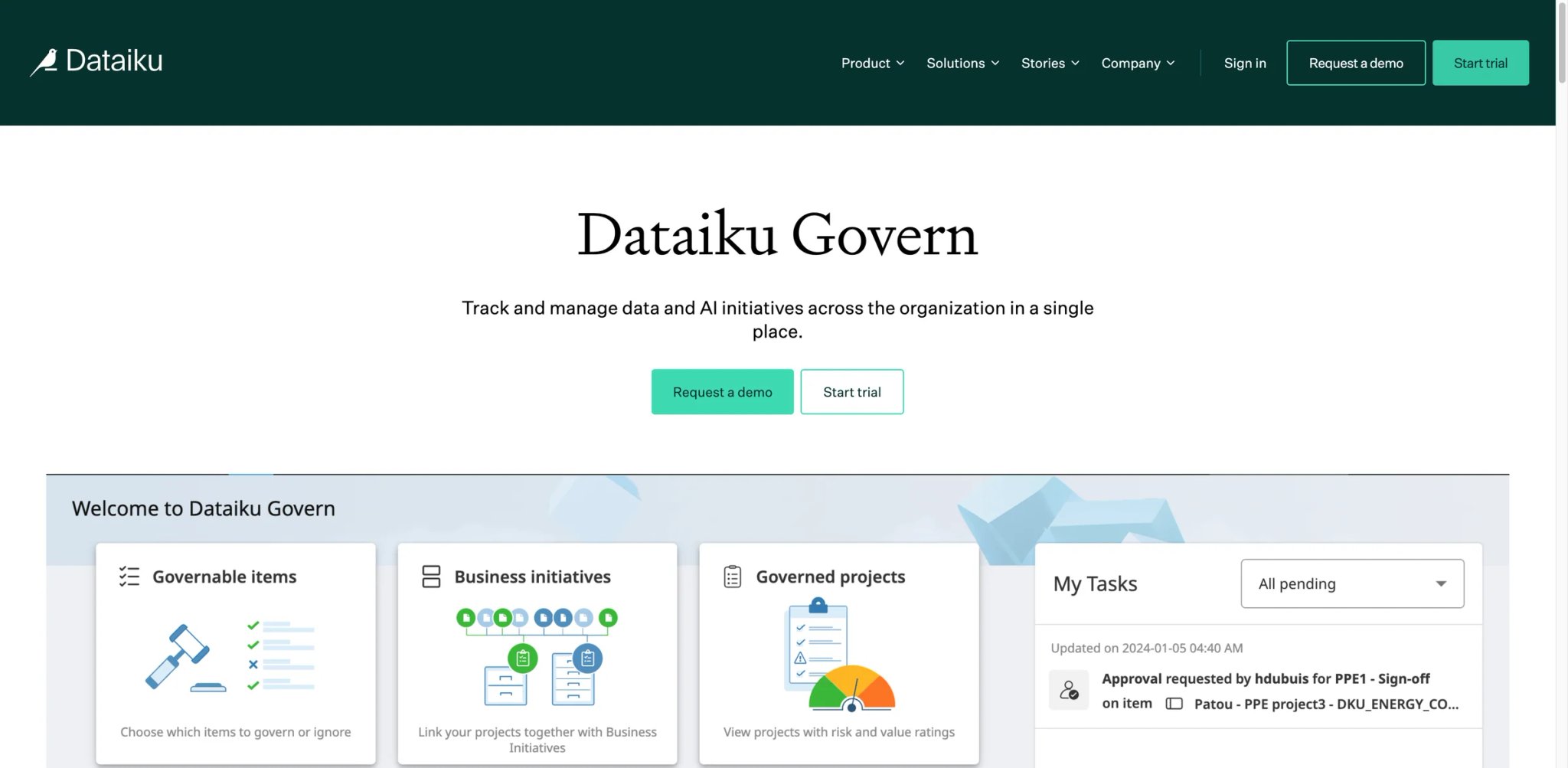
Governance that exists outside the development workflow is governance that gets bypassed. Dataiku Govern solves this by embedding approval workflows, sign-off requirements, and compliance templates directly into the Dataiku platform where models are actually built. For organizations using Dataiku as their primary AI development environment, this means governance isn't an additional process layer—it's enforced within the tools data scientists already use. Dataiku was named a Leader in the IDC MarketScape 2025-2026 for Unified AI Governance, covering analytics, traditional ML, generative AI, and agentic systems under one governance framework.
Key Features
- Embedded Governance with Enforced Controls — Governance workflows and sign-off requirements are enforced directly within the Dataiku development environment. Project standards automatically validate compliance against organizational policies before release—governance can't be skipped by routing around a separate tool.
- Customizable Governance Templates and Hierarchical Rules — Configurable templates for different project types, with governance policies applied hierarchically across the project structure. Parent items must be governed before child items can be governed, enforcing systematic review order.
- Govern + Hide Framework — Two-mode governance: apply full sign-off workflows to items requiring oversight, or explicitly exclude items from the governance cycle when oversight isn't warranted. This prevents governance overhead from accumulating on low-risk work.
- Full API Access for External Compliance Integration — Complete API coverage for governance tasks, artifact management, and administration enables integration with external GRC systems—important for organizations that need Dataiku governance data to flow into enterprise risk management platforms.
Pricing & Plans
Dataiku does not publish standalone public pricing for Govern. Governance capabilities are part of the broader Dataiku platform and depend on higher-tier licensing and Govern node deployment. Dataiku's standard 14-day free trial explicitly excludes Govern and advanced LLM Mesh, so evaluating Govern requires an appropriately licensed or sales-provisioned environment—buyers should confirm which tier unlocks governance features before evaluation.
Pros & Cons
Pros:
- IDC MarketScape 2025-2026 Leader recognition for unified AI governance—meaningful third-party validation
- Governance is enforced, not optional—embedded controls prevent the workflow bypass problem that external governance tools can't solve
- On-premises deployment option for air-gapped or data-sensitive environments
Cons:
- Value is entirely bounded by Dataiku platform usage; not designed as a standalone governance layer for models built elsewhere
- Compliance framework support is narrower than purpose-built governance platforms—Credo AI, IBM, and Holistic AI all offer deeper regulatory framework coverage
- Governance capabilities serve project oversight rather than enterprise-wide AI risk management; if your requirement is cross-platform AI inventory and risk scoring, Dataiku Govern is insufficient
Implementation Notes
- Typical timeline: Dataiku does not publish a standard 2–4 week Govern implementation duration; existing Dataiku customers should scope timing around templates, approval workflows, integrations, and organizational governance requirements.
- Internal resources required: Dataiku platform administrator for template configuration; governance owner (compliance or risk function) to define sign-off requirements and approval hierarchies
- Watch for: Dataiku Govern governs Dataiku projects—it does not discover or govern AI systems deployed outside Dataiku. If your organization has AI deployed across multiple platforms, Dataiku Govern covers only the Dataiku slice of the portfolio
Best For
- Data science teams using Dataiku as their primary AI development platform who need governance integrated into the workflow rather than added as a separate checkpoint
- Organizations with on-premises or air-gapped deployment requirements where cloud-based governance tools aren't viable
- Teams that want governance enforcement at the development phase rather than only at deployment
- Not the right fit if: You need enterprise-wide AI inventory covering systems built outside Dataiku, or your primary governance requirement is regulatory framework compliance mapping rather than project sign-off workflows
Get started with Dataiku Govern
ValidMind AI Governance
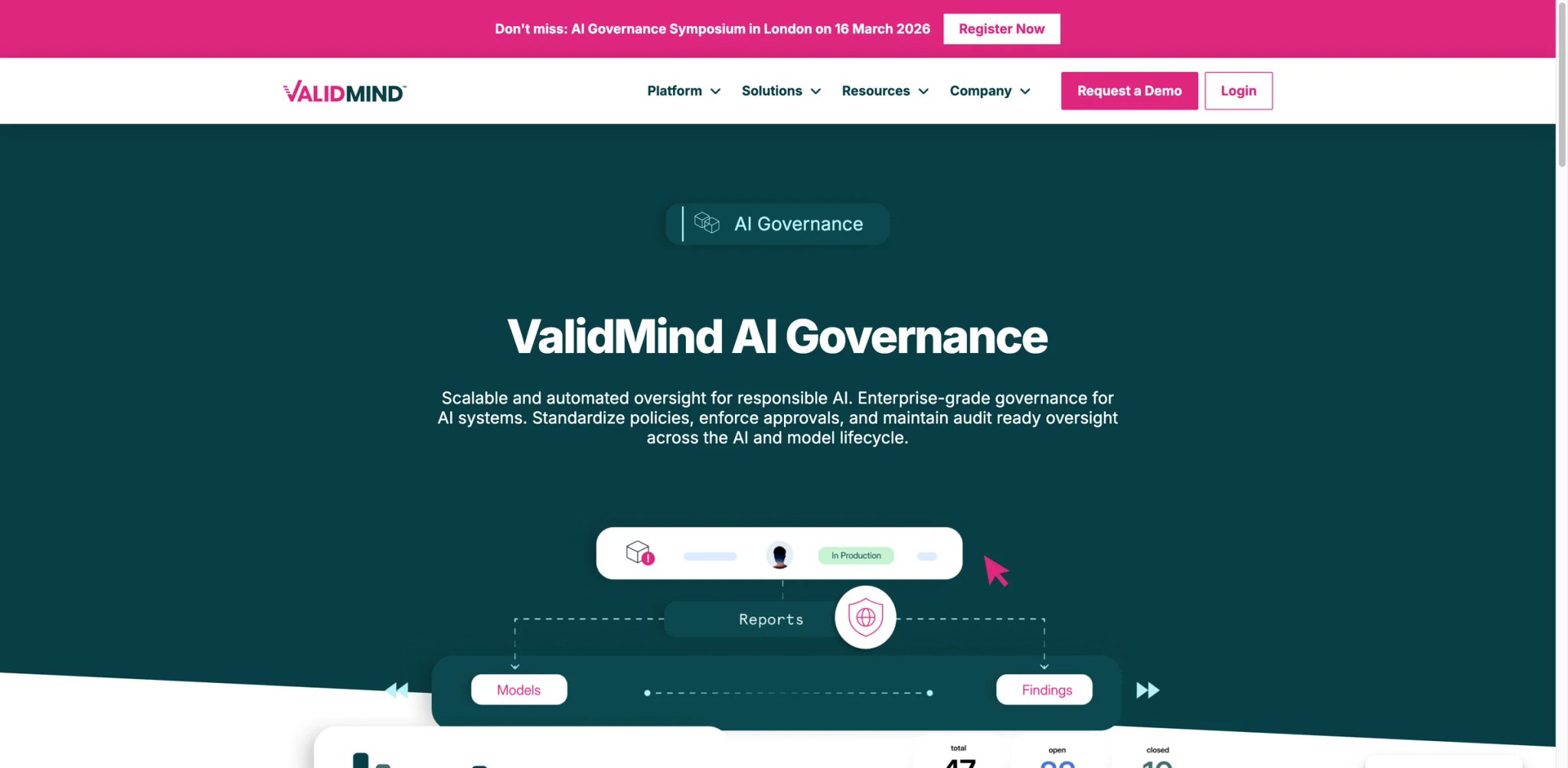
Model documentation in financial services has always been the bottleneck. A model risk team that could handle 20 models a year can't scale to 80 when the organization moves to AI at pace—and regulators don't accept "we didn't have the bandwidth" as a compliance explanation. ValidMind says its AI-assisted generation from code and metadata can reduce model-documentation work by up to 60%, and Chartis ranked it first in the AI Governance category of the 2026 RiskTech100®. In a ValidMind-published case study, one Fortune 500 bank rolled the platform out in 12 weeks and reached 545 active users across all three Lines of Defense.
Key Features
- AI-Automated Model Documentation — Generates model documentation from code and metadata; ValidMind reports reductions of up to 60%. Financial-services buyers should measure the effect on their own documentation and validation workflows during a proof of concept.
- Validation Automation with Pre-Built Test Library — Standardized validation workflows with automated evidence generation across statistical tests, performance benchmarks, and fairness assessments. The Fortune 500 bank implementation processed 38 unique scenarios covering 10 core MRM workflows through 318 individual tests during their PoV alone.
- Attestations Dashboard with Regulatory Document Checker — Structured attestation workflows with questionnaire fields and model snapshots; production-ready document checker validates regulatory compliance before submission. January 2026 updates added webhook integrations and upgraded to GPT-4.1 for documentation AI.
- AWS Bedrock Model Inventory — Native management of AI models deployed through AWS Bedrock, reflecting the growing adoption of managed GenAI services in financial services—and the governance gap that creates when Bedrock models aren't registered alongside internally built models.
Pricing & Plans
Custom enterprise pricing based on number of models, governance complexity, and which modules are needed. Four purchasable modules: AI Governance, AI & Model Risk Management, Validation Automation, and Development Automation. Full platform value requires multiple modules. Contact ValidMind for a quote.
Pros & Cons
Pros:
- Ranked first in the AI Governance category of the Chartis RiskTech100 2026
- ValidMind reports up to 60% less documentation work; buyers should establish a baseline and verify the result in their own workflow
- A vendor-published Fortune 500 bank case study provides a 12-week implementation reference, not a universal deployment timeline
- AWS Bedrock integration covers the GenAI governance gap that banks adopting managed AI services face
Cons:
- Highly specialized for financial services model risk—organizations outside banking, insurance, and investment management will find limited regulatory framework coverage for their sector
- Full platform value requires purchasing multiple modules; organizations that need only documentation automation or only governance oversight pay for more than they need
- No public pricing and no self-serve trial
Implementation Notes
- Typical timeline: The documented Fortune 500 bank case study provides a concrete implementation reference point (12 weeks to 545 users); ValidMind does not publish a separate 6–8 week implementation target for smaller institutions
- Internal resources required: Model risk officer or Chief Risk Officer as executive sponsor; model validators for workflow configuration; data science lead for documentation automation setup; all three Lines of Defense participation during the PoV phase
- Watch for: The multi-module structure means the total contract value can escalate significantly as you add capabilities. Clarify the minimum viable module set for your immediate compliance requirements before the negotiation begins
Best For
- Banks, credit unions, and financial institutions managing model risk under SR 11-7 and OCC guidelines where documentation velocity is a bottleneck
- Model validation teams that need automated evidence generation to keep pace with accelerating model deployment timelines
- Insurance and investment firms expanding model risk programs to cover GenAI deployments on AWS Bedrock
- Not the right fit if: Your organization is outside financial services, or your governance requirement is broad enterprise AI governance (shadow AI discovery, cross-platform inventory) rather than specialized model risk management
Get started with ValidMind AI Governance
Asenion
Asenion stands out because it publishes SMB pricing and offers a free-trial path, reducing the barrier to initial evaluation compared with quote-only enterprise vendors. Its compliance-team-oriented approach lets smaller teams test governance workflows without first navigating an enterprise sales process. The platform launched in June 2025 from Fairly AI's acquisition of Swedish AI governance startup anch.AI, combining a research-based governance framework with practical ISO 42001 compliance tooling.
Key Features
- Fairly Controls™ — Automated Regulatory Mapping — Automatically maps applicable regulations and internal policies to specific controls and continuously monitors AI model compliance status. Reduces the manual effort of interpreting regulatory requirements into actionable controls—a task that absorbs disproportionate time in small governance teams.
- ISO/IEC 42001 Compliance on Entry Plans — ISO 42001 compliance features are included at the entry tier—not paywalled to a premium tier. As enterprise procurement teams increasingly require ISO 42001 certification from AI vendors and partners, this is becoming a table-stakes requirement even for smaller organizations.
- 1,000+ Risk Category Checks at Higher Tiers — Higher-tier plans add comprehensive scanning across 1,000+ risk categories, covering bias, security, and compliance vulnerabilities across predictive, generative, and agentic AI systems. Confirm current tier structure with Asenion.
- Private Cloud and On-Premises Deployment at Higher Tiers — Higher-tier plans support private cloud and on-premises deployment—bringing data residency options to organizations that also need flexible commercial terms. Confirm current availability with Asenion.
Pricing & Plans
Asenion publicly highlights a free-trial path and positions itself as more accessible than enterprise-first vendors. Published self-serve pricing is available: Essential costs $99/month or $1,089/year, Pro costs $299/month or $3,289/year, and Premium is custom-priced—buyers should verify current plan details and pricing directly with Asenion before comparing costs.
Pros & Cons
Pros:
- More accessible entry point than enterprise-first platforms—free-trial path available without sales engagement
- Unlimited users on all tiers—governance doesn't become more expensive as your team grows
- Essential includes ISO/IEC 42001 compliance features, but purchasing the plan does not itself provide or guarantee certification
- Private cloud deployment available at higher tiers for organizations with data residency requirements
Cons:
- Public tiers make initial budgeting easier, though buyers should still confirm current limits, included systems, and deployment options
- Less established analyst recognition compared to Forrester/IDC-rated enterprise platforms; limited reference customers at large enterprise scale
- Fewer pre-built integrations with MLOps platforms (MLflow, Kubeflow, SageMaker) compared to enterprise alternatives
Implementation Notes
- Typical timeline: Asenion does not publish a standard implementation duration for entry plans; confirm deployment timing directly, particularly for private-cloud or on-premises configurations.
- Internal resources required: Compliance owner or risk manager to configure framework templates; minimal technical resources required—the platform is designed for compliance teams without dedicated AI engineering support
- Watch for: Confirm your AI system count and exact tier capabilities with Asenion before selecting a plan, as coverage varies by tier
Best For
- Startups, scale-ups, and SMBs that need real ISO 42001-aligned governance without a six-figure procurement cycle
- Organizations that want to begin governing AI immediately while enterprise procurement processes for larger platforms are underway
- Teams with data residency requirements that need private cloud deployment without an enterprise contract
- Not the right fit if: You need analyst-validated governance credentials for enterprise procurement committees, or your portfolio requires deep integration with enterprise MLOps platforms at scale
Get started with Asenion
Best AI Governance Tools by Use Case
For Large Enterprises with Complex Regulatory Requirements
If you're managing hundreds of AI models across a regulated industry—banking, healthcare, insurance, or government—the depth of IBM watsonx.governance or Credo AI is worth the enterprise price tag. IBM's combination of Forrester and IDC leader status, agentic AI monitoring, and third-party model governance (AWS, Azure, OpenAI) makes it the most comprehensive option for hybrid cloud deployments. Credo AI's strong Forrester Wave performance (12 criteria highest scores per their official summary) makes it the strongest choice for compliance teams that need analyst-validated governance documentation.
For Financial Services Model Risk Management
ValidMind AI Governance is the purpose-built choice for banks and financial institutions managing model risk under SR 11-7 and OCC guidelines. Its documentation automation targets a major labor cost in financial model risk management, but buyers should verify ValidMind's reported reduction in their own workflow. ModelOp Center is the stronger choice for institutions managing both traditional ML models and newer GenAI systems that need a single system of record across all AI asset types.
For Organizations Already on a Platform
Three tools deliver the most value as extensions of existing platforms rather than standalone purchases. DataRobot AI Governance is the clear choice if your data science team already builds models in DataRobot. Dataiku Govern fits teams using Dataiku as their primary AI development environment. ServiceNow AI Control Tower integrates governance into existing ITSM workflows for IT-centric organizations. OneTrust AI Governance is the right choice if you're already managing data privacy and vendor risk through OneTrust.
For Startups and SMBs on a Budget
Asenion is positioned as the most accessible entry point in this comparison, with a free-trial path and an SMB-oriented approach that avoids an enterprise sales cycle. ISO 42001 compliance features are available at entry-level plans. Buyers should confirm current pricing and tier structure directly with Asenion.
For Shadow AI Discovery at Scale
Holistic AI stands out for its shadow AI discovery capabilities—making it the strongest choice for enterprises that suspect significant undiscovered AI deployments across business units. Its AI-agent-driven automation is particularly valuable for large organizations that don't have the governance staff to manually review every AI system.
How to Choose the Right AI Governance Tool
1. Start with your regulatory obligations. If you're subject to the EU AI Act, NIST AI RMF, or ISO 42001, shortlist tools that explicitly support those frameworks. If you're in financial services, ValidMind or ModelOp Center are specialized for SR 11-7 and OCC requirements. Don't pay for compliance coverage you don't need.
2. Audit your existing technology stack. If your team builds models in DataRobot or Dataiku, their native governance tools are the lowest-friction starting point. If your operations run on ServiceNow, AI Control Tower is the logical choice. Platform-native tools avoid the integration overhead of a standalone governance solution.
3. Estimate your AI asset count and complexity. Do not use a universal model-count cutoff when selecting a governance platform. Compare portfolio complexity, regulatory scope, integrations, workflow requirements, and total cost using your actual AI inventory. Regardless of scale, consider pairing your governance platform with AI data analysis tools to get deeper insight into model outputs and data quality.
4. Evaluate your team's technical capacity. Enterprise platforms like Credo AI, ModelOp Center, and Collibra require meaningful implementation investment and technical expertise to configure. If your governance team is primarily compliance and legal professionals, look for platforms with pre-built frameworks and workflow automation that don't require data engineering support.
5. Set your budget expectations. Most enterprise platforms here use custom pricing, so do not assume a six-figure annual contract without a scoped quote. Compare license fees, implementation services, usage-based charges, and required base-platform costs separately. If budget predictability matters, Asenion offers a free-trial path and self-reported pricing, though buyers should confirm current plan details directly. Collibra's benchmark pricing from public procurement documents suggests substantial multi-year costs, but direct quotes may differ. Automating governance workflows can also reduce team workload—see our guide to AI workflow generator tools for complementary automation options.
6. Demand a proof of concept before signing. AI governance platforms are long-term commitments—the best vendors will provide a structured evaluation period or proof-of-concept engagement. Use it to test AI discovery accuracy against your actual environment and verify that compliance framework mapping matches your specific regulatory obligations.
Frequently Asked Questions
What is AI governance software and why do organizations need it?
Which AI governance tool is best for EU AI Act compliance?
What is the difference between AI governance and model risk management?
Are there any free AI governance tools?
How long does it take to implement an AI governance platform?
Can AI governance tools govern third-party or vendor AI systems?
What compliance frameworks do AI governance platforms typically support?
Get ToolWorthy Weekly
New AI tools, practical guides, and selected AI signals in one weekly brief.
Related Posts
- 10 Best AI Security Posture Management Tools 2026 — CISO Buyer's Guide
10 AI SPM tools ranked for CISOs managing shadow AI, model risk, and EU AI Act compliance. Includes real deployment data and pricing transparency analysis.
For AI tool founders
Built a tool that belongs in this decision set?
Request an editorial evaluation for possible inclusion in ToolWorthy.
Submit your tool for reviewPaid submission does not guarantee a ranking, recommendation, inclusion, or editorial outcome.