

Overview
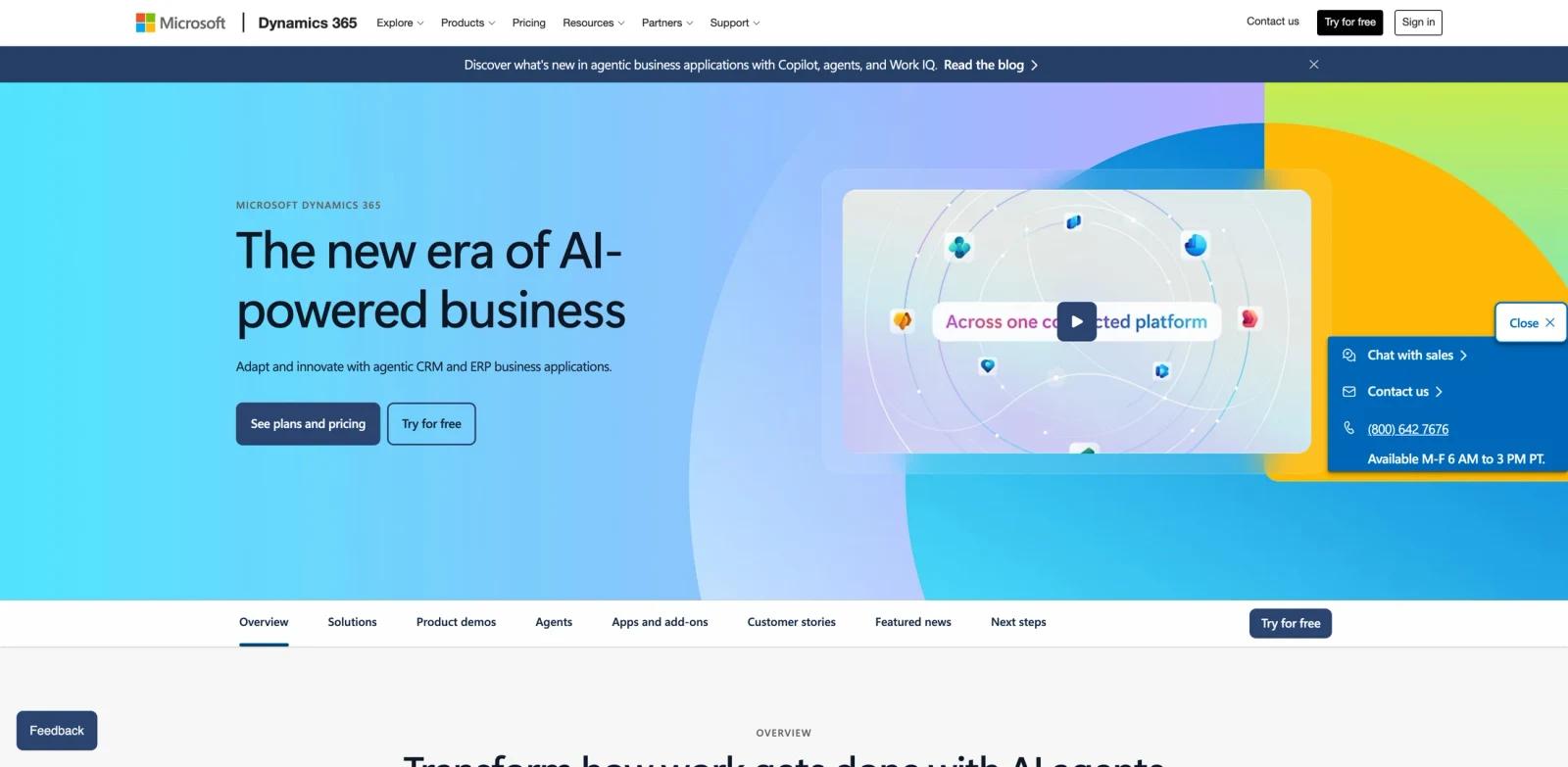
Microsoft Dynamics 365 is a finance platform for finance teams, accountants, founders, bookkeepers, and operations managers. The official page describes the product around "The new era of AI-powered business", and the surrounding product copy highlights themes such as transform how work gets done with ai agents, one platform. limitless possibilities, do more with agents in dynamics 365, explore business process agents in dynamics 365, how customers innovate with dynamics 365, what's new and notable, get started with dynamics 365, follow dynamics 365. That positioning makes Microsoft Dynamics 365 most relevant for teams comparing AI accounting software rather than for users who only need a generic prompt box.
The practical value of Microsoft Dynamics 365 is that it packages a repeatable workflow into a product surface: users get screens, templates, integrations, exports, or guided steps instead of starting from scratch every time. The public meta description summarizes the promise as: "Enter the era of agentic business with Dynamics 365-CRM and ERP business applications that connect your teams, processes, and data.". For buyers, the question is not whether the product mentions AI, but whether it can reduce the manual work, review cycles, and operational friction in a specific process.
Use Microsoft Dynamics 365 when your team can define a clear before-and-after workflow. For example, compare the time it takes to create a form, clean an audio clip, build a governed data inventory, produce a product image, plan a trip, generate a document, or process a transcript before and after introducing the tool. If the result is faster, easier to review, and easier to repeat, Microsoft Dynamics 365 can earn a place in a broader stack alongside AI data analysis and AI productivity tools.
Key Features
Core financial workflows - Covers recurring work such as invoices, bills, payments, ledgers, bank activity, reporting, and month-end follow-up.
Automation for repetitive tasks - Reduces manual entry by routing documents, matching transactions, syncing accounts, or suggesting next steps where supported.
Operational reporting - Turns financial activity into dashboards, statements, cash-flow views, or exports that business owners can actually use.
Controls and approvals - Helps teams separate preparation, approval, payment, and audit steps so financial operations do not depend on informal email threads.
Integrations with business systems - Connects accounting data with banks, payment providers, payroll, CRM, inventory, ERP, or productivity tools.
Scalable finance foundation - Supports a cleaner path from solo bookkeeping to multi-user finance operations as the company grows.
How to Get Started
- Confirm the primary workflow - Decide whether the first use case is AI accounting software, reporting, automation, content creation, data intake, or another concrete job.
- Start with a narrow pilot - Use one team, one dataset, one content workflow, or one operational process so the output can be judged quickly.
- Connect the minimum required systems - Add only the accounts, files, databases, forms, audio, or product assets needed for the first workflow.
- Define quality checks - Review accuracy, formatting, permissions, approval paths, and edge cases before scaling the workflow to more users.
- Document ownership - Assign the person responsible for templates, prompts, data sources, billing, governance, and vendor administration.
- Scale after the first result is repeatable - Expand to more teams or higher volume only after the pilot produces reliable output and a clear operating pattern.
Pricing & Plans
Dynamics 365 pricing varies by CRM, ERP, finance, supply chain, sales, service, and Copilot capabilities. Confirm the specific app license with Microsoft.
| Option | Public pricing signal | Best fit |
|---|---|---|
| Core access | Paid or quote-based | Teams or individuals evaluating AI accounting software workflows |
| Expanded use | Dynamics 365 pricing varies by CRM, ERP, finance, supply chain, sales, service, and Copilot capabilities. Confirm the specific app license with Microsoft. | Users who need higher limits, more integrations, stronger controls, or production support |
| Enterprise or regulated use | Confirm directly with the vendor | Organizations that need security review, procurement, custom deployment, or contractual terms |
Pricing can change quickly, especially when products mix trials, free tiers, usage-based billing, enterprise quotes, and promotional discounts. Treat the pricing field above as a structured starting point, then confirm the current plan page before making a procurement or production decision.
Best For
- Finance teams, accountants, founders, bookkeepers, and operations managers evaluating AI accounting software workflows.
- Teams that want a practical product workflow rather than a blank general-purpose chatbot.
- Operators who need repeatable output, reviewable steps, and clearer ownership.
- Organizations comparing specialist tools against broader productivity or data platforms.
- Users who are willing to verify pricing, limits, and integrations before depending on the tool in production.
Microsoft Dynamics 365 is also worth shortlisting when you are comparing specialist products against broader AI data visualization. Specialist tools usually win when the workflow is narrow and repeated; broad platforms win when one team wants many loosely related jobs in a single environment.
FAQ
What is Microsoft Dynamics 365?
Microsoft Dynamics 365 is a finance platform for finance teams, accountants, founders, bookkeepers, and operations managers. Its public website positions it around AI accounting software workflows, with features that help users move from manual work to a more structured, repeatable process.
Who should use Microsoft Dynamics 365?
Microsoft Dynamics 365 is best for finance teams, accountants, founders, bookkeepers, and operations managers that have a real workflow to improve, such as planning, creation, governance, intake, reporting, cleanup, or document generation.
Is Microsoft Dynamics 365 free?
Microsoft Dynamics 365 is treated as a paid product here. It may offer a trial, demo, or custom quote, but users should confirm current pricing with the vendor.
What makes Microsoft Dynamics 365 different from a general AI chatbot?
A general chatbot can answer prompts, but Microsoft Dynamics 365 is built around a specific AI accounting software workflow, with product screens, integrations, templates, exports, governance, or domain-specific controls depending on the plan.
Does Microsoft Dynamics 365 need setup?
Yes. Even simple tools need a setup pass: connect the right accounts or files, define the first workflow, check output quality, and decide who owns ongoing changes.
What should teams verify before buying Microsoft Dynamics 365?
Verify pricing, usage limits, data handling, export formats, integrations, support, cancellation terms, and whether the tool fits the exact workflow you plan to run.
How should I compare Microsoft Dynamics 365 with alternatives?
Compare it against other AI accounting software by testing the same real task in each product. Track setup time, output quality, collaboration, pricing, integrations, and how much manual cleanup remains.