



Overview
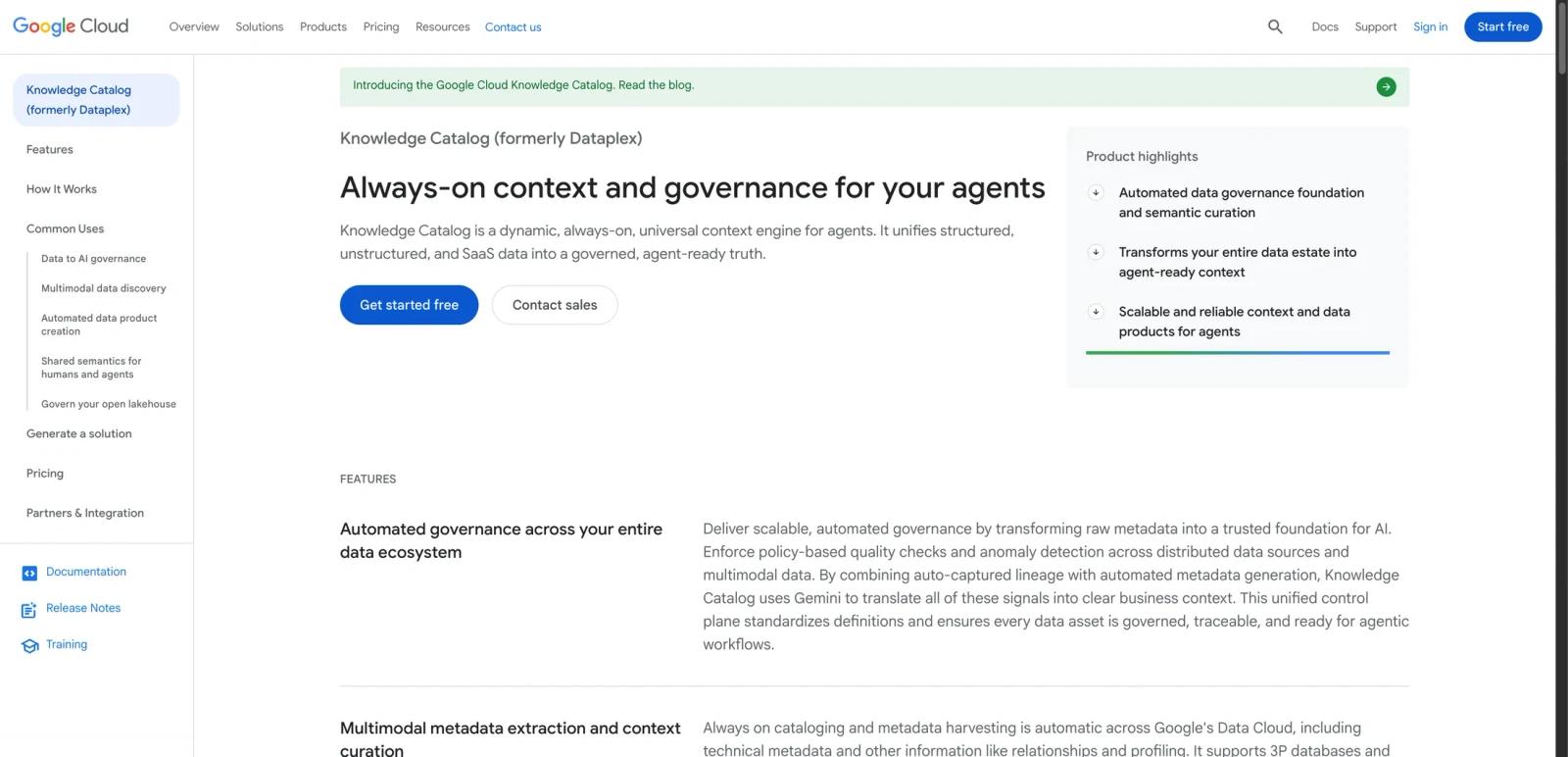
Knowledge Catalog (formerly Dataplex) is Google's unified data governance and metadata management layer for analytics and AI assets, now positioned as an always-on context engine for agents across Google Cloud and connected enterprise systems. As of April 23, 2026, Google is surfacing the product on its main marketing page as Knowledge Catalog (formerly Dataplex), while the documentation and pricing layers still reference Dataplex and Dataplex Universal Catalog.
The product matters most in environments where data is already spread across Cloud Storage, BigQuery, BigLake, and related Google Cloud services. Instead of acting like a general-purpose dashboard or notebook tool, Dataplex focuses on making data assets discoverable, trustworthy, and governable so analysts, data engineers, and platform teams can actually use them with less manual metadata cleanup.
If you are evaluating AI data governance or modern metadata catalog tools, Dataplex is less about flashy end-user UX and more about infrastructure discipline. The buying tradeoff is also different from typical SaaS tools: there is a real free tier, but most serious usage becomes pay-as-you-go and feature-dependent, especially once you need premium processing for lineage, data quality, or profiling.
Key Features
Unified metadata and context catalog — Dataplex Universal Catalog, now marketed as Knowledge Catalog, acts as a central metadata and context layer for data and AI assets in Google Cloud, helping teams search, organize, and enrich technical and business metadata from distributed environments.
Automated discovery and harvesting — Google documents always-on cataloging and automatic metadata harvesting across Google's data cloud, which reduces the manual work normally required to keep catalogs current.
Data quality, profiling, and lineage — Premium Dataplex processing covers higher-value governance functions such as data quality, data profiling, and data lineage, making it more than a passive metadata index.
Integration with BigLake and Google Cloud analytics — Dataplex is deeply integrated with BigLake and broader Google Cloud analytics tooling, which is the main reason it is compelling for Google-native data platforms rather than neutral multi-cloud estates.
Policy application and data organization — Google states that lake, zone, and asset setup plus security policy application and propagation are included without separate Dataplex processing charges, which is important for platform teams managing structured data estates.
Agent-ready context and semantics — Google's current positioning emphasizes context APIs, semantic search, business semantics, and shared governance for humans and agents, which moves the product beyond classic data cataloging into AI-ready context management.
Gemini-powered metadata and data insights — Google now documents Gemini-powered features in Dataplex, including automated metadata generation and data insights, though these AI features are billed through Gemini in BigQuery or Gemini Code Assist rather than standard Dataplex pricing.
Pricing & Plans
Dataplex uses a freemium, pay-as-you-go model. There is a genuine free tier, but pricing becomes usage-based once you move beyond basic discovery.
| Plan / SKU | Price | Notes |
|---|---|---|
| Free tier | No charge | First 100 DCU-hours per month for standard processing, plus first 1 MiB of monthly average metadata storage |
| Standard processing | From $0.060 per DCU-hour | Covers data discovery functionality such as automatic metadata discovery across managed data |
| Premium processing | From $0.089 per DCU-hour | Covers exploration workbench, data lineage, data quality, and data profiling |
| Metadata storage | From $2 per GiB per month | Automatically ingested Google Cloud technical metadata is free |
| API calls | Official Google pages are inconsistent here: the main Knowledge Catalog product page says Data Catalog API and Data Lineage API calls are free for the first 1 million/month, then start at $10 per 100,000 calls, while the detailed Dataplex pricing page says Dataplex Universal Catalog API calls are free. Verify current billing behavior in your account before relying on either interpretation. | |
| Shuffle storage | From $0.040 per GB-month | Covers disk storage specified for the data exploration workbench environments |
Google also notes that some Knowledge Catalog functionality can trigger separate charges through Google Cloud Managed Service for Apache Spark, BigQuery, and Dataflow; the detailed pricing page also references Cloud Scheduler for some workflows. Gemini-powered features in Dataplex are billed separately as part of Gemini in BigQuery or Gemini Code Assist, not as standard Dataplex SKU usage.
That means Dataplex is not best understood as a simple seat-based subscription. It is closer to infrastructure software: easy to start small, but cost depends on what governance capabilities you turn on and how much data processing you actually drive through the platform.
Best For
- Data platform teams standardizing governance across BigQuery, BigLake, and Cloud Storage assets
- Organizations that need lineage, profiling, and data quality inside an existing Google Cloud estate
- Enterprises comparing unified metadata catalog platforms with governance-first AI data governance workflows
- Teams that want Google-native metadata discovery before adopting a heavier standalone governance stack
- Buyers comfortable with pay-as-you-go infrastructure pricing instead of fixed seat-based subscriptions
FAQ
Is Google Cloud Dataplex free?
Partly. Dataplex has a real free tier for Dataplex Universal Catalog standard processing: Google lists 100 DCU-hours per month at no charge, plus the first 1 MiB of monthly average metadata storage. Beyond that, pricing becomes usage-based.
What does Dataplex charge for?
The main billing components are standard processing, premium processing, and metadata storage. Premium processing covers higher-value governance features such as data lineage, data quality, and data profiling.
What is the difference between standard and premium Dataplex processing?
Standard processing is primarily for data discovery and metadata harvesting. Premium processing covers deeper governance capabilities such as lineage, profiling, and quality checks, which is where more advanced operational value starts.
Is Dataplex now called Knowledge Catalog?
Mostly yes at the marketing layer. Google's primary product page now presents the service as "Knowledge Catalog (formerly Dataplex)." But official docs, pricing pages, and many technical references still use Dataplex and Dataplex Universal Catalog terminology, so buyers should expect both names during the transition.
Is Dataplex the same as Data Catalog?
No. Google is migrating from the older Data Catalog positioning toward Dataplex Universal Catalog. Dataplex is now the broader governance and metadata platform, while Data Catalog is in deprecation phase according to Google's pricing materials.
Does Dataplex include AI features?
Yes, but with a pricing nuance. Google documents Gemini-powered data insights and automated metadata generation in Dataplex, but those capabilities are billed through Gemini in BigQuery or Gemini Code Assist rather than normal Dataplex processing SKUs.
Who should use Dataplex?
Dataplex is best suited to data engineering, governance, and analytics platform teams rather than casual business users. If your main problem is trust, discoverability, and policy control across cloud data assets, Dataplex is much more relevant than a simple BI layer.
Is Dataplex good for multi-cloud governance?
Its strongest fit is clearly Google Cloud. If your environment is centered on BigQuery, BigLake, Cloud Storage, and related services, Dataplex makes strategic sense. If you need a more neutral catalog or governance layer across multiple clouds, you should compare it carefully against broader metadata platforms.

