



Overview
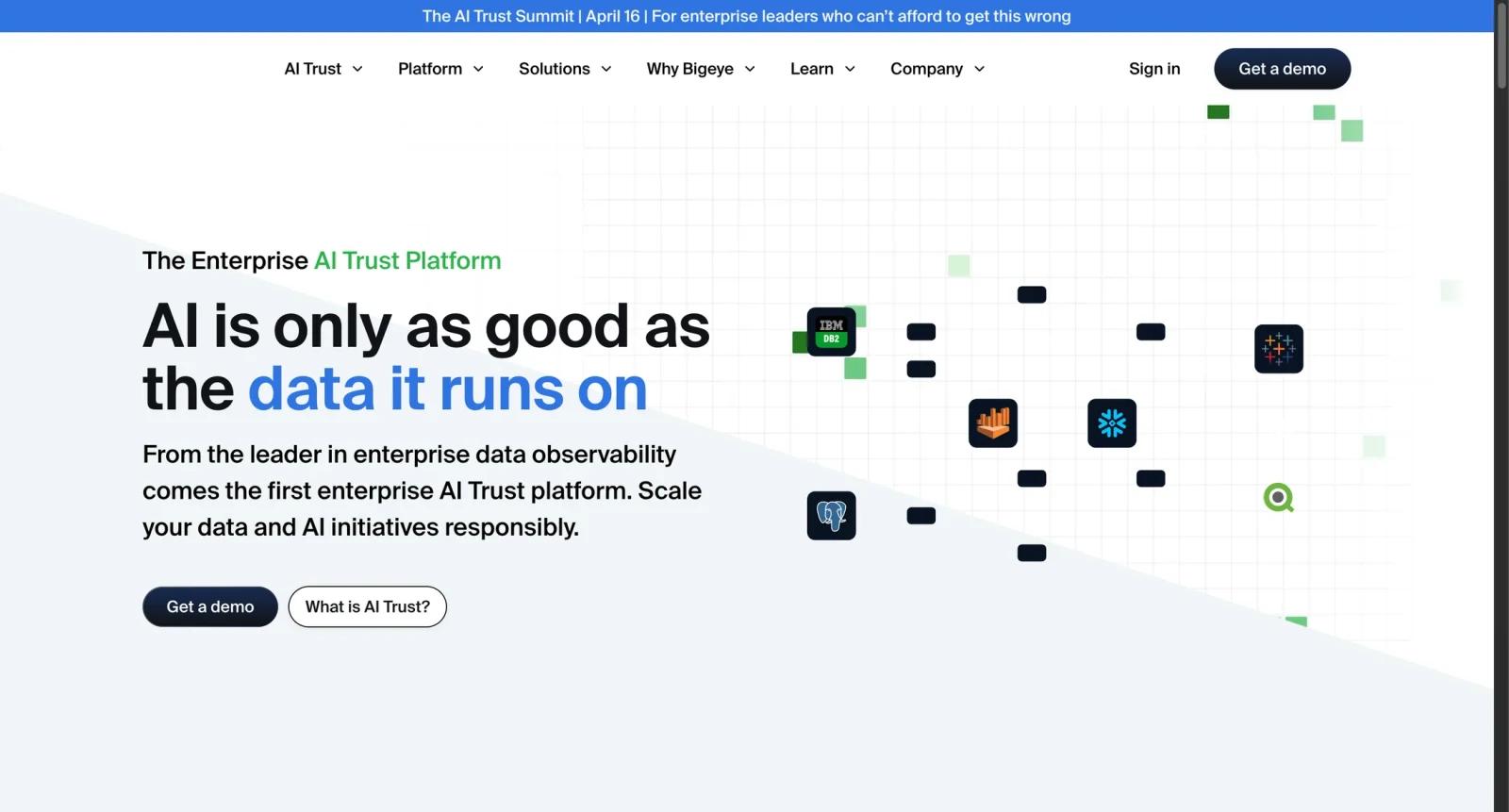
Bigeye is an enterprise data observability platform that helps data teams trust the data used for analytics, reporting, and machine learning. It monitors datasets and pipelines for anomalies, freshness issues, schema changes, reconciliation problems, and other quality risks that can damage downstream decisions.
Unlike rule-only data quality tools, Bigeye combines dynamic metadata, continuous profiling, anomaly detection, quality rules, lineage, and incident workflows. It belongs in the AI data cleaning tools conversation, but its real use case is ongoing observability rather than one-time cleansing. Teams often compare it with Anomalo, Monte Carlo, or broader governance platforms.
Bigeye is best for organizations where broken data creates visible business cost: bad dashboards, late executive reporting, corrupted ML inputs, failed reconciliations, or long investigation cycles.
Key Features
- Data observability monitoring - Tracks pipeline and dataset behavior so teams can detect freshness, volume, schema, and distribution problems.
- Anomaly detection - Uses dynamic monitoring to catch unexpected changes that would be hard to predict with static rules alone.
- Data quality rules - Lets teams define explicit checks for business requirements, known edge cases, and compliance expectations.
- Lineage and dependency context - Helps users understand which dashboards, models, or downstream systems may be affected by a data issue.
- Reconciliation and incident workflows - Supports teams investigating mismatches, resolving incidents, and documenting data reliability problems.
- Enterprise security posture - Bigeye describes controls for regulated teams and notes that monitoring can rely on aggregated statistics with careful data handling.
Integration Guide
Bigeye should be rolled out around high-value data products first. Pick the datasets that executives, customers, or machine learning systems rely on, then define which signals should be monitored automatically and which rules require explicit business logic.
The second implementation layer is workflow. Decide where incidents should be routed, who owns each dataset, how lineage should be used during triage, and how the team will measure fewer broken dashboards or faster resolution.
Pricing & Plans
Bigeye pricing is quote based. Public documentation describes product capabilities, but the site does not publish a simple monthly plan.
| Buying area | Pricing signal | Best fit |
|---|---|---|
| Data observability platform | Contact sales | Data teams monitoring important datasets and pipelines |
| Enterprise deployment | Custom quote | Organizations needing security review, integrations, and governance |
| Advanced workflows | Custom quote factor | Teams needing reconciliation, lineage, and incident management at scale |
Ask about monitored asset count, query volume, warehouse cost impact, users, alerting integrations, lineage support, retention, and customer success coverage.
Best For
- Data engineering teams responsible for production analytics pipelines
- Analytics engineering teams protecting BI and executive reporting
- ML teams that need reliable feature and training data inputs
- Enterprises that need lineage-aware incident response for data quality
- Organizations comparing observability tools beyond manual SQL checks
FAQ
What is Bigeye?
Bigeye is a data observability platform that monitors data pipelines, datasets, quality rules, anomalies, lineage, and incidents.
How much does Bigeye cost?
Bigeye uses quote-based pricing. Buyers need to request pricing based on monitored data assets, data sources, scale, users, and enterprise requirements.
Is Bigeye a data cleaning tool?
Not primarily. Bigeye detects and helps investigate data reliability issues; remediation happens through the team's data pipelines and operational workflow.
What does Bigeye monitor?
Bigeye can monitor freshness, volume, schema, distribution, data quality rules, reconciliation checks, and other signals related to data reliability.
How does Bigeye compare with Anomalo?
Both address data quality monitoring. Bigeye emphasizes enterprise-grade observability, lineage, anomaly detection, reconciliation, and incident management workflows.
Does Bigeye work for machine learning data?
Yes. It is relevant when ML systems depend on reliable input data, though teams should verify source and feature monitoring requirements.
What should buyers verify?
Verify supported warehouses and data sources, monitor scale, query cost, alert routing, lineage depth, security controls, and pricing metric.
Who should avoid Bigeye?
Small teams with only a few manual datasets may not need a full observability platform and may prefer lighter data validation or preparation tools.


