



Overview
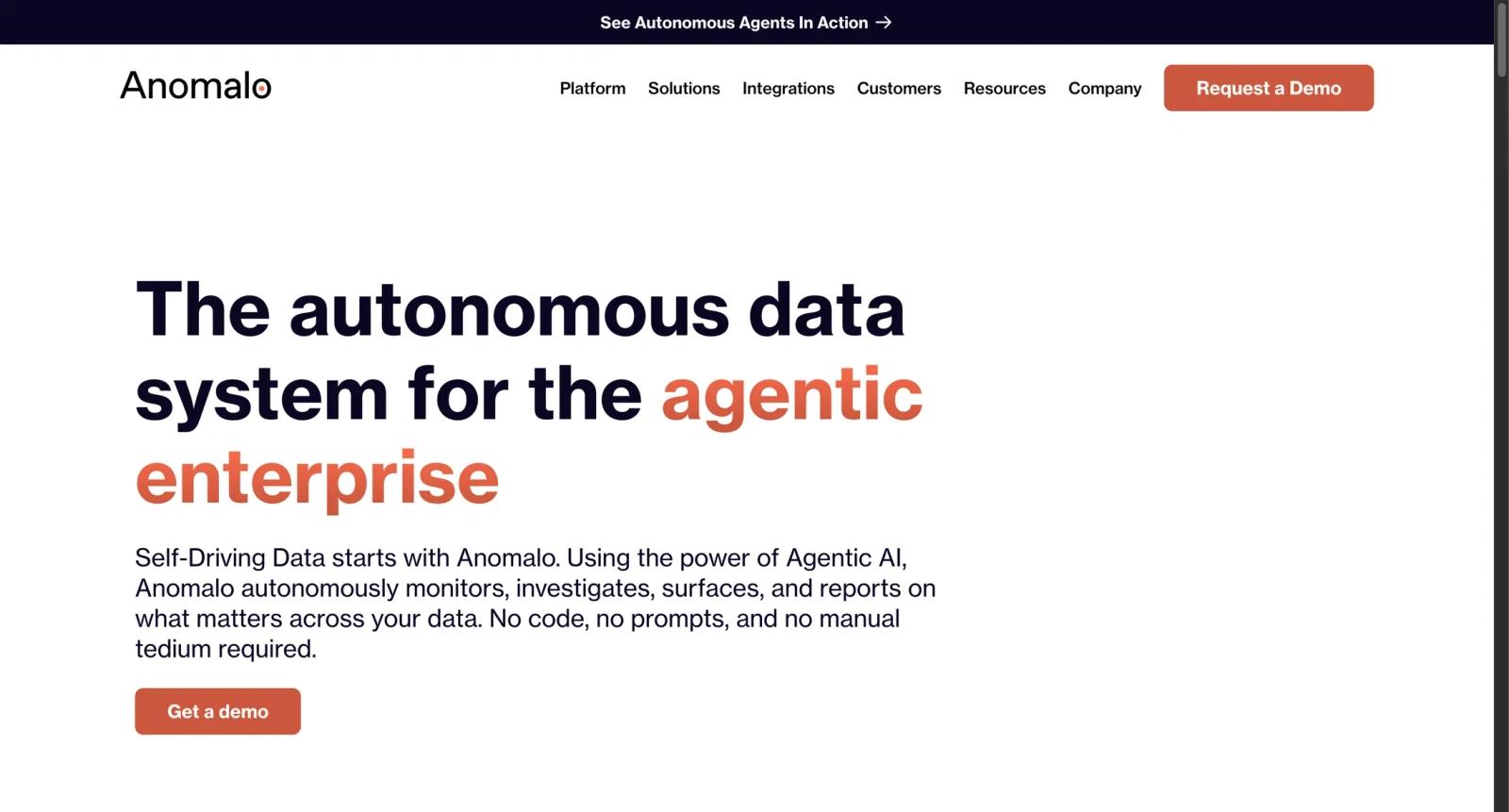
Anomalo is an enterprise data quality and observability platform built to detect data problems before they affect dashboards, AI systems, customer experiences, or business decisions. It uses automated monitoring, machine learning, root-cause analysis, lineage context, and data quality workflows to help teams trust both structured and unstructured data.
The product is a strong fit for organizations comparing AI data cleaning tools, but Anomalo is not a one-off spreadsheet cleanup app. It is designed for continuous monitoring across warehouses, pipelines, and business-critical datasets. Teams evaluating Anomalo will often compare it with Bigeye, Ataccama ONE, or broader enterprise data platforms.
Anomalo is most useful when data quality issues are expensive because they break reporting, corrupt ML features, trigger operational mistakes, or erode trust between data producers and consumers.
Key Features
- Automated anomaly detection - Uses machine learning to find missing, late, abnormal, or unexpected data patterns without requiring every rule to be written by hand.
- Data validation rules - Supports explicit checks for accuracy, completeness, consistency, and business-specific requirements when teams know what should be enforced.
- Root-cause analysis - Helps investigators understand likely causes, affected fields, samples, and downstream context instead of stopping at a generic alert.
- Alert routing and noise reduction - Sends data quality issues to the right owners while suppressing false positives that would create alert fatigue.
- Lineage-aware monitoring - Shows data quality problems in the context of how data flows from source to destination.
- Unstructured data monitoring and AIDA - Extends quality monitoring to document-style data and offers AI-assisted data analysis and conversational exploration.
Integration Guide
Start with the tables, dashboards, ML features, or business KPIs where broken data has the highest impact. Anomalo works best when monitoring is mapped to ownership: each alert should have a data owner, expected response path, and escalation rule.
Teams should also decide how Anomalo fits with catalog, orchestration, ticketing, and warehouse systems. The operational value comes from closing the loop: detect the issue, understand root cause, notify the right person, and confirm remediation.
Pricing & Plans
Anomalo pricing is sales-led. Public pages promote demos and enterprise deployment rather than a simple seat-based plan.
| Buying area | Pricing signal | Best fit |
|---|---|---|
| Data quality monitoring | Contact sales | Teams monitoring important warehouse tables, metrics, and pipelines |
| Enterprise observability | Custom quote | Organizations needing lineage, integrations, governance, and alert routing |
| Unstructured data and AI agents | Custom quote factor | Teams monitoring documents or using AIDA-style analysis workflows |
Ask about monitored table count, query volume, connected systems, alerting integrations, support, security review, and whether unstructured data monitoring is included.
Best For
- Data platform teams responsible for business-critical warehouse tables
- Analytics teams protecting executive dashboards and operational reporting
- AI teams that need trustworthy training, feature, or document data
- Enterprises that want lineage-aware issue detection and root-cause workflows
- Organizations comparing data quality platforms beyond manual rules
FAQ
What is Anomalo?
Anomalo is a data quality and observability platform that monitors enterprise data, detects anomalies, validates rules, and helps teams investigate root causes.
How much does Anomalo cost?
Anomalo uses quote-based pricing. Buyers need to request pricing based on monitoring scope, data sources, scale, integrations, and enterprise needs.
Does Anomalo only monitor structured data?
No. Anomalo also promotes unstructured data monitoring for document-style enterprise data, in addition to warehouse and table monitoring.
Is Anomalo a data cleaning tool?
It is better described as a continuous data quality monitoring and observability platform. It can identify quality issues, but remediation still depends on your data workflows.
How does Anomalo compare with Bigeye?
Both address data observability and quality monitoring. Anomalo emphasizes autonomous data quality, root-cause analysis, unstructured data monitoring, and AI-agent style workflows.
Who should use Anomalo?
Data engineering, analytics engineering, data platform, governance, and AI teams that need continuous trust in important datasets are the best fit.
What should buyers verify before choosing Anomalo?
Verify supported data sources, monitoring scale, alert routing, catalog integration, lineage depth, security requirements, and pricing metric.
Who should avoid Anomalo?
Small teams that only need to clean a spreadsheet or run occasional validation checks may be better served by lighter data preparation tools.


