
7 ElevenLabs Alternatives 2026 — What Can You Take With You?
Compare seven ElevenLabs alternatives for studio voiceovers, speech APIs and local generation—and see which audio, scripts and voice assets you can actually move.
On this page
The right ElevenLabs alternative depends on what you need to keep: an editable voiceover project, a recognizable authorized voice, or an application that speaks reliably. A cheaper audio generator is not automatically a replacement for all three.
Start with Murf Studio or WellSaid for browser-based narration, Descript for speech inside a podcast/video editing workflow, Cartesia, Deepgram or Google Cloud TTS for a developer-owned speech workflow, and Chatterbox if running the model yourself is the point of switching. None should be purchased on the assumption that an ElevenLabs voice ID or Studio project will import unchanged.
Research boundary: Official product, pricing, support and repository sources checked October 21, 2026. This is desk research, not a listening benchmark. We did not buy plans, generate paid audio, clone a speaker, benchmark latency or test cross-vendor imports. The recommendations below concern documented workflow fit, not measured voice quality. This guide replaces narration/TTS workflows, not the entire ElevenLabs suite, including music, dubbing and agent orchestration.
ElevenLabs alternatives at a glance
Choose the row matching your reason for leaving, then apply its first elimination test below. On mobile, swipe inside each table; the tool name remains visible.
| Alternative | Consider it when… | Main switching cost |
|---|---|---|
| Murf Studio | You want a browser project for repeatable voiceover revisions | Rebuild the script/project; paid plan required to download |
| WellSaid | English narration and a finished-audio download allowance fit your work | Re-audition voices; check download minutes and file formats |
| Descript | Narration needs to stay inside an audio/video edit | Rebuild the composition; media and AI credit limits differ |
| Cartesia | Your application needs a different managed speech/voice-cloning layer | Rebuild API integration and voice setup; not a Studio import |
| Deepgram | You want model-specific, character-metered speech APIs | Rework streaming/voice configuration and the surrounding app |
| Google Cloud Text-to-Speech | Routine stock-voice generation matters more than keeping a clone | Rebuild cloud integration; choose a specific model and voice |
| Chatterbox | Local execution matters more than a hosted editor | Own the runtime, deployment and voice evaluation |
These are switching routes, not a universal ranking. If you are buying your first voice tool rather than leaving an existing workflow, start with our broader AI voice generator comparison.
Why leave—and when should you stay with ElevenLabs?
Common reasons to investigate alternatives are a mismatch between the billing meter and your revision habits; needing a particular editor/export workflow; wanting a different speech API; and needing local control over generation. Voice preference alone is also legitimate—but listen to your own difficult script before rebuilding a production workflow around a demo.
Stay when the existing voice is approved and the workflow already fits. Recasting a recurring narrator, rebuilding pronunciation fixes and reviewing old projects can cost more than a small subscription difference. If Studio, dubbing and other creative tools are used together, replacing only TTS may leave you paying for several products instead of one.
For context, ElevenLabs Creative pricing currently lists Starter at $6/month with 30,000 credits, a commercial license and 20 Studio projects. Free has 10,000 credits but not commercial usage rights. Its project count is inconsistent across official pages—main pricing says three; the Studio limit guide says five. Check the applicable account limit before switching for capacity. Creative, API and Agents are separate pricing views.
Before switching to solve a licensing problem, read the commercial-use guidance. Paid-plan output can retain commercial use after the subscription ends, subject to applicable rights and terms; upgrading does not retroactively license free-plan output. Beta services have separate restrictions.
What can you actually move from ElevenLabs?
An exported MP3 or WAV is a rendered asset—not a transferable editable project or a portable voice model. Studio documents full-project and chapter audio exports, but those outputs do not establish that another editor can restore its tracks, generation history, voice assignments or settings. We found no verified cross-vendor Studio-project or cloned-model import in the sources reviewed.
A partial switch may avoid recasting the narrator. ElevenLabs explicitly says clones cannot be exported as standalone files, but compatible third-party services can generate speech through the ElevenLabs API using account voices. You may change the surrounding workflow while retaining that service and its billing/permissions. This is continued vendor dependence, not portable weights, and not proof that every editor below supports such an integration.
Audit the source quality, not just the extension. Studio's Free/Starter/Creator WAV exports can be converted from a 128 kbps source; Pro and higher support 16-bit, 44.1 kHz WAV for newly created projects. Older project quality settings may be fixed. Converting an old MP3 to WAV, or merely upgrading the subscription, does not establish that an existing project becomes a higher-quality master.
Save a small handover bundle before cancelling:
- Approved audio: finished files and useful chapter/section outputs, clearly named by version. Check that the download reflects the latest edits.
- Rebuildable text: your original scripts, chapter order, speaker labels, timing notes and pronunciation rules. Save these separately where no suitable export is available; this is a handover checklist, not a promise of a one-click export.
- Voice setup: record the voice/model names, settings and approved reference clips for comparison. An identifier is a note about the old service, not an import key for the new one.
- Authorized originals and permissions: retain original speaker recordings you are entitled to use, consent records and relevant usage terms. Do not assume a license to publish generated audio also grants permission to train or clone a voice elsewhere.
- Application dependencies: inventory API calls, retry rules, pronunciation handling, audio formats and monitoring before replacing the endpoint.
Do not “migrate” by cloning an ElevenLabs stock voice from generated audio. Its use policy restricts training/improving AI with Output and developing competing products using Output without permission. Use authorized original recordings only where the destination's rules and the speaker's permission allow it; preserve required provenance.
Rebuild one representative project first. Choose a real script with your difficult names, numbers, pauses and revision patterns. Confirm a usable export, commercial entitlement and a sustainable repeat-edit workflow before moving the library. For an app, include partial responses, interruptions, reconnects and peak-load behavior. These are proposed acceptance tests—not tests we performed.
Compare the replacement boundary
Use the same questions across the shortlist: where will revisions live, what must be rebuilt, and what does the recommendation not replace?
| Alternative | Revision workflow after switching | Not supplied by this route |
|---|---|---|
| Murf Studio | Recreate narration in a browser project | An imported ElevenLabs project or identical narrator |
| WellSaid | Edit script sections and regenerate takes | Automatic recovery of ElevenLabs voice/settings history |
| Descript | Edit speech inside a rebuilt audio/video composition | An imported ElevenLabs clone or its Studio history |
| Cartesia | Integrate speech generation into your own app | A like-for-like Studio timeline or complete agent migration |
| Deepgram | Manage model, voice and streaming behavior in code | A browser narration editor in the API purchase |
| Google Cloud Text-to-Speech | Choose a model/stock voice and control synthesis in code | A ready-made narration editor or the old narrator's identity |
| Chatterbox | Run a selected model in infrastructure you operate | Hosted accounts, editor, support or a managed SLA |
The closest comparisons are within each lane. Murf versus WellSaid is an editor-and-delivery decision; test Murf first if an affordable WAV export is non-negotiable. Descript is relevant when editing the surrounding recording/video is the bottleneck. Compare Cartesia and Deepgram for speech integration, and Google Cloud's specific stock voices when routine generation cost matters more than retaining a cloned identity. Chatterbox changes the operating model. For more API buying criteria, see text-to-speech APIs compared.
Compare a usable export—not just the headline price
Public USD-facing offers checked October 21, 2026; tax, currency, account and negotiated terms can differ. We retain only costs and limits that can eliminate a route. Credits, generated minutes, downloaded minutes and characters are different meters; there is no honest universal “minutes per dollar” ranking here.
| Alternative | Free or evaluation boundary | Purchase decision that matters |
|---|---|---|
| Murf Studio | Free trial previews voices; no project download | Creator $29/month, 2 generated hours; paid WAV/FLAC export. Business license and broadcast rights need separate checks |
| WellSaid | Trial: 3 downloaded minutes/month, no commercial rights | Starter $19/month, 20 downloaded minutes, MP3. WAV/OGG: Business $1,920/user/year or Enterprise |
| Descript | Free plan has limited media/AI usage; check the intended task | Hobbyist $24/person/month, 10 media hours and 400 AI credits; media hours are not TTS hours |
| Cartesia | Free: 20,000 credits/month | Pro: $5/month, 100,000 credits; Sonic uses 1 credit/character. Commercial license and instant cloning included |
| Deepgram | $200 initial credit, then pay as you go | Aura-2: $0.030/1,000 characters; Flux TTS: $0.045/1,000 characters on PAYG |
| Google Cloud Text-to-Speech | Billing account required; free allowance depends on model | Legacy Standard/WaveNet: $4/million after listed 4M free band. Chirp 3 HD: $30/million after 1M free band |
| Chatterbox | Open-source repository; no hosted-plan allowance | Infrastructure, operations and exact model/license requirements remain yours |
WellSaid's $10/month Starter is an annual equivalent ($120/year, 240 download minutes/year); $160/user/month Business means a $1,920 annual commitment, not a monthly WAV upgrade. Murf Creator's annual alternative is $228/year with 24 generation hours; the $19 equivalent is not monthly billing. Its Business license is a separate $99/month offer ($792/year annually). For Cartesia, an agent service has a different meter from TTS credits. Consult WellSaid, Murf, Cartesia and Deepgram before purchase.
An API cost sanity check: ElevenAPI lists Flash/Turbo and v4 Turbo at $0.040/1,000 characters. At those public rates, 1 million billable characters is $40, versus $30 for Deepgram Aura-2 or $45 for Flux TTS. That is arithmetic, not an equal-quality benchmark, and excludes credits, contractual discounts, retries and other services. A $10 nominal monthly difference does not fund much engineering. Google's Standard/WaveNet paid rate is $4/million after applicable free usage, but evaluating a different stock voice/model is a different decision—not a promise of equivalent expressiveness. Cartesia credits and token-priced Google models cannot be substituted into this calculation without conversion and workload verification.
Cartesia does publish the Sonic conversion: one credit per character. Pro's $5 includes 100,000 characters, not a million. With its listed $65/million-credit overage enabled, 1 million Sonic characters on Pro would be about $63.50 ($5 + $58.50), before tax/other usage; Startup instead lists $49 with 1.25 million credits. Select the plan before comparing—not a fictitious $50 PAYG rate obtained by multiplying the small subscription. Do not convert token-priced Google models as if they used characters.
Seven alternatives, by switching job
Murf Studio
Best for: Someone leaving ElevenLabs to organize recurring narration as browser projects rather than maintain a speech API. This recommendation is specifically Murf Studio, not Murf Dub or the API subscription.
The important gain is a project-based replacement workflow, not proof that its voices sound better. Murf documents folder/project organization and duplication, so a repeatable script template is a sensible evaluation task. The loss is continuity: plan to recreate your scripts and voice choices rather than import an ElevenLabs project.
Skip if: You need the same voice identity without re-auditioning, or a free downloadable production file. Murf's free-trial documentation reserves download/export for paid plans. Also exclude entry plans for traditional TV/radio work: broadcast rights require Enterprise.
First elimination test: Rebuild one short, revision-heavy section. Can you correct a product name, retain the intended pauses and organize a second version without recreating the whole job? Use the trial to inspect the editing workflow; do not pay until the export and commercial terms fit.
Trial / buying boundary: Paid Studio export supports MP3, WAV and FLAC; that makes it worth testing before WellSaid's higher-tier WAV route. Check the Studio tab, not an API or dubbing allowance. Creator targets individuals/freelancers; Murf recommends a Business license for registered businesses. Generation time, project limits and seats still apply; “unlimited downloads” is not unlimited regeneration or broadcast permission.
WellSaid
Best for: A narration team whose initial requirement is English voiceover, script-section editing and control over which finished takes consume its download allowance.
WellSaid's current Studio guide describes projects, sections and voice selection. That is a closer editing route than moving directly to an API. You still need to find an acceptable new narrator and translate your pronunciation/editing habits into its controls; do not expect an ElevenLabs voice ID to follow you.
Skip if: You need entry-plan WAV. The download guide reserves WAV/OGG for Business or Enterprise: the listed Business commitment is $1,920/user/year. Bulk downloads cap at 32 audio files at a time; project ZIPs contain active takes, not a portable editing timeline. Also check multilingual entitlement for localization.
First elimination test: Use the trial on difficult names, inspect a permitted file and check a representative segmented project's export process, including the 32-file limit. Does the required format fit your budget? Evaluate revisions separately from download volume.
Trial / buying boundary: Trial audio is not commercially licensed. Monthly Starter includes 20 downloaded minutes; annual Starter's 240-minute allocation is yearly, not a fresh 240 minutes every month. Unlimited regeneration is not an unlimited export plan.
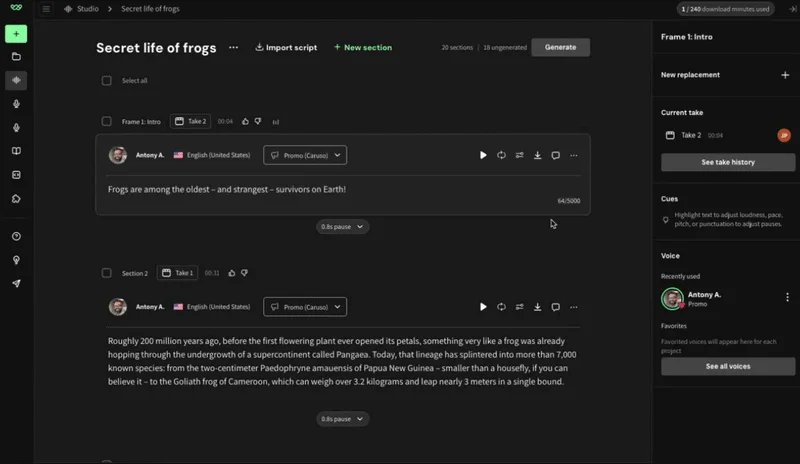
A still from WellSaid's official download walkthrough, not our account or hands-on test. Visible download controls are not evidence that every plan includes every format; the restriction above controls the decision.

Best for: An ElevenLabs user whose generated narration ultimately lives inside a podcast or video edit, and who wants to revise speech alongside the rest of that composition.
Descript's AI Speech sits in a text-based audio/video editor. This can replace the round trip between a voice generator and a separate edit—not transfer an ElevenLabs project's internals. Stock voices and authorized custom speakers are distinct from importing the old clone. For an existing speaker, use its current speaker workflow and permission requirements.
Skip if: You only need a speech endpoint or a small MP3 and do not want another editing environment. Exporting approved old narration into an edit preserves the file, not a voice you can regenerate indefinitely.
First elimination test: Rebuild one edit containing an existing permitted narration file and one new AI-spoken correction. Can you review the transition and produce the required deliverable without an unacceptable voice mismatch? This is a suggested test, not a result we measured.
Trial / buying boundary: Current plans separate uploaded/recorded media hours from AI credits. Hobbyist lists $24/person/month and 400 AI credits; its 10 media hours are not ten hours of synthesized speech. Check the intended feature's credit use and export settings. Buying a video editor for plain TTS can add complexity rather than remove it.
Cartesia
Best for: Developers replacing the speech-generation layer of an application, particularly when an authorized voice-cloning workflow belongs in the evaluation.
The Sonic product page positions speech for voice applications. The meaningful alternative is a different managed voice layer; it is not a promise to preserve an ElevenLabs Studio project or replace a complete ElevenAgents deployment. Rebuild voice configuration and integration, and verify the current model's language/support requirements directly.
Skip if: You need a no-code migration of a chapter-based production library. Also skip a Free-plan budget assumption for commercial cloning: the pricing page lists commercial licensing and instant voice cloning under Pro.
First elimination test: Define your own difficult utterances and application behavior before buying capacity. For a live application, check first audio, interruptions and reconnects in your integration—not a vendor's best-case latency number. For a clone, confirm eligibility and speaker authorization before uploading any recording.
Trial / buying boundary: The $5 Pro offer is not evidence of equivalent output volume or voice quality to any ElevenLabs tier. Compare the actual credit allowance, required model and production workload; agent-minute charges are a separate question.

Best for: Developers who want to compare model-specific speech costs and integrate a managed TTS service into an existing application.
Deepgram's TTS product and pricing distinguish Aura models from Flux TTS. Choose the model for the workload before comparing rates. Do not confuse Flux TTS, charged by characters in the quoted PAYG offer, with Deepgram's speech-to-text products or an all-in Voice Agent bill.
Skip if: Your real need is a browser editor or a guaranteed recreation of an existing cloned narrator. This API route is not evidence of either capability.
First elimination test: Check the chosen model's supported voice/language and audio format against the exact deployment. Then test your streaming, interruption and failure-handling requirements before replacing the old endpoint. A successful sample file does not demonstrate an application's behavior under load.
Trial / buying boundary: The $200 credit is an initial evaluation allowance, not a recurring monthly free tier. Aura-2 and Flux TTS have different rates; do not use a cheaper model or prepaid Growth price to estimate the PAYG model you actually intend to run.
Google Cloud Text-to-Speech
Best for: Applications producing routine stock-voice audio where keeping an ElevenLabs clone is not necessary and model-specific cost is a reason to investigate.
Google Cloud offers several voice families, not one uniform replacement model. Its voice capability documentation lists SSML support for Standard and WaveNet; do not assume that every newer voice family supports the same controls. Choose the exact voice and language before estimating cost or rewriting pronunciation handling.
Skip if: The whole reason for switching is to preserve the same branded narrator without re-approval, or to avoid cloud setup. The low Standard/WaveNet rate is not a benchmark showing equivalent voice quality or expressiveness to an ElevenLabs model.
First elimination test: Specify one stock voice, language, required SSML/control behavior and output format. Evaluate the same difficult script used for the incumbent. If the voice is unsuitable, the low rate is irrelevant; do not assume another model has the same price or free allowance.
Trial / buying boundary: Billing must be enabled, even within a free allowance; excess usage and connected cloud resources can be charged. The $4/million Standard/WaveNet offer is in Google's legacy-model section. Chirp 3 HD lists $30/million after its 1-million-character free band; Gemini-TTS uses tokens. This is a cloud API, not a free browser editor or a single universal voice price.
Chatterbox
Best for: A technically capable team for whom running speech generation locally or in its own infrastructure is the switching objective.
The official Chatterbox repository provides models and generation examples rather than a managed Studio replacement. It includes distinct model variants; the Nano example supports CPU execution. That is not a benchmark showing acceptable speed on your computer. We did not install or run it.
Skip if: Nobody will own deployment, access control, updates, storage and audio review. Self-hosted does not mean automatically private, reliable or cheaper. A hosted demonstration is not proof that your production pipeline stays local.
First elimination test: Have the intended operator evaluate one supported model on the actual target environment using authorized material. Check whether the resulting file, runtime and maintenance burden are acceptable before rebuilding any library. Do not select a model purely because the repository has an open-source license.
Trial / buying boundary: Review the repository license and exact checkpoint terms, retain required watermark/provenance behavior, and separately establish rights to the source speaker recording. Code/model permissions do not grant someone else's voice identity. There is no hosted commercial plan included in this recommendation.
Other names worth checking—without another generic top ten
Need a standalone hosted clone workflow? Fish Audio deserves a separate check: Plus lists $15/month ($132/year annually), cloning and ten private voice slots. Do not upload an original speaker recording into a public slot by default. Its Free card says commercial use, while the same page's FAQ says free output is personal/noncommercial; we therefore do not recommend Free for commercial migration. For paid use, verify your own voice rights, private storage, exact model and required MP3/WAV delivery before choosing it over the editor/API routes above. That unresolved free-use discrepancy is not evidence that paid Fish Audio is unsuitable or that your old voice will match exactly.
Already on Azure or AWS? Evaluate Azure Speech or Amazon Polly in your existing cloud before adding another provider. Use voice/locale, required SSML controls, regional needs and integration effort as the elimination test. Google's row represents a stock-voice cloud route, not a finding that it beats those services. Azure custom-voice eligibility is separate from ordinary synthesis; no cloned-voice import or equal-quality price claim is implied. These infrastructure-specific choices do not need another set of generic profiles here.
Speechify Studio is relevant if the job includes video, dubbing or captions as well as voiceover; distinguish it from the reading app. We have not treated one Speechify subscription as entitlement to every product. If a complete creative suite is the requirement, evaluate that broader route rather than force an API into an editor comparison.
/v1/audio/speech. That can change the cost of switching twice.A practical decision before you cancel
Pick one editor, one API route, or one self-hosted route according to the problem you actually have—not one of each. Keep ElevenLabs available while rebuilding the representative project. Preserve approved old audio and its licensing records, but assume future revisions may need a newly approved voice.
If the alternative fails your export requirement, pronunciation case or operating budget, stop the migration. Staying is a valid outcome. For the incumbent's broader product boundaries, use our ElevenLabs overview; this page's job is to make the switching decision, not reproduce that product page.
Leaving ElevenAgents rather than just changing TTS?
Treat that as a platform decision. Cartesia Managed Agents and Deepgram Voice Agent API are broader offerings than the speech endpoints compared above. They are not ruled out by a TTS-only recommendation—but neither is a verified one-click migration of your existing agent.
Inventory transcription, turn handling, telephony, tool permissions, monitoring/evaluations and total call cost. Do not price that stack from a TTS credit allowance. Our voice agent platform comparison covers that separate buying job; keep this article's narration/API comparisons from turning into an unbounded suite list.
Frequently asked questions
What is the easiest ElevenLabs alternative?
For a browser-based narration job, start by comparing Murf Studio and WellSaid because both offer project/script editing workflows. We have not tested which is easier. The useful test is whether you can rebuild and revise one representative section without losing your delivery requirements. Neither is a verified one-click Studio migration.
Is there a free ElevenLabs alternative for commercial work?
Do not equate a free preview or download with commercial rights. Murf's trial does not export; WellSaid's trial allows limited downloads but not commercial use; Cartesia lists commercial licensing under Pro. Chatterbox is a self-hosted option, but model terms, speaker permissions and operating costs still apply. Check the exact route rather than a blanket “free” label.
Can I move my ElevenLabs projects and cloned voice to another service?
You can preserve permitted rendered audio and separately save your original scripts and authorized recordings. We found no verified cross-vendor import that transfers Studio editing history or a cloned model unchanged. Rebuild a small project, re-audition its voice and verify permission before any cloning. Do not use generated stock-voice audio as an assumed migration training set.
Which alternative works locally or offline?
Chatterbox is the self-hosted route in this shortlist. You must obtain the required model/runtime and verify how your complete application handles files and network access. A local model does not make connected tools or storage offline, and we have not benchmarked its hardware requirements on your machine.
Which alternative replaces ElevenLabs for a real-time voice agent?
Cartesia and Deepgram offer both speech-layer and broader agent routes. Their Managed Agents and Voice Agent API offerings need a separate platform evaluation: compare transcription, turn handling, telephony, tools, monitoring and total call costs, not just TTS credits. No one-click migration is verified here. For narration files, that engineering may be unnecessary.
Get ToolWorthy Weekly
New AI tools, practical guides, and selected AI signals in one weekly brief.
Related Posts
- 15 Best AI Voice Cloning Tools 2026 - Consent, Quality & Pricing
Compare 15 AI voice cloning tools for creators, podcasters, video teams, localization workflows, APIs, consent controls, pricing and commercial rights.
- 16 Best AI Tools for Content Creation 2026 — Tested Stacks by Format
16 AI tools for content creation tested across design, writing, video and voice — with real pricing, tool-sprawl warnings, and picks by format.
- Sesame AI: Transforming Conversational AI with Natural Voice
Sesame AI delivers natural, context-aware voice interactions, making AI conversations more expressive and engaging.
For AI tool founders
Built a tool that belongs in this decision set?
Request an editorial evaluation for possible inclusion in ToolWorthy.
Submit your tool for reviewPaid submission does not guarantee a ranking, recommendation, inclusion, or editorial outcome.