
Best Text-to-Speech APIs in 2026: Choose by Workload, Not Demo Voice
Compare 10 text-to-speech APIs by realtime protocol, voice control, pricing meter, language coverage, cloud fit, and private-deployment needs.
On this page
The best text-to-speech API is the one whose contract fits your application—not the one with the most persuasive demo voice. A realtime agent needs incremental text input, interruption behavior, telephony formats, and enough concurrency. A media product may care more about direction, voice identity, and long-form continuity. A regulated enterprise may eliminate both in favor of an API it can run in a chosen region or private environment.
This guide compares 10 current TTS APIs by those buying jobs. It does not name a universal voice-quality or latency winner because ToolWorthy did not run a controlled cross-vendor benchmark. Start by removing APIs that fail a non-negotiable, then trial the remaining two or three on the same scripts and workload.
Short Answer: Start With the API Contract
| If your primary job is... | Start with... | Also trial... | Eliminate first if... |
|---|---|---|---|
| A turn-based English voice agent with interruption handling | Deepgram | Cartesia, Inworld, Murf AI | Your production locale is outside the selected model's documented support |
| Multilingual realtime speech over a multiplexed WebSocket | Cartesia | Inworld, ElevenLabs | The plan's concurrency cannot cover peak sessions |
| Several realtime, async, and batch routes in one voice stack | Inworld | Deepgram, Murf AI | Character/minute economics are unclear for your real workload |
| Regional streaming endpoints and telephony formats | Murf AI | Deepgram, Speechmatics | Non-US PAYG concurrency is too low |
| Expressive speech, voice identity, and multiple model choices | ElevenLabs | OpenAI | A utility voice and lower cloud-infrastructure price are enough |
| Instruction-directed delivery in an existing OpenAI stack | OpenAI | ElevenLabs | You need character billing, or marketplace/private-deployment support is not verified |
| Google Cloud speech with Chirp, Gemini, or legacy voice routes | Google Cloud TTS | Azure AI Speech, Amazon Polly | You expect one meter and one control surface across all model families |
| Microsoft cloud governance, SSML, or qualified TTS containers | Azure AI Speech | Google Cloud TTS, Amazon Polly | You need one globally fixed public price |
| AWS-native utility, accessibility, or long-form synthesis | Amazon Polly | Google Cloud TTS, Azure AI Speech | You need identical features across every engine and region |
| English-first streaming with a managed or on-prem route | Speechmatics | Deepgram, Azure AI Speech | Bidirectional streaming or broad language support is mandatory |
Before You Audition Voices
Freeze four requirements before listening to a demo:
- Protocol and workload: full-text request, output streaming, incremental WebSocket input, stateful turn session, long-form task, or batch queue.
- Language and audio: exact production locale and voice, codec, sample rate, telephony compatibility, input length, and pronunciation-control route.
- Operations: steady and burst concurrency, region, retention, model version, deprecation path, support, and private-deployment requirements.
- Economics: native billing unit, failed or repeated work, plan allowance, overage, and actual cost for one representative corpus.
Eliminate any API that fails one of those requirements before comparing naturalness claims. Vendor latency and quality figures describe vendor measurements; they do not show which API will perform best on your network, scripts, names, languages, or concurrency.
Governance boundary: This guide does not normalize retention, training use, residency, DPA/BAA, security, or private-deployment contract terms across every provider. Treat those as unresolved hard filters and verify the exact provider, plan, region, and contract before retaining a finalist.
Realtime Voice Agents: Five Different Streaming Contracts
Deepgram, Cartesia, Inworld, Murf AI, and Speechmatics all support realtime-oriented output, but they do not expose the same integration.
| Decision factor | Deepgram | Cartesia | Inworld | Murf AI | Speechmatics |
|---|---|---|---|---|---|
| Realtime shape | Turn-based /v2 WebSocket plus batch REST | Multiplexed WebSocket contexts | Sync, streaming, WebSocket, async, and batch | HTTP and WebSocket streaming | Output streaming, not full bidirectional input |
| First language check | Flux is English-only; Aura-2 covers seven documented languages | Sonic 3.6 documents 44 languages | Verify the exact TTS-2 model/voice route | Verify Falcon 2 locale and endpoint | English-first today |
| Capacity check | Model and region-specific concurrency | Plan concurrency: 2 to 15 before Enterprise | Plan/model allowance and overage | 5 US-East or 2 elsewhere on Free/PAYG | Contract capacity for managed or on-prem |
| Lifecycle check | Flux is newly GA; Aura remains separate | Stable alias or dated immutable snapshot | Realtime TTS-2 versus Flash | Gen2 streaming deprecated; use Falcon 2 | Confirm roadmap if controls/languages are required |

Deepgram Flux TTS matters when a voice agent needs a defined turn lifecycle rather than only progressive audio bytes. Its /v2/speak WebSocket accepts streaming text, returns turn events, keeps context across turns, and exposes interruption feedback. The same Flux voices also have a batch REST route for fixed prompts.
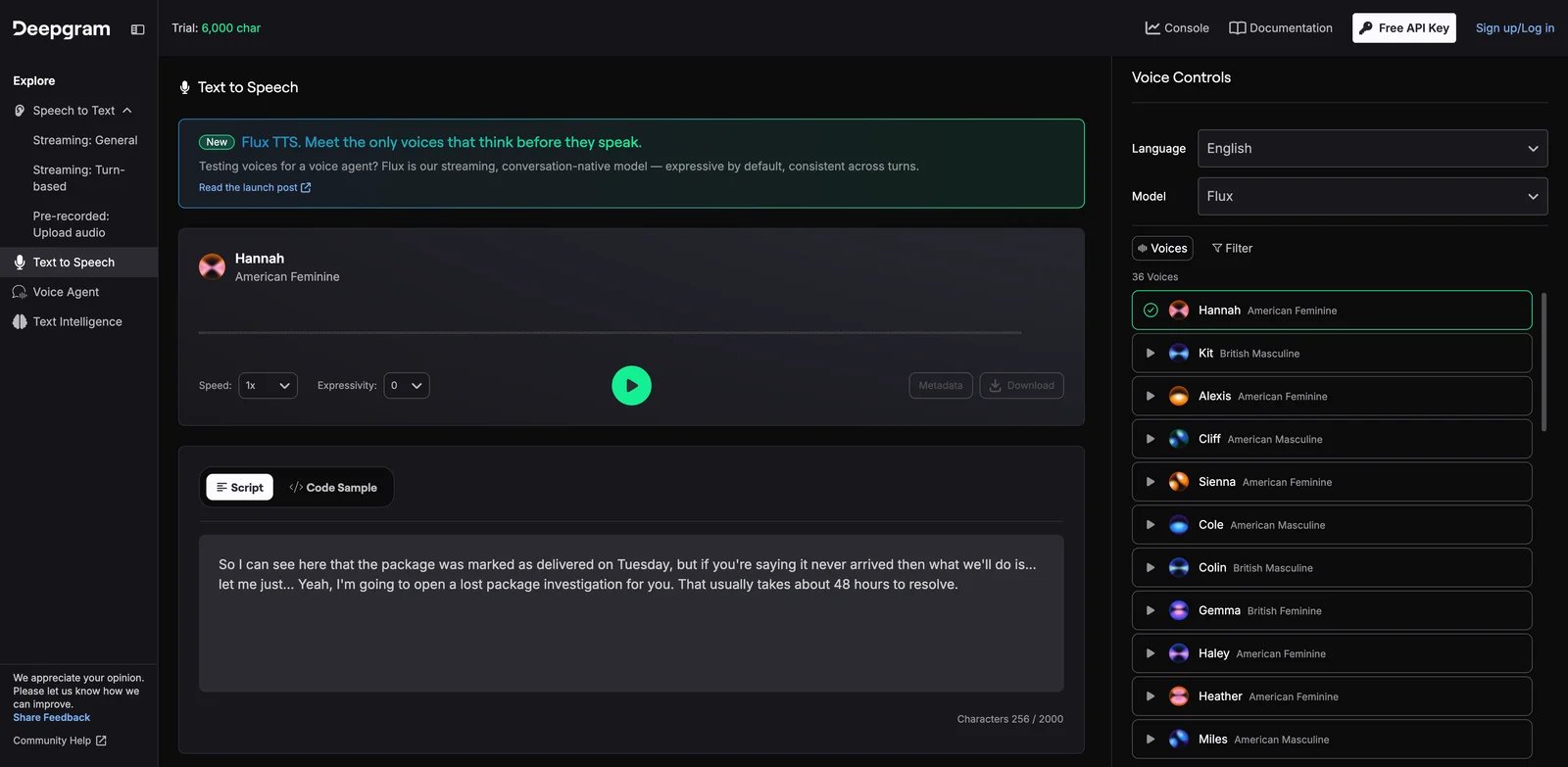
Model routing is the important limitation. Flux is currently English-only. Aura-2 remains on /v1/speak and documents seven languages, so choosing “Deepgram” is not enough—you must freeze the model family, endpoint, voice, and language together. Deepgram's Twilio TTS guide documents μ-law at 8 kHz for direct use with Twilio Media Streams, supporting a concrete telephony route without implying a private-deployment entitlement.
Flux became generally available in August 2026. Current pricing shows a temporary free period through September 12, followed by $0.045 per 1,000 characters on pay-as-you-go; Aura-2 is listed at $0.030. Budget against the post-promotion amount, and treat the recent launch as a reason to pin the selected route and watch the changelog.
Trial focus: interruptions, reconnects, exact telephony encoding, English pronunciation cases, and the operational difference between Flux and Aura-2. Skip Flux if the required production locale is not documented.
Cartesia
Cartesia Sonic 3.6 is a shortlist route when one WebSocket needs to manage several independent generations. Cartesia's context IDs let a client multiplex work over a connection while keeping each generation's response associated with its own context.
Sonic 3.6 is generally available and documents 44 languages plus locale codes. For teams that evaluate before every model update, Cartesia offers dated snapshots such as sonic-3.6-2026-08-27; the sonic-3.6 alias follows the latest stable snapshot. That version choice is more useful for production planning than an unqualified promise that a model is “stable.”
The plan table expresses TTS allowance as generated minutes/credits and lists concurrency of 2 on Free, 3 on Pro, 5 on Startup, 15 on Scale, and custom on Enterprise. A small demo can therefore pass while the intended burst traffic still fails the buying test.
Trial focus: the exact locale and voice, incremental LLM text, context cancellation, peak concurrent generations, and output format. Choose the dated snapshot if reproducibility outweighs automatic model updates.
Inworld
Inworld Realtime TTS belongs on a voice-agent shortlist when the application may need more than one delivery pattern. Its documentation exposes synchronous, output-streaming, WebSocket, asynchronous, and batch synthesis routes around Realtime TTS-2 and a lower-priced Flash option.
That breadth can reduce integration sprawl, but it also creates a procurement question: which model and route is actually being priced and evaluated? Inworld's pricing page separates TTS-2 and Flash, supports character or generated-minute views, and varies rates by plan. Its minute estimate assumes roughly 1,000 characters, which is useful for orientation but not a safe normalized cost for every language or speaking pace.
Trial focus: compare TTS-2 and Flash on the same conversational turns, verify the required language/voice, and capture actual billed usage rather than accepting the calculator's character-to-minute assumption.

Murf Falcon 2 is a practical route for teams whose contract starts with regional streaming and audio output. Murf documents HTTP and WebSocket streaming, regional endpoints, and formats including MP3, FLAC, WAV, ALAW, ULAW, OGG, and PCM. That is useful for IVR and telephony work where a good voice in the wrong codec is still a failed candidate.
The details are model-specific. Murf deprecated Gen2 streaming while retaining Gen2 for non-streaming synthesis; new realtime evaluations should explicitly send falcon-2. Falcon 2's public rate-limit page lists five concurrent TTS requests in US-East and two in other regions for Free/PAYG, with custom Enterprise capacity. Murf's help center lists PAYG at $0.03 per 1,000 characters.
For controlled deployment, Murf's Falcon 2 on-premises documentation describes private-data-center and private-cloud/VPC routes. Those require enterprise activation and deployment assets; they are not implied by the self-serve PAYG plan.
Trial focus: route traffic to the intended region, check the exact locale and format, and exercise the actual plan under expected load. Skip the self-serve route if two or five concurrent requests cannot represent production.
Speechmatics
Speechmatics TTS is a narrower option: English-first speech with streaming output, a managed API, and an on-premises route. The public page lists $0.011 per 1,000 characters.
Its boundaries are unusually useful for fast elimination. Speechmatics says the current API streams audio output but does not yet provide full bidirectional streaming, and fine-grained speed, pitch, or emphasis controls are not available. Those are not quality defects; they tell buyers whether the current contract matches the application.
Shortlist Speechmatics when English, output streaming, and private deployment are the main constraints. Remove it early when incremental text input, a broad language set, or detailed expressive control is mandatory.
Expressive Speech and Voice Identity: ElevenLabs or OpenAI?
These APIs are more directly comparable when the job is controlled delivery rather than cloud-standard utility speech. They still differ in voice ecosystem, control style, and billing unit.
| Decision factor | ElevenLabs | OpenAI |
|---|---|---|
| Control model | Voice/model selection, voice settings, pronunciation dictionaries, model-specific expressive features | Instructions on how the selected built-in or approved custom voice should speak |
| Delivery routes | Complete response, HTTP output streaming, and WebSocket input/output routes | /v1/audio/speech with audio or SSE streaming |
| Durable billing reference | $0.10/1K characters for v2/v3; $0.05 for Flash/Turbo | $0.60/M input text tokens plus $12/M output audio tokens |
| Version decision | Pick among v3, v3 Conversational, Multilingual v2, and Flash | Alias or dated gpt-4o-mini-tts snapshot |

ElevenLabs is the more expansive voice-platform route. Its current docs separate expressive Eleven v3, realtime-oriented v3 Conversational and Flash, and the longer-form Multilingual v2. The API supports a completed audio response, HTTP chunked output, and WebSocket input for realtime applications.
That model menu is useful only if the team chooses deliberately. Each model has its own language coverage, input limit, cost, and realtime behavior. For example, a production integration built around a low-latency Flash model is not evidence that v3 will meet the same latency budget, and a voice available in the library is not automatically available on every plan or route.
ElevenLabs' API pricing currently lists $0.10 per 1,000 characters for v2/v3 and $0.05 for Flash/Turbo. The page also shows plan allowances and occasional promotions; use the ordinary model rate for durable budgeting.
The official Text to Speech product guide also documents the Voice Library, voice settings, cloning routes, and pronunciation controls. Shortlist ElevenLabs when those voice-identity and expressive-control surfaces drive the purchase. If a utilitarian cloud voice is sufficient, its additional surface may not justify the integration and governance work.
For broader product context, read ToolWorthy's ElevenLabs review. If cloning consent, voice ownership, and deletion terms drive procurement, browse the separate AI voice cloning category rather than treating every TTS API as equivalent.
OpenAI
OpenAI's speech endpoint is a focused option for teams already using OpenAI APIs. gpt-4o-mini-tts accepts instructions that describe delivery, supports built-in or approved custom voice references, and returns formats such as MP3, Opus, AAC, FLAC, WAV, or PCM through audio or SSE streaming.
Its economics are token-based rather than character-based. The model page lists $0.60 per 1 million input text tokens and $12 per 1 million output audio tokens. OpenAI also exposes dated snapshots, which matter when a team wants to evaluate a fixed model rather than a moving alias.
The input limit deserves a direct implementation check: current official pages describe it in both model-token and endpoint-character terms. Do not convert one into the other with a generic constant. Send the longest real script through the exact snapshot and endpoint you plan to deploy.
Choose OpenAI when instruction-driven delivery and stack consolidation matter. Use a different route for character-denominated budgeting; treat voice-marketplace and private-deployment requirements as unresolved until current vendor documentation or contract terms establish them.
Cloud-Native Synthesis: Google, Azure, or AWS?
For teams already standardized on a hyperscaler, IAM, region, support, and billing consolidation can matter more than a demo winner. Compare model families inside each cloud before comparing cloud logos.
| Decision factor | Google Cloud TTS | Azure AI Speech | Amazon Polly |
|---|---|---|---|
| Main model families | Chirp 3 HD, Gemini TTS, and legacy voices | Neural voices plus qualified connected/disconnected container routes | Standard, Neural, Long-Form, and Generative engines |
| Control surface | REST/gRPC, model-specific SSML and prompt controls | SDK/REST and voice-specific SSML | Engine-specific SSML, lexicons, and speech marks |
| Billing shape | Characters for Chirp/legacy; tokens for Gemini | Per character, region-dependent | Per character by engine |
| Private/controlled route | Cloud project and region controls | Connected/disconnected neural TTS containers for qualified use | AWS region/account controls; verify any private-runtime requirement separately |
Google Cloud Text-to-Speech
Google Cloud Text-to-Speech is not one homogeneous model. It includes Chirp 3 HD, prompt-directed Gemini TTS, and older voice families, exposed through cloud APIs with audio-format controls.
The model choice changes the buying math. Google prices Chirp and legacy routes by characters but Gemini TTS by input and output tokens. The current pricing page lists Chirp 3 HD at $30 per 1 million characters after its free allowance. Current quotas also include a 5,000-byte request content limit and model-specific request or streaming limits.
Use Google when Cloud IAM, project quotas, and the broader Google stack reduce operational friction. During trial, freeze the exact model and locale; do not assume SSML, streaming, prompt control, price, and quota behavior transfer from one family to another.
Azure AI Speech
Azure AI Speech is the cloud route to prioritize when Microsoft procurement, SSML, or container deployment is already part of the architecture. Azure documents SDK and REST synthesis, neural voices, real-time and batch routes, and qualified connected or disconnected neural TTS containers.
Azure's standard neural TTS is billed per character, but the paid amount is region-dependent. Use the pricing calculator for the intended region rather than copying a number from another market. The current Standard quota documentation lists 30 transactions per second by default, up to 10 minutes of audio per request, and a 64 KB SSML WebSocket message limit.
The control surface is voice-specific: not every neural or HD voice supports every SSML tag. Trial the exact voice, region, and container/cloud route together, then confirm retention, residency, quota increases, and support terms in the contract.

Amazon Polly is useful when the team wants AWS-native speech with several explicit engine classes. Standard, Neural, Long-Form, and Generative engines differ in voice inventory, regions, SSML support, speech marks, and operations. Polly also provides asynchronous long-audio tasks, while bidirectional input/output streaming is specific to the Generative engine.
The pricing model is transparent but engine-dependent: $4 per 1 million characters for Standard, $16 for Neural, $30 for Generative, and $100 for Long-Form outside free allowances. A normal SynthesizeSpeech request accepts up to 3,000 billed characters and ten minutes of output; longer work uses a different operation.
Polly is a strong operational fit for existing AWS teams generating utility speech, notifications, accessibility audio, or long-form output. It is a poor fit if the application assumes every engine offers identical voices, SSML, speech marks, regions, or streaming behavior.
Private Deployment Is a Contract Filter, Not a Separate Leaderboard
Deepgram, Azure AI Speech, Speechmatics, and other vendors in the wider market document private or containerized routes. A marketing phrase such as “on-prem” does not finish procurement. Ask what actually runs inside your environment, which GPUs or CPUs it requires, how it reaches a billing endpoint, where model files live, how upgrades are delivered, what telemetry leaves the environment, and which features are missing from the hosted service.
Rime and Resemble AI are relevant here but are not in this guide's core shortlist. Rime's current pricing page documents cloud, VPC, and on-prem deployment yet conflicts with itself on free minutes, voice inventory, and language breadth. Resemble's Billing API can expose active plans and prices, while its product material documents cloud, on-prem, and air-gapped routes; this review did not normalize a current managed-TTS unit price or contract terms. Treat both as verify before shortlist, not as poor products.
Hume Octave 2 is another watchlist route for expressive speech, but it is explicitly preview. If production policy requires GA models, that status is a hard stop regardless of the demo.
How to Run a Representative TTS Trial
Use the same corpus and measurement boundary for every finalist:
- Conversational turns: short replies, incremental LLM text, interruptions, cancellations, reconnects, and telephony playback.
- Pronunciation stress set: names, addresses, account IDs, currencies, dates, abbreviations, domain terms, and code-switching if required.
- Longer content: the longest real notification, lesson, article section, or narration unit your product sends.
- Language review: native listeners for every production locale; English performance cannot stand in for another language.
- Latency: client-observed time to first decodable audio at P50/P95/P99, plus completion time. Do not compare vendor “model latency” with your end-to-end result.
- Reliability: errors, 429s, silent output, truncation, disconnects, retries, and recovery under steady and burst concurrency.
- Economics: record actual metered characters, tokens, audio tokens, credits, or seconds and the resulting invoice estimate.
- Governance: verify retention, training use, region, voice-clone consent, deletion, DPA/BAA, and private-deployment terms for the purchased plan.
The result should be a lane-specific trade-off, not a weighted universal ranking. If one candidate is cheaper but fails the required locale or protocol, averaging that failure with a good demo result hides the real decision.
For the wider category—including creator studios and reader tools rather than APIs—browse ToolWorthy's AI text-to-speech category. Teams building the full conversational stack can compare orchestration, telephony, and QA ownership in our AI voice agent platforms guide.
FAQ
Which text-to-speech API should I trial first?
Which TTS API has the best voice quality?
How should I compare TTS API pricing?
What matters most for a realtime voice agent?
When should I use a cloud TTS service instead of a specialist API?
Get ToolWorthy Weekly
New AI tools, practical guides, and selected AI signals in one weekly brief.
Related Posts
- 10 Best Web Scraping APIs in 2026: Choose the Right Contract
Choose among 10 web scraping APIs by the contract you actually need: raw page requests, structured extraction, crawling, managed datasets, or a platform runtime.
- Best AI Test Automation Tools 2026: Pick by Testing Goal
A lane-based guide to AI test automation tools for QA and engineering teams: broad QA platforms, plain-English E2E, visual testing, managed QA, and cloud/device agent testing.
- 10 Best AI Voice Agent Platforms 2026: Pricing & Telephony
Shortlist AI voice agent platforms by build model, telephony, QA controls, integrations, production controls, and total cost—not an incomparable starting price.
For AI tool founders
Built a tool that belongs in this decision set?
Request an editorial evaluation for possible inclusion in ToolWorthy.
Submit your tool for reviewPaid submission does not guarantee a ranking, recommendation, inclusion, or editorial outcome.