
14 Best Frase Alternatives 2026 - SEO, GEO & Workflow
Compare 14 Frase alternatives for 2026 by SEO content optimization, GEO visibility, pricing, workflow fit, and migration risk.
On this page
Frase is not being replaced because SEO teams suddenly stopped needing briefs, SERP research, content scoring, and AI-assisted writing. The sharper 2026 question is whether Frase is still the best place to run that work after its V2 shift toward a broader SEO and GEO content operating system.
That shift created two different searches under the same keyword. Some buyers want a closer Frase alternative: another content optimizer with briefs, scores, and writer guidance. Others want to leave the category behind and rebuild the workflow from SEO data, AI search monitoring, and a general AI assistant. A June 29, 2026 AppSumo user report about seeing a "Start Free Trial" screen on a legacy account made the second path more urgent for lifetime-deal users, but the broader switching decision is not only about one account type.
This guide compares Frase against 14 alternatives by switching reason. Use it with ToolWorthy's alternatives, AI SEO, and AI keyword for SEO research categories if you are rebuilding a full content stack rather than swapping one editor.
| Tool | Best For |
|---|---|
| Surfer SEO | Closest Frase-style SEO editor with broader AI visibility |
| Clearscope | Premium editorial scoring and semantic coverage |
| MarketMuse | Site-level topical authority and content inventory |
| NeuronWriter | Budget NLP optimization and Frase-like workflows |
| Scalenut | SEO, GEO, and AI visibility in one production loop |
| Rankability | Agency content operations, approvals, and reporting |
| PageOptimizer Pro | Controlled-testing on-page optimization |
| Content Harmony | Search-intent briefs and writer handoff |
| Keyword Insights | SERP clustering and brief planning upstream of Frase |
| Writesonic | AI-search visibility plus agentic content workflows |
Why People Are Leaving Frase in 2026
The useful question is not "is Frase bad?" It is "which Frase job became risky, too narrow, or too expensive for this team?" The evidence clusters into six switching reasons.
1. Legacy and V2 access anxiety became a fresh 2026 risk. Frase's 2026 product direction is broader: research, writing, SEO/GEO scoring, publishing, and monitoring in a single system. That can be attractive for new buyers. It is less simple for AppSumo and lifetime-deal users who felt left on Legacy Frase after the V2 launch. In the same long-running r/AppSumo thread, users reported account and entitlement issues on April 9, April 21, and June 29, 2026, including the June report that a legacy account showed a "Start Free Trial" screen. This does not prove Frase has announced a V1 shutdown. It does make migration planning rational for teams that cannot tolerate access uncertainty.
2. The LTD trust break is separate from normal pricing. A January 2026 r/AppSumo thread was blunt: one user said Frase thanked LTD users and then "ditch[ed] the LTD users," while another predicted V1 would eventually be sunset. Those are user opinions, not official policy. Still, they show a trust shock that is different from "the tool costs too much." When a team buys a lifetime or legacy promise, the switching trigger is not only the current invoice. It is whether the vendor relationship still feels auditable.
3. Classic content scoring feels weaker in AI Search. A 2025 r/SEO discussion asked whether on-page tools were still effective, especially for AI Search. Another r/seogrowth comment argued that old optimization tools lack a useful LLM, RankBrain, or Gemini friendliness metric. That is where Frase-style editors face a category-level challenge. A term list and score can still improve a draft, but they do not automatically answer whether ChatGPT, Gemini, Perplexity, or AI Overviews will cite the page.
4. Chasing the score can make writing worse. A r/seogrowth discussion described content optimizers making content "less readable" and "stiff." A June 2026 Frase comparison page made a similar claim about Frase's AI writing requiring heavy editing. Treat vendor comparisons carefully, but the user pain is real: writers can overfit to a score and produce prose that looks optimized while reading worse.
5. Some teams want real content gaps, not just term frequency. Frase can help a writer see competitors and recommended topics, but the 2026 buyer increasingly wants deeper answers: what did competitors miss, which entities matter, what topical authority gaps exist, which page should be refreshed, and which answer-engine prompts expose a missing angle. A r/seogrowth comment summarized the complaint as seeing frequency, not gaps. This is why MarketMuse, Clearscope, Rankability, PageOptimizer Pro, and Keyword Insights show up in the shortlist for different reasons.
6. The workflow can still feel isolated. Frase tries to cover more of the content loop than a pure editor, but users and competitor comparisons still surface handoff friction: CMS copy-paste, brief rebuilding, internal knowledge not flowing into briefs, and separate tools for audit, monitoring, approvals, and reporting. A Spike AI comparison called out manual CMS copy-paste, while a RankSpot article framed the buyer need as less manual work and better automation. This pain point does not always mean "choose a better editor." Sometimes it means moving to a broader SEO suite or pairing SEO data with a general AI assistant.
These six pain points map to different replacement paths. If your risk is Legacy access, start with tools that can take over the full workflow quickly. If your problem is prose quality, start with Clearscope, Content Harmony, Claude, or ChatGPT. If your problem is AI-search visibility, prioritize Scalenut, Writesonic, Rankability, Surfer, Semrush, and Ahrefs.
Top 14 Frase Alternatives Compared
The first row is Frase as the baseline. The next ten tools are covered in Detailed Reviews. The last four are honorable mentions for adjacent workflows where the real replacement is a broader SEO data layer or a general AI assistant.
| Tool | Pricing Shape | Predictable Cost? | Editor Form | Migration Effort |
|---|---|---|---|---|
| Frase (anchor) | 7-day trial; current platform starts around $49/mo | Medium - V2 and legacy context matter | SEO/GEO content workflow | Baseline |
| Surfer SEO | No permanent free tier confirmed; annual display from about $49/mo | Medium - localized pricing and plan limits need checking | SEO editor, audit, topical map, AI visibility | Low |
| Clearscope | 14-day trial; Essentials $129/mo; Business $399/mo | High | Premium editorial optimizer | Low |
| MarketMuse | Free tier; paid tiers require sales/demo in current public view | Medium | Strategy and inventory platform | High |
| NeuronWriter | Trial available; Bronze $23/mo and higher tiers | High | Budget NLP content optimizer | Low |
| Scalenut | 7-day trial; standard plans from $59/mo, discount shown | Medium - promotion should be rechecked | SEO/GEO production workflow | Low |
| Rankability | Starter $99/mo; higher agency tiers | High | Optimization plus operations | Medium |
| PageOptimizer Pro | Basic $40/mo; higher individual and team tiers | High | Technical on-page optimizer | Medium |
| Content Harmony | $10 paid trial; Standard-5 from $50/mo | High | Brief-first research workflow | Low |
| Keyword Insights | $1 trial; Basic $58/mo; Professional $99/mo | High | Clustering and brief planning | Medium |
| Writesonic | Free trial; annual display from $79/mo | Medium | AI-search and content workflow suite | Medium |
| Semrush | Content Toolkit $60/mo; broader SEO suite separate | Medium | SEO data and content suite | Medium |
| Ahrefs | Limited free plan; Starter $29/mo and higher SEO plans | High | SEO data platform | Medium |
| Claude | Free; Pro $20/mo; Max from $100/mo | High | General AI assistant | High |
| ChatGPT | Free; Go $8/mo; Plus $20/mo; Pro from $100/mo | High | General AI assistant and workspace | High |
Read the table by failure mode. Surfer, Clearscope, NeuronWriter, Scalenut, Rankability, PageOptimizer Pro, and Content Harmony are easiest to test because they keep a recognizable SEO content workflow. MarketMuse and Keyword Insights move the decision upstream into strategy and clustering. Writesonic, Semrush, Ahrefs, Claude, and ChatGPT change the system around the article rather than only the writing surface.
Also separate "AI-search visibility" from "AI-search action." Many tools can now claim AI visibility, GEO, answer-engine tracking, or prompt monitoring. The harder question is whether the tool tells you which content to create, how to revise it, who should approve it, where it should be published, and how to know if the answer-engine gap improved.
Detailed Reviews
Surfer SEO
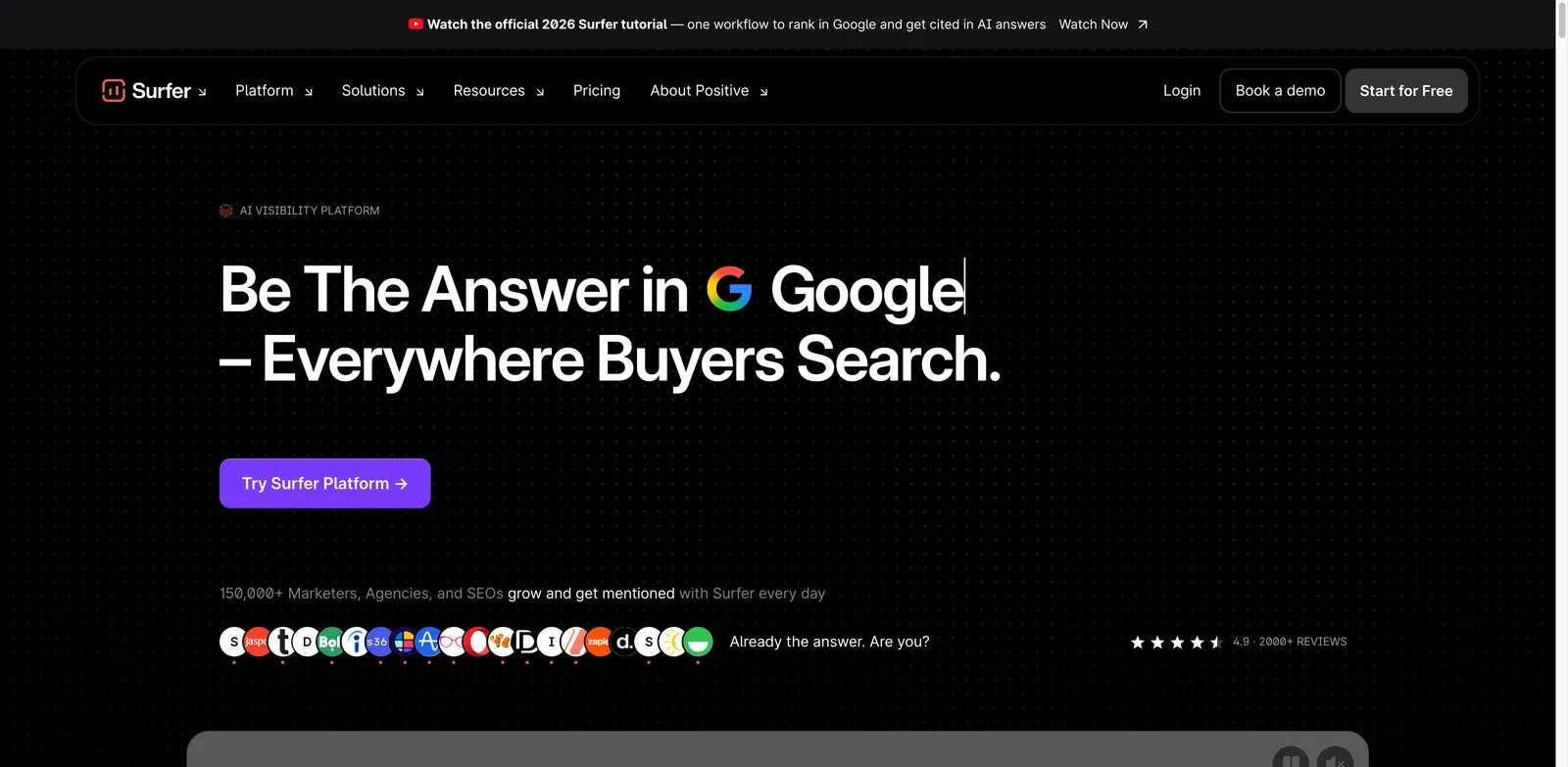
Surfer SEO is the closest Frase alternative when you still want a familiar content editor, score, topic guidance, and SEO workflow, but want a broader suite around it. It is not the cheapest option in the list. It is the most natural "keep the category, switch the operating surface" candidate.
What Surfer SEO solves vs Frase:
- Closer optimizer workflow: Surfer keeps the page-level editor and scoring model familiar for writers.
- Broader SEO surface: Content Editor, audit, topical mapping, and adjacent SEO workflows can replace more than a Frase document.
- AI visibility direction: Surfer's current positioning makes it relevant to teams asking whether content appears in AI answers.
- Low migration effort: Writers who understand Frase-style scoring can usually test Surfer without rebuilding the whole process.
Pricing vs Frase: Surfer's official pricing display can vary by locale and billing term. The research pass found annualized tiers around $49, $99, $182, and $299 per month, with no durable free tier confirmed. That means Surfer can look close to or above Frase depending on plan and capacity. Verify current USD checkout before making the price case.
Limitations: Surfer can become busy. If the team only wants a simple brief and editor, the extra modules may distract. It is also still a scoring-driven tool, so it does not automatically solve the "score over readability" problem.
Best for: Teams that like Frase's core workflow but want a more mature SEO editor and broader AI visibility surface. Not the right fit if you want to leave content scoring behind completely.
Get started with Surfer SEO.
The best Surfer pilot is a refresh, not a blank article. Take one Frase-optimized page that already ranks but has stopped gaining traffic, run it through Surfer's editor and audit workflow, then compare three things: overlap with the Frase terms, new structural recommendations, and whether AI-visibility guidance changes the update plan. If the output is only a different score, the switch is mostly preference. If it produces a clearer refresh plan, Surfer is replacing more of the workflow.

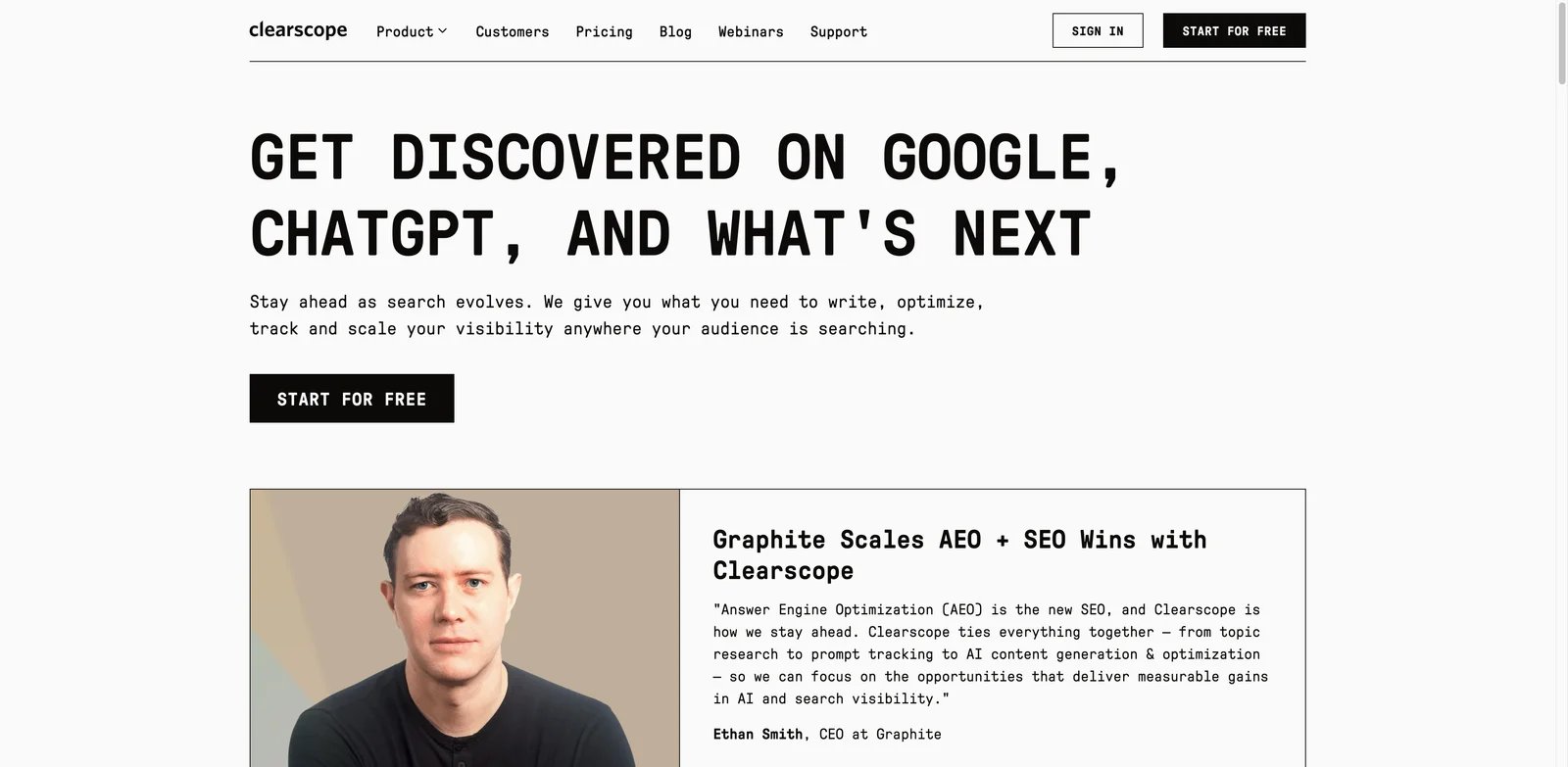
Clearscope is the premium Frase alternative for teams that care less about an all-in-one production loop and more about clean writer guidance. It does not try to be the cheapest or broadest option. It tries to give editors a trusted optimization surface.
What Clearscope solves vs Frase: Editorial grade first: Clearscope is strongest when the main problem is quality control. It gives writers and editors a focused place to evaluate semantic coverage, readability, terms, and grade. For teams frustrated by Frase's breadth or AI writing quality, that narrower surface can be the advantage.
Pricing vs Frase: Clearscope's current public pricing shows a 14-day free trial, Essentials at $129/month, Business at $399/month, and Enterprise custom. That is materially more expensive than Frase's lower entry path. The tradeoff is not volume. It is confidence in a focused editorial optimizer.
Limitations: Clearscope may feel too narrow if your Frase workflow depends on research, AI drafting, CMS publishing, audit pages, and broader GEO monitoring. You may need to pair it with Ahrefs, Semrush, Google Search Console, ChatGPT, Claude, or an operations tool.
Best for: Editorial teams that want premium content optimization and consistent writer guidance. Not the right fit if your primary goal is replacing Frase's research-to-publish workflow with one cheaper all-in-one platform.
Get started with Clearscope.
The right Clearscope test is writer adoption. Give the same draft to one writer in Frase and one in Clearscope, then compare edit time, readability, editor cleanup, and whether the writer understands which changes matter. Clearscope earns its price only when the team produces better final prose with less manager explanation. If the team still edits mechanically to satisfy a score, the premium surface is not solving the core problem.

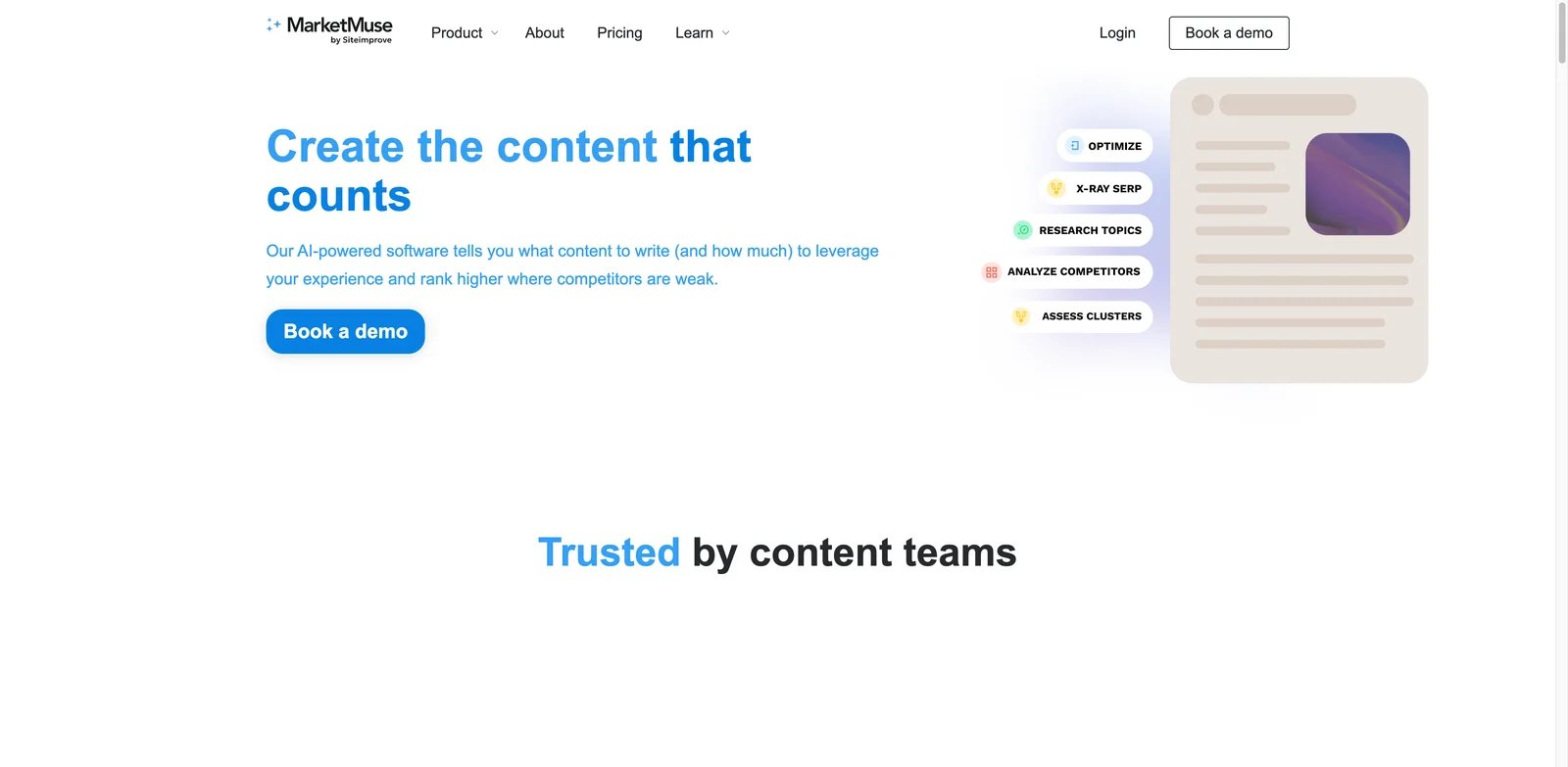
MarketMuse is not just a Frase editor replacement. It is the alternative to test when the real question is: "Which pages and topics should we work on at all?" That makes it stronger for content strategists than for teams that simply want a cheaper scoring panel.
What MarketMuse solves vs Frase: MarketMuse moves the workflow toward site-level inventory, topical authority, personalized difficulty, content gaps, briefs, and prioritization. Frase can help optimize a document. MarketMuse is more useful when the decision is whether to update, create, merge, or ignore a page inside a larger topic cluster.
Pricing vs Frase: MarketMuse currently exposes a real free tier with 1 user and 10 queries per month. The researched pricing surface did not show stable public dollar pricing for Optimize, Research, or Strategy tiers, so paid budgeting requires a sales or demo conversation. Compared with Frase, that makes testing easier at low volume but procurement less transparent.
Limitations: MarketMuse is heavier. It needs an SEO lead or content strategist who will actually use inventory and prioritization data. If your team only wants a writer-facing editor, MarketMuse can feel slower than Frase.
Best for: Publishers, B2B content teams, and strategists who need topical authority and content inventory decisions. Not the right fit if the main job is fast draft scoring for a small writing team.
Get started with MarketMuse.
MarketMuse should be tested across a topic cluster. Pick 10 to 20 existing pages, map the topic, and ask whether MarketMuse changes the order of work. Does it reveal a missing page, a weak support article, or an update that matters more than the keyword you planned to target? If the pilot only produces another brief, MarketMuse will feel expensive. Its value appears when it prevents the team from publishing the wrong article.

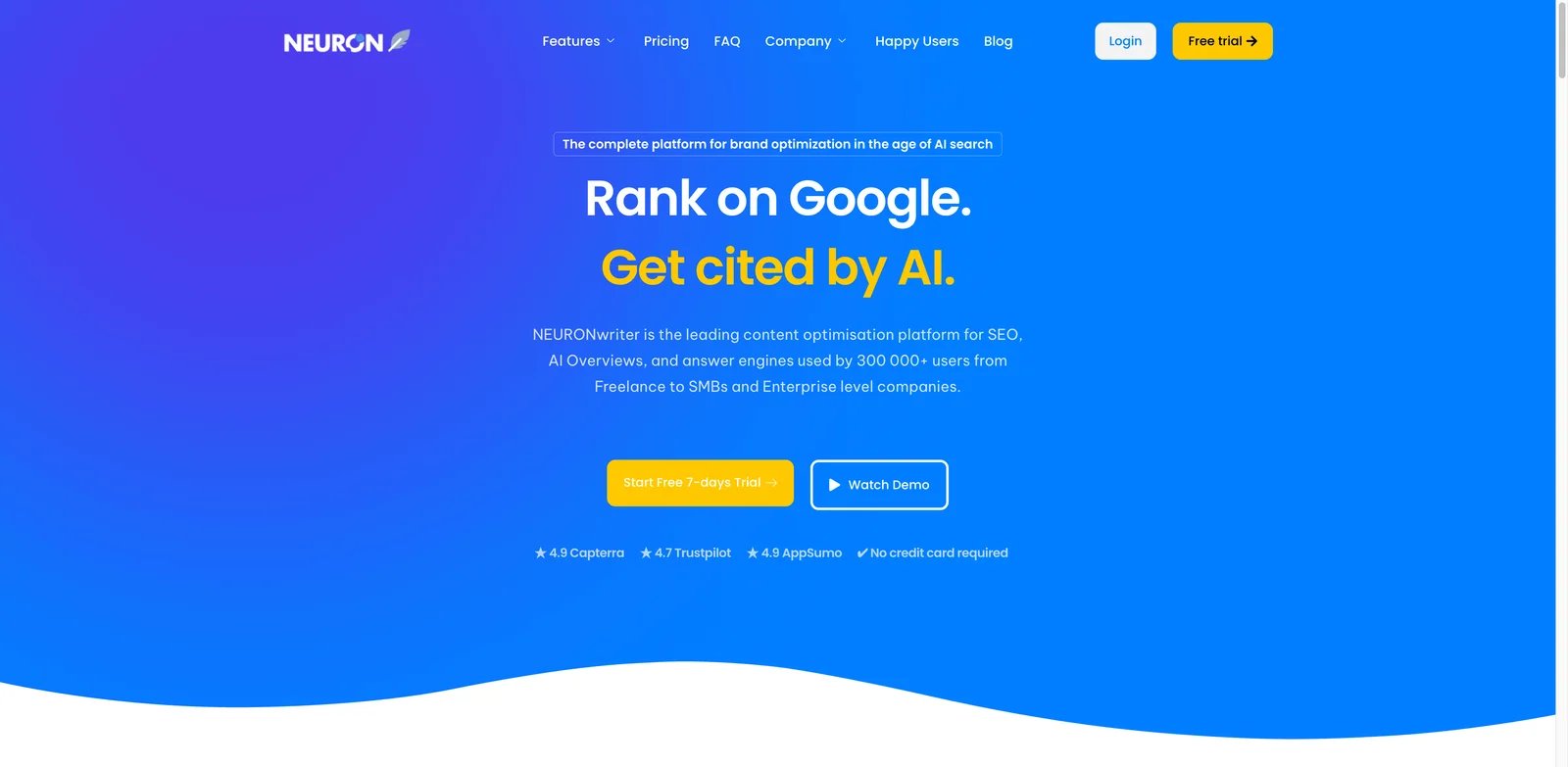
NeuronWriter is the budget pressure test for Frase. If the only reason you keep Frase is "we need a content score, competitor terms, and AI-assisted writing," NeuronWriter forces a practical question: how much polish are you paying for?
What NeuronWriter solves vs Frase:
- Lower entry price: The Bronze plan starts far below most serious SEO content platforms.
- Familiar workflow: SERP analysis, NLP recommendations, content scoring, and AI writing cover the core Frase-like job.
- Good long-tail coverage: Low cost can make it realistic to optimize pages that would not justify premium usage.
- Quick pilot: A writer can test the workflow without changing the entire content stack.
Pricing vs Frase: NeuronWriter lists a free trial path and monthly tiers beginning with Bronze at $23/month, then Silver, Gold, and higher plans. Annual billing reduces effective cost. Compared with Frase, the entry cost is the reason to evaluate it.
Limitations: Lower cost does not automatically mean equal recommendation quality, UX, collaboration, or executive trust. It is also easy for junior writers to chase the score too mechanically.
Best for: Freelancers, niche-site operators, and small teams that need credible NLP optimization at a lower monthly cost. Not the right fit if enterprise confidence, mature collaboration, and premium editorial polish matter more than budget.
Get started with NeuronWriter.
NeuronWriter is also a coverage tool. A premium optimizer may be used only on the most important pages. A lower-cost optimizer can be used across support pages, older posts, and long-tail refreshes. That changes the evaluation. Do not ask whether NeuronWriter feels as polished as Frase. Ask whether it makes 20 neglected pages good enough to improve without creating a review burden the editor cannot handle.

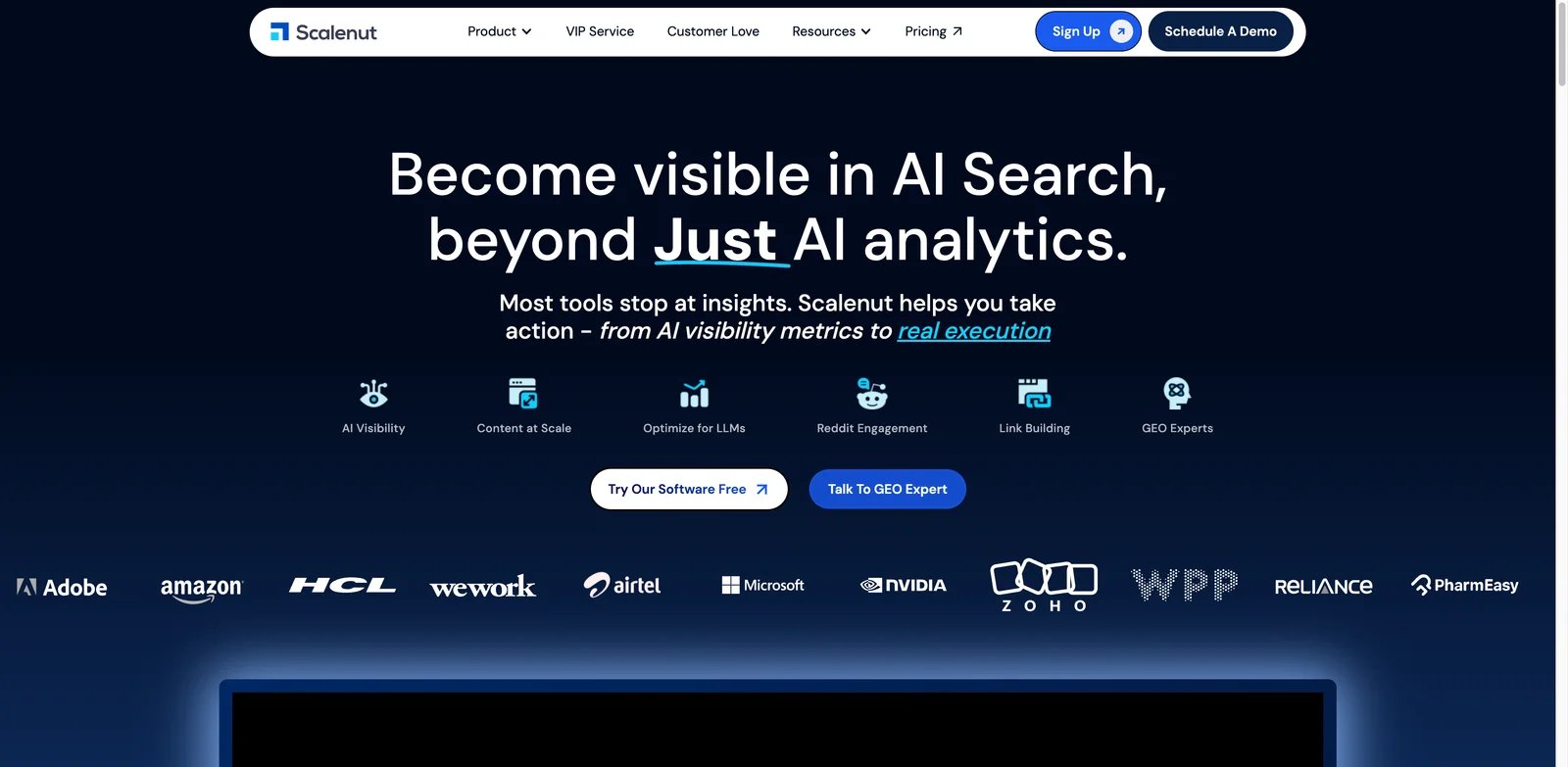
Scalenut is the Frase alternative for teams that want the category to move forward, not shrink. It puts SEO content, GEO direction, content audit, internal linking, and AI-assisted workflows into a broader production surface.
What Scalenut solves vs Frase: GEO workflow bet: Scalenut is interesting because it does not only say "optimize this article." It pushes toward AI visibility, GEO action, audits, and production workflows. That makes it relevant when the switching reason is that Frase-style scoring feels too classic for the AI-search era.
Pricing vs Frase: Scalenut lists a 7-day free trial and standard monthly tiers around Starter $59, Plus $89, Professional $199, and VIP custom. The researched page also displayed a temporary 60%-off promotion, so treat discounted numbers as volatile. Compared with Frase, Scalenut may cost more or less depending on whether you need its broader modules.
Limitations: Breadth creates evaluation risk. A product can list GEO, audit, writing, optimization, and internal linking without being equally strong at every step. Test the actual action recommendations, not only the feature list.
Best for: Lean SEO teams that want a practical SEO and GEO production workflow. Not the right fit if you only need a focused writer-facing editor.
Get started with Scalenut.
The Scalenut pilot should include a full loop: keyword, brief, AI-assisted draft, optimization, audit, internal-link recommendation, and publish handoff. If the team only tests the editor, Scalenut's broader value will be invisible. If the loop removes two or three separate tools, a higher monthly plan can still be cheaper than the current stack.
Rankability
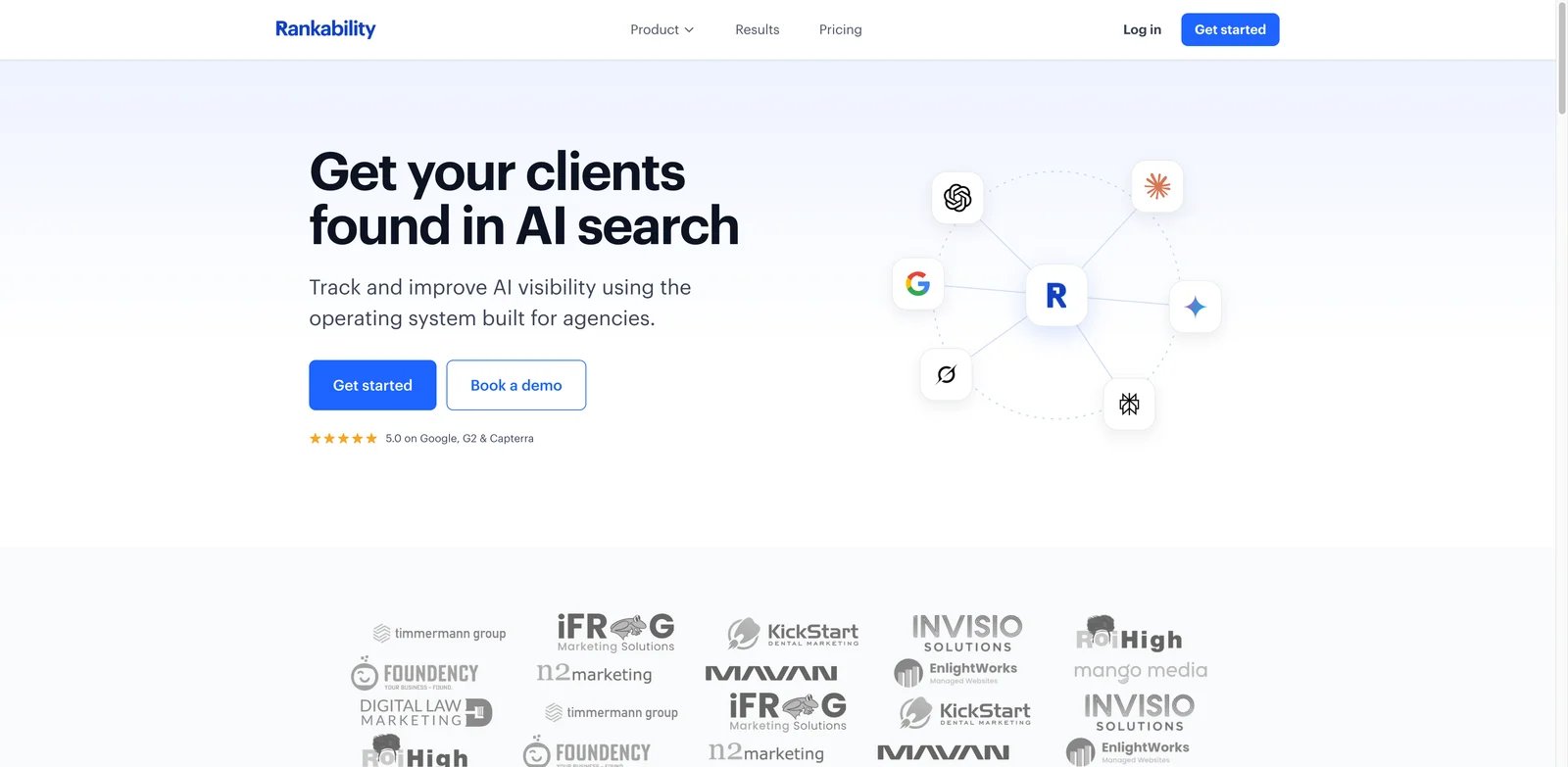
Rankability is the Frase alternative for agencies and operators who say the draft score is no longer the bottleneck. The value is in research, optimization, approval, publishing, routines, API/MCP options, and reporting around the article.
What Rankability solves vs Frase:
- Operations layer: Rankability connects optimization to approval, publishing, and reporting workflows.
- Agency shape: Pricing and product packaging make more sense for teams managing many pages or clients.
- AI/search tracking: It is better aligned with buyers who want to report content work against newer visibility surfaces.
- Repeatable routines: Scheduled work and integrations matter when refreshes are ongoing, not one-off.
Pricing vs Frase: Rankability's researched public pricing listed Starter at $99/month, Growth at $199/month, Scale at $399/month, and Agency at $799/month, with annual savings. That is not a budget swap. It is a workflow consolidation argument.
Limitations: Rankability may be too much product for a solo writer or small site. If your process still happens in Google Docs, Slack, and a CMS, evaluate whether the team will actually adopt the workflow layer.
Best for: Agencies and content operations teams that need optimization tied to approvals, publishing, and reporting. Not the right fit if all you need is lower-cost Frase-style scoring.
Get started with Rankability.
Rankability should be evaluated with roles, not only pages. Give one article to a writer, one to an editor, one to the SEO lead, and one to the person responsible for publishing or client reporting. The product is valuable if those people stop managing the work through side channels. If the score improves but the approval trail still lives in Slack and spreadsheets, the migration has not captured the reason to choose Rankability.
PageOptimizer Pro
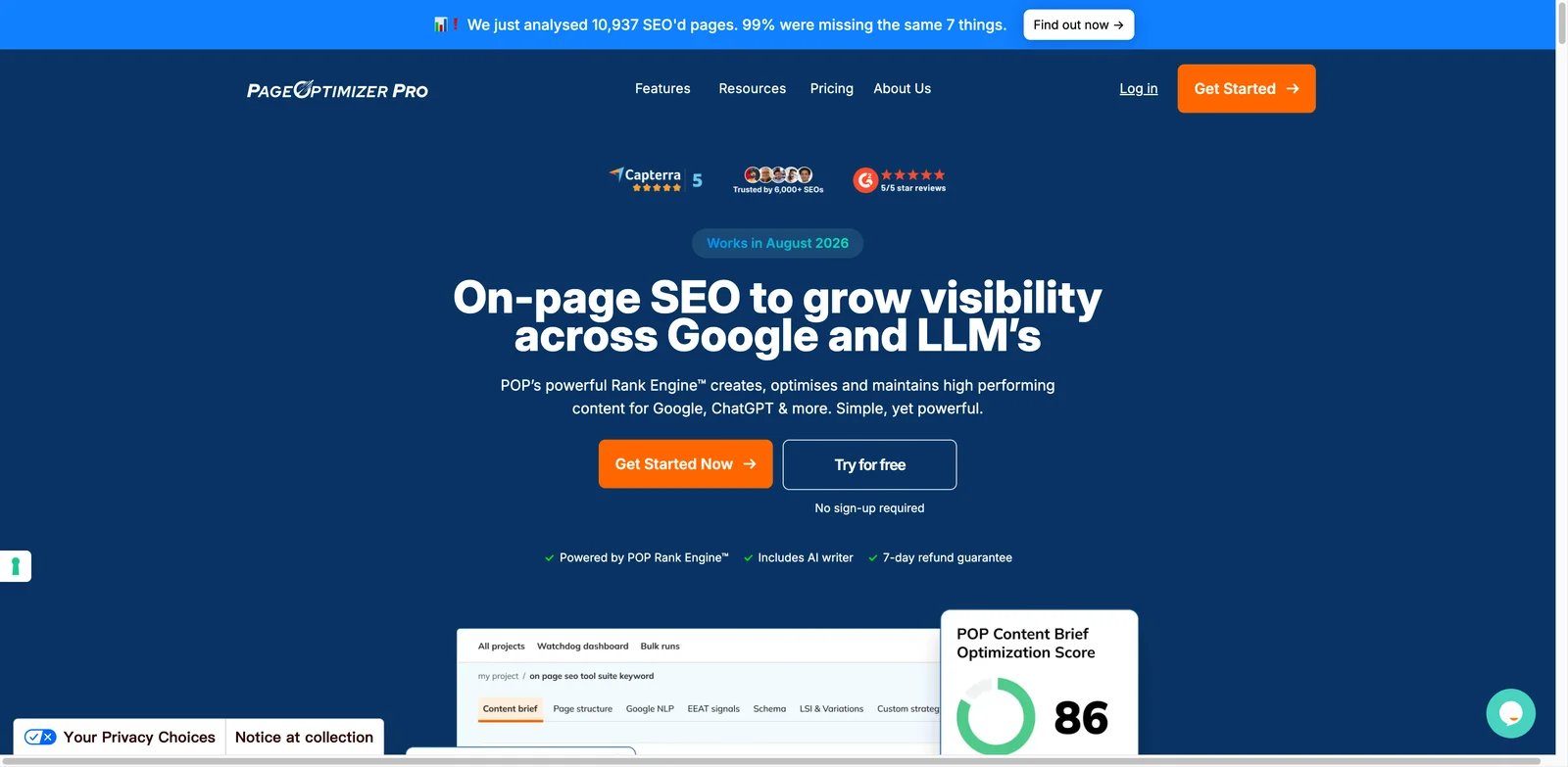
PageOptimizer Pro is the contrarian Frase alternative. It is less about AI writing and more about on-page testing logic. If your skepticism is that Frase-style scores are too correlation-based, POP gives you a different theory of optimization.
What PageOptimizer Pro solves vs Frase: Controlled-testing angle: POP's appeal is its Rank Engine and on-page methodology. It is useful when the team wants technical recommendations, page-level optimization, and a more test-driven view rather than a broad AI writing workspace.
Pricing vs Frase: PageOptimizer Pro lists Basic around $40/month, Unlimited around $72/month monthly or lower annualized, and Teams around $143/month monthly or lower annualized. There is no permanent free tier in the researched pricing, but the entry point is lower than many all-in-one content platforms.
Limitations: POP is not a replacement for Frase's research, brief, AI writing, and publishing loop. You may need separate tools for briefs, writing, content planning, and AI-search monitoring.
Best for: SEOs who care about technical on-page optimization and want a lower-cost testing-oriented tool. Not the right fit if you need an all-in-one content production platform.
Get started with PageOptimizer Pro.
POP is strongest when you can run controlled update tests. Pick pages where the team can isolate on-page changes and measure ranking movement without also changing backlinks, internal links, and content scope at the same time. That discipline is the difference between a useful POP pilot and another subjective SEO tool comparison.
Content Harmony
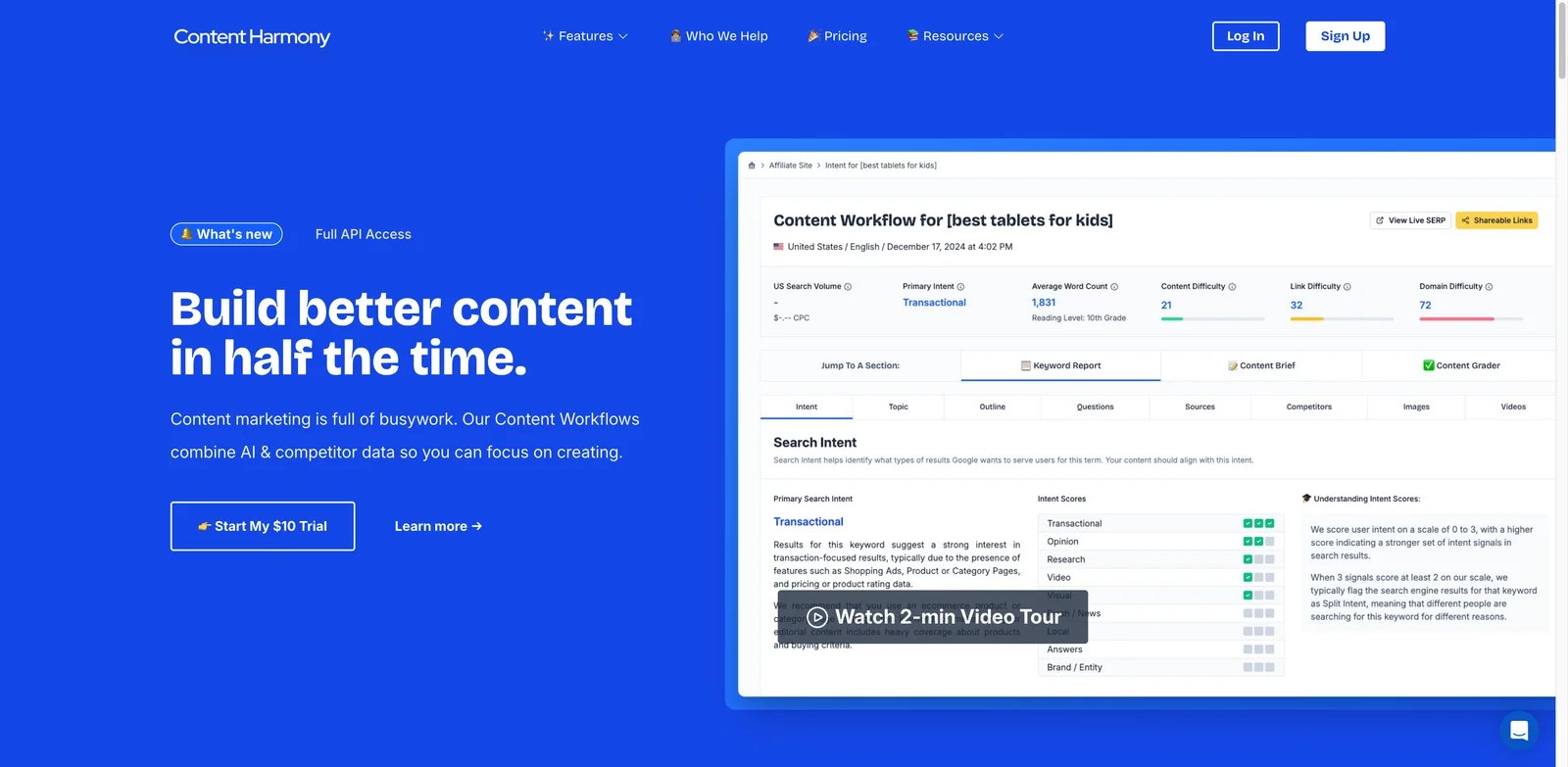
Content Harmony is the better Frase alternative when the deliverable is a brief, not a score. It is especially useful for agencies, editors, and content managers who need writers to understand search intent before drafting.
What Content Harmony solves vs Frase: Content Harmony emphasizes SERP research, intent analysis, competitor review, questions, outlines, visual examples, and writer handoff. That solves a different problem from a live score. It helps teams reduce messy upstream research before the draft exists.
Pricing vs Frase: Content Harmony offers a $10 paid trial with workflow credits and no auto-billing, then packages such as Standard-5 at $50/month, Standard-12 at $99/month, and Standard-25 at $199/month. Compared with Frase, the cost maps naturally to briefing volume.
Limitations: It may not replace every Frase workflow. If your writers rely on live optimization while drafting, you may need to pair Content Harmony with Clearscope, Surfer, NeuronWriter, or a custom review step.
Best for: Agencies and editorial teams that want better search-intent briefs and writer handoff. Not the right fit if your main need is AI writing or AI-search monitoring.
Get started with Content Harmony.
The Content Harmony pilot starts before writing. Build a brief for a keyword where your previous Frase workflow produced a generic draft, then ask whether the brief changes the angle, subtopics, examples, and search-intent framing before a writer begins. If yes, Content Harmony is improving the highest-leverage step. If the brief looks similar to what your SEO lead already writes manually, the savings may be limited.

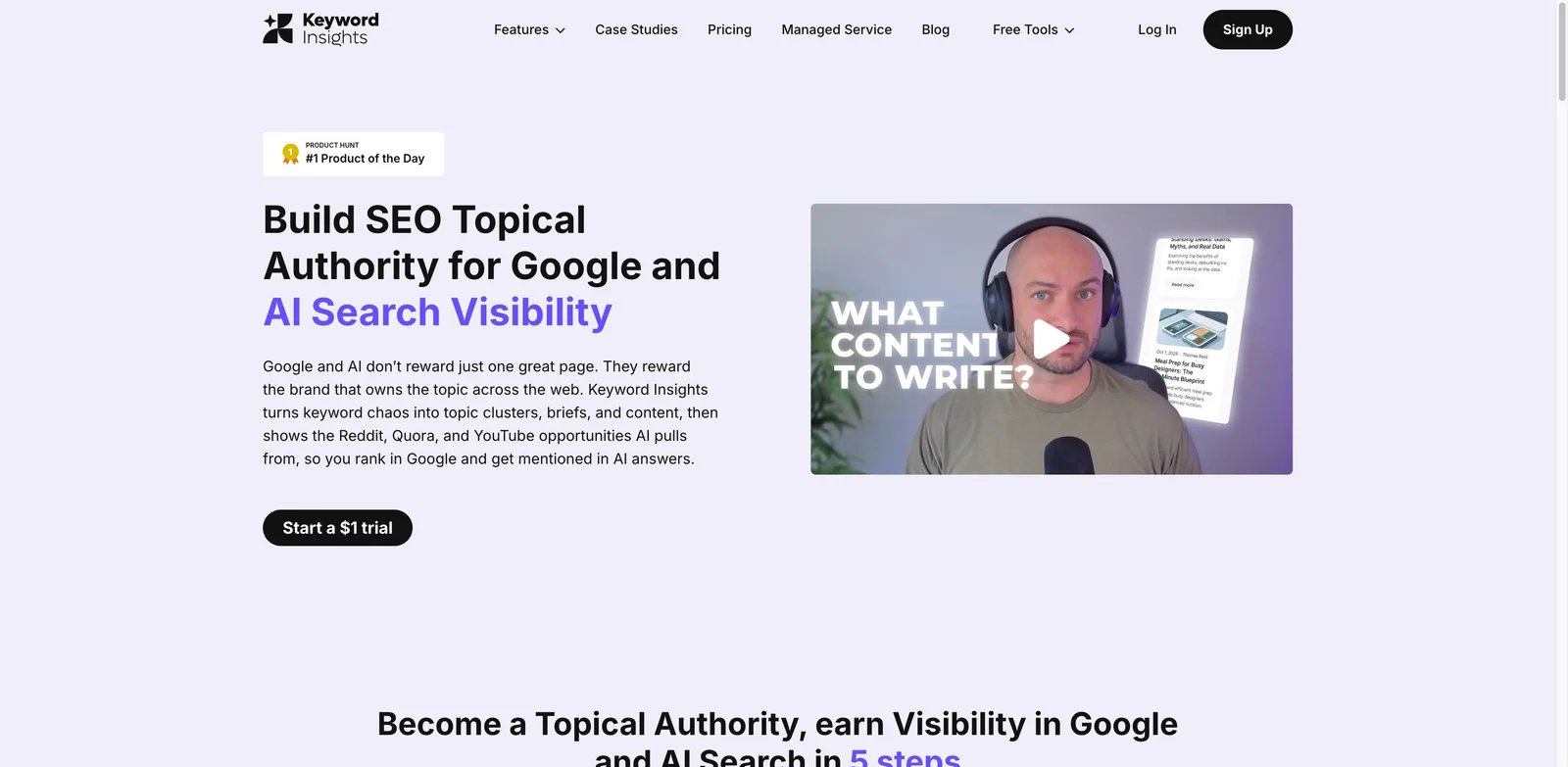
Keyword Insights does not replace Frase at the editor. It replaces the upstream decision that tells you which article should exist, how keywords cluster, and what search intent the brief should satisfy.
What Keyword Insights solves vs Frase: Upstream clarity: Keyword Insights is strongest for SERP clustering, intent classification, topical planning, and brief creation. That matters when Frase is being used as a workaround for keyword planning rather than as the final editor.
Pricing vs Frase: Keyword Insights offers a $1 seven-day trial with a one-time credit allocation, then Basic around $58/month, Professional around $99/month, and Enterprise custom. Compared with Frase, it is not cheaper for the same job; it is priced for a different job.
Limitations: You will still need a writing environment, editor, and final optimization process. Keyword Insights is a planning layer, not a full content production system.
Best for: SEO teams that need clustering and briefs before writing begins. Not the right fit if the writer needs one tool that takes a draft from research through final score.
Get started with Keyword Insights.
Keyword Insights is especially useful when the team keeps creating duplicate or overlapping articles. Use it on a messy keyword export and inspect the clusters manually. If it prevents three near-duplicate briefs from becoming three thin posts, it has already paid for part of the workflow. The output still needs editorial judgment; clustering is a decision aid, not an autopublishing plan.

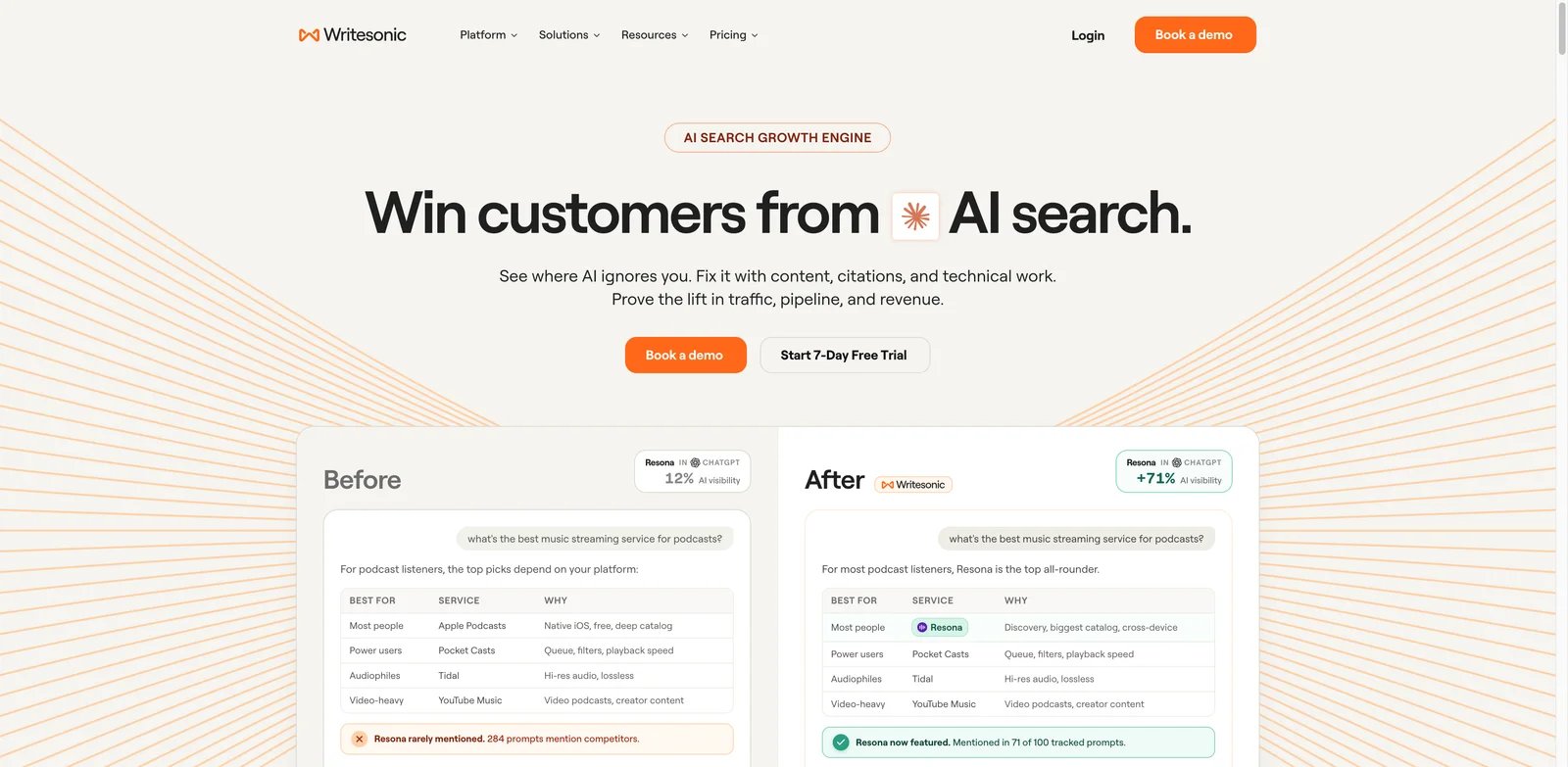
Writesonic is the Frase alternative for teams that want to move toward AI-search visibility and agentic content production. It is less of a clean editor swap and more of a stack-consolidation candidate.
What Writesonic solves vs Frase:
- AI-search visibility: Writesonic's current positioning is closer to AI visibility and answer-engine monitoring than classic article scoring alone.
- Agentic workflows: The product can support content creation, audits, and SEO workflows around AI-generated drafts.
- Broader surface: It may replace multiple AI writing and SEO workflow pieces if the team adopts the suite.
- Fast experimentation: Content teams can test AI articles, visibility, and workflow automation without building everything internally.
Pricing vs Frase: Writesonic's researched pricing showed no permanent free tier, a free trial without credit card, and annual-display paid plans around Starter $79/month, Basic $199/month, Growth $399/month, and Enterprise custom. Compared with Frase, Writesonic is not the cheapest option. It is a broader AI-search and content operations bet.
Limitations: Broad AI content platforms require strict fact review. Do not treat generated articles or AI-search recommendations as publish-ready. Also verify which visibility and workflow features are included in the plan you are considering.
Best for: Teams that want AI-search visibility, AI-assisted content production, and a broader workflow suite. Not the right fit if you want a focused editor and minimal AI stack complexity.
Get started with Writesonic.
Writesonic needs a stricter QA loop than a narrow optimizer. During the pilot, separate three checks: factual accuracy, SEO usefulness, and AI-search visibility logic. A tool can create a fluent draft while still making unsupported claims. It can also show visibility gaps without proving the recommended action will close them. Writesonic is most useful when an experienced operator controls the workflow and treats AI output as a draft, not a final asset.
Honorable Mentions
Semrush is not a Frase clone. It makes sense when the replacement is really a broader SEO data and content stack. The researched Content Toolkit price was $60/month with a 7-day trial, while the broader Semrush suite is packaged separately. Best for teams that need keyword, competitor, audit, and reporting data around content decisions.
Ahrefs belongs here when the Frase problem is weak upstream evidence. A limited free plan and Starter from $29/month make it useful for keyword, backlink, site audit, and competitive research. It will not give writers a Frase-style editor by itself.
Claude can replace large parts of the brief, outline, editing, and rewrite workflow, especially when the issue is stiff prose. Free and Pro plans make it easy to test. Pair it with Ahrefs, Semrush, GSC, or a content optimizer if you need SEO-specific data.
ChatGPT is the adjacent alternative many teams already pay for. It can help with SERP summaries, briefs, outlines, rewrites, and editorial QA, but it is not a native SEO scoring tool. It is strongest when paired with first-party data and a disciplined review process.
Migrating from Frase - A Practical Guide
Migration should start from risk, not tool curiosity. If you are a Frase V2 buyer with no legacy entitlement issue, you may only need a product trial. If you are a Legacy or AppSumo user worried about access, export and continuity planning come first.
Data and Account Migration
Export or copy every active brief, content document, SERP note, target keyword, competitor URL, scoring screenshot, AI draft, custom template, audit page, and publishing workflow you depend on. If your team uses Frase for CMS handoff, document the exact CMS path before switching. Keep Frase read-only during the transition instead of canceling immediately.
For Legacy or LTD accounts, do not rely on memory. Capture plan status, invoices, support messages, screenshots of access, and any Frase account notices before changing the workflow. The article should not claim Frase has announced a shutdown, but your team should still preserve proof of entitlements before migration.
Learning Curve by Alternative
Low-effort migrations are Surfer SEO, Clearscope, NeuronWriter, and Content Harmony. The mental model is close enough that a writer can test these workflows in a week. PageOptimizer Pro is better treated as medium effort because it does not replace Frase's full research, brief, AI writing, and publishing loop.
Medium-effort migrations are PageOptimizer Pro, Scalenut, Rankability, Keyword Insights, Writesonic, Semrush, and Ahrefs. These tools change more of the process around planning, optimization, approval, publishing, reporting, or data.
High-effort migrations are MarketMuse, Claude, and ChatGPT when they replace Frase as part of a custom workflow. The software may be easy to open, but the process design is harder.
Pricing Brackets vs Frase
Lower-cost entry paths include NeuronWriter, PageOptimizer Pro, Ahrefs Starter, ChatGPT Go or Plus, and Claude Pro. Content Harmony, Keyword Insights, and Semrush Content Toolkit start around or above Frase's cited ~$49/month entry point, so treat them as comparable-cost alternatives rather than cheaper ones.
Similar or higher all-in workflows include Surfer, Scalenut, Rankability, Clearscope, Writesonic, and MarketMuse paid tiers. These can still be worth it if they replace multiple tools or reduce editorial handoff time.
Before canceling Frase, run one real article through the replacement: research, brief, draft, optimize, edit, publish handoff, and post-publish review. If the replacement only wins one step, keep looking.
Best Frase Alternatives by Use Case
If Your Reason Is "I need AI-search and GEO visibility, not only classic SERP scoring"
Start with Writesonic, Scalenut, Rankability, and Surfer SEO. The test is not whether the vendor says GEO. Ask each tool to show the prompt gap, the recommended content action, and how it proves the action worked after publishing.
If Your Reason Is "I want optimization guidance without making the prose stiff"
Start with Clearscope, Content Harmony, Claude, and ChatGPT. Clearscope is the premium editor. Content Harmony improves the brief before the draft. Claude and ChatGPT are useful for rewrite passes where readability is the bottleneck.
If Your Reason Is "I need real content gaps and semantic depth, not just term frequency"
Start with Clearscope, MarketMuse, PageOptimizer Pro, and Rankability. MarketMuse is the strongest strategic option. POP gives a different on-page theory. Rankability connects recommendations to execution.
If Your Reason Is "I want fewer handoffs from research to writing to publishing"
Start with Scalenut, Writesonic, Keyword Insights, and Semrush. The best choice depends on where the handoff breaks. Keyword Insights helps before writing. Scalenut and Writesonic help inside production. Semrush helps when the missing layer is SEO data.
If Your Reason Is "I no longer trust lifetime or legacy entitlements"
Start with Clearscope, Content Harmony, and MarketMuse if you want vendors with clearer current commercial surfaces. Also keep exports and screenshots from Frase until the replacement has shipped live content for at least two weeks.
If Your Reason Is "I need a fallback if Legacy Frase access disappears"
Start with MarketMuse, NeuronWriter, PageOptimizer Pro, and ChatGPT. This is an emergency continuity path: preserve documents first, then choose the smallest stack that can keep content production moving.
How to Choose the Right Frase Alternative
1. Diagnose the switching reason and run one free-tier test. Do not compare feature pages first. Pick the pain: legacy risk, trust, AI-search visibility, prose quality, content gaps, or workflow handoff. Then run one real article through the most relevant alternative.
2. Verify pricing, capacity, and plan boundaries. Frase alternatives often hide the real cost in document limits, credits, user seats, tracked prompts, AI articles, exports, audits, or annual-only pricing. Surfer and Scalenut need extra attention because researched pricing involved localization or temporary discounts.
3. Confirm compliance and data posture. If drafts include client data, unpublished product details, or regulated content, ask where prompts, briefs, documents, and uploaded sources are stored. General AI assistants are useful, but they may need stricter internal rules than a dedicated SEO platform.
4. Keep a two-week hybrid period. Run Frase and the replacement in parallel for one or two articles. Compare time to brief, writer acceptance, edit quality, publishing handoff, and post-publish monitoring. Cancel only after the replacement handles the real workflow, not after a nice demo.
Frequently Asked Questions
What is the best Frase alternative in 2026?
Surfer SEO is the closest direct Frase alternative for teams that still want a content editor and SEO workflow. Clearscope is better for premium editorial optimization. Scalenut, Rankability, and Writesonic are stronger when the buyer wants broader SEO/GEO workflow.
What is the best free alternative to Frase?
MarketMuse has a real free tier for limited strategic research, while Ahrefs has limited free SEO tools and ChatGPT or Claude can handle briefs, outlines, and edits. None is a full free Frase replacement.
Is Surfer SEO better than Frase?
Surfer is better if you want a mature SEO editor with broader audit, topical, and AI visibility direction. Frase may still be better if you like its research-to-writing flow and current V2 platform direction.
Is Clearscope better than Frase for content optimization?
Clearscope is often stronger as a focused editorial optimizer. Frase is broader and may be easier for teams that want research, AI writing, optimization, and publishing in one workflow.
What is the cheapest serious Frase alternative?
NeuronWriter and PageOptimizer Pro are the strongest low-cost direct options. NeuronWriter is closer to a Frase-style NLP editor. PageOptimizer Pro is better if you want technical on-page testing logic.
Which Frase alternative is best for agencies and AI search?
Rankability, Writesonic, Scalenut, and Surfer SEO are the best starting points. Agencies should test approval, publishing, reporting, and AI-search monitoring, not only the draft editor.
Can ChatGPT or Claude replace Frase?
They can replace parts of Frase: briefs, outlines, rewrites, content QA, and editorial reasoning. They do not replace native SEO scoring, SERP data, content inventory, or AI-search monitoring unless you pair them with tools such as Ahrefs, Semrush, GSC, or a dedicated optimizer.
What happened to Frase V2 and AppSumo lifetime users, and should I migrate now?
Frase's 2026 product direction moved toward a broader SEO/GEO content platform, while some AppSumo/LTD users reported legacy entitlement concerns in Reddit threads through June 29, 2026. There is no official evidence in the research that Frase has announced a V1 shutdown. If you depend on Legacy Frase, export important work and run a fallback pilot before you need it.
Get ToolWorthy Weekly
New AI tools, practical guides, and selected AI signals in one weekly brief.
Related Posts
- 15 Best Clearscope Alternatives 2026 - Cost, GEO & Workflow
Compare 15 Clearscope alternatives for 2026 by content scoring, GEO visibility, pricing, workflow depth, AI writing, and migration effort.
- 15 Best Surfer SEO Alternatives 2026 - Better Value, Cleaner Content
Compare 15 Surfer SEO alternatives for 2026, including Frase, NeuronWriter, Clearscope, MarketMuse, Content Harmony, Scalenut, Semrush, and Ahrefs.
- 16 Best AI Marketing Tools 2026 — Real Pricing, Honest Limits
From $9/mo email tools to enterprise ad platforms, we compared 16 AI marketing tools with full pricing tiers, honest cons, and use-case recommendations.
For AI tool founders
Built a tool that belongs in this decision set?
Request an editorial evaluation for possible inclusion in ToolWorthy.
Submit your tool for reviewPaid submission does not guarantee a ranking, recommendation, inclusion, or editorial outcome.