
6 Best Bolt.new Alternatives in 2026: Token Burn, Code Ownership & Migration Guide
Outgrowing Bolt.new's token burn? Compare the 6 best Bolt.new alternatives in 2026—Lovable, Replit Agent, Base44, v0 by Vercel, Cursor, and Claude Code (plus open-source bolt.diy)—by billing model, GitHub ownership, and migration path.

On this page
Builders rarely leave Bolt.new on day one—its browser-based WebContainers sandbox is still one of the fastest ways to spin up a working prototype. Switching usually happens on week two, once a project grows beyond a handful of files: because Bolt bills strictly on raw tokens read and written, every multi-file debugging loop re-reads a larger codebase and drains your $25/month Pro pool (~10M tokens) faster than expected. Teams also hit friction when they realize Bolt’s $30/member/month Teams tokens are assigned individually rather than pooled, while solo tinkerers on Free (300k tokens/day) start hunting for an open-source BYOK option.
The right alternative depends on replacement distance: do you want another browser prompt-to-app studio with a different credit model (Lovable, Base44, Replit Agent, v0), a free open-source WebContainers fork (bolt.diy), or has your codebase reached the point where graduating your exported Git repo into a local AI IDE or CLI (Cursor, Claude Code) stops browser debugging loops for good?
Quick Routing: Best Bolt.new Alternatives by Switch Trigger
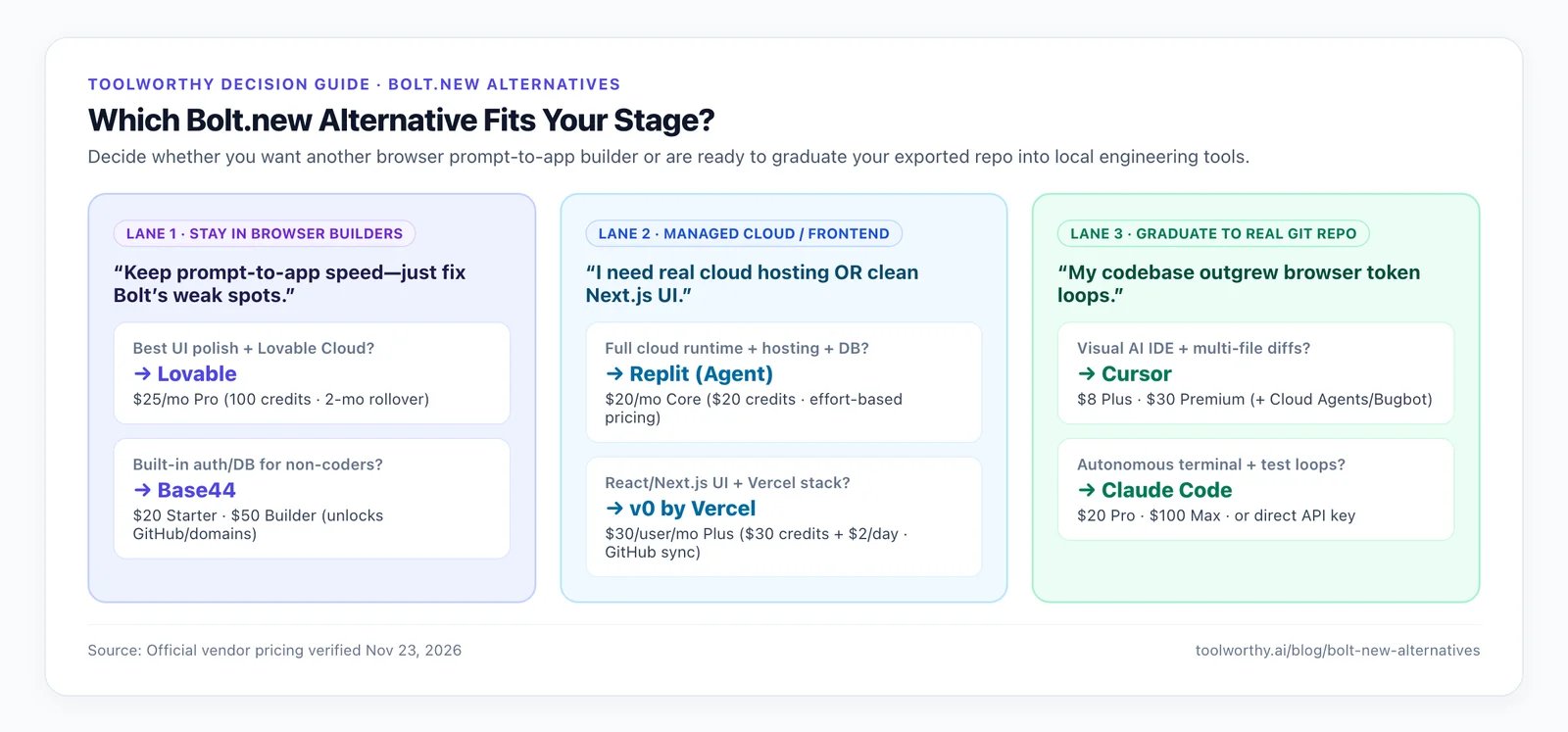
| Alternative | Replacement Distance | Starting Paid Price (Nov 2026) | Best For | Skip If |
|---|---|---|---|---|
| Lovable | Direct browser substitute | $25/mo Pro (100 credits) | Polished UI generation, unlimited team users on shared Pro/Business pools, and 2-month rollover | You need arbitrary local Git debugging or non-browser runtimes |
| Replit (Agent) | Managed cloud runtime + hosting | $20/mo Core ($20 credits) | Built-in cloud runtime (4 vCPU), private hosting, and shared Pro pools (up to 15 users) | You dislike unpredictable dynamic effort-based checkpoint costs on complex loops |
| Base44 | All-in-one built-in backend/auth | $20/mo Starter · $50/mo Builder | Non-technical builders wanting logins, databases, and runtime actions bundled cleanly | You need custom domains and GitHub integration under $50/month (gated to Builder) |
| v0 by Vercel | Frontend UI specialist | $30/user/mo Plus ($30 + $2/day) | React/Next.js UI components, Design Mode, GitHub sync, and native Vercel deploys | You need an all-in-one hosted backend/database builder without separate Vercel hosting |
| Cursor | Local AI IDE graduation | $8/mo Plus (native) · $30/mo Premium | Graduating a Bolt repo into local Git & diffs ($8 Plus native-only; Cloud Agents & Bugbot on $30 Premium) | You want zero-install browser prompting or third-party models bundled without prepaid API credits |
| Claude Code | Terminal CLI graduation | $20/mo (Claude Pro) or API | Autonomous multi-file refactors, real test suites, and CI/CD after exporting from Bolt | You prefer visual drag-and-drop or side-by-side browser previews over terminal diffs |
(Just want to keep Bolt.new’s exact browser UI with your own API keys and $0 software fees? Jump straight to the open-source bolt.diy section below.)
Side-by-Side Comparison: Billing, Rollover & Code Ownership
| Tool | Environment | Billing Unit | Entry Paid Tier | Credit / Token Rollover | GitHub Sync & Code Ownership |
|---|---|---|---|---|---|
| Bolt.new (Anchor) | Browser (WebContainers) | Raw tokens read/written | $25/mo Pro (~10M tokens) | Up to 2 months (active Pro) | Exportable repo + external DB choice |
| Lovable | Browser prompt-to-app | Build credits (shared across unlimited users) | $25/mo Pro (100 credits) | Up to 2 months (active Pro) | Standard repo export + custom domains on Pro |
| Replit (Agent) | Managed cloud IDE | Effort-based checkpoints ($ credit pool) | $20/mo Core ($20 credits) | Rollover options on Pro ($100/mo) | Git-backed cloud workspace; deploy inside Replit or export |
| Base44 | Browser all-in-one app studio | Dual credits (message + integration) | $20/mo Starter ($16 annual) | Monthly pools (verify rollover terms) | GitHub & custom domains gated to $50/mo Builder |
| v0 by Vercel | Browser UI generator | Token-mapped $ credits | $30/user/mo Plus ($30 + $2/day) | Monthly pool (verify rollover) + $2 daily login credits | GitHub sync included on Free; standard Next.js/React code |
| Cursor | Local AI IDE (VS Code fork) | Weekly native pool + 3rd-party API credits | $8/mo Plus (native) · $30/mo Premium | Weekly reset (prepaid API credits) | 100% local Git repo (zero hosting lock-in) |
| Claude Code | Terminal CLI + IDE integration | Claude tier or direct API tokens | $20/mo Pro · $100/mo Max | Subscription window / API balance | 100% local Git repo + CI/CD (zero hosting lock-in) |
Why Entry Prices Look Similar—Until Debugging Loops Hit
Most browser-based alternatives start between $20 and $30/month (with Cursor starting even lower at $8/month Plus for native models only), which hides how differently your bill scales when an agent gets stuck fixing a multi-file bug:
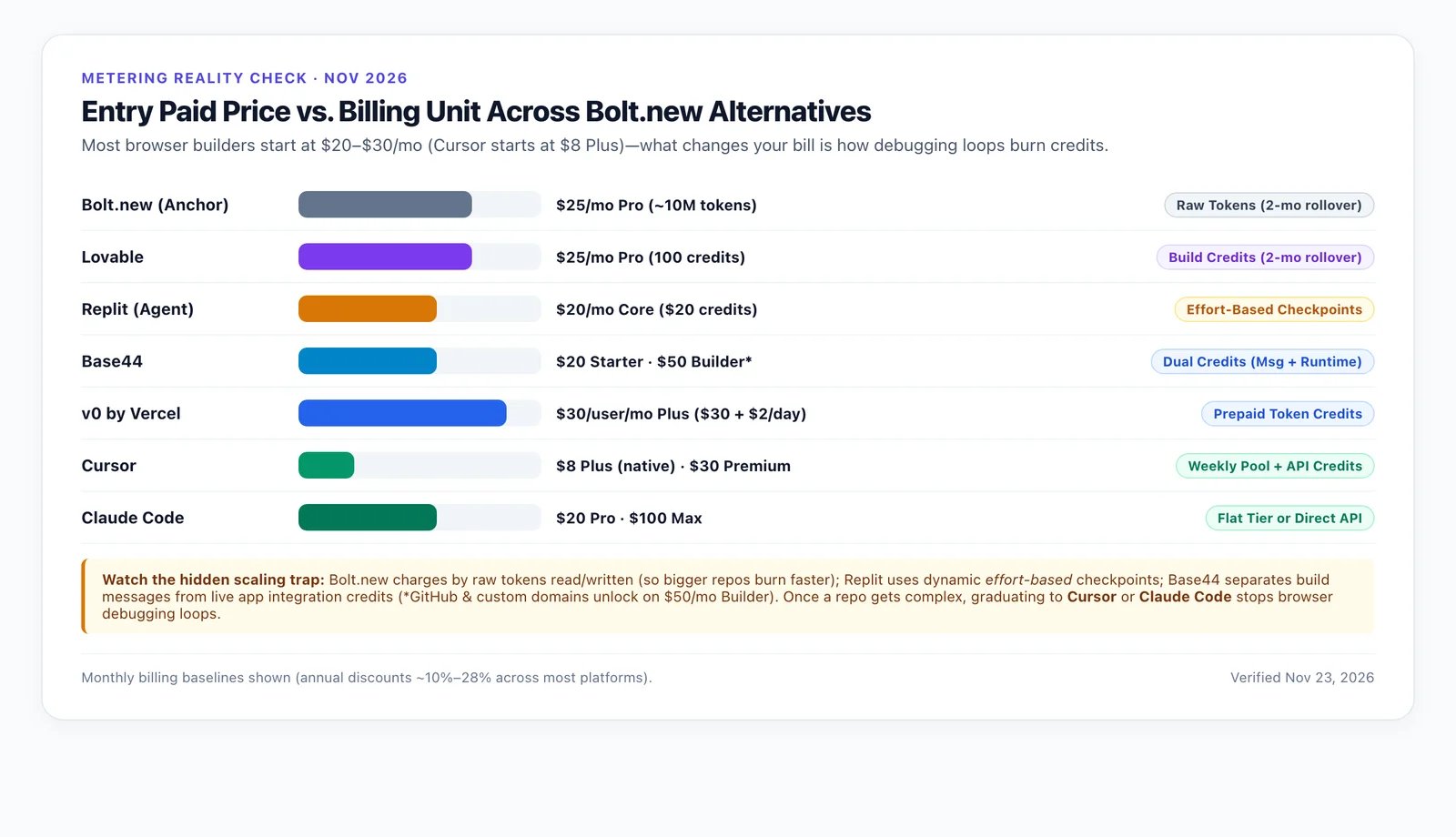
What you actually lose when leaving Bolt.new: Leaving Bolt for a local tool (Cursor or Claude Code) means giving up zero-install WebContainers instant previews in your browser. Leaving Bolt for Base44 or Lovable keeps browser speed, while shifting you from raw token pools into structured build/runtime credit buckets.
Detailed Breakdown of the 6 Best Bolt.new Alternatives
Lovable
Best for: Founders, product designers, and lean teams who want the closest direct browser substitute to Bolt.new with high visual UI polish, shared team pools, and 2-month credit rollover.
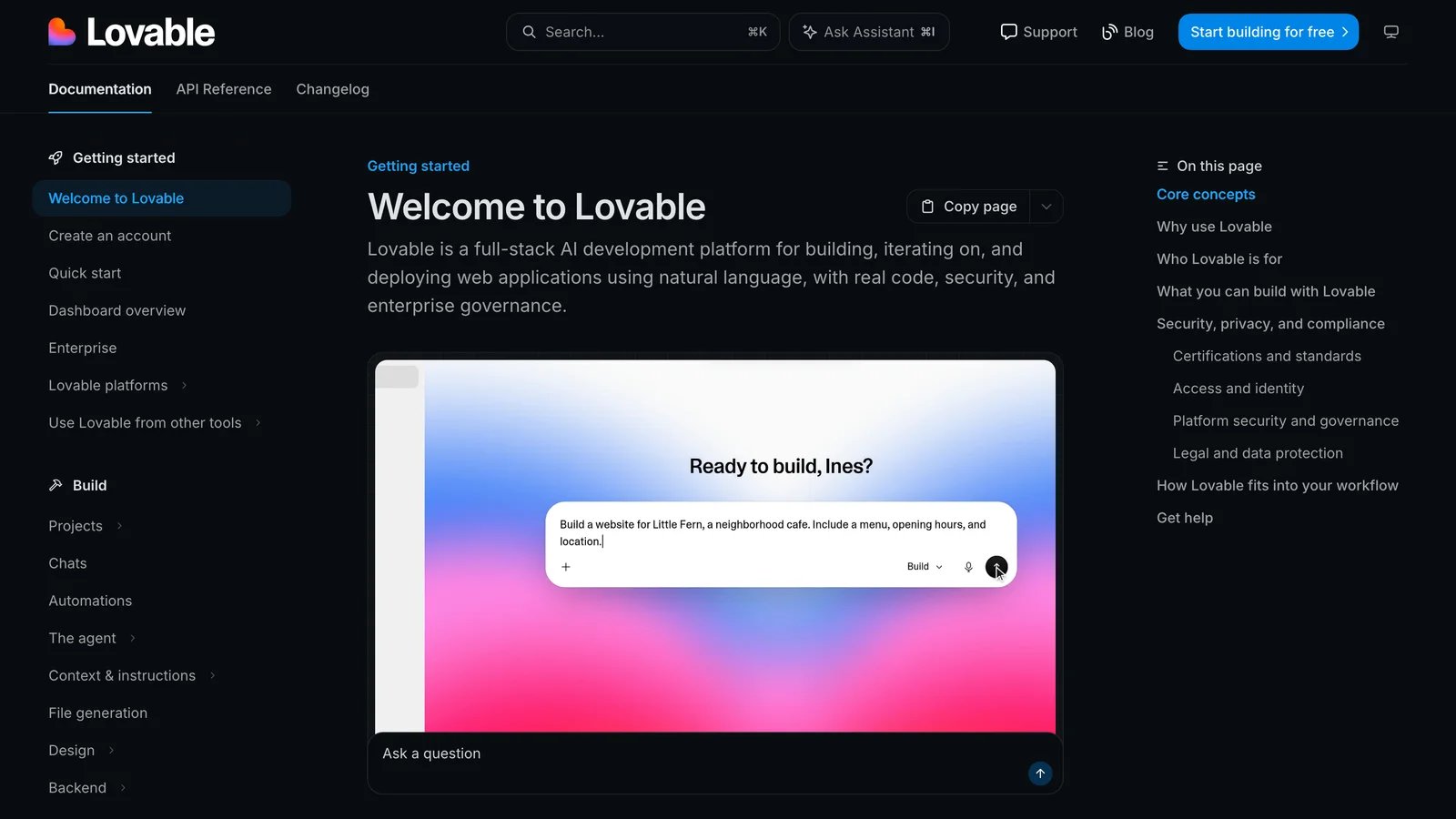
Lovable uses a credit system spanning building, chatting, and workspace operations: Free ($0, 5 build credits/day capped at ~30/month, Lovable badge, no rollover), Pro (starting at $25/month for 100 credits, scaling up to 10,000 credits/month; includes unlimited users sharing the credit pool, removes the badge, adds custom domains, and rolls unused credits over for 2 months while active), and Business (from $50/month for 100 credits, adding SSO, security center, and design templates), with roughly 2 months free on annual billing.
- What you gain over Bolt.new: Higher default frontend polish, structured credit scaling rather than raw file-size token spikes, and unlimited team users sharing one credit pool (solving Bolt Teams' non-pooled $30/member allocation).
- What you lose: Full arbitrary Node.js runtime flexibility inside WebContainers when you step outside Lovable’s core stack.
- Skip if: Your codebase is already complex enough that you need local Git branches and automated test suites. (Also evaluating Lovable’s rivals? See our Lovable alternatives breakdown.)
Replit (Agent)
Best for: Builders who want real managed cloud compute, databases, private deployments, and an autonomous Agent in one browser workspace—without gluing together external hosting.
Replit bundles hosting and AI spend cleanly: Starter ($0, 0.5 vCPU, public deploys), Core ($20/month or $18/month annual, includes $20 in usage credits, 4 vCPU, private repls, full AI Agent), and Pro ($100/month or $90/month annual, $100 monthly credits with rollover options, parallel agents, shared collaboration for up to 15 users).
- What you gain over Bolt.new: True server-side cloud infrastructure (not just in-browser WebContainers), always-on deployments, and lower $20/month entry pricing with $20 in included credits.
- What you lose: Upfront cost predictability per prompt. Replit’s Effort-Based Agent Pricing bills dynamically by actual scope and compute—light edits can cost ~$0.05–$0.06, while heavy autonomous self-debugging loops consume credits much faster.
- Skip if: You prefer a fixed-scope token meter or already deploy cleanly to Vercel/AWS from a local repo. (See our Replit alternatives guide.)
Base44
Best for: Non-technical founders and operations teams who want user logins, databases, and automated backend actions built in from prompt one—with clear separation between building costs and live-app runtime costs.
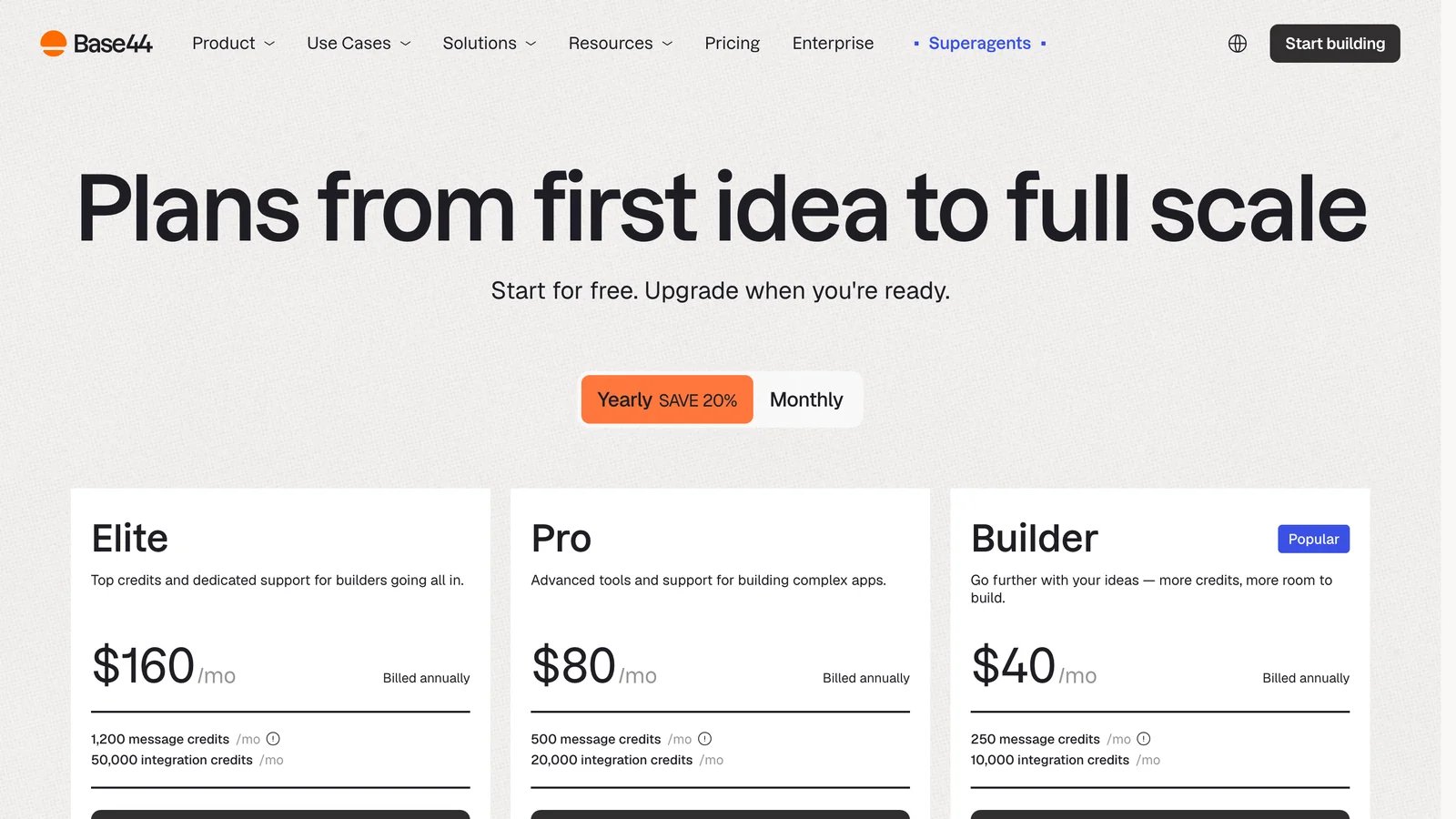
Base44 splits usage into message credits (prompting/building) and integration credits (live app automations, APIs, emails): Free ($0, 25 message / 100 integration credits, up to 5 apps), Starter ($20/month or $16/month annual, 100 msg / 2,000 int), Builder ($50/month or $40/month annual, 250 msg / 10,000 int—unlocks custom domains, backend capabilities, and GitHub integration), Pro ($100/month or $80/month annual, 500 msg / 20,000 int), and Elite (from $200/month).
- What you gain over Bolt.new: Turnkey auth and database provisioning without wiring external services, plus predictable live-app runtime budgeting.
- What you lose: Low-cost GitHub and custom-domain unlocks—both sit on the $50/month Builder tier rather than the $20 Starter plan.
- Skip if: You are a developer who wants immediate GitHub sync and custom domains at $20–$25/month. (See our Base44 alternatives review.)
v0 by Vercel
Best for: Frontend and full-stack developers building on React, Tailwind, and Next.js who want crisp UI generation, Figma/Design Mode workflows, and native GitHub + Vercel deployment.
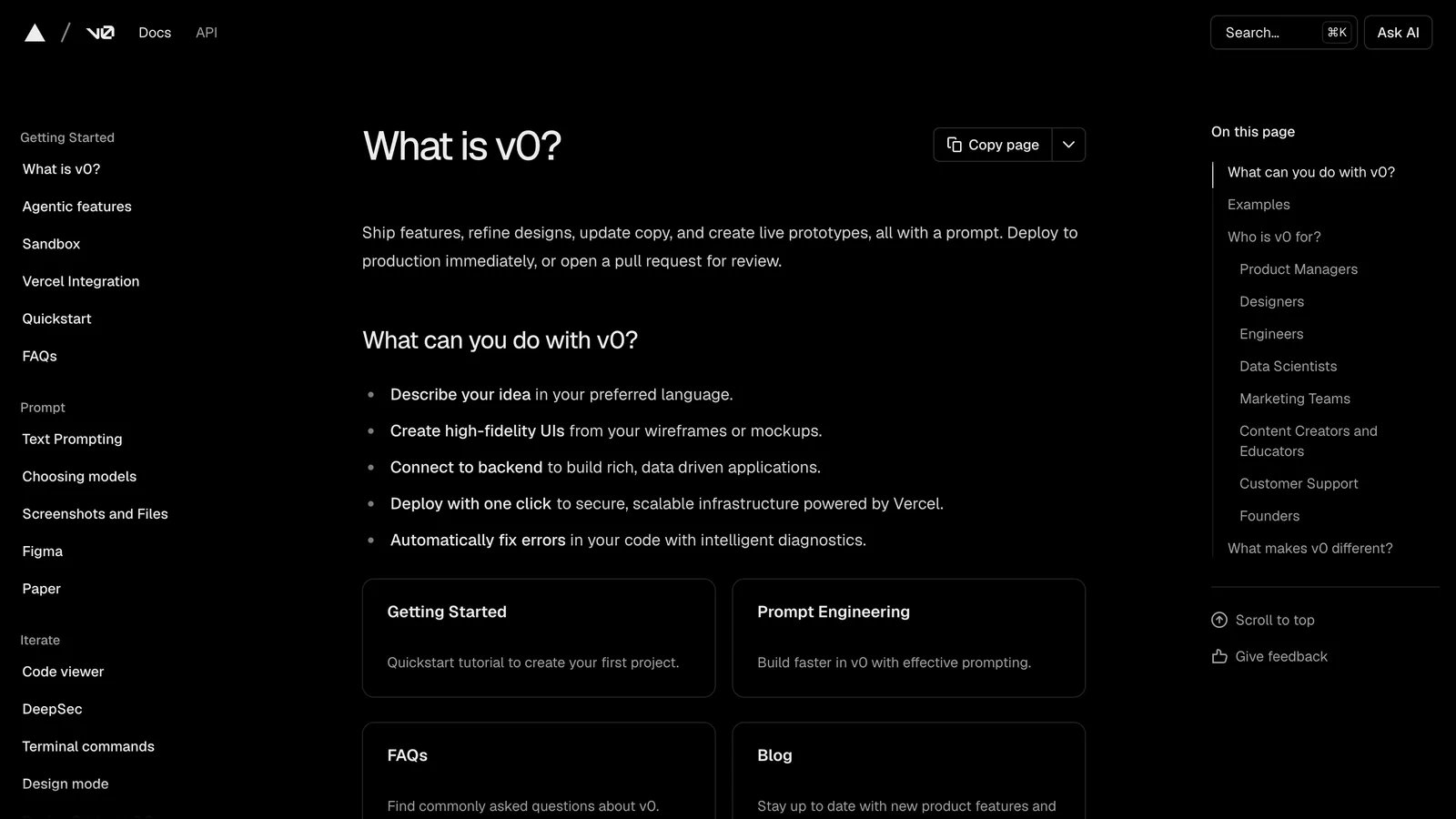
v0 by Vercel runs on token-mapped prepaid credits: Free ($0, $5 one-time credits for new users, 7 messages/day limit, Design Mode, GitHub sync, Vercel deploy), Plus ($30/user/month with $30 in monthly credits + $2 free daily login credits, all models, shared team chats), Business ($100/user/month—same $30 monthly + $2 daily credit allowance, adding default training opt-out and org controls), and Enterprise (custom, SAML SSO, RBAC)—keeping UI generation credits cleanly separate from standard Vercel hosting bills.
- What you gain over Bolt.new: Cleaner React/Next.js component architecture, native Vercel ecosystem ergonomics, and GitHub sync even on the free tier.
- What you lose: Bolt’s all-in-one in-browser Node.js sandbox for quick non-Vercel full-stack prototypes.
- Skip if: You are non-technical and want a single vendor to manage your database, auth, and backend logic without touching Vercel/GitHub. (Comparing frontend UI generators specifically? See our best AI UI generator guide.)
Cursor
Best for: Developers whose Bolt.new prototype has turned into a real production codebase that needs local Git branches, multi-file diffs, Cloud Agents, and automated PR reviews (Bugbot).
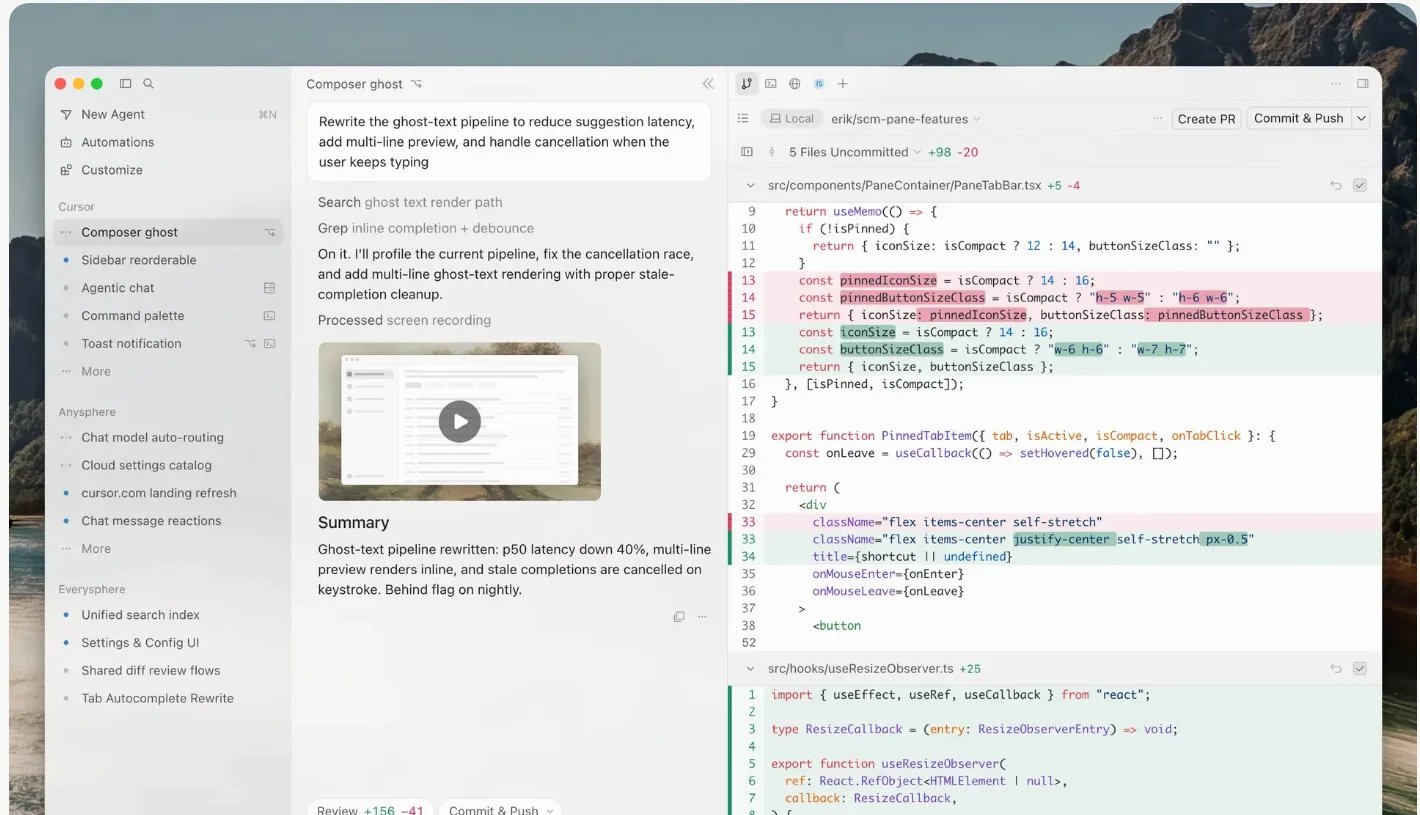
Cursor is an AI-native VS Code fork with Free ($0), Plus ($8/month native models weekly pool only), Premium ($30/month, 4x Plus + Cloud Agents, Automations, Bugbot; third-party models billed separately via prepaid API credits), Super ($100/month), and Ultra ($200/month).
- What you gain over Bolt.new: Total repository ownership, real local debugging/testing, automated PR review (Bugbot), and no browser WebContainers ceiling.
- What you lose: Instant zero-install browser prototyping—you must export your Bolt.new project to GitHub and clone it locally.
- Skip if: You have never used VS Code or Git and prefer staying strictly inside a browser builder. (See our Cursor alternatives guide.)
Claude Code
Best for: Technical founders and engineers who want to export their Bolt.new repo into Git and let an autonomous agent run tests, fix type errors, and refactor across files without paying browser-sandbox token markups.
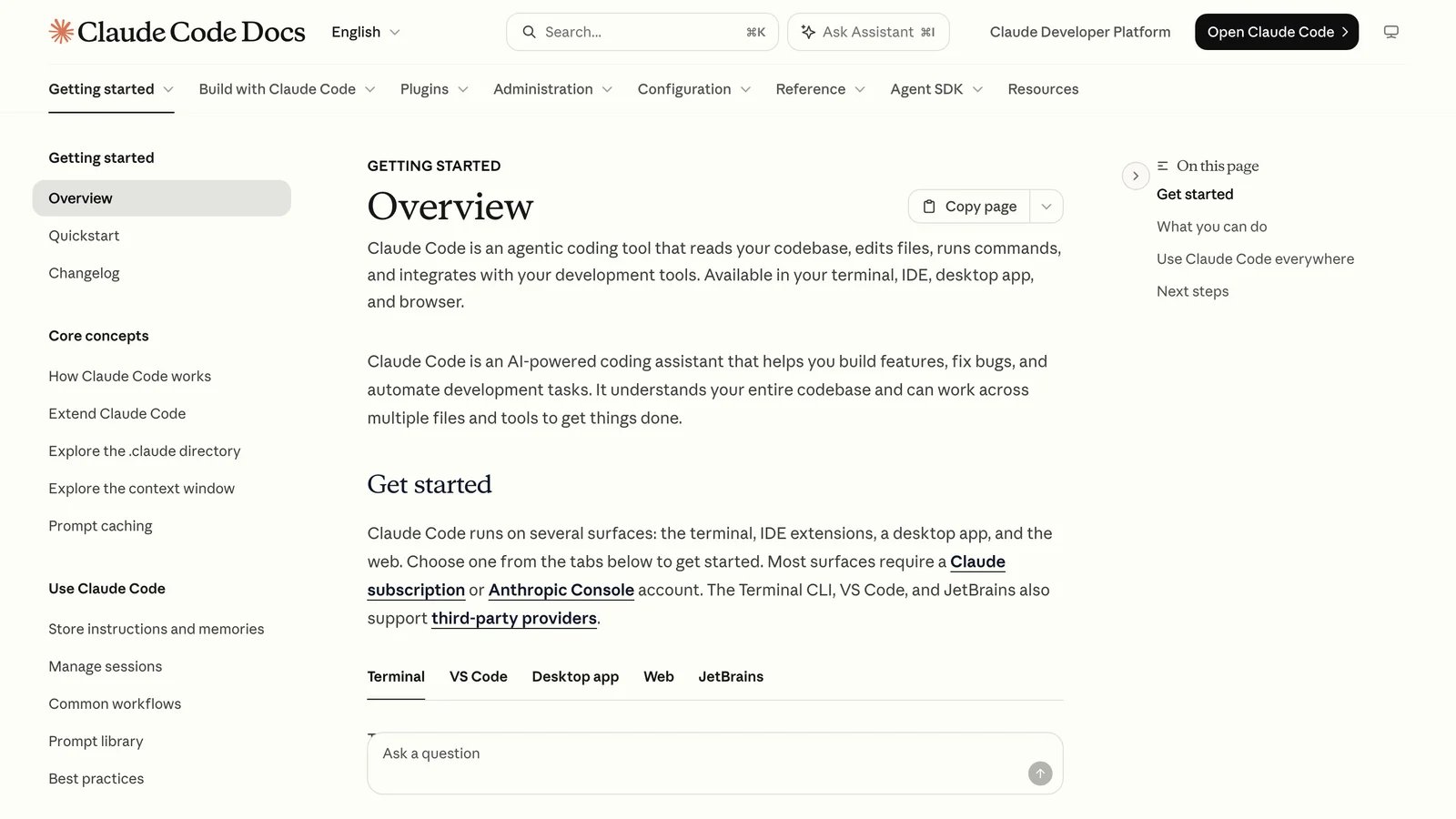
ANTHROPIC_API_KEY across Terminal, VS Code, Desktop, Web, and JetBrains.- What you gain over Bolt.new: Deep shell/test-loop autonomy that fixes real build failures instead of looping blindly in a browser preview, plus scriptable CI/CD automation.
- What you lose: Visual side-by-side prompt-to-preview convenience for non-coders.
- Skip if: You want an all-in-one visual app builder with built-in hosting and auth. (Comparing terminal agents? Read our Claude Code alternatives guide, or browse our best AI app builder roundup and AI App Builder directory.)
Open-Source BYOK Route: bolt.diy
bolt.diy (stackblitz-labs/bolt.diy, MIT license, 20.1k+ GitHub stars)—the official community-maintained open-source fork of Bolt.new.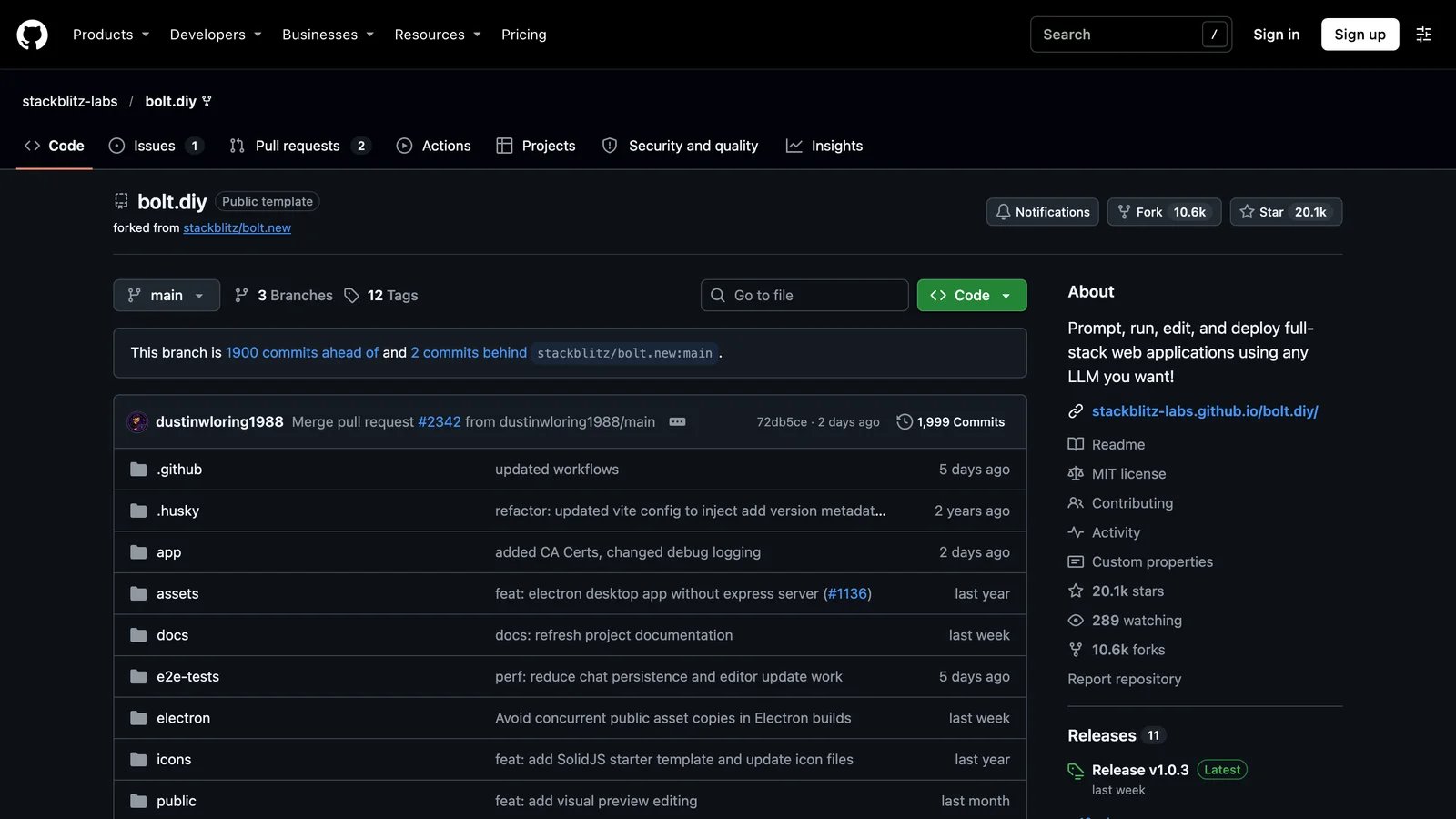
- How it works: Run it locally via Node/Docker and plug in your own API keys (Anthropic, OpenAI, Gemini, DeepSeek, OpenRouter, or local Ollama models) with $0 software fee and 0% token markup.
- Trade-off: You manage your own local runtime, API keys, and deployment pipeline—ideal for developers, not non-technical beginners.
When to Switch vs. Graduate Off Bolt.new (Safe Migration Checklist)
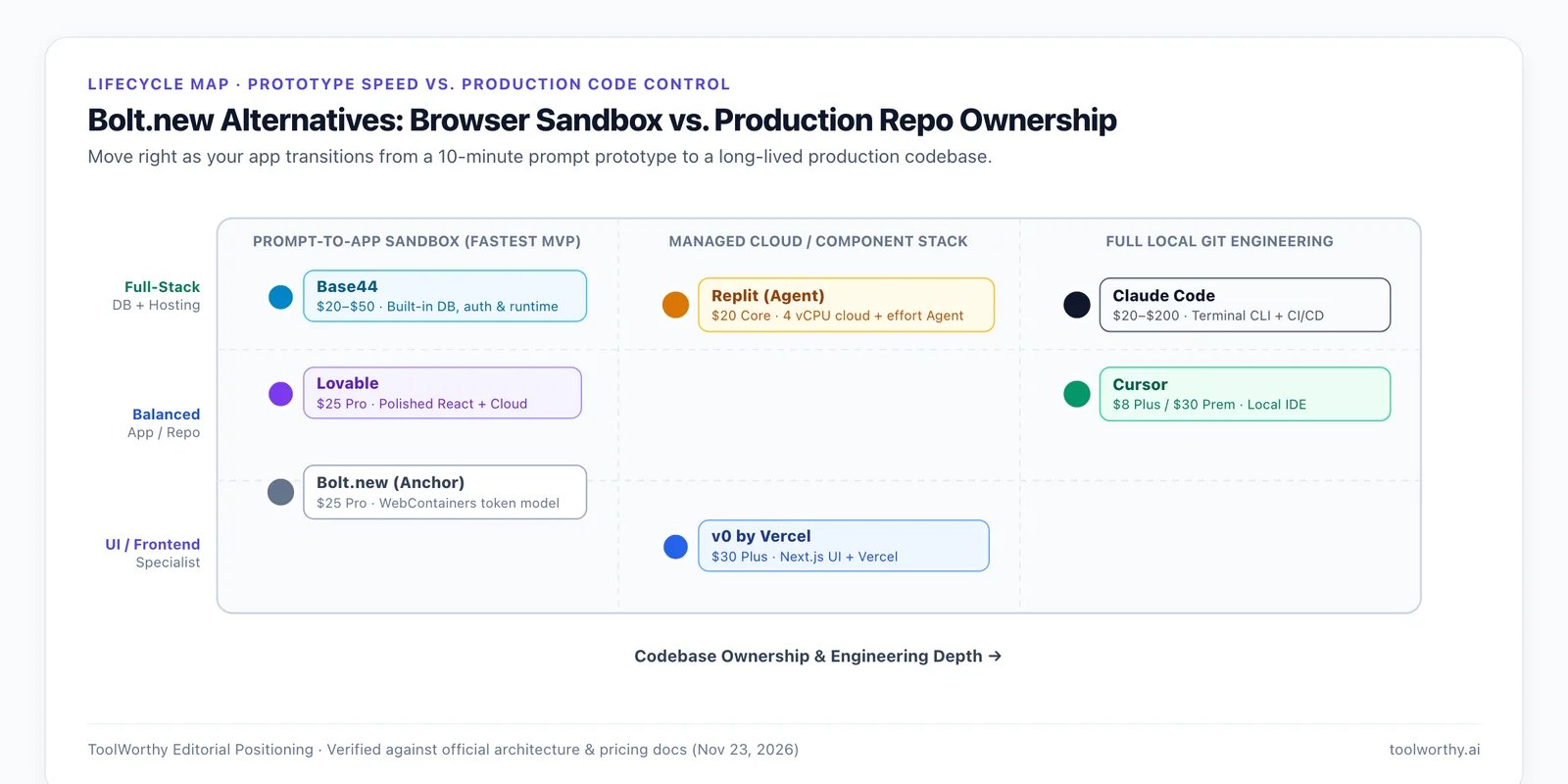
Use the lifecycle map below to decide whether you should hop sideways to another browser studio or graduate your exported repository into full local engineering:
4-Step Safe Migration Checklist Off Bolt.new
| Asset / Layer | Transfers Cleanly? | Action Required Before Cancelling Bolt.new |
|---|---|---|
Source Code & package.json | ✅ Yes | Push to GitHub or download the project ZIP; verify npm install && npm run build passes locally. |
Environment Variables (.env) | ⚠️ Manual copy | Copy all API keys, auth callbacks, and database URLs into .env.local (or Vercel / Replit Secrets) — never commit secrets to Git. |
| External Database & Auth (e.g., Supabase) | ✅ Stays intact | Keep your external database project active and update allowed redirect URLs once you move hosting domains. |
| Bolt Chat History & Ephemeral Preview State | ❌ Lost on exit | Summarize core architecture decisions and rules into a README.md, CLAUDE.md, or .cursor/rules file before leaving. |
- Export to GitHub before your repo hits the debugging wall: The moment a single bug fix eats 1M+ tokens in circular retries, pull the repo into Cursor or Claude Code rather than upgrading to Bolt Pro 100 ($100/month) just to fight context bloat.
- Watch team & tier gates before paying: If you are leaving Bolt Teams because $30/member tokens aren't pooled, Lovable Pro/Business lets unlimited users share one credit pool and Replit Pro ($100/month) pools $100 across up to 15 collaborators. On Base44, budget for $50/month Builder if you need GitHub sync or custom domains.
- Keep a 2-tool hybrid stack: Many fast-shipping teams prototype UI flows in Lovable or v0, then merge the synced GitHub PR into Cursor or Claude Code for backend logic, payments, and production hardening.
Frequently Asked Questions
What is the closest direct replacement for Bolt.new?
Lovable ($25/month Pro) is the closest direct browser prompt-to-app substitute with 2-month credit rollover, polished UI output, and unlimited team users sharing a single credit pool. If you want built-in server runtime and hosting in the browser, Replit Core ($20/month) is the strongest direct alternative.
Is there a completely free or open-source Bolt.new alternative?
bolt.diy (stackblitz-labs/bolt.diy) is an MIT-licensed open-source fork of Bolt.new with 20k+ GitHub stars. You can run it locally for $0 software cost and connect your own API keys (Anthropic, OpenAI, Gemini, OpenRouter) or free local Ollama models.Which Bolt.new alternative avoids exponential token burn on larger apps?
Graduating your exported GitHub repo to Cursor or Claude Code is the cleanest way to escape browser-sandbox token loops on complex codebases. Among browser builders, Base44 and Lovable replace raw file-size token metering with structured message/build credit tiers.
Does Base44’s $20/month Starter plan include GitHub sync and custom domains?
No. Base44’s $20/month Starter plan ($16/month annual) is aimed at early MVPs; custom domains, deeper backend capabilities, and GitHub integration unlock on the $50/month Builder tier ($40/month annual).
Should I move from Bolt.new to Replit or Cursor?
Move to Replit ($20/month Core) if you want to stay in the browser with managed cloud compute, databases, and hosting handled for you. Move to Cursor ($8/month Plus for native models only, or $30/month Premium to unlock Cloud Agents and Bugbot PR reviews, with third-party models billed via separate prepaid API credits) if you are comfortable running a local Git repo and want full IDE debugging and zero platform hosting lock-in.
Get ToolWorthy Weekly
New AI tools, practical guides, and selected AI signals in one weekly brief.
Related Posts
- 6 Replit Alternatives 2026: Keep Your App, Change the Layer
Compare six Replit alternatives by what they replace: AI building, coding, a browser workspace or hosting. Check migration risks before moving a working app.
- 5 Lovable Alternatives in 2026: Choose for Your Website or App
Compare five Lovable alternatives for your next website or web app. Find the right workflow, check real costs, and learn what survives an existing-project move.
- Base44 Alternatives 2026: Choose by What Must Move
Compare nine Base44 alternatives by app type, code and data control, mobile needs, backend ownership, and the real work required to migrate a live app.
For AI tool founders
Built a tool that belongs in this decision set?
Request an editorial evaluation for possible inclusion in ToolWorthy.
Submit your tool for reviewPaid submission does not guarantee a ranking, recommendation, inclusion, or editorial outcome.