
12 Best AI Search Monitoring Tools 2026 — Compared for ChatGPT & AI Overviews
Your Google rank hasn't moved but organic traffic is down. Here are the 12 AI search monitoring tools worth paying for — from $16/mo add-ons to enterprise GEO.
On this page
When organic traffic falls while familiar Google rankings hold, AI answer surfaces can be one contributing factor worth measuring. ChatGPT, Perplexity, Gemini, Copilot, Grok, and Google's AI Overviews can answer some commercial questions without a traditional result click, so teams increasingly need to ask both "where do we rank?" and "are we being cited, and by what?"
That's the job of an AI search monitoring tool: run a set of tracked prompts across multiple LLMs on a schedule, capture which brands and sources get mentioned, and turn the raw answers into share-of-voice, citation, and competitor data you can act on. We researched 30+ products across native AI visibility platforms, SEO-suite add-ons, and enterprise GEO tools, then kept 12 with enough public product, pricing, and policy evidence to compare. Each entry flags the intended user, documented workflow trade-offs, and the pricing or usage limit to verify before buying.
| Tool | Best For |
|---|---|
| Scrunch | Agencies and B2B SaaS teams that need citation + competitor depth |
| Peec AI | Analyst teams piping AI visibility data into Looker Studio and BI |
| SE Ranking AI Search Toolkit | SEO teams that want AI monitoring bundled with rank tracking |
| Ahrefs Brand Radar | Research-heavy teams already paying for Ahrefs |
| AthenaHQ | PR and comms teams tracking sentiment across 8+ LLMs |
| Hall | Teams that want a free baseline before committing to a subscription |
| OtterlyAI | Solo marketers and small brands on a tight monthly budget |
| Mangools AI Search Watcher | Indie SEOs already on Mangools stack |
| Semrush AI Visibility Toolkit | Teams living inside a Semrush workflow day to day |
| Profound | Enterprise brands with dedicated GEO budget and demographic targeting needs |
| Surfer AI Tracker | Content teams that want monitoring wired to optimization |
| Beamtrace | Budget-conscious small teams |
Decision Shortcut: Independent Tracker or SEO-Suite Add-On?
| Your existing workflow | Shortlist first | Why this route is usually the better starting point |
|---|---|---|
| Your team already works in Ahrefs, Semrush, or SE Ranking | The matching suite add-on | One reporting stack and less onboarding; confirm the add-on price and included engines |
| You need prompt-level citations, competitor share of voice, or alerts across several engines | Scrunch, Peec AI, or AthenaHQ | These are purpose-built visibility products rather than extensions of a classic rank tracker |
| You need a low-cost pilot before building a weekly reporting process | Hall or OtterlyAI | Lower commitment, but check refresh cadence, prompt caps, and paid engine add-ons |
| You need enterprise governance, audience data, or a BI/API pipeline | Profound, Peec AI, or an enterprise tier | The extra cost only makes sense when those data and workflow requirements are explicit |
Choose the route before comparing vendor feature counts. A suite add-on can be sufficient for an SEO team, while a brand or communications team may need citation and sentiment depth that a rank-tracking interface does not prioritize.
How We Researched and Compared
We started from a pool of 32 candidates across three groups: native AI visibility platforms (purpose-built for tracking brand mentions in LLM answers), AI search modules inside established SEO suites (Ahrefs, Semrush, SE Ranking, Mangools, Surfer), and enterprise GEO/AEO platforms targeting Fortune 1000 brand teams. We dropped products that only track Google SERP rankings without LLM answer monitoring, pure API endpoints without a visibility analysis view, and tools whose pricing and feature pages were too thin to cross-verify. What remained went through feature, pricing, and policy review.
Our research combined vendor documentation, pricing pages, changelogs, and G2/Capterra feedback. Where a product was a module inside a larger SEO suite, we used the suite's aggregate public reviews as proxy signal and discounted the user-feedback weight accordingly. Pricing was checked against the live pricing page as of April 2026 and cross-referenced with recent independent reviews.
Evaluation Dimensions: We evaluated each tool across 5 dimensions that map to what an SEO or brand lead actually decides on:
- Engine Coverage — How many LLMs and answer engines are monitored, and whether AI Overviews / AI Mode / Perplexity / ChatGPT / Gemini / Claude / Copilot are first-class citizens or add-ons.
- Citation & Share-of-Voice Depth — Whether the tool surfaces the specific URLs being cited, brand mentions, and competitive share-of-voice, or stops at a blunt visibility score.
- Pricing Transparency — Published pricing, prompt/credit limits, and whether "enterprise" means "call sales before you see a number."
- Workflow Fit — Web-first usability, export paths (CSV, BI, API), team seats, and whether the tool fits an existing SEO stack or demands its own.
- Reporting & Action Loop — Alerts, trend history, content recommendations, and whether the tool stops at reporting or pushes toward execution.
Research Scope: This is a source review, not a claim that ToolWorthy operated every paid product or ran a common prompt benchmark. We compared public feature pages, documentation, pricing, policies, and changelogs, then used attributed third-party feedback only for longer-term workflow and deployment context. Paid placements, when present, are identified in the Disclosure section. Payment purchases inclusion, not an editorial verdict, and does not change the evaluation criteria.
Transparency & Limitations: Pricing is listed as of April 2026 from each vendor's public pricing page. Several products (notably Profound, AthenaHQ, and Scrunch) have restructured plans in the past six months — always verify before subscribing. Hall, Mangools, and SE Ranking offer free or low-commitment entry points you should use before paying annually.
Top 12 AI Search Monitoring Tools Compared
Before the detailed reviews, here's the fast read. The column that matters most is Starting Price paired with Engine Coverage — the gap between a $16/mo bolt-on and a $2,000/mo enterprise platform is real, and so is the gap in how many LLMs they actually watch.
| Tool | Best For | Category | Engine Coverage | Starting Price | Notable Trade-off |
|---|---|---|---|---|---|
| Scrunch | Agencies + B2B SaaS | Native AI visibility | Core plan covers 4 engines; broader platform supports more | $250/mo (Core) | 7-day free trial exists; deeper tiers are still demo-led |
| Peec AI | Analyst / BI teams | Native AI visibility | 3 models per project | €85/mo (~$95) | EUR pricing, prompt-count caps |
| SE Ranking AI Search Toolkit | SEO teams | SEO suite + AI module | ChatGPT, Perplexity, AI Overviews, AI Mode | $89/mo | Paid AI Search add-on on top of the SE Ranking suite |
| Ahrefs Brand Radar | Research-heavy teams | SEO suite + AI module | AI Overviews + multi-LLM | $199/mo | Requires Ahrefs subscription |
| AthenaHQ | PR / comms teams | Native AI visibility | 8+ LLMs | $295/mo | Credit burn on large prompt sets |
| Hall | Baseline audits | Native AI visibility | Broad multi-engine | Free tier | Paid tier jumps to $199/mo |
| OtterlyAI | Solo / small brand | Native AI visibility | Google AI Overviews, ChatGPT, Perplexity, MS Copilot | $25/mo | AI Mode and Gemini cost extra |
| Mangools AI Search Watcher | Indie SEOs | SEO suite + AI module | ChatGPT, Gemini, Claude, Grok, Llama, Mistral | $15.60/mo annual | Depth is lighter than premium GEO platforms |
| Semrush AI Visibility Toolkit | Semrush users | SEO suite + AI module | ChatGPT, Perplexity, Gemini, AI Overviews | $99/mo | Standalone add-on to Semrush |
| Profound | Enterprise brand teams | Enterprise GEO | Multi-platform enterprise tracking | Sales-led pricing | Verify live pricing before signing |
| Surfer AI Tracker | Content teams | SEO suite + AI module | ChatGPT, Perplexity, Google AI Mode, Google AI Overview, Google Gemini | $99/mo billed yearly | Best value when paired with Surfer's content workflow |
| Beamtrace | Budget-conscious small teams | Native AI visibility | ChatGPT only (5 more listed as coming soon) | $24/mo ($20 billed yearly) | Single engine at launch; one website per plan, no documented API |
Detailed Reviews
Scrunch

Scrunch is the native AI visibility platform most likely to show up in the shortlist of an agency pitching AI search monitoring to a B2B SaaS client. It's not the cheapest and it doesn't self-serve — you book a call to get in — but the depth of its citation intelligence, competitor tracking, and alerting is where the price lands. For teams who need to tell a brand stakeholder "here's every time you were cited by ChatGPT this week, here's the source, here's which competitor replaced you", Scrunch is built for that specific conversation.
Key Features
- Core plan covers 4 engines, while the broader platform supports more — Core includes ChatGPT, Perplexity, Google AI Overviews, and Microsoft Copilot; Scrunch's product materials also describe broader coverage beyond that starter bundle. Unlike bolt-on modules that just say "you're mentioned 12 times," Scrunch tells you which source URL was quoted and whether it was yours.
- Competitor share-of-voice with prompt-level attribution — See exactly which competitor is winning which prompt, not just an aggregate leaderboard. Useful when the question is "why is this specific high-intent prompt citing them and not us?"
- Alerts and historical trend lines — New citations, lost citations, and sentiment changes trigger alerts. The change tracking matters more than the dashboard itself — most teams check these tools weekly, not daily.
- API and export for downstream analysis — Data can leave Scrunch. For reporting-heavy teams, that's the difference between a usable tool and a dashboard you screenshot.
Pricing & Plans
- Core (brands): $250/month — 125 unique prompts, 5 site audits per month, 1 brand workspace, 5 user licenses, and support for ChatGPT, Perplexity, Google AI Overviews, and Microsoft Copilot
- Agency pricing: Custom / contact sales — Scrunch lists dedicated agency pricing separately from its self-serve brand Core plan
- Enterprise: Custom pricing — expanded prompts, API access, dedicated support
- Seat add-ons: $25/month per extra user, or $75/month for 5 seats
- Free trial: 7-day free trial on the Core self-serve plan
Cost reality: Brand pricing now starts at $250/month on Core, and Scrunch also offers a 7-day free trial on its self-serve entry plan. Annual contracts get two months free.
Limitations
- Deeper tiers are still demo-led: The entry plan has a 7-day free trial, but enterprise evaluation and custom setups still run through sales.
- Per-brand billing compounds fast: Agencies tracking 10 client brands aren't paying $300/mo — they're paying $3,000+/mo unless they negotiate.
- Overkill for solo marketers: If you're the only person at your company looking at AI visibility, Scrunch's agency-flavored depth is more than you'll use.
Best For
Agencies and in-house B2B SaaS teams with a real brand stakeholder asking hard questions about AI search visibility, and a budget to match. It earns its price when someone on the team has "prove AI visibility ROI" as a quarterly goal.
Not the right fit if you're testing the category for the first time, if you have one brand to track and no budget for a sales cycle, or if you just want a Friday-afternoon baseline (use Hall's free tier first).
Get started with Scrunch
Peec AI

Peec AI's distinguishing move is the Looker Studio integration. Most AI visibility tools pipe you into a proprietary dashboard and make export a Pro-tier feature; Peec treats the data as a first-class feed you can ship into Looker, BigQuery, or any BI workflow your analyst team already runs. For teams where the AI visibility data has to live alongside SEO, paid, and pipeline reporting in one place, that's the reason to pick it.
Key Features
- Native Looker Studio + API export — Data flows into your existing BI stack, not just a PNG you drag into a slide deck. Analyst teams get attribution data they can actually join against other channels.
- Prompt-level tracking with 3 model picks — Starter includes 50 prompts and lets you choose 3 models from ChatGPT, AI Mode, AI Overviews, Microsoft Copilot, Perplexity, Gemini, and Grok. The model choice is yours, not a fixed bundle.
- Multi-country tracking on higher tiers — Pro and above track the same prompts across multiple countries, which matters if your brand visibility varies by region (a common pattern for B2B SaaS with EU/US split).
- Daily tracking as standard — Even on Starter you get daily refreshes, not the weekly cadence common on entry tiers.
Pricing
- Starter (Brand): €85/month (~$95) — 50 tracked prompts, 3 models, 1 project, daily tracking, unlimited users
- Pro (Brand): €205/month (~$225) — 150 prompts, 2 projects, multi-country (3 countries/project)
- Advanced (Brand): See live pricing — 350 prompts, 5 projects, 3 included models, daily tracking, multi-country support, and GSC/GA/Looker integrations
- Agency tiers: €205–€675/month — scaled prompts and client seat support
- Additional AI models: €30–€140/month depending on the plan
Cost reality: EUR-denominated, so US buyers should budget for exchange rate drift. The prompt cap is the thing to watch — 50 prompts at daily cadence is roughly 1,500 API-style calls/month, and heavy trackers will outgrow Starter inside two months.
Limitations
- Prompt caps bite fast: 50 prompts sounds like enough until you break down "brand + 5 product variations + 4 personas + 3 competitor comparisons" and realize you're at 40 before touching long-tail.
- EUR pricing adds planning friction: Invoice and expense workflows in US teams sometimes hit approval friction on non-USD vendors.
- Additional models cost extra: Adding a fourth or fifth model isn't free — read the model list carefully against the engines that matter for your category.
Best For
Analyst-driven teams that already run Looker Studio, BigQuery, or a BI stack, and need AI visibility data to flow through the same pipeline as paid and organic. Also works well for EU-based teams where the EUR pricing is native.
Not the right fit if you just want a dashboard to check once a week, or if your team tracks 200+ prompts from day one (you'll be on Advanced immediately, which is comparable to Scrunch).
Get started with Peec AI
SE Ranking AI Search Toolkit
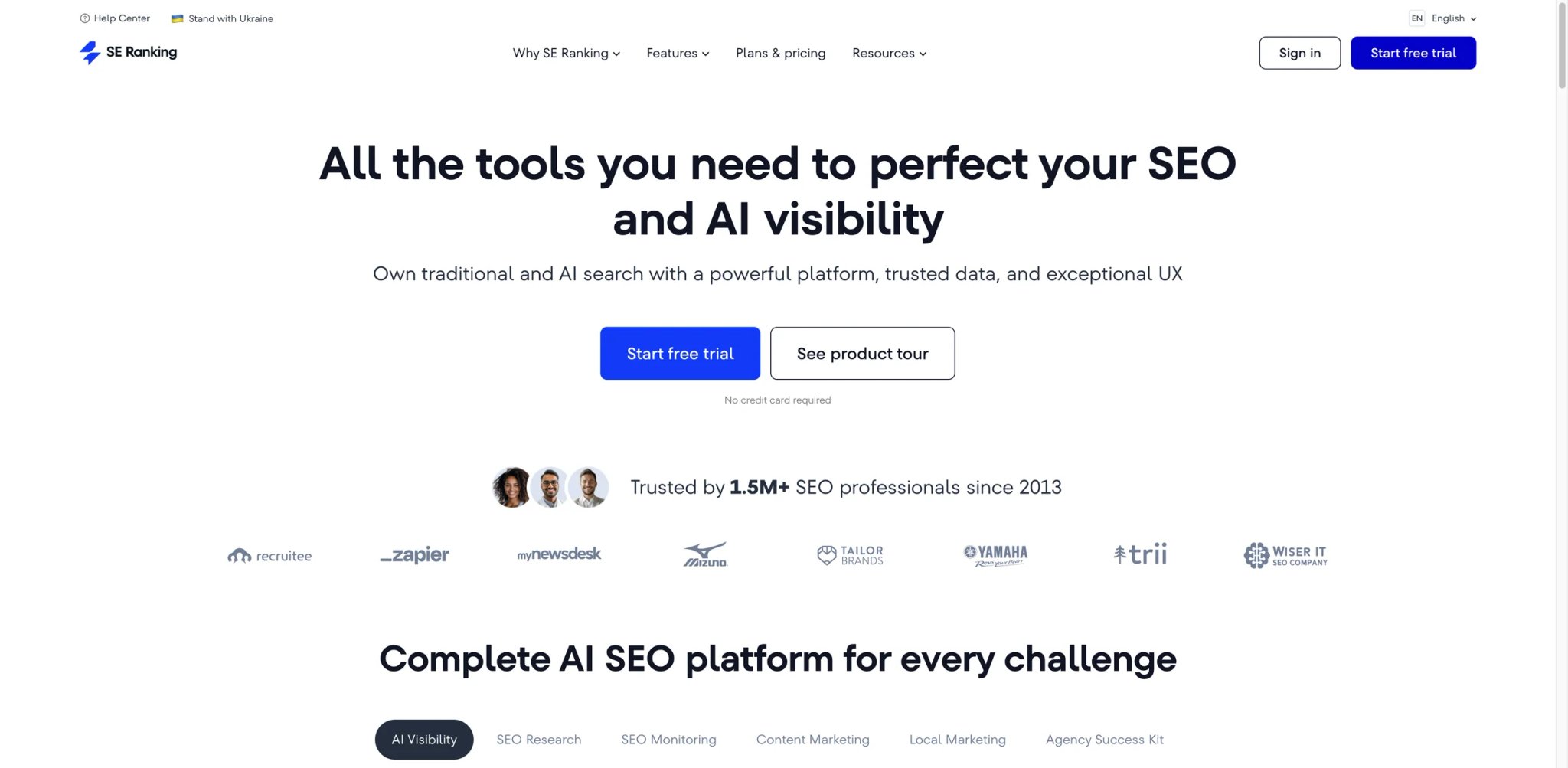
SE Ranking is the mid-market SEO suite that has a dedicated AI Search module rather than a marketing page with a "coming soon" badge. If you already run rank tracking, keyword research, and site audits inside SE Ranking, the AI Search Toolkit is the cheapest way to add LLM monitoring without bolting a second vendor contract onto the stack. The pricing also undercuts Semrush and Ahrefs meaningfully, which matters when the finance team is asking why you need yet another subscription.
Key Features
- AI Overviews + AI Mode tracking in the same workspace — Track which of your keywords trigger Google AI Overviews and AI Mode, and monitor brand visibility in ChatGPT and Perplexity from the same SE Ranking project.
- Keyword-level AI trigger data — See the percentage of your tracked keywords that have AI Overviews, plus visibility for each. This is the data most SEO dashboards still don't surface.
- API is a separate add-on, not bundled into entry AI Search pricing — SE Ranking lists AI Search and API as distinct add-ons on its subscription page. If you need programmatic access, budget for both.
- Team seats without per-user price gouging — Collaborative plans don't punish small-team usage the way some enterprise competitors do.
Pricing & Plans
- AI Search add-on: $89/month monthly or $71.20/month billed annually — 200 prompts and access to AI Overviews, AI Mode, Perplexity, and ChatGPT tracking
- Higher AI Search volumes: SE Ranking's live pricing grid also shows 450-prompt and 1,000-prompt configurations for the AI Search add-on.
- API: Sold separately as its own add-on; it is not bundled into the base AI Search price.
Cost reality: The value only fully holds if you use SE Ranking as your primary SEO platform. If you'd still need Semrush or Ahrefs for keyword research alongside it, the combined cost eats the savings.
Limitations
- Tied to the SE Ranking workflow: Works best inside SE Ranking's project structure. Standalone use is possible but clunky.
- LLM engine coverage is narrower than native platforms: Solid on AI Overviews and ChatGPT; lighter on Perplexity citation depth compared to Scrunch or Peec.
- UI still SEO-first, not visibility-first: The AI data lives inside an SEO product, so the hierarchy leads with keywords, not brand mentions. Fine for SEOs, cognitively awkward for PR leads.
Best For
In-house SEO teams and mid-market agencies that want AI search monitoring as an extension of their existing rank tracking and site audit workflow, without paying native-platform pricing. Strong value for teams already considering SE Ranking for core SEO.
Not the right fit if you don't need a full SEO suite, or if your primary buyer is PR/comms rather than SEO (Scrunch or AthenaHQ frame the data for that audience better). Our AI SEO tools guide covers the broader SEO suite category.
Get started with SE Ranking AI Search Toolkit
Ahrefs Brand Radar
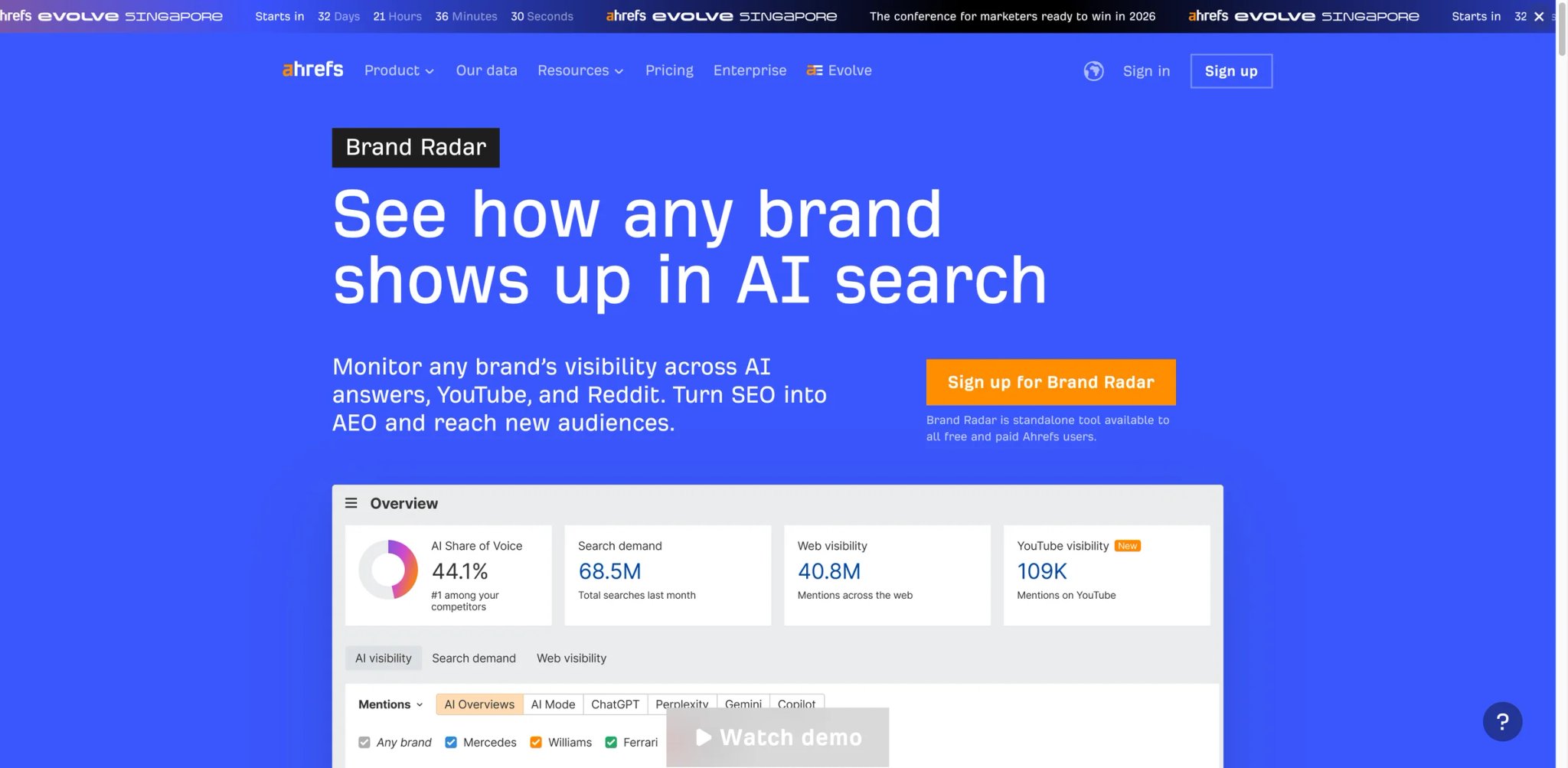
Ahrefs already sits on the biggest crawler-backed data layer in the industry, and Brand Radar is what they built on top of it for the AI search era. If you're an Ahrefs shop already — keyword research, backlink monitoring, content gap analysis — Brand Radar is the natural place to add AI visibility without adopting a new vendor. The research-grade depth is where it shines; the price is where most solo users find a ceiling.
Key Features
- Crawler-backed citation source analysis — Brand Radar uses Ahrefs' existing index to tell you which URLs are being cited in AI answers, and what backlink / authority profile those sources have. Most native visibility tools just tell you that you were cited; Ahrefs tells you why that source beat yours.
- AI Overviews tracking tied to keyword research — See which of your tracked keywords are being answered in AI Overviews and what sources get pulled. Pair that with Ahrefs' keyword difficulty data and you can prioritize the AI queries worth earning.
- Integrated into Ahrefs workspaces — If your team already lives in Ahrefs daily, adding Brand Radar doesn't introduce another login or another dashboard.
- Research-first methodology — The entire tool is framed around "how do we earn this citation?" rather than "how many times were we mentioned?" Different audience, different value.
Pricing & Plans
- Lite: $129/month — entry tier, limited Brand Radar access
- Standard: $249/month — full keyword research and Brand Radar features
- Advanced and Enterprise: Higher tiers with expanded projects and API access
- Brand Radar entry pricing lands around $199/month effective when you need the AI visibility features beyond the Lite allowance
Cost reality: You're paying for Ahrefs the platform, not just Brand Radar. If you already have an Ahrefs seat, Brand Radar is a high-value addition. If you don't, the total spend is $200+/mo even before the AI features deliver value.
Limitations
- Locked inside the Ahrefs ecosystem: You can't buy Brand Radar standalone. If you don't use Ahrefs as your main SEO tool, the math doesn't work.
- Heavier UI than pure visibility tools: Brand Radar is one panel inside a dense SEO workspace. Non-SEOs can get lost.
- Less real-time than dedicated alerts: Alerting and change tracking are lighter than what Scrunch or AthenaHQ push around notifications.
Best For
Teams that already pay for Ahrefs and want AI visibility to live inside the same research workflow as keyword difficulty, backlinks, and content gaps. Best when the user is an SEO manager thinking in terms of "why does this source rank?" not "who said my brand today?"
Not the right fit if you don't already use Ahrefs, or if your primary need is brand/PR reporting rather than SEO-driven content strategy.
Get started with Ahrefs Brand Radar
AthenaHQ
AthenaHQ's positioning is the PR and comms version of AI search monitoring. While most tools lead with "rank tracking for ChatGPT," AthenaHQ leads with sentiment, share-of-voice, and ROI storytelling — the language a VP of Communications speaks. It covers 8+ LLMs as first-class citizens (not add-ons) and pushes analytics past "were you mentioned" into "how were you framed." That's the pitch, and it lands when the buyer is a brand lead, not an SEO lead.
Key Features
- 8+ LLM coverage as standard — ChatGPT, Perplexity, Gemini, Claude, Copilot, Grok, and more are tracked from day one, not as paid add-ons. For comparison, most competitors bundle 3–4 and charge extra for the rest.
- Sentiment analysis on every mention — Each citation comes with a sentiment read so you can spot narrative shifts early. Useful when a product launch or press cycle changes how AI describes your brand.
- Unlimited topics on Self-Serve — Unusual for this category. Most tools cap you at 50–100 tracked keywords; AthenaHQ lets topic count scale with credit burn.
- PR + ROI reporting layer — Reports frame data for leadership, not just for dashboards. Executive-ready outputs save the weekly "translate this to a slide" work.
Pricing & Plans
- Starter (Self-Serve): $295/month — 3,600 credits, flexible AI visibility across up to 8 major LLMs, with unlimited topics
- Enterprise: Custom pricing — tailored prompts, 10+ AI engines, ChatGPT Shopping, AI content generation
- First-month discount: $95 introductory offer and a free audit available
- No permanent free tier
Cost reality: 1 AI response = 1 credit. Tracking 100 prompts across 8 engines biweekly burns ~1,600 credits/month on prompts alone — add competitor monitoring and ad-hoc queries and the 3,600 Starter allocation feels tight faster than the plan page implies. Budget for Enterprise if you're at scale.
Limitations
- Credit burn math is unintuitive: The "3,600 credits" framing hides the real capacity until you run the numbers. Teams often upgrade within 60 days of signup.
- No permanent free tier: Can't pilot it with zero commitment. The $95 first month is the closest thing to a trial.
- Sentiment isn't always accurate on technical B2B topics: LLMs can misread technical jargon as neutral or negative. Don't over-index on the sentiment score for niche categories.
Best For
PR, comms, and brand teams at mid-market and enterprise companies where leadership wants to see AI visibility framed as narrative, sentiment, and share of voice — not just citation counts. Especially strong for consumer brands and B2B SaaS with active press cycles.
Not the right fit if your primary user is an SEO manager (the UI and reports are brand-speak, not SEO-speak), or if you're testing the category on a strict budget — Starter burns credits faster than it looks.
Get started with AthenaHQ
Hall
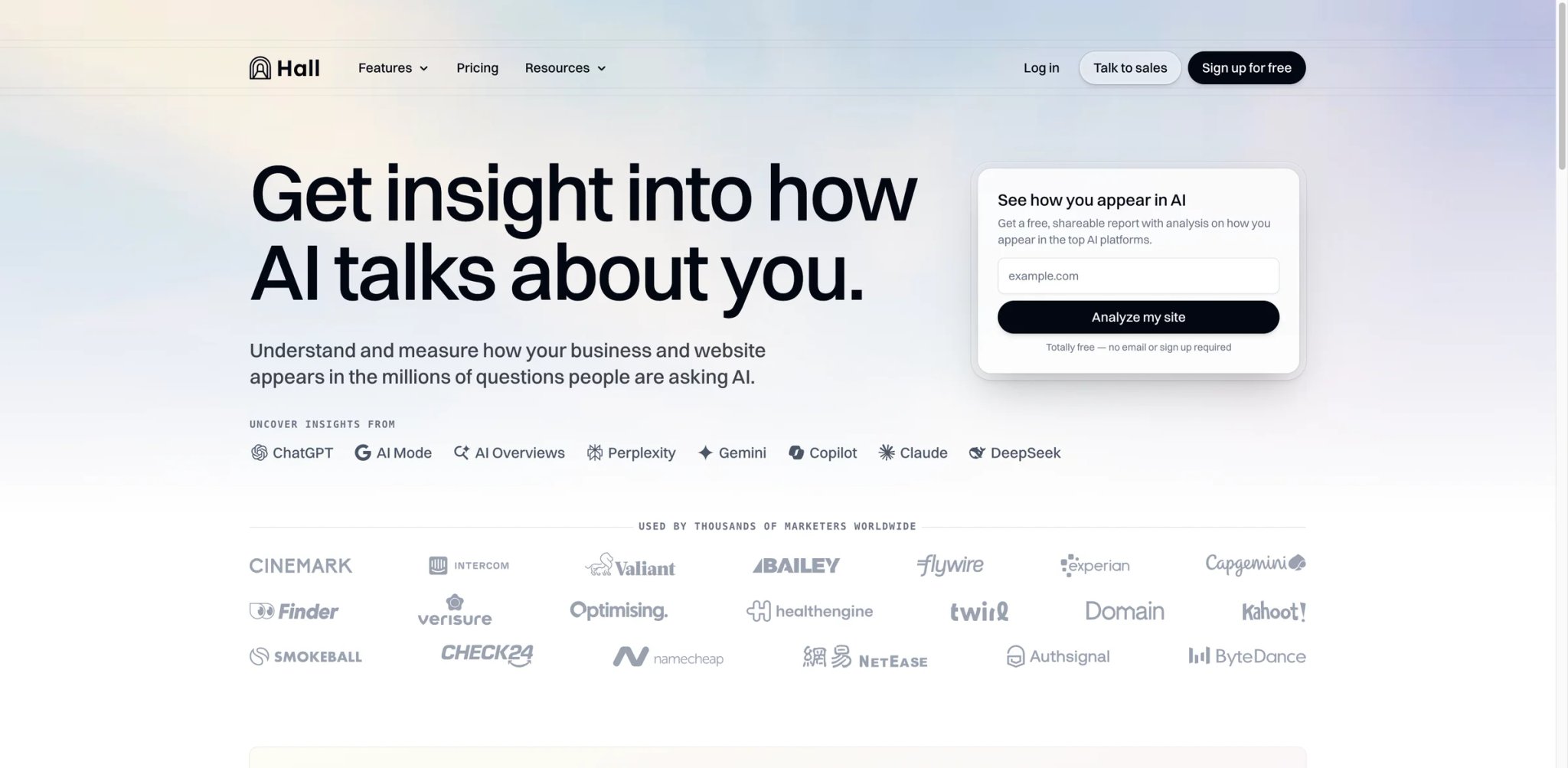
Hall is the one tool on this list you should actually try before any of the others. The free tier is real: 25 tracked questions, 300 answers analyzed per month, weekly data, 1 project. That's enough to answer "does ChatGPT even know who we are?" — the first question every team asks when they start paying attention to AI search. Most teams use Hall for the baseline, then either stay on the free tier forever or upgrade to a paid platform once they know what they're looking for.
Key Features
- Actually usable free tier — 25 questions, 300 answers/month, weekly refresh, 1 contributor, unlimited viewers, 60-day data retention. This is a real tier, not a five-day demo.
- AI agent analytics — Tracks how AI agents crawl, reference, and reuse your site content — a distinct angle from pure mention tracking. Useful for sites worried about ChatGPT / Claude / Gemini scraping behavior.
- Domain-level comparison — Compare your brand against competitor domains across the same tracked questions. The comparison view is cleaner than most paid competitors.
- Multi-brand coverage on paid tiers — Starter jumps to 20 projects and 500 tracked questions, which is enough for an agency to run 3–4 clients on one seat.
Pricing
- Lite: Free — 1 project, 25 tracked questions, 300 answers/month, weekly refresh, and 3 months of historical data (AI agent analytics includes 60 days of data)
- Starter: $199/month (billed $2,388 annually, ~16% savings) — 20 projects, 500 questions, 45,000 answers/month, daily refresh, 2 contributors
- Business: $599/month (billed $7,188 annually) — 50 projects, 1,000 questions, 120,000 answers/month, 5 contributors
- Enterprise: From $1,499/month — API access and enterprise security
Cost reality: The free tier is the value. Paid tiers are competitive with Hall's category but not cheaper than SE Ranking or Mangools once you're comparing full features.
Limitations
- Free tier data is weekly, not daily: Fine for a baseline, too slow to catch day-over-day narrative shifts.
- Jump from Free to Starter is $199: No middle tier. Teams that outgrow Free but can't justify $199 are stuck.
- AI agent analytics vs brand tracking focus split: The dual focus (brand mentions + agent crawling) can feel diffuse. You're paying for two views of AI visibility, which not every team needs.
Best For
Any team evaluating the category for the first time — start here, run the free audit, learn what matters to your brand. Also strong for small agencies managing 3–4 client projects who need multi-project support without enterprise pricing.
Not the right fit as a long-term solution for enterprise PR teams (AthenaHQ frames the data better for that audience), or for teams needing citation-level source URL depth (Scrunch and Ahrefs go deeper).
Get started with Hall
OtterlyAI
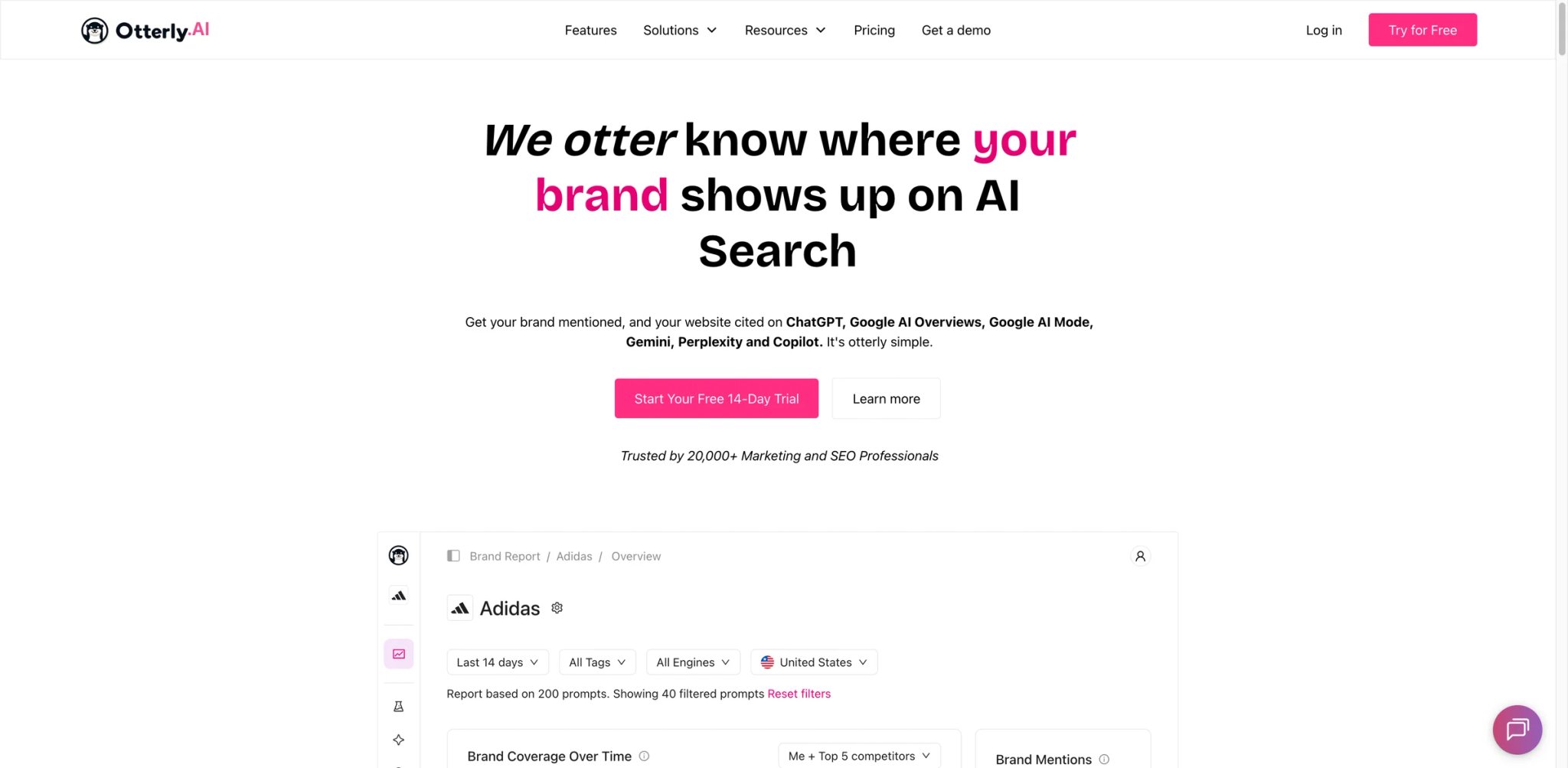
OtterlyAI is the lowest-priced purpose-built AI visibility tracker with clearly published pricing. At $29/month entry, it's the tool solo marketers and indie founders can actually adopt without writing a business case. The trade-off is engine coverage: ChatGPT and Perplexity are included on the base plan, but Google AI Mode and Gemini require add-ons that push the effective price higher. Read the engine list carefully against the ones that matter to your category before subscribing.
Key Features
- Transparent published pricing — $29/month for the entry tier, clearly listed, no sales call required. In a category dominated by "contact us," this matters.
- Four core engines are included on the entry plan — Lite covers Google AI Overviews, ChatGPT, Perplexity, and Microsoft Copilot by default, while Google AI Mode and Gemini are paid add-ons. You don't have to upgrade just to see your basics.
- Prompt history and change tracking — See how your visibility on a given prompt has trended over time, not just a snapshot. Basic but functional.
- Self-serve signup — Create an account, paste prompts, see data. No onboarding gauntlet.
Pricing
- Lite: $25/month — 15 search prompts with Google AI Overviews, ChatGPT, Perplexity, and Microsoft Copilot included by default
- Standard: Higher tier with expanded prompts and additional engines
- Business / Enterprise: Custom pricing with full engine coverage and team seats
- Google AI Mode and Gemini tracking: Available as paid add-ons on most tiers
Cost reality: The $29 sticker is honest but partial. If AI Mode or Gemini are the engines your category uses most, factor add-ons into your real monthly cost. Solo marketers chasing ChatGPT visibility specifically get the best value.
Limitations
- Engine coverage is tiered: Core engines cost extra. Teams that assumed "all engines for $29" will be disappointed.
- Shallower citation depth: OtterlyAI reports mentions; Scrunch and Ahrefs report which specific source was cited. Different tier of analysis.
- Not built for team collaboration: Fine for solo or two-person teams; teams larger than that will outgrow the workflow quickly.
Best For
Solo marketers, indie founders, and single-person brand teams who need AI visibility monitoring on a budget and whose primary engines are ChatGPT and Perplexity. Also works as a second tool alongside a bigger SEO suite when you want a cheap dedicated visibility layer.
Not the right fit if your category is dominated by Google AI Overviews / AI Mode (factor add-ons in), or if you need citation-level source analysis.
Get started with OtterlyAI
Mangools AI Search Watcher
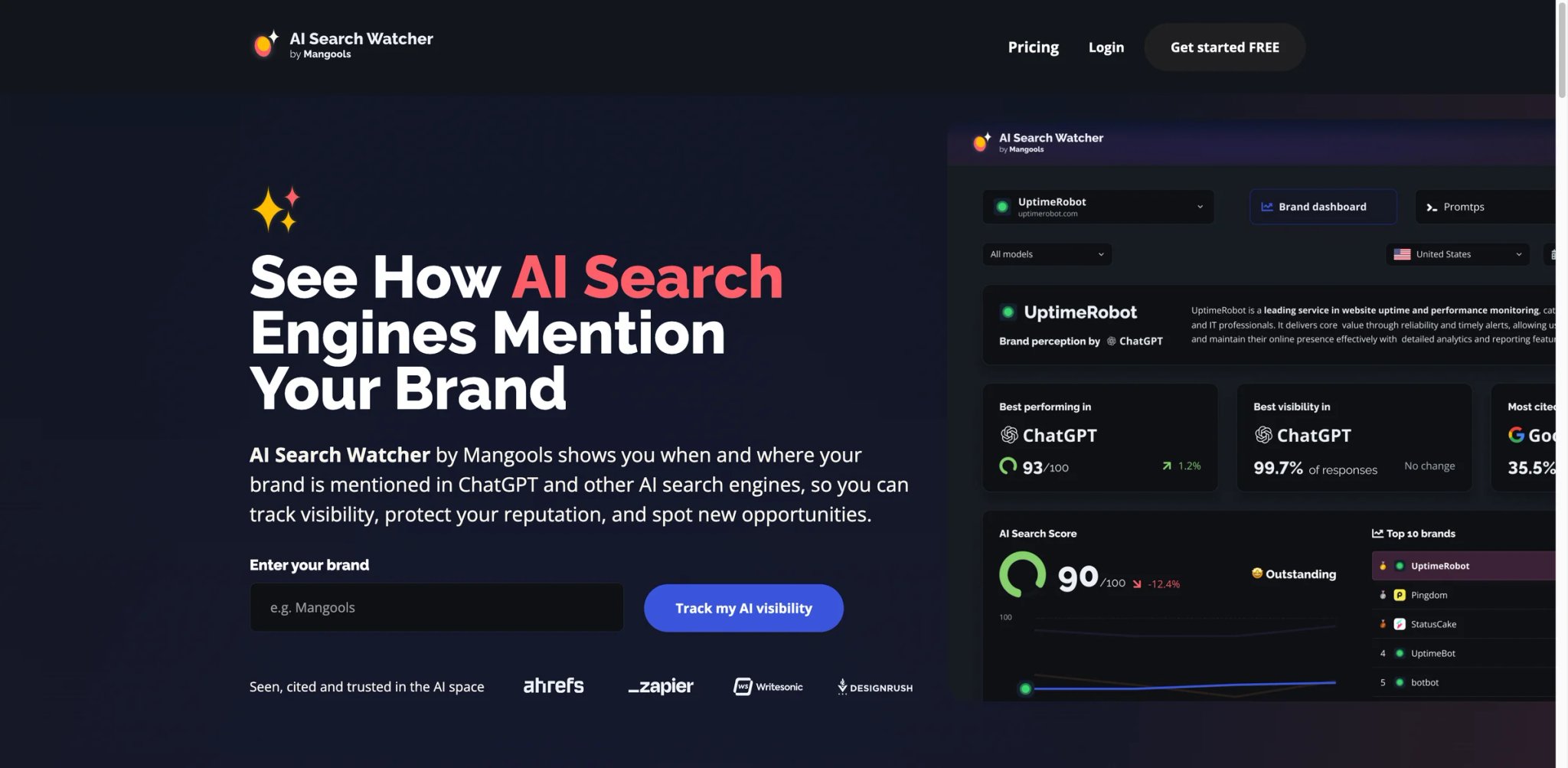
Mangools is the SEO suite beloved by indie SEOs and small agencies for being functional, cheap, and not trying to be Ahrefs. AI Search Watcher is their bolt-on module for AI visibility tracking, and it's priced at a level — $15.60/month effective on annual — that makes it the lowest-cost entry on this entire list. For SEOs already paying for KWFinder, SERPChecker, and LinkMiner inside Mangools, adding AI Search Watcher is closer to "flip a switch" than "evaluate a vendor."
Key Features
- AI Search Watcher bundled with full Mangools suite — You get AI visibility monitoring alongside keyword research, rank tracking, SERP analysis, and backlink tools in one subscription. For indie SEOs, that consolidation is the real value.
- Six-engine tracking, not just two surfaces — Mangools says AI Search Watcher tracks ChatGPT, Gemini, Claude, Grok, Llama, and Mistral, and runs each prompt multiple times for more stable averages.
- Low-friction onboarding — Mangools is famously easy to get started with. AI Search Watcher inherits that UX — import keywords, see AI visibility, done.
- Clean reporting for client work — Small agencies use Mangools as their client reporting platform. AI visibility data slots into existing reports without custom setup.
Pricing & Plans
- Basic: $15.60/month billed annually (~$29/month monthly) — KWFinder, SERPChecker, SERPWatcher, LinkMiner, and AI Search Watcher access with entry limits
- Premium: $29.90/month billed annually — expanded tracked keywords, AI Search Watcher at higher volume
- Agency: $55.90/month billed annually — multi-user, multi-project, agency reporting
Cost reality: Cheapest way on this list to get AI search monitoring combined with a full SEO suite. The trade-off is depth — Mangools is "SEO tools for people who don't want to pay $200/mo," and AI Search Watcher inherits that design philosophy.
Limitations
- Shallow AI module depth: AI Search Watcher covers the basics (mention tracking, AI Overviews trigger data) but doesn't reach Scrunch / Ahrefs Brand Radar levels of citation source analysis.
- Narrow engine coverage: ChatGPT and AI Overviews are solid; Perplexity, Gemini, and Claude coverage is thinner than dedicated visibility platforms.
- Mangools first, AI second: The product philosophy is SEO suite with an AI add-on, not AI visibility platform. Fine for indie SEOs, wrong tier for brand teams.
Best For
Indie SEOs, small agencies, and solo consultants who already use Mangools as their primary SEO stack, and need AI visibility monitoring without paying a second vendor. Also a solid starting point for anyone who wants the cheapest possible entry into the category.
Not the right fit if you need multi-LLM citation depth, sentiment analysis, or enterprise reporting. Budget tools give budget data. For the broader AI SEO category, see our AI keyword research tools guide.
Get started with Mangools AI Search Watcher
Semrush AI Visibility Toolkit
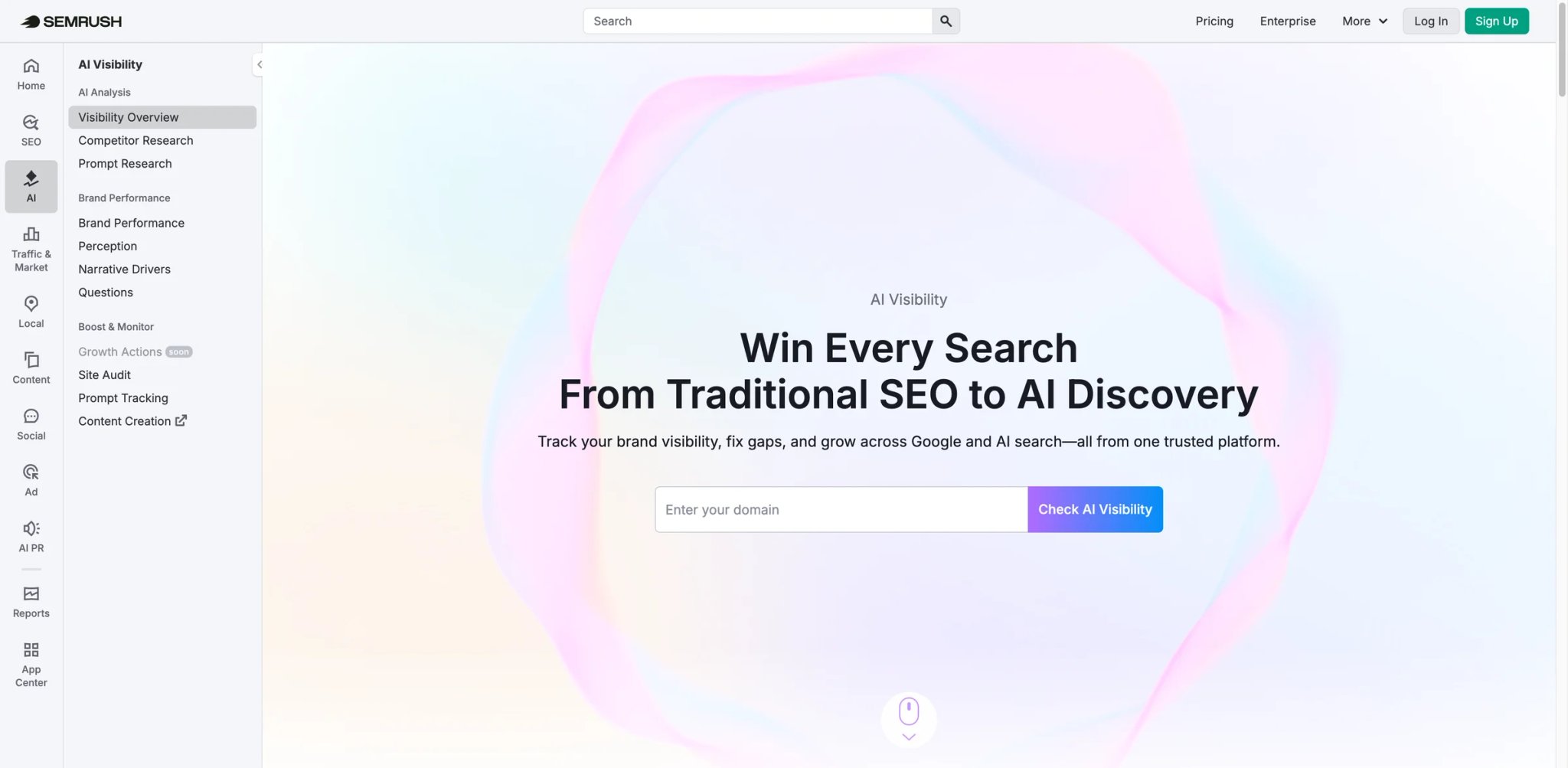
Semrush shipped the AI Visibility Toolkit as a standalone add-on to its core platform rather than folding AI monitoring into existing modules. The distinction matters: you're paying for a purpose-built AI visibility product, but inside the Semrush UI your team already uses. For teams that already run keyword research and competitive analysis inside Semrush daily, adopting the AI Visibility Toolkit is the lowest-friction option — no new login, no data silo, no second vendor to onboard.
Key Features
- Tracks ChatGPT, Perplexity, Gemini, and AI Overviews — Four-engine coverage as standard, which is on par with most dedicated tools and ahead of budget SEO bolt-ons.
- Inside Semrush's project structure — AI visibility data lives alongside keyword rankings and backlink profiles for each project, so brand monitoring becomes part of your existing SEO reporting rhythm.
- Competitive share-of-voice across LLMs — Compare your brand mention frequency against tracked competitors in each AI engine. Integrates with existing Semrush competitive research data.
- Unified Semrush reporting — Add AI visibility charts to your existing Semrush client reports without a separate export workflow.
Pricing & Plans
- AI Visibility Toolkit: $99/month — sold as a premium Semrush toolkit with a free demo report; Semrush One is the optional bundle if you also want the broader SEO workflow
Cost reality: The toolkit itself is sold at $99/month. Teams that also want the broader Semrush SEO workflow can buy Semrush One separately, but a core SEO subscription is no longer required just to access AI Visibility Toolkit.
Limitations
- Standalone purchase is available: Semrush lists AI Visibility Toolkit as its own premium toolkit at $99/month; Semrush One is optional rather than required. Teams that want both still pay meaningfully more than either piece alone.
- Engine coverage is flat, not deep: Tracks the big four LLMs well, but citation source analysis and sentiment framing are thinner than native platforms like AthenaHQ.
- UI inherits Semrush complexity: Semrush is powerful and dense; the AI Visibility Toolkit sits inside that density. PR users often find it harder to navigate than dedicated visibility tools.
Best For
Mid-market and enterprise SEO teams that already pay for Semrush Pro or higher and need AI monitoring inside the same workflow. Strongest when the primary user is an SEO analyst running keyword-to-visibility correlation analysis.
Not the right fit if you don't already use Semrush (total cost explodes), or if your primary buyer is a brand / PR lead (AthenaHQ frames the data better).
Get started with Semrush AI Visibility Toolkit
Profound
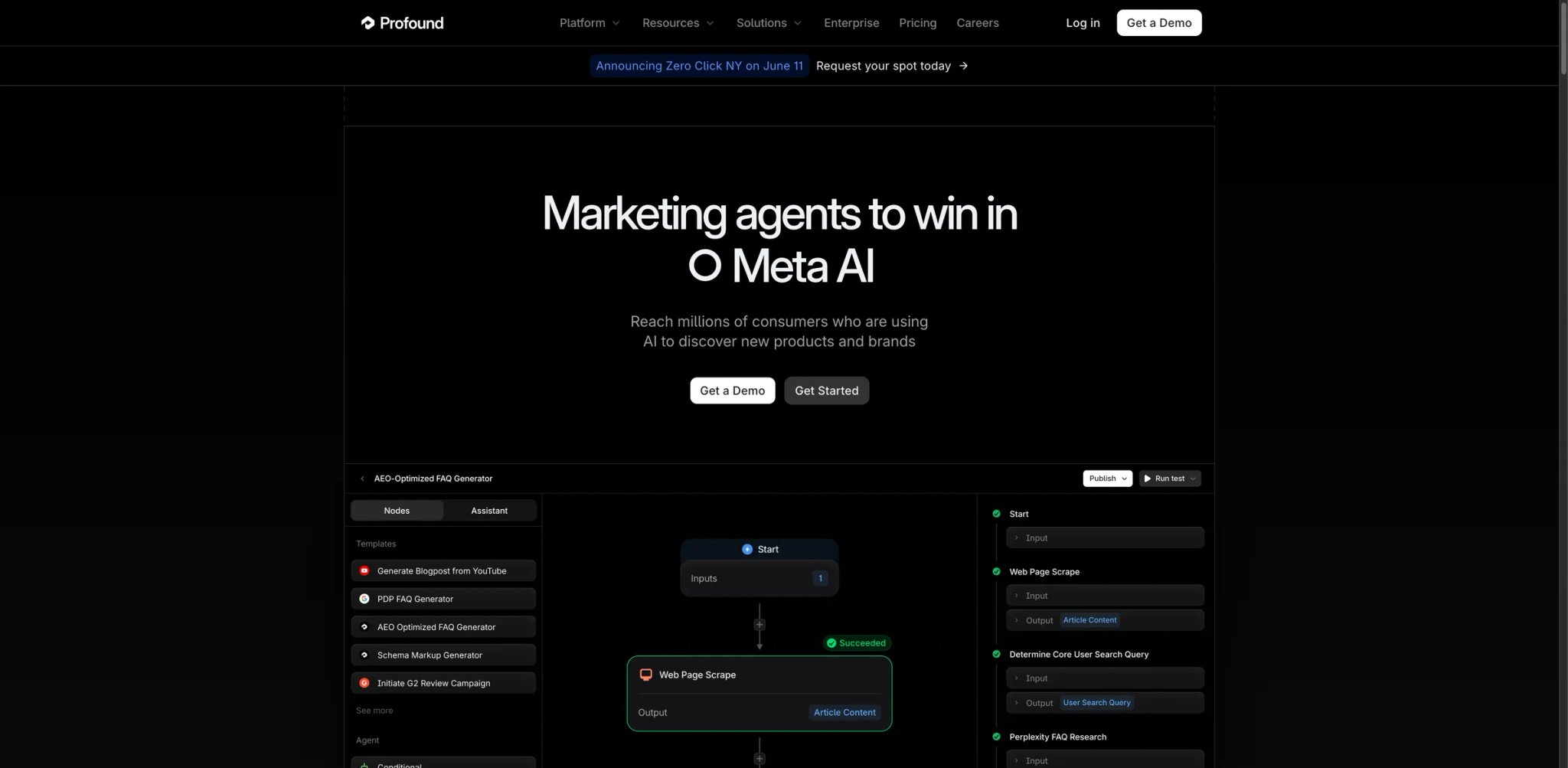
Profound is the enterprise-tier GEO platform most frequently cited by Fortune 1000 brand teams, and it's priced to match. The value story isn't "cheaper than the competition" — it's "Prompt Volumes," a proprietary demographic data layer that tells you not just which prompts cite you, but who is asking them. For a brand team that needs to tie AI visibility back to actual audience segments and campaign attribution, that's a different product than everything else on this list.
Key Features
- Prompt Volumes with demographic breakdowns — Proprietary panel data showing what real people ask AI platforms, with age / geo / interest segmentation. Positioned as "keyword research for AI search." No other tool on this list offers this.
- Full platform coverage at enterprise tier — ChatGPT, Perplexity, Google AI Overviews, Gemini, Claude, and more. Lower tiers restrict engine access.
- API access and unlimited seats on Enterprise — Built for brand teams that need the data everywhere, not just in one dashboard.
- Market-leading update velocity — Profound ships features faster than most competitors in this category. Independent reviews consistently flag this as a point of difference.
Pricing & Plans
- Sales-led across tiers: Profound's public materials currently reference multiple plan structures (Starter, Lite, Growth, Enterprise) with prices cited in third-party reviews ranging from ~$99/month on the lowest documented self-serve entry to $2,000+/month on Enterprise. Verify the live plan grid with Profound sales before budgeting.
- No free trial: Every tier requires a sales conversation; there is no self-serve free trial or permanent free tier.
Cost reality: The "real" Profound experience lives at Enterprise pricing. Lite and Growth are useful for pilots but don't unlock Prompt Volumes or the full engine set. Budget $2K+/mo if you're buying Profound for the core value proposition.
Limitations
- Enterprise-only features drive the ROI: Prompt Volumes — the core differentiator — isn't on sub-Enterprise tiers. Small teams can't realistically access it.
- Sales-gated, no free trial: Longer evaluation cycle than self-serve tools. Expect 2–4 weeks from first call to contract.
- Overkill for non-enterprise teams: If you can't justify $2K+/mo, you're paying for features you can't access at Lite pricing.
Best For
Fortune 1000 brand teams, enterprise communications groups, and agencies managing enterprise client AI visibility where demographic segmentation of AI queries matters to campaign strategy. The value is in the data layer, not the dashboard.
Not the right fit for mid-market or SMB teams (pricing and sales cycle don't match), or for SEO-first use cases where keyword-driven tools like Ahrefs Brand Radar are closer to your existing workflow.
Get started with Profound
Surfer AI Tracker
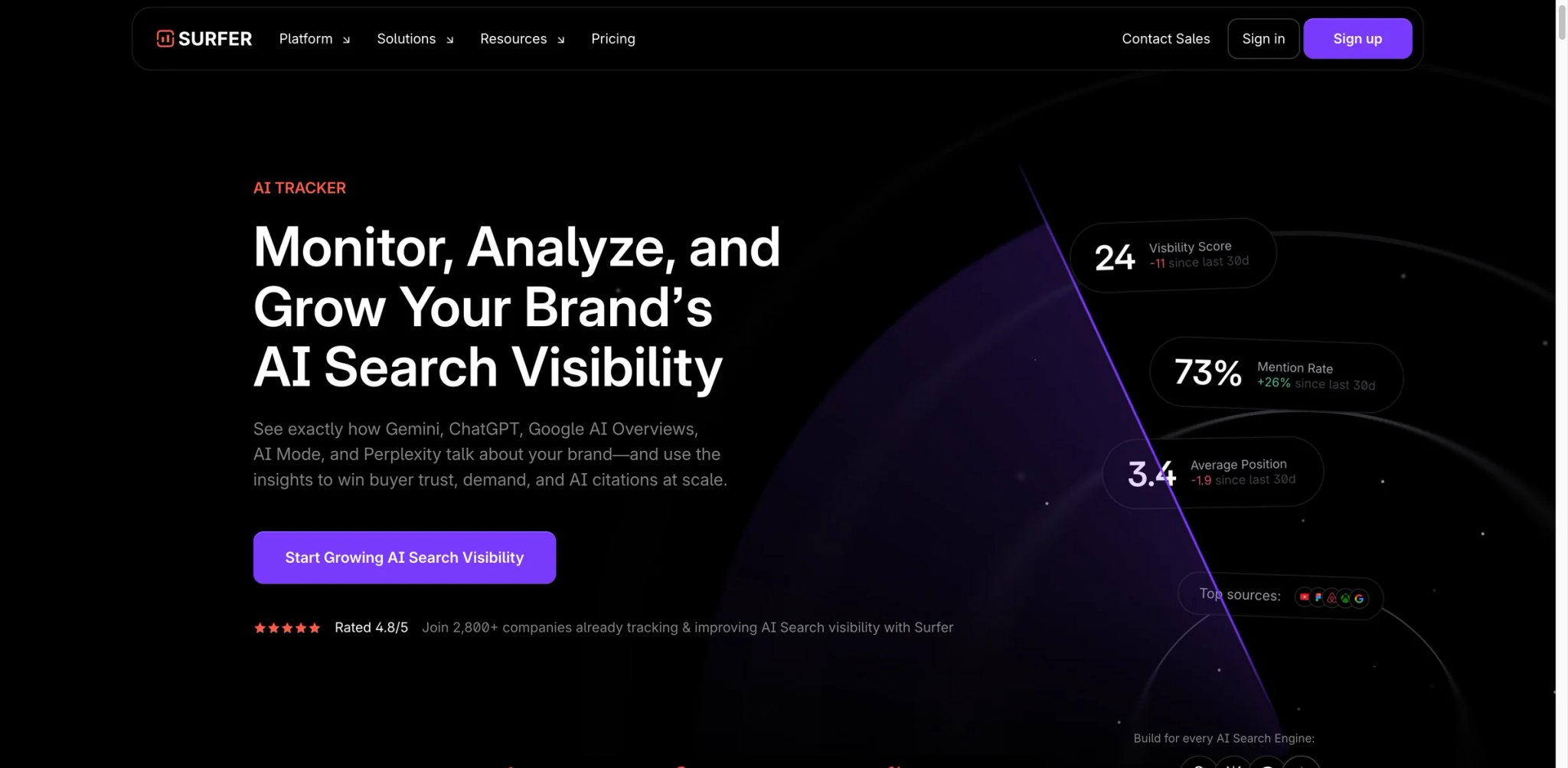
Surfer built its business on on-page content optimization scoring — write with the Surfer editor, hit your content score, publish. AI Tracker is the visibility layer they added so you can close the loop: track whether the content you optimized is actually getting cited in AI answers, and if not, what to change. For content-led teams whose existing workflow revolves around Surfer's editor, this is the shortest path from "monitor" to "fix."
Key Features
- Visibility + content optimization in one loop — Surfer's current pricing page shows AI visibility tracking across ChatGPT, Perplexity, Google AI Mode, Google AI Overview, and Google Gemini inside the same workflow. You can open the cited (or uncited) page in Surfer's editor to see content score and optimization recommendations — no other tool ties these two halves together.
- Content score correlation — See whether pages with higher Surfer content scores get more AI citations. Useful for proving the Surfer methodology to content managers.
- Integration with Surfer's existing keyword and content planner — AI visibility data sits alongside the keyword cluster planning most Surfer users already run.
- Competitive page analysis — When a competitor's page gets cited instead of yours, Surfer tells you what structural or content differences might explain it.
Pricing & Plans
- Standard: $99/month billed yearly — includes AI visibility tracking with 25 AI prompts refreshed weekly
- Pro: $182/month billed yearly — includes 50 AI prompts refreshed daily and broader brand workspace support
- Peace of Mind: $299/month billed yearly for the top self-serve tier with 100 AI prompts refreshed daily
- Enterprise: Tailored packages starting from $999/month
Cost reality: Cheaper than Scrunch and on par with Semrush's Visibility Toolkit. The value is strongest if you'd already pay for Surfer as your content editor — adding AI Tracker is nearly free. If you don't use Surfer for content, the math gets worse.
Limitations
- Content-team-centric framing: AI Tracker is built for teams who write and optimize content as a primary job. Brand / PR teams will find it mismatched.
- Depends on the Surfer editor thesis: If you don't believe in content scoring methodology, half the value of AI Tracker is gone.
- Narrower engine depth: Covers the major LLMs but with less citation source granularity than Ahrefs Brand Radar or Scrunch.
Best For
Content-led SEO teams already using Surfer as their on-page optimization tool, where the AI visibility data feeds directly into content revision decisions. Also strong for in-house content marketers whose primary KPI is organic + AI citation volume.
Not the right fit if you don't use Surfer for writing, or if brand mention sentiment / PR-style reporting is your primary need.
Get started with Surfer AI Tracker
Beamtrace
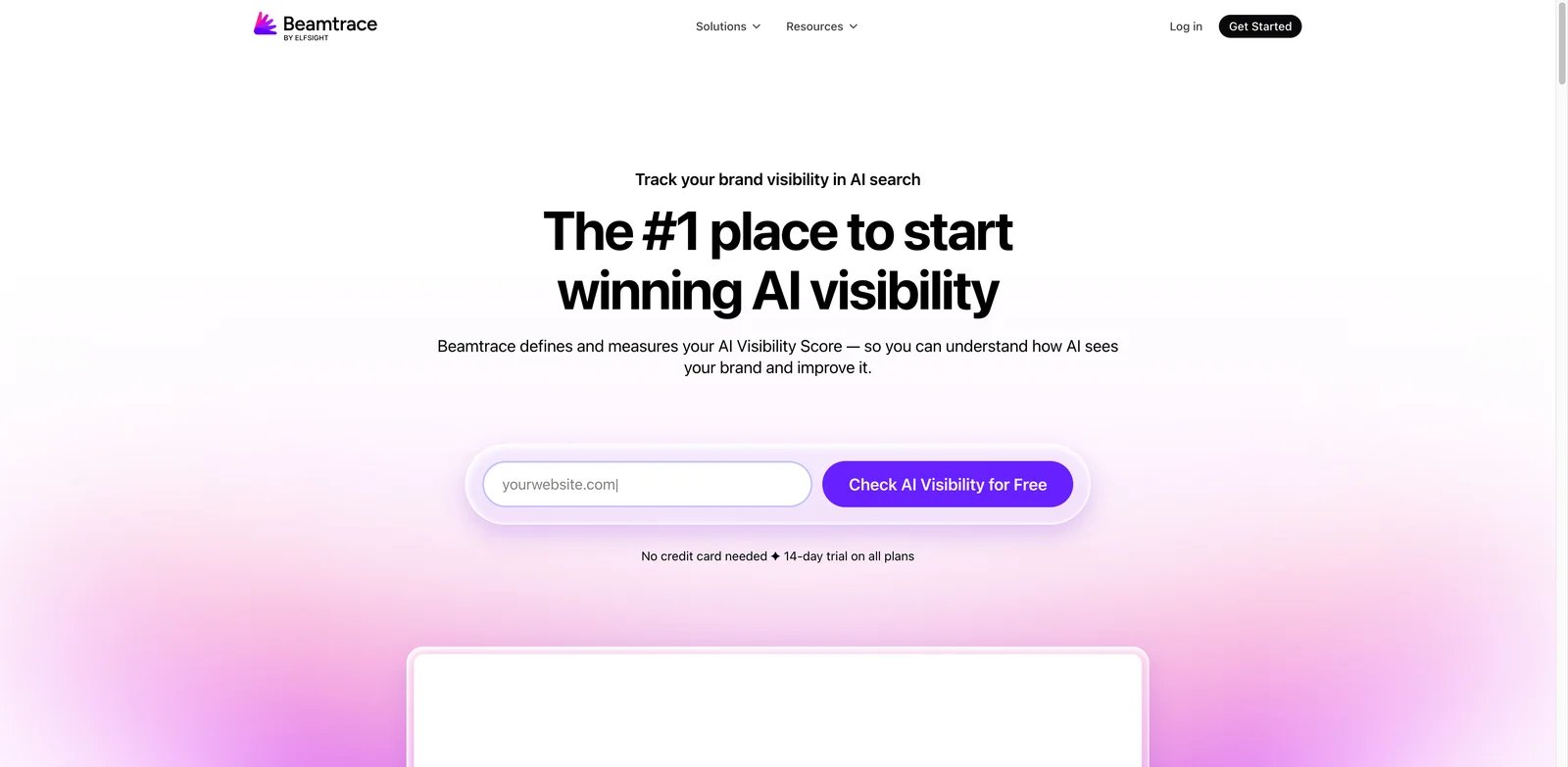
Beamtrace is the newest tool on this list and the cheapest native platform on it — $24/mo for a purpose-built AI visibility tracker, against $250/mo for Scrunch and $295 for AthenaHQ. The catch sits in the engine column: at launch it tracks ChatGPT and nothing else, with five more engines listed as coming soon. Whether that's disqualifying depends entirely on whether your buyers ask anything else. For a lot of small businesses they don't — ChatGPT is the AI search behaviour. It's built by Elfsight, whose widget platform runs on several million sites, so the company isn't going anywhere even though the product is new.
Key Features
- Visibility Score with trend history — One headline number for how present your brand is in AI answers, tracked over time rather than as a one-off audit. The trend line is the part that earns the subscription; a single visibility snapshot tells you nothing about whether last quarter's content work moved anything.
- Prompt-level performance and average position — Track business-critical prompts individually and see typical placement inside the answer, not just a binary mentioned/not-mentioned. Prompts group by topic, which is how you separate "we're invisible for comparison queries" from "we're invisible everywhere."
- Side-by-side competitor benchmarking — 5 to 30 tracked competitors depending on plan, framed as strengths and weaknesses rather than a bare leaderboard.
- Share of Voice and reputation monitoring on every tier — Not gated behind an upgrade, which is unusual at this price. Several more expensive tools on this list put sentiment behind a higher plan.
- Citation analysis — Listed among the solutions, though source-level citation depth isn't documented publicly the way Scrunch's is. Treat it as present rather than proven.
Pricing & Plans
- Starter: $24/month, or $20/month billed yearly — visibility checks every 3 days, 10 prompts, 5 competitors, basic support
- Growth: $48/month, or $40/month billed yearly — checks every 2 days, 30 prompts, 15 competitors, priority support
- Premium: $120/month, or $100/month billed yearly — daily checks, 60 prompts, 30 competitors, priority support with live chat
- Free trial: 14 days on Growth features, no credit card required
- Refunds: full refund within 14 days, self-serve cancellation at any time
Cost reality: The entry price is genuine, but read the refresh cadence as part of it. Starter checks every three days — in a category where one model update reshuffles who gets cited, that's a coarse sampling rate. If you're buying this to detect change rather than to run a one-time audit, Growth at $48 is the honest starting line.
Limitations
- One engine live at launch: ChatGPT is supported; Gemini, Claude, Perplexity, DeepSeek, and Grok are all marked coming soon. Every other tool in this comparison covers at least two engines today, and the $15.60/mo Mangools add-on covers six. If your category leans on Perplexity or Gemini, no price makes this work yet.
- No documented API or export path: Neither the pricing page nor the product pages mention API access, CSV export, or BI integrations. If AI visibility data has to land in a reporting stack next to SEO and paid, that's a hard stop — compare Peec AI's Looker Studio integration at a similar price.
- No track record to check: The product is recent and there are no independent long-run reviews yet. Elfsight's parentage is reassuring about the company continuing to exist; it says nothing about how this product behaves after a year of accumulated data.
- Prompt caps are tight at entry: 10 tracked prompts on Starter answers "are we visible at all," not "where in this category are we losing."
- One website per plan: Every tier, Premium at $120/mo included, covers a single website. Agencies and multi-brand teams are excluded by structure rather than by seat price, and the pricing page documents no multi-site path.
Best For
Small businesses, startups, and solo marketers who need to know whether ChatGPT recommends them, at a budget where $250/mo platforms were never a conversation. The 14-day no-card trial plus a 14-day refund window means finding out costs nothing, which matters more than any feature checklist when you're still testing whether this category applies to you.
Not the right fit if you need multi-engine coverage today, if your data has to reach a BI stack, or if you're an agency tracking many client brands — every plan covers one website, so that case isn't priced for at all.
Get started with Beamtrace
Best AI Search Monitoring Tools by Use Case
For SEO Teams That Already Pay for Ahrefs or Semrush
Stick with what you have. Ahrefs Brand Radar (~$199/mo on top of existing Ahrefs seat) or Semrush AI Visibility Toolkit ($99/mo add-on) give you AI visibility inside the workflow you already run daily. The consolidation value — one login, one contract, one reporting stack — typically outweighs the depth difference versus native platforms unless citation analysis is your primary job.
For Indie SEOs and Small Agencies on a Budget
Mangools AI Search Watcher at $15.60/mo annual is the cheapest way to get AI visibility bundled with a full SEO suite. If Mangools already covers your core SEO work, the AI add-on pays for itself within a month. For teams that want a purpose-built visibility tool at low cost, OtterlyAI at $29/mo is the alternative — just budget for Google AI Mode / Gemini add-ons if your category leans on those engines.
For B2B SaaS Brand and PR Teams Reporting to Leadership
AthenaHQ frames AI visibility as sentiment, share-of-voice, and narrative — the language comms leaders speak. Scrunch goes deeper on citation source analysis if you need to answer "why that source, not ours?" Pair one of these with Hall's free tier for a no-cost weekly baseline that non-stakeholders can check without a seat.
For Teams Evaluating the Category for the First Time
Hall's free tier. 25 tracked questions, 300 answers/month, weekly refresh, zero commitment. Run it for 4 weeks to figure out what matters to your brand before committing $200+/mo to a paid platform. Most teams learn more from the free baseline than from reading vendor marketing pages.
For Enterprise Brands With Dedicated GEO Budget
Profound Enterprise ($2,000+/mo) is the only tool on this list offering Prompt Volumes — proprietary panel data showing who is asking which prompts, with demographic breakdowns. For brand teams tying AI visibility to audience segmentation and campaign attribution, no other tool ships that data layer. AthenaHQ Enterprise is the alternative if sentiment and narrative reporting are more important than audience segmentation.
For Analyst Teams Piping Data Into Looker Studio or BI
Peec AI's Looker Studio integration and API-first design make it the easiest fit for teams where AI visibility data has to live alongside SEO, paid, and pipeline metrics in one BI stack. Starter (€85/mo) is viable for pilots; Advanced (€425/mo) is the real tier once you need API access and unlimited prompts.
For Content Teams Wiring Monitoring to Optimization
Surfer AI Tracker closes the loop between "this page isn't getting cited" and "here's what to change in the editor." It only makes sense if you already use Surfer as your content optimization tool — the whole value is in the one-click handoff from visibility data to editor.
How to Choose the Right AI Search Monitoring Tool
-
Start with "who is the primary user?" — If it's an SEO manager, pick a tool that frames data as keyword-level visibility (SE Ranking, Ahrefs, Semrush, Mangools, Surfer). If it's a PR / brand lead, pick sentiment-first tools (AthenaHQ, Scrunch). The data under the hood is similar; the framing determines whether the tool gets opened or not.
-
Run Hall's free tier for two weeks before paying anyone — It's the fastest way to answer "does this category even matter for our brand?" without a sales cycle. Most teams learn their top 10 tracked questions from the free tier and then buy a paid tool with confidence.
-
Count the engines that actually matter to your category — Not every brand needs all 8 LLMs. B2B SaaS typically cares about ChatGPT + Perplexity + Claude. Consumer retail cares about ChatGPT + Google AI Mode. If your target engines are ChatGPT and Perplexity, OtterlyAI at $29/mo is enough; if you need 8+, AthenaHQ or Profound Enterprise are the realistic options.
-
Audit your existing SEO stack before adding a native platform — If you already pay $200+/mo for Ahrefs or Semrush, adding Brand Radar or AI Visibility Toolkit is almost always cheaper than signing a second vendor. Native platforms (Scrunch, Peec, AthenaHQ) are worth the extra cost only when the existing stack genuinely doesn't serve your use case.
-
Factor add-ons and credit burn into the real monthly cost — Sticker prices lie in this category. OtterlyAI's $29 doesn't include Google AI Mode. AthenaHQ's $295 credits deplete faster than the plan math suggests. Profound's published $499 doesn't include Prompt Volumes. Read the footnotes before committing annually.
-
Budget for annual contracts only after a paid pilot — Every tool on this list has restructured pricing in the past six months. Lock yourself into a 12-month Enterprise contract only after you've run a paid pilot for 4–6 weeks and confirmed the workflow holds up under weekly reporting cadence.
Frequently Asked Questions
What's the cheapest way to start monitoring AI search visibility in 2026?
Which AI search monitoring tool covers the most LLMs as standard, not as add-ons?
Do I need a separate AI visibility tool if I already pay for Ahrefs or Semrush?
Is Profound actually worth $2,000+/month, or is the Lite plan enough?
How often should I actually check AI search visibility data?
Can AI search monitoring tools track Google AI Mode and AI Overviews separately?
What's the difference between AI search monitoring, AEO, and GEO tools?
Disclosure
ToolWorthy sells sponsored placements in some articles. Beamtrace's entry on this page is a paid placement, purchased in August 2026. No other entry on this page is sponsored.
A paid placement buys a slot, never a verdict. It does not move any other tool's position, does not change the factual columns in the comparison table, and does not soften the limitations we publish — sponsored entries are held to the same scrutiny as every other entry, and all copy on this page is written by our editorial team.
Get ToolWorthy Weekly
New AI tools, practical guides, and selected AI signals in one weekly brief.
For AI tool founders
Built a tool that belongs in this decision set?
Request an editorial evaluation for possible inclusion in ToolWorthy.
Submit your tool for reviewPaid submission does not guarantee a ranking, recommendation, inclusion, or editorial outcome.