

Overview
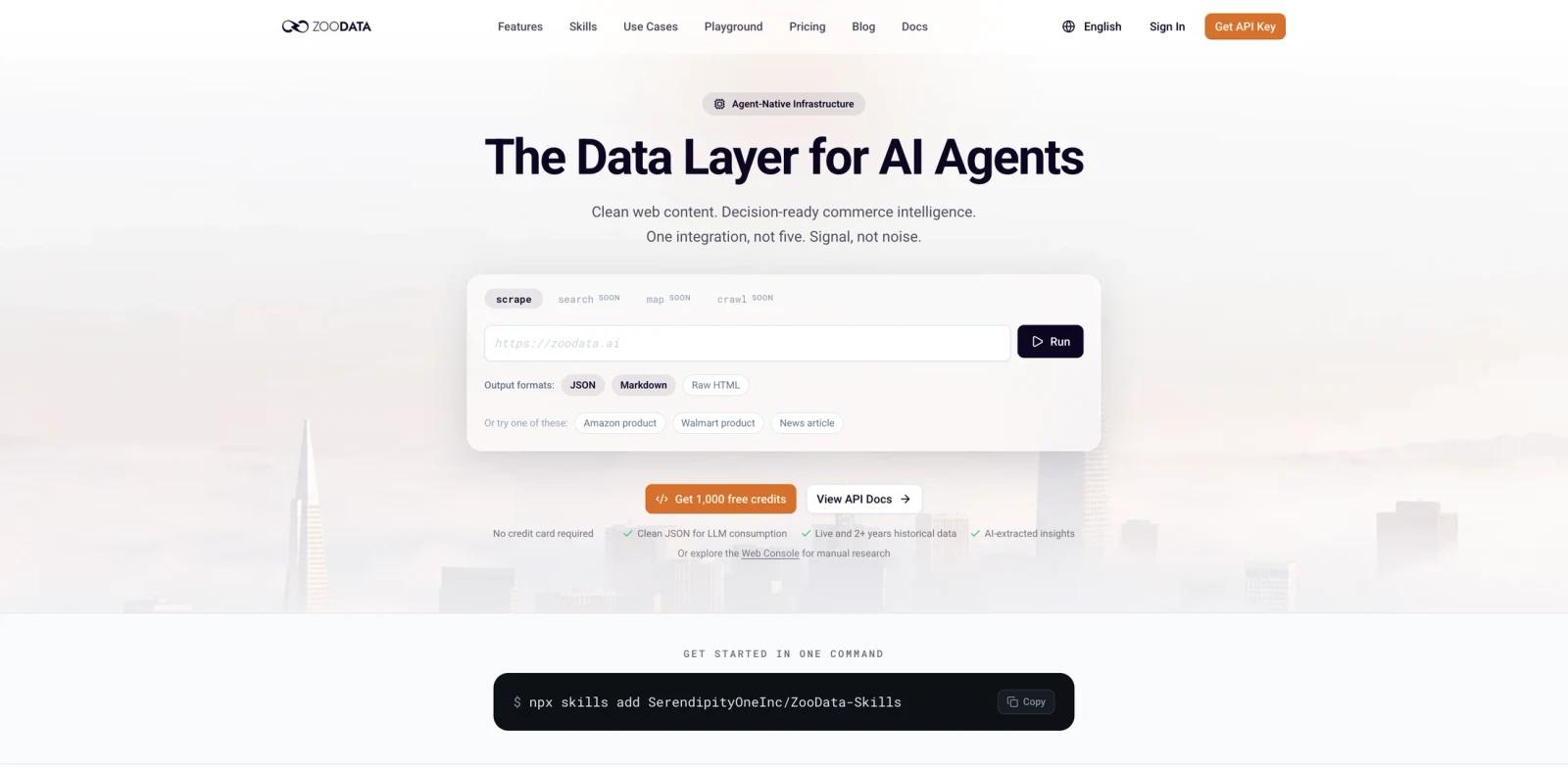
ZooData is a data layer built for AI agents that need structured, decision-ready inputs instead of raw HTML or noisy scraped pages. It turns web content and commerce data into formats that agents can consume directly, including clean JSON, Markdown, raw HTML, and API responses.
The product's strongest fit is agentic e-commerce research. ZooData focuses on real-time and historical product, competitor, market, traffic, and consumer signals, with the official site describing 500M+ tracked products, frequent Best Sellers Rank refreshes, and API endpoints optimized for automated workflows.
ZooData belongs in the AI agent, AI data analysis, and AI market research categories. It also overlaps with AI data science workflows where data quality and freshness matter before a model makes a decision. It is relevant to teams building research agents, listing agents, pricing agents, or other commerce workflows that need structured data before model reasoning.
Key Features
URL to structured data - Convert web pages into agent-ready JSON, Markdown, or raw HTML so downstream models spend less context on boilerplate.
Commerce intelligence layer - Query product, competitor, market, category, real-time, and historical endpoints for e-commerce workflows.
Agent-native API design - The site highlights OpenAPI 3.0, API docs, CLI usage, and integrations for LangChain, CrewAI, AutoGen, Claude MCP, OpenAI, and custom agents.
Fresh market signals - Official materials describe 15-minute BSR refreshes, 30-minute key price refreshes, daily high-priority data, and weekly full catalog data.
MCP and skills workflow - Product Hunt and the official site describe MCP server support and an install path via
npx skills add SerendipityOneInc/ZooData-Skills.Token-efficiency focus - ZooData positions clean JSON as a way to reduce LLM token waste compared with raw HTML or markdown extraction.
How to Get Started
Start with the free credits, generate an API key, and test one endpoint against a real product or market research task. The lowest-risk first workflow is read-only: ask an agent to collect competitor prices, category demand, product attributes, or listing gaps, then inspect the returned JSON before allowing the workflow to take action.
For developers, import the OpenAPI spec or connect ZooData through an MCP-compatible agent. Teams building autonomous commerce workflows should preserve timestamps and source URLs alongside extracted fields so agents can reason about freshness and verify values before making pricing or listing changes. If the workflow needs broader warehouse-style reporting, compare ZooData's agent API approach with AI data visualization tools that focus on dashboards rather than agent-callable data.
Pricing & Plans
ZooData publishes a credit-based pricing model and a free starting allowance.
| Item | Public pricing detail |
|---|---|
| Free start | 1,000 free credits, no credit card required |
| Billing model | Credit-based usage for data calls |
| Paid packages | Public pricing page references prepaid credits and packages, but detailed package amounts were not visible in the static page snapshot |
| Support contact | support@zoodata.ai |
Because the official pricing page exposes the credit-system FAQ but not every paid package amount in static text, teams should confirm current package prices inside the ZooData console before committing to high-volume workloads.
Best For
- Developers building AI agents for commerce research
- Marketplace teams monitoring competitors and category shifts
- Listing automation workflows that need structured product attributes
- Market researchers comparing live demand and price signals
- Agent builders who want API, CLI, and MCP access to structured data
FAQ
What is ZooData?
ZooData is an agent-native data layer that turns URLs and commerce information into structured data for AI agents.
What formats does ZooData return?
The official site lists JSON, Markdown, and raw HTML output formats, with JSON positioned as the main agent-ready format.
Does ZooData support MCP?
Yes. Product Hunt and the official site reference MCP server support and an npx skills add installation path.
Is ZooData free?
ZooData offers 1,000 free credits with no credit card required. Paid usage appears to follow a credit-based model.
What data is ZooData best at?
The strongest published use cases are e-commerce and market intelligence, including product, competitor, category, pricing, and historical signals.
Should agents trust ZooData fields automatically?
No. Acting agents should preserve source URLs, timestamps, and validation rules, especially when using extracted fields for pricing, customer answers, or listing changes.