


Overview
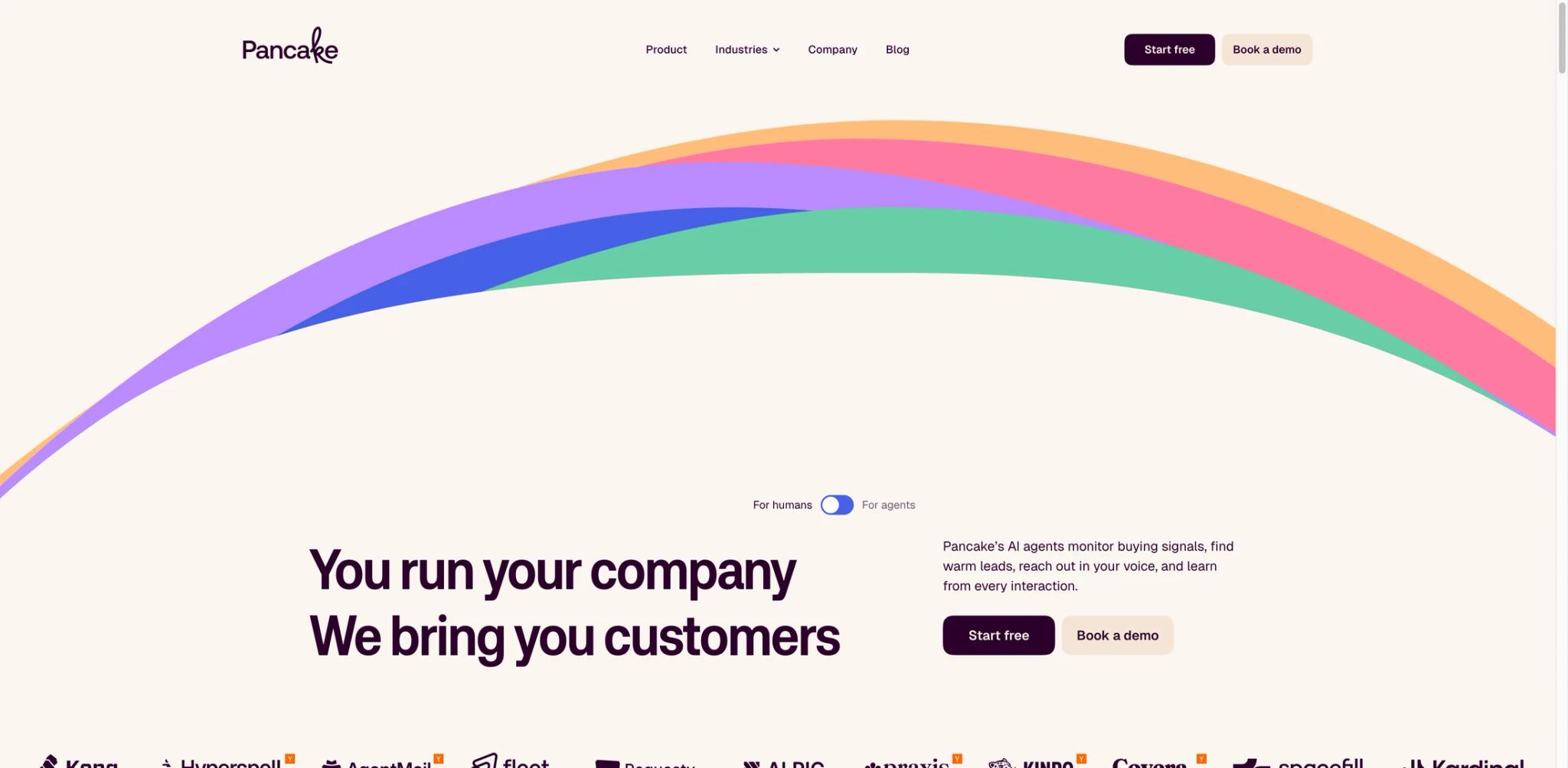
Pancake is an autonomous AI agent system that lives inside Slack. The pitch is to give a founder or small company an "AI org chart" — squads of agents organized by department (growth, engineering, operations) that run real tasks 24/7, sync context from meeting notes and Slack discussions, and escalate to a human only when an action crosses a spend, scope, or trust threshold.
Each agent is markdown-configured: behavior is defined in .md files rather than a visual builder, which fits teams that want their AI agent definitions version-controlled and editable like code. Agents are context-aware (reading Notion, docs, and meeting notes), always-on, sandboxed with tool/data restrictions, and backed by audit logging with replay and rollback.
Pancake targets founders and startups that want operational leverage without hiring — the framing is "your co-founder," with agent squads that can write copy, ship pull requests, screen recruits, handle invoicing, and post daily digests. Both the official site and Product Hunt position Pancake as an OpenClaw-based Slack cofounder layer; Pancake's own blog describes it as the assembled company layer built on top of Hermes and OpenClaw.
Key Features
- Agent squads by department — Pre-organized squads for Growth (copywriter, ad manager, social, email), Engineering (full-stack, DevOps, performance monitor, QA), and Operations (scheduling, recruiting screener, invoicing, support), so the org chart maps to real functions rather than a generic agent.
- Markdown-configured agents — Agent behavior is defined in
.mdfiles, making definitions version-controllable and editable like code rather than locked in a visual builder. - Lives in Slack — Agents operate inside Slack where work is already discussed, with one-tap approvals on phone or Slack for actions exceeding spend, scope, or trust thresholds.
- Context-aware and always-on — Agents read Notion, docs, and meeting notes for context and run 24/7, pairing naturally with coding workflows like Claude Code for the engineering squad's pull-request work.
- Approval gates for risky actions — Irreversible or costly actions (spend, production changes) require explicit human approval, so autonomy doesn't mean unsupervised.
- Audit logging with replay/rollback — Every agent action is logged with replay and rollback, and agents are sandboxed with tool/data restrictions — important when a fleet of agents acts on company systems.
How It Compares
- vs. Lindy / Cassidy / general AI agent builders — Those give a canvas to build individual automations. Pancake ships a pre-organized org chart of department squads and lives in Slack, trading some build flexibility for faster time-to-an-operating-team.
- vs. Manus / autonomous task agents — Manus excels at completing a single complex task end-to-end. Pancake is built for ongoing, parallel operations across functions with persistent context, closer to "standing team" than "one-shot task."
- vs. Slack workflow bots (Standuply, Workflow Builder) — Those are scripted automations. Pancake's agents are LLM-driven, context-aware, and markdown-configured, with audit/rollback — a different abstraction than trigger-action bots.
- vs. coding-agent-only tools (Claude Code, Codex) — Those focus on the engineering loop. Pancake spans growth, ops, and engineering, using the coding agent as one squad among several.
The honest read: Pancake is best for founders who want a standing, multi-function agent team operating in Slack. It's a worse fit for teams that need one deep capability (just coding, just sales) or that don't run on Slack.
Pricing & Plans
Pancake uses a token-pass-through model — "we charge what the labs charge," with margin coming from volume discounts. There's a 3-day trial with $100 in credits (no credit card required), then paid plans.
| Plan | Price | What's Included |
|---|---|---|
| Free Trial | $0 (3 days, $100 credits) | Evaluate the platform with credit headroom, no card required |
| Always-on | $49/mo | Private cloud computer with 50GB storage, encrypted secrets, any AI model, web browsing, inbox, phone number, email, authenticated browsing, live web access, deep web search, unlimited sub-agents (iMessage and credit-card features noted as coming soon) |
| Syrup | $99/mo (token packs $50 / $100 / $250 / $500 / $1,000) | Positioned "for side projects"; includes all Always-on features plus a chosen token pack |
Token costs are pass-through to the underlying model labs; the monthly fee covers the platform/infrastructure rather than marked-up tokens. Tokens reset monthly, token-pack changes are prorated, and cancellation is unrestricted. Because real cost tracks token consumption, benchmark a representative workload before committing.
Best For
- Founders and tiny startups wanting an operating team across growth, engineering, and ops without hiring
- Slack-native teams comfortable approving agent actions from their phone
- Technical founders who want agent definitions as version-controlled markdown rather than a visual builder
- Operators who need AI productivity leverage across multiple functions, not just one deep capability
- Teams comfortable with usage-based token costs in exchange for no token markup
FAQ
Is Pancake free?
There's a 3-day free trial with $100 in credits and no credit card required — but not a permanent free tier. After the trial, Always-on is $49/mo and Syrup is $99/mo (with token packs). Token costs are passed through from the underlying model labs.
How does Pancake's pricing actually work?
The monthly fee (Always-on $49, Syrup $99) covers the platform and infrastructure; token usage is billed pass-through at "what the labs charge," with Pancake's margin coming from volume discounts. Tokens reset monthly with prorated adjustments, and you can cancel anytime.
Is Pancake built on OpenClaw?
Yes — Pancake's own blog describes it as the assembled company layer built on top of Hermes and OpenClaw. The "OpenClaw in Slack" tagline reflects that technical base, with Pancake adding the agent-org-chart, Slack interface, and governance layer on top.
What agent squads are available?
Growth (copywriter, ad manager, social media manager, email marketer), Engineering (full-stack engineer, DevOps, performance monitor, QA tester), and Operations (scheduling, recruiting screener, invoicing, customer support). Agents are organized as an "AI org chart."
How are agents configured?
Agents are markdown-configured — behavior is defined in .md files rather than a visual builder, so definitions can be version-controlled and edited like code.
What stops an agent from doing something costly or irreversible?
Approval gates: actions that exceed spend, scope, or trust thresholds require explicit human approval, delivered as one-tap approvals on phone or in Slack. Agents are also sandboxed with tool/data restrictions, and all actions are audit-logged with replay/rollback.
What does Pancake integrate with?
Slack is the primary interface; agents read context from Notion, docs, and meeting notes, and can act through connected tools. The engineering squad can generate pull requests. Verify the specific integration footprint for your stack before relying on it.
Who is Pancake not for?
Teams that don't run on Slack lose the main interface. Teams needing one deep capability (just coding, or just sales) may prefer a specialized tool. And teams that need a flat, predictable monthly bill should account for the usage-based token model.