



Overview
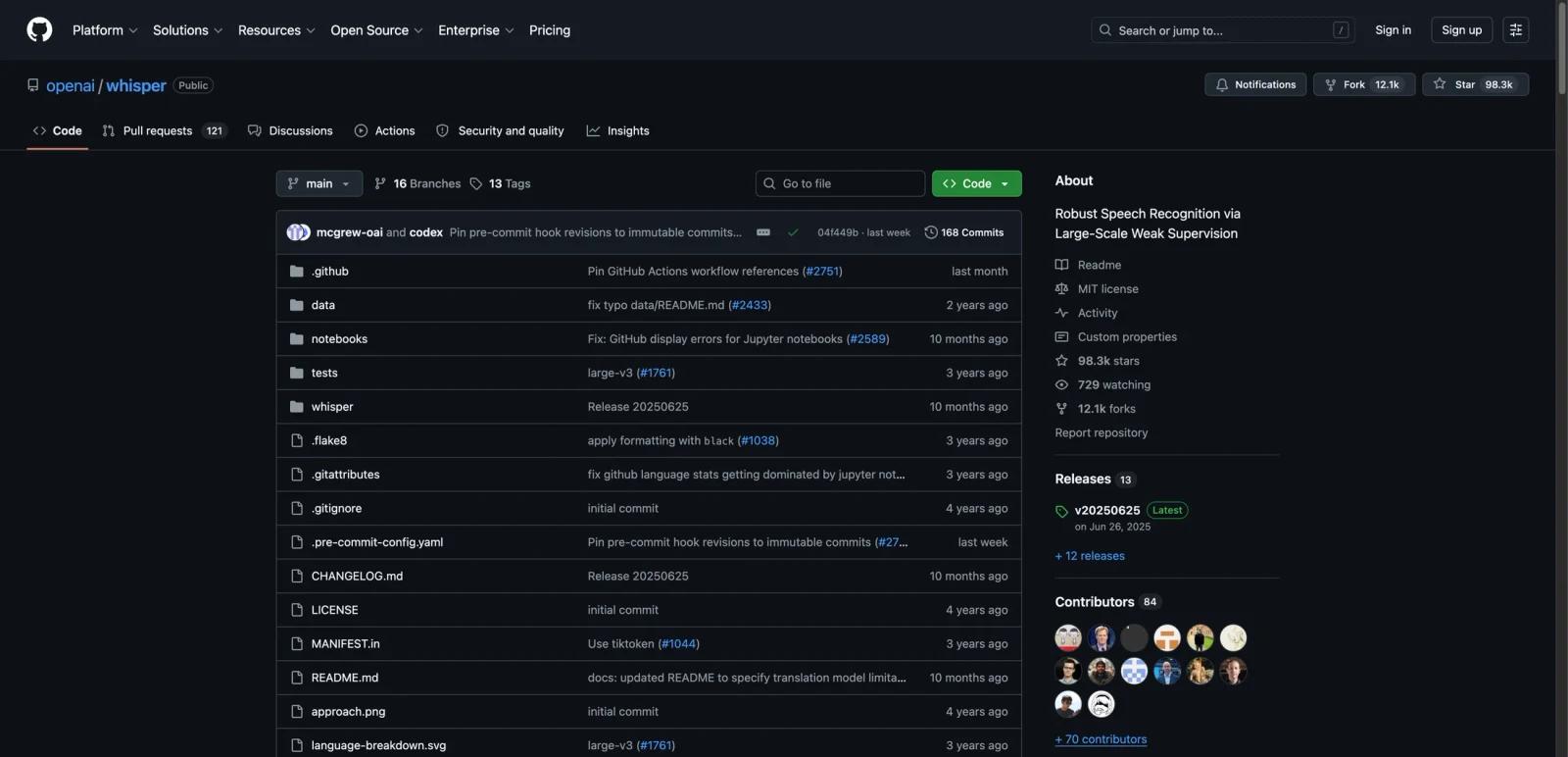
OpenAI Whisper is OpenAI's open-source automatic speech recognition model for transcription, language identification, and speech translation. Unlike a hosted SaaS transcription product, Whisper is distributed primarily as open-source code and model weights through GitHub under the MIT License, which makes it attractive to developers and research teams that want control over deployment, privacy, and inference behavior.
The core positioning is different from a managed speech to text API. Whisper is a model family, not a polished end-user workspace. You run it locally, in your own infrastructure, or through third-party wrappers. That means the value is highest when you want open-source flexibility, offline or self-hosted transcription options, and broad multilingual support without per-minute SaaS lock-in.
As of April 24, 2026, the public repository still positions Whisper as a general-purpose speech recognition model trained on large-scale weak supervision. The repository currently lists model sizes from tiny through large, plus turbo, and the latest GitHub release shown on the repo is v20250625 published on June 26, 2025.
For adjacent research, compare AI music generator tools, AI music generator guide.
Key Features
Open-source speech recognition under MIT — Whisper's code and model weights are released under the MIT License, which is a major advantage for teams that need flexible deployment or want to inspect and extend the stack.
Multilingual transcription and language identification — OpenAI describes Whisper as a multitasking model that can perform multilingual speech recognition and language identification across a broad set of languages.
Speech translation into English — Whisper also supports speech translation workflows, though the current repository documentation explicitly notes that the
turbomodel is not trained for translation tasks.Multiple model sizes for speed vs accuracy tradeoffs — The repo documents model sizes
tiny,base,small,medium,large, andturbo, with approximate VRAM requirements ranging from about 1 GB to around 10 GB depending on the model.Python and CLI workflows — Whisper supports direct command-line use and Python integration, which makes it practical both for developer scripts and for embedding transcription inside larger ML or automation pipelines.
Strong ecosystem and third-party wrappers — Because Whisper is open source and widely adopted, it has a large ecosystem of community ports, GUIs, hosted wrappers, and integrations beyond the core repository itself.
Pricing & Plans
Whisper does not have a standard SaaS subscription price on the official repository because the project itself is open source and free to use under the MIT License. In that sense, Whisper is best understood as a free model family rather than a paid hosted product.
| Option | Price | What you are paying for |
|---|---|---|
| OpenAI Whisper repository | Free | Code and model weights under MIT License |
| Self-hosted deployment | Variable infrastructure cost | Compute, storage, GPU or CPU runtime, and ops overhead |
| Third-party hosted wrappers | Varies by provider | Managed inference, APIs, UI, support, or packaged workflows |
The real cost question with Whisper is infrastructure, not licensing. Small models can run on lighter hardware, while larger models require more VRAM and slower inference. The repository currently lists approximate VRAM needs of about 1 GB for tiny and base, about 2 GB for small, about 5 GB for medium, about 10 GB for large, and about 6 GB for turbo. For teams comparing Whisper to paid transcription services, the tradeoff is usually lower software licensing cost versus higher engineering and compute responsibility.
Best For
- Developers who want full control over transcription deployment and data handling
- Teams building private or on-prem speech recognition workflows
- Researchers and builders comparing model sizes and inference tradeoffs directly
- Products that need embedded transcription without a strict per-minute SaaS dependency
- Power users comfortable with Python, CLI tools, or self-hosted ML infrastructure
FAQ
Is OpenAI Whisper free?
Yes. The official repository distributes Whisper as open-source code and model weights under the MIT License. You do not pay a software subscription fee to use the core project itself.
Is Whisper a SaaS transcription app?
No. Whisper is primarily a model and codebase, not a polished hosted workspace. You usually run it yourself or access it through third-party wrappers and services.
What can Whisper do?
Whisper supports speech transcription, language identification, and speech translation. OpenAI describes it as a general-purpose speech recognition model trained on diverse audio.
What model sizes are available?
The repository currently lists tiny, base, small, medium, large, and turbo, with different speed, memory, and accuracy tradeoffs.
Can Whisper translate speech into English?
Yes, but not every model is equally suited for it. The current repo documentation says the turbo model is not trained for translation tasks, so multilingual models such as medium or large are better choices for translation use cases.
Is Whisper good for production use?
It can be, especially if you need open-source control and are willing to manage deployment yourself. But production suitability depends heavily on your language mix, latency goals, hardware budget, and tolerance for operating your own inference stack.


