

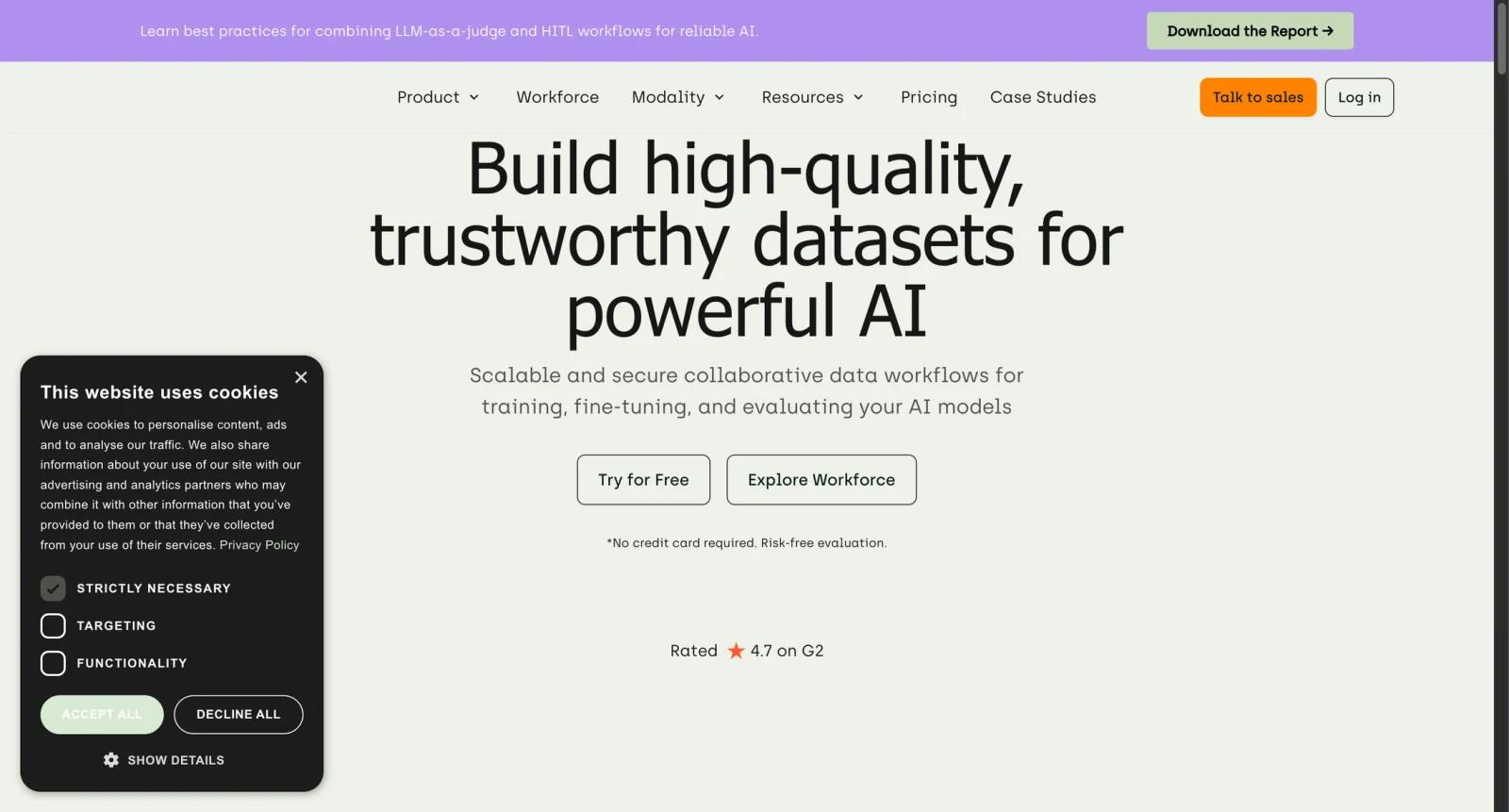


Overview
Kili Technology is a data labeling and annotation platform for AI teams building training, fine-tuning, and evaluation datasets. It supports labeling workflows across text, documents, images, video, and satellite imagery, with AI-assisted labeling, review workflows, workforce management, API access, and professional services.
The official pricing page lists a Free Trial at $0/month with asset limits, a Grow plan with custom subscription pricing, and an Enterprise plan with custom contract pricing. That makes Kili one of the clearer options in the AI data annotation category for teams that want to test before committing. Buyers may compare it with SuperAnnotate, Labelbox, and V7 Darwin.
Kili is best for teams that need repeatable data operations, not just a one-time labeling task. It is useful when label quality, reviewer workflows, workforce coordination, and project traceability matter.
Key Features
- Multimodal annotation - Supports labeling for text, documents, images, video, and satellite imagery depending on plan and asset limits.
- AI-assisted labeling - Helps speed up repetitive annotation work and gives teams a faster starting point for high-volume datasets.
- Review and quality control - Supports reviewer workflows so teams can audit, correct, and improve label quality before model training.
- API and Python SDK - Grow and higher plans include programmatic access for teams integrating annotation into ML pipelines.
- Workforce management - Lets organizations manage internal annotators, external contractors, and Kili's professional services team in one platform.
- Enterprise controls - Enterprise options include custom seats, custom terms, SSO, advanced security, on-premise deployment, and compliance support.
Pricing & Plans
Kili publishes plan structure on its pricing page.
| Plan | Published pricing signal | Best fit |
|---|---|---|
| Free Trial | $0/month, 1 team seat, asset limits | Testing Kili on small text, document, image, video, or satellite projects |
| Grow | Custom subscription, up to 20 team seats and 50,000 assets | Teams scaling annotation workflows with API and support |
| Enterprise | Custom contract | Organizations needing custom seats, SSO, advanced security, on-premise deployment, or compliance support |
Confirm whether your data type, asset volume, annotation workforce, storage, and deployment requirements fit the listed limits before choosing a plan.
Best For
- ML teams building training or evaluation datasets across multiple data types
- AI product teams that need reviewer workflows and quality control
- Enterprises managing internal and external annotation workforces
- Teams that want an API-driven labeling platform with professional services available
- Buyers comparing data annotation tools before committing to a custom contract
FAQ
What is Kili Technology?
Kili Technology is a data labeling and annotation platform for building high-quality datasets for AI training, fine-tuning, and evaluation.
How much does Kili Technology cost?
Kili lists a Free Trial at $0/month. Grow uses custom subscription pricing, and Enterprise uses custom contract pricing.
What data types does Kili support?
Kili supports text, documents, images, video, and satellite imagery, with different limits and capabilities depending on plan.
Does Kili offer AI-assisted labeling?
Yes. AI-assisted labeling is included in the Free Trial description and is part of Kili's data labeling workflow.
Is Kili good for enterprise annotation?
Yes. Enterprise options include custom seats, SSO, advanced security, on-premise deployment, and compliance support.
How does Kili compare with SuperAnnotate?
Both support enterprise annotation workflows. Kili has a clear free trial with asset limits, while SuperAnnotate emphasizes multimodal editors, data curation, orchestration, and AI DataOps consulting.
What should buyers verify?
Verify asset limits, data type support, SDK needs, storage, workforce model, review workflow, security requirements, and add-on pricing.
Who should avoid Kili?
Teams with only a tiny one-off labeling task may not need a full annotation platform and may prefer simpler manual tools.
