

Overview
AutoGen is Microsoft's open-source framework for building AI agents and multi-agent applications. The current official docs split the stack into several layers: AgentChat for conversational agent apps, Core for event-driven multi-agent systems, Extensions for integrations and tooling, and AutoGen Studio as a web UI for no-code prototyping.
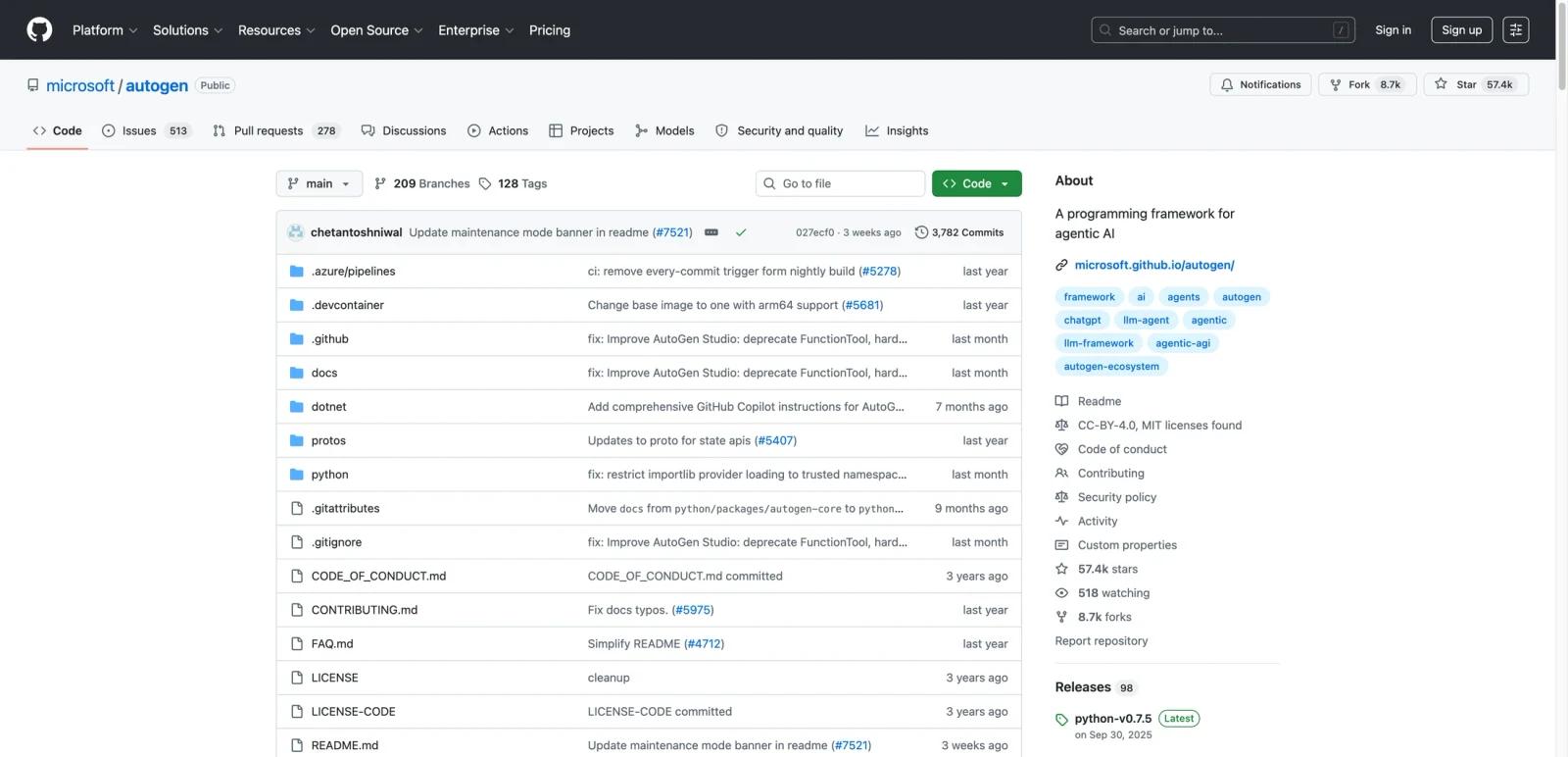
The key reality in 2026 is that AutoGen is still widely known, but it is no longer the forward-looking default inside Microsoft's own ecosystem. The official GitHub repository explicitly says AutoGen is in maintenance mode, will not receive new features or enhancements, and is now community-managed. Microsoft directs new users to start with Microsoft Agent Framework instead, while existing users are encouraged to migrate with the published migration guide.
That changes how AutoGen should be evaluated. It is still relevant for teams maintaining existing AutoGen codebases, learning from its architecture, or prototyping with a mature open-source agent framework. But if you are starting a fresh long-term production build, the official maintenance-mode banner materially weakens its position.
For adjacent research, compare AI design tools, AI UI design tools, AI website design tools.
Key Features
Multi-agent application framework — AutoGen is designed for building AI agents that can act autonomously or collaborate with humans and other agents.
AgentChat layer — The official docs position AgentChat as the main framework for conversational single-agent and multi-agent applications built on top of Core.
Core runtime — AutoGen Core is presented as an event-driven programming framework for scalable multi-agent systems, including deterministic and dynamic workflows.
Extensions ecosystem — AutoGen Extensions provide integrations with external services and libraries, including MCP-related workbenches, assistant integrations, and code execution components.
AutoGen Studio — The docs describe AutoGen Studio as a web-based UI for prototyping with agents without writing code, which lowers the barrier for experimentation. The official Studio docs frame it as a prototyping surface rather than a production-ready application.
Multi-language and open-source ecosystem — The GitHub repository contains Python, C#, and TypeScript code, plus releases, packages, forks, stars, and a large contributor base.
Pricing & Plans
AutoGen is not sold like a SaaS subscription. It is an open-source framework, so the software itself is free to use under the repository's licenses. Your actual cost comes from the model providers, infrastructure, and services you connect to it.
| Plan | Pricing | Best fit |
|---|---|---|
| Open-source framework | Free software | Developers and teams building or maintaining agent systems in code |
| AutoGen Studio | Free software layer; infrastructure and model costs still apply | Teams that want a UI-based prototyping surface without starting from raw code |
| Production usage | Variable external cost | Teams paying for model APIs, hosting, observability, and surrounding infrastructure rather than AutoGen itself |
The more important buying question is not license cost. It is whether you want to invest in a framework that Microsoft's own repository now labels as maintenance-mode and points new users away from.
Best For
- Teams maintaining existing AutoGen projects
- Developers studying multi-agent framework patterns
- Engineers prototyping agent workflows in an open-source stack
- Users who want AutoGen Studio for quick experimentation
- Organizations that understand the migration tradeoff and accept maintenance-mode status
FAQ
What is AutoGen?
AutoGen is Microsoft's open-source framework for building AI agents and multi-agent applications.
Is AutoGen still actively developed?
Not in the normal growth sense. The official repository says AutoGen is in maintenance mode, community-managed, and will not receive new features or enhancements.
What is AutoGen Studio?
AutoGen Studio is the web-based UI in the AutoGen ecosystem for low-code or no-code agent prototyping, but the official docs do not position it as a production-ready application.
Does AutoGen have pricing?
AutoGen itself is open-source software, so there is no public SaaS subscription price for the framework. Your costs come from the model APIs and infrastructure you use with it.
Should new teams start with AutoGen?
Usually not as a first choice. The official repository recommends new users start with Microsoft Agent Framework instead.
Who should use AutoGen today?
AutoGen is most useful for existing users, migration-aware teams, and developers who want to learn from or maintain a widely used multi-agent open-source framework.