



Overview
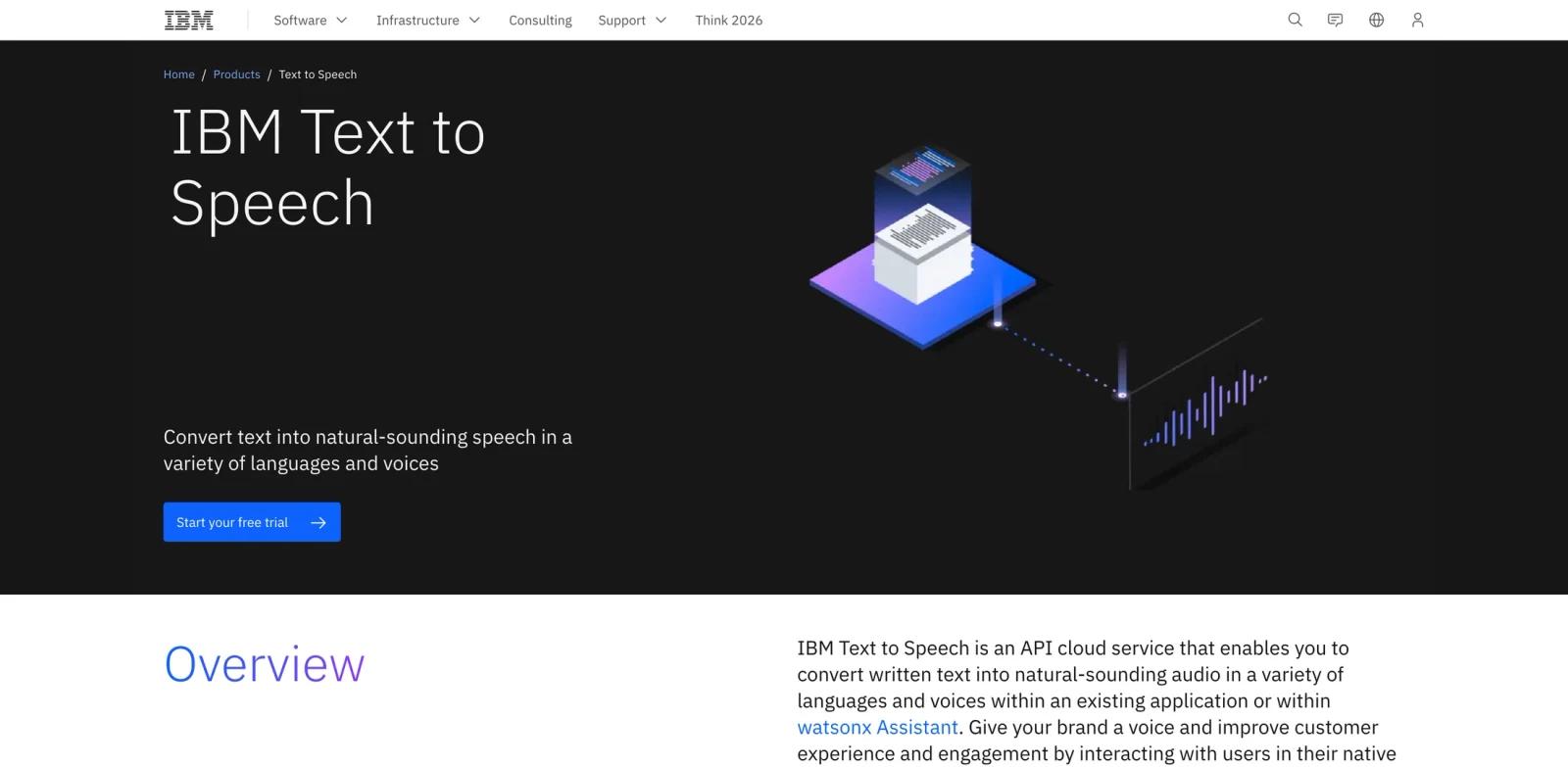
IBM Text to Speech is an AI-assisted tool for voice, speech, and production audio workflows. The public product page positions it around practical workflows rather than novelty: users bring in text, speech, dialogue, or production audio and use the product to move faster from raw input to a usable output.
Watson Speech to Text is an API that transcribes speech to text in a variety of languages. It's available as SaaS or for self-hosting. The best way to evaluate it is with a realistic input from your current workflow rather than a sample prompt.
IBM Text to Speech belongs in a workflow with AI audio editors, AI audio enhancers, and AI audio cleanup tools, depending on whether the main task is generation, cleanup, or post-production. The strongest fit is not just "people who want AI." It is users who already have a recurring workflow and need a faster, more consistent way to complete it without losing review control.
Key Features
- Speech generation or enhancement - Uses AI to create or improve voice output for apps, media, accessibility, or production workflows.
- Developer and creator workflows - Supports both technical integration and practical content production, depending on the product surface.
- Language and voice controls - Helps teams match speech output or audio processing to the audience, use case, and channel.
- Quality management - Reduces common issues such as robotic delivery, background noise, or inconsistent dialogue clarity.
- Scalable production - Makes repeated voice or audio work more manageable than recording and editing every asset manually.
How to Get Started
- Open IBM Text to Speech from the official product page and confirm the workflow matches your intended use case.
- Prepare one realistic input: a real file, campaign brief, job description, dataset, document, video, or prompt from your current work.
- Run a first output with default settings, then review the result for accuracy, brand fit, formatting, and missing context.
- Test the export or handoff path before using it in production. For team use, check permissions, collaboration, approval, and data retention settings.
- Compare the time saved against the manual process you use today. The tool is worth adopting when it reduces repeated work without creating a heavier review burden.
Pricing & Plans
IBM Text to Speech is best treated as a freemium or free-to-start product unless your team has confirmed otherwise on the live pricing page. Public product pages emphasize an accessible starting workflow, while advanced exports, collaboration, higher usage, brand controls, or commercial licensing may require a paid plan.
| Plan type | What to expect | Best fit |
|---|---|---|
| Free or starter access | A way to try the core workflow with practical limits on usage, exports, or advanced controls. | Individuals validating whether the workflow fits. |
| Paid plan | More volume, stronger export options, team features, or commercial use rights. | Teams using voice, speech, and production audio workflows repeatedly. |
| Enterprise or custom | Security, admin, procurement, support, or scaled deployment terms when offered. | Larger organizations with governance needs. |
Before committing annually, verify current usage limits, watermark rules, export formats, cancellation terms, and whether AI features are included in the advertised plan.
Best For
- developers and product teams adding speech output to apps
- media teams cleaning voice-heavy recordings
- podcasters improving dialogue clarity before publishing
- support and accessibility teams creating audio experiences at scale
- Teams comparing several tools in this category and needing a practical benchmark before committing budget
FAQ
What is IBM Text to Speech used for?
IBM Text to Speech is used for voice, speech, and production audio workflows. It helps users move from source material or a written instruction to a more usable output, usually with less manual setup than traditional workflows.
Is IBM Text to Speech free?
IBM Text to Speech appears to offer a free or free-to-start path, but limits can change by region and plan. Check the live pricing page for export limits, watermark rules, commercial rights, and paid plan thresholds.
Who should consider IBM Text to Speech?
Consider IBM Text to Speech if your team handles voice, speech, and production audio workflows regularly and the current process is slow, inconsistent, or too dependent on one specialist. Occasional users may still benefit, but the return is clearer when the workflow repeats every week.
What should I test before adopting it?
Test the product with real inputs, not sample prompts. Review output accuracy, editing effort, export quality, collaboration controls, privacy terms, and whether the result can move cleanly into the next tool in your workflow.
How does IBM Text to Speech compare with general AI chatbots?
General chatbots are flexible, but IBM Text to Speech provides a more focused workflow for voice, speech, and production audio workflows. That focus can reduce setup time, improve formatting, and make handoff easier when the output has to be published, shared, or reused.
Can teams use IBM Text to Speech for client or commercial work?
Many tools in this category support professional work, but commercial usage rights vary by plan and asset type. Verify licensing, attribution, watermarking, and data usage terms before using outputs for client campaigns or paid distribution.
Does IBM Text to Speech replace human review?
No. It can reduce drafting, editing, analysis, or production time, but users should still review facts, tone, formatting, accessibility, and compliance before publishing or sharing final outputs.
What are the main risks?
The main risks are over-trusting generated output, misunderstanding plan limits, uploading sensitive data without checking terms, and assuming the first result is production-ready. A lightweight review checklist solves most of these issues.
What alternatives should I compare?
Compare IBM Text to Speech with category-specific tools listed in AI audio editors, plus adjacent workflows such as AI audio enhancers and AI audio cleanup tools. The right alternative depends on whether you need the fastest draft, the most control, or the strongest team governance.


