



Overview
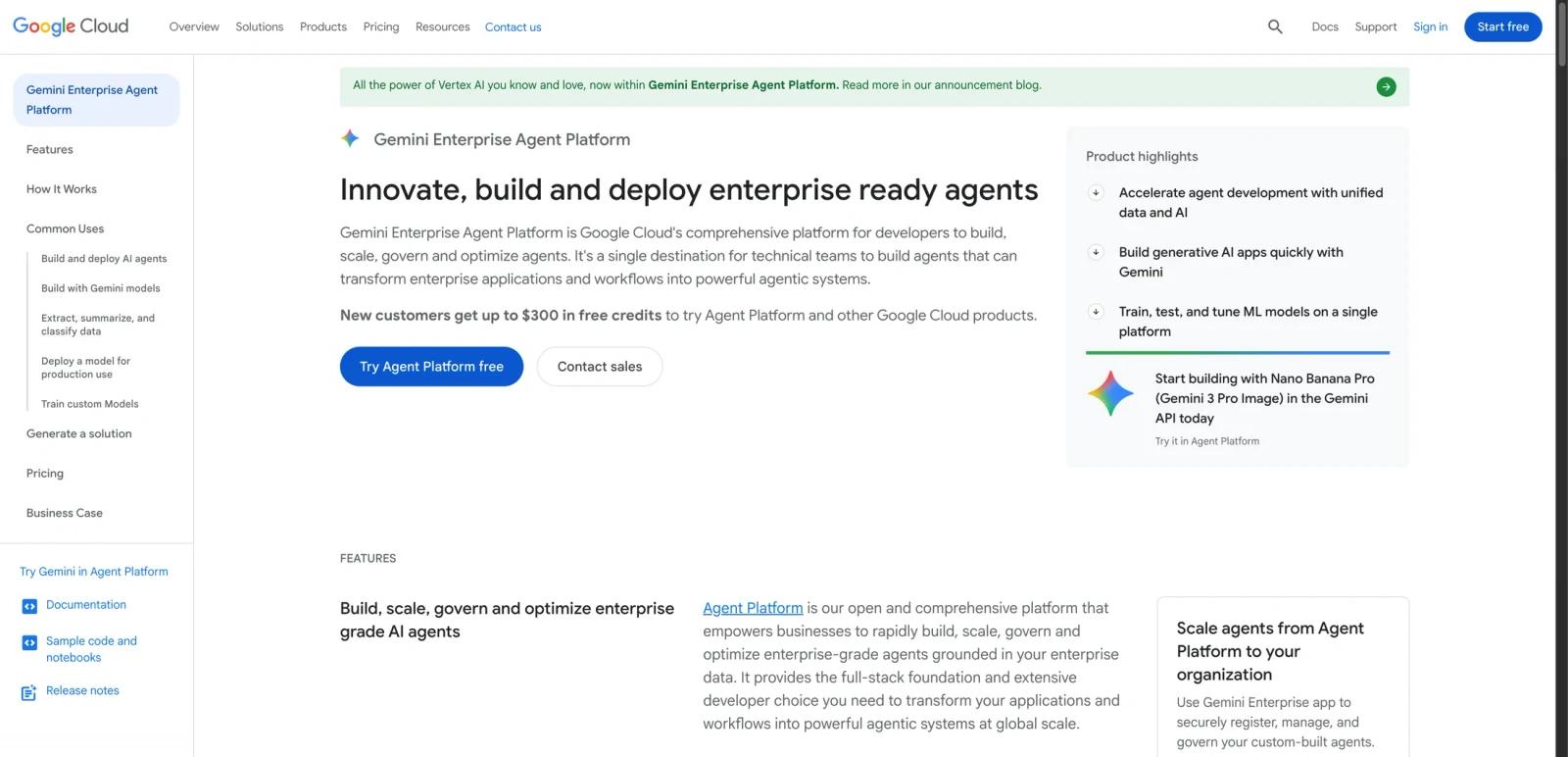
Google Vertex AI is Google's enterprise AI development platform for building, tuning, deploying, and governing machine learning models, generative AI applications, and production agents. Google is increasingly positioning Vertex AI under the Gemini Enterprise Agent Platform branding, though naming may vary across marketing pages, documentation, and regions.
That branding transition matters because the platform is broader than a single model API. Vertex AI combines Gemini access, third-party and open models in Model Garden, agent tooling, notebooks, custom training, prediction endpoints, vector search, pipelines, and MLOps workflows. It is best thought of as Google's full-stack enterprise AI platform rather than as a narrow chatbot or inference endpoint product.
The reason teams choose Vertex AI is consolidation. If you want Gemini plus managed infrastructure, evaluation, tuning, model governance, pipelines, and production deployment inside one Google Cloud stack, Vertex AI remains one of the most complete options available. The tradeoff is complexity: pricing is multi-layered, the product surface is sprawling, and the best value appears when you are already committed to Google Cloud.
For adjacent research, compare AI video generator tools, AI video editor tools.
Key Features
Gemini models and multimodal AI access — Vertex AI provides access to Google's latest Gemini models for text, image, video, audio, and code workflows. Google now positions these capabilities inside Agent Platform and Agent Studio, but they still run within the broader Vertex AI ecosystem.
Model Garden with first-party, third-party, and open models — Model Garden includes a wide range of first-party, third-party, and open models. Availability of specific models, including some partner-hosted families, can vary by region and partnership status.
Enterprise agent development — The current flagship positioning is around building and governing enterprise-ready agents. Google documents agent building, scaling, governance, context grounding, and developer workflows with frameworks such as ADK.
Custom training and prediction infrastructure — Vertex AI still provides the managed training and prediction workflows that made it useful before the generative AI boom. Teams can run custom training jobs, deploy online or batch predictions, and use optimized AI infrastructure instead of stitching these pieces together manually.
MLOps and lifecycle management — Google documents MLOps tooling for evaluation, pipelines, model registry, feature store, notebooks, and model monitoring. This is one of Vertex AI's biggest advantages over model API-only competitors.
Integrated notebooks, data, and deployment stack — Vertex AI notebooks, BigQuery integration, vector search, pipelines, and serving options make it viable as a production AI platform rather than just an experimentation surface.
Pricing & Plans
Vertex AI uses usage-based cloud pricing rather than simple seat-based SaaS plans.
| Area | Pricing shape | Notes |
|---|---|---|
| Generative AI text, chat, and code | Variable | Pricing varies by model and usage. Refer to official Vertex AI pricing pages for current per-token or per-character rates. |
| Imagen image generation | Variable | Pricing depends on image generation, editing, and resolution settings. Refer to official pricing documentation for current rates. |
| Pipelines | Variable | Vertex AI Pipelines pricing includes orchestration and underlying compute costs, with rates varying by region and execution environment. |
| Custom training | Variable | Based on machine type, region, and accelerators used |
| Notebooks / Workbench | Variable | Compute, storage, and management fees apply |
| Model serving / prediction / vector search | Variable | Depends on deployed resources, query load, and selected features |
Google Cloud offers up to $300 in free trial credits for new accounts, which can be used across services including Vertex AI, subject to eligibility and regional terms. That is useful for evaluation, but it should not be confused with a simple ongoing free tier for the whole platform.
The important pricing nuance is that Vertex AI has no single "starts at $X/month" answer. Google's detailed pricing pages split costs across classic ML services, generative AI model usage, Agent Platform runtime, notebooks, pipelines, vector search, training, prediction, and additional cloud resources. Generative AI pricing varies by model version, region, and usage tier. In other words, Vertex AI is infrastructure pricing, not subscription pricing.
Best For
- Enterprises building production AI systems on Google Cloud
- ML engineers and platform teams who need training, deployment, monitoring, and model governance in one place
- Developers who want Gemini plus managed infrastructure, evaluation, and agent tooling
- Teams comparing full-stack AI agent platforms rather than standalone model APIs
- Organizations that care more about scalability and governance than about minimal setup
FAQ
Is Vertex AI now called Gemini Enterprise Agent Platform?
At the marketing layer, largely yes. Google's main product page now presents the service as "Gemini Enterprise Agent Platform (formerly Vertex AI)." But the docs, APIs, tutorials, and technical workflows still use Vertex AI extensively, so buyers should expect both names during the transition.
Is Vertex AI free?
Not in the normal SaaS sense. Google offers up to $300 in free credits for new customers, but Vertex AI itself is primarily a pay-as-you-go cloud platform. Ongoing costs depend on the services, models, compute, and storage you actually use.
What can you do with Vertex AI?
You can access Gemini and other models, build and evaluate prompts, create agents, fine-tune or train custom models, deploy prediction endpoints, run MLOps pipelines, use notebooks, manage model lifecycle assets, and build production AI applications on Google Cloud.
Does Vertex AI only support Google models?
No. Google highlights first-party, third-party, and open models in Model Garden, including Gemini, Imagen, Veo, Chirp, Claude-family models, Gemma, and other open model options.
How does Vertex AI pricing work?
Pricing is usage-based and split by service area. Generative AI requests, agent runtime, pipelines, notebooks, training, prediction, vector search, and related cloud resources can all contribute to cost. There is no single flat monthly plan that covers the entire platform.
Is Vertex AI good for enterprise AI agents?
Yes. In fact, that is now Google's headline positioning. The current product branding emphasizes enterprise-ready agents, agent governance, context grounding, and agent development workflows as a central use case.
Who should not use Vertex AI?
Small teams that only need a simple inference API or a lightweight chatbot backend may find Vertex AI heavier than necessary. The platform makes most sense when you need managed infrastructure, governance, lifecycle tooling, or deeper Google Cloud integration.
How is Vertex AI different from using the Gemini API directly?
The Gemini API gives you model access. Vertex AI adds the broader enterprise platform around that access: governance, deployment, MLOps, training infrastructure, notebooks, model registry, pipelines, monitoring, and enterprise controls.


