

Overview
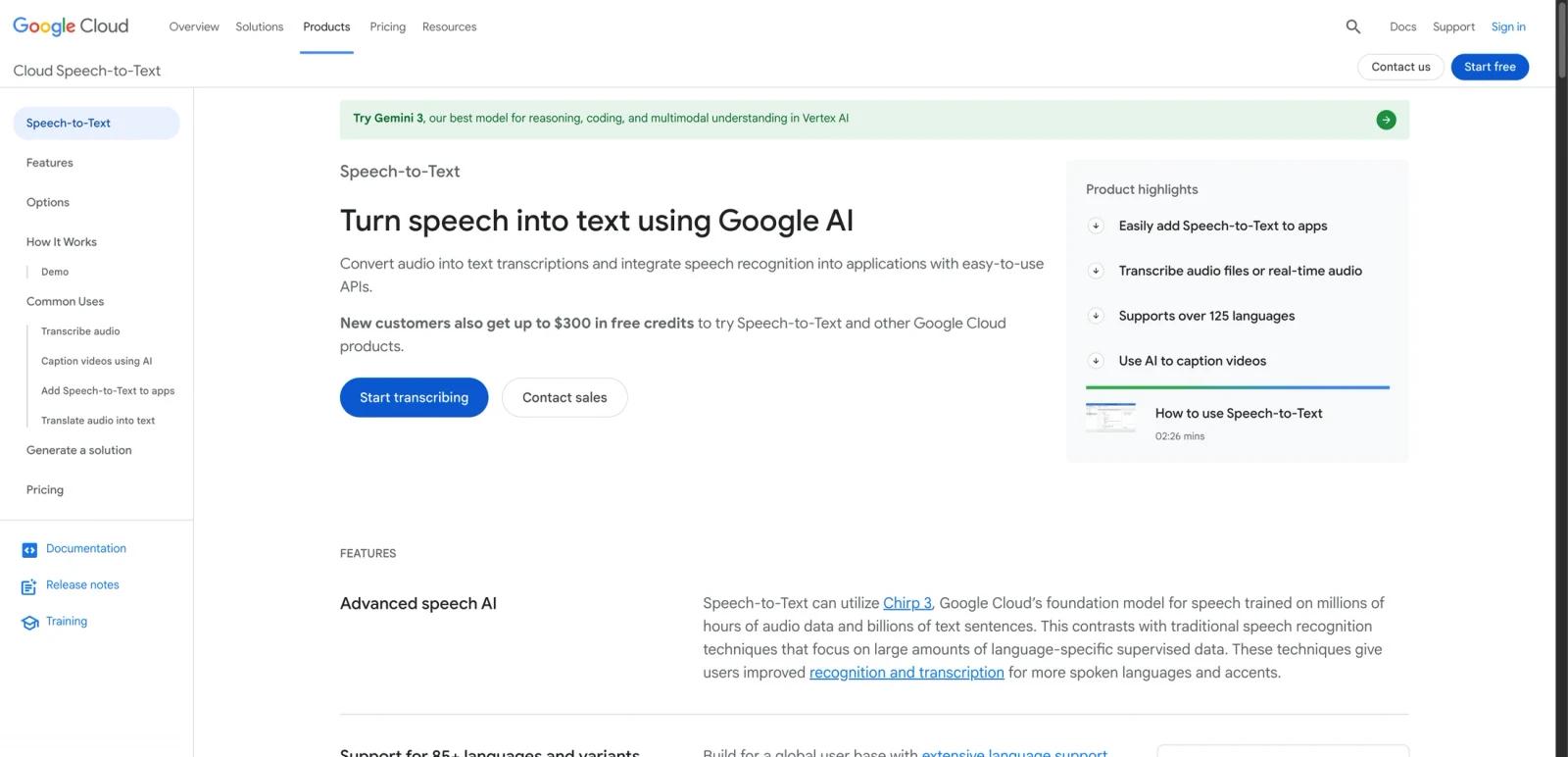
Google Cloud Speech-to-Text is Google's managed speech recognition product for converting audio into text through cloud APIs and no-code testing tools. The current product page positions it around transcription, captioning, app integration, and multilingual speech AI, with Chirp 3 now presented as the core speech foundation model behind the latest experience.
Unlike an open-source model such as OpenAI Whisper, Speech-to-Text is built as an enterprise-ready cloud service. That means the main value is not just recognition quality, but the combination of hosted APIs, streaming support, region options, security controls, auditability, and Google Cloud purchasing workflows. For many teams, that makes it more of an infrastructure decision than a pure model comparison.
As of April 24, 2026, the product page highlights support for 85+ languages and variants, real-time and batch transcription methods, speaker diarization, model adaptation, and up to $300 in free credits for new Google Cloud customers. Google also compares the product between a no-code Vertex AI interface and the Speech-to-Text V2 API for production applications.
For adjacent research, compare AI music generator tools, AI music generator guide.
Key Features
Chirp 3 speech model — Google positions Chirp 3 as the latest speech foundation model behind Speech-to-Text, emphasizing broader multilingual coverage and improved recognition across accents and spoken languages.
Short, long, and streaming transcription — The product supports synchronous, asynchronous, and streaming recognition, which makes it viable for uploads, call transcription, live captions, and embedded voice interfaces.
85+ languages and variants — The current product page highlights support for more than 85 languages and variants, which keeps it relevant for global products and multilingual customer workflows.
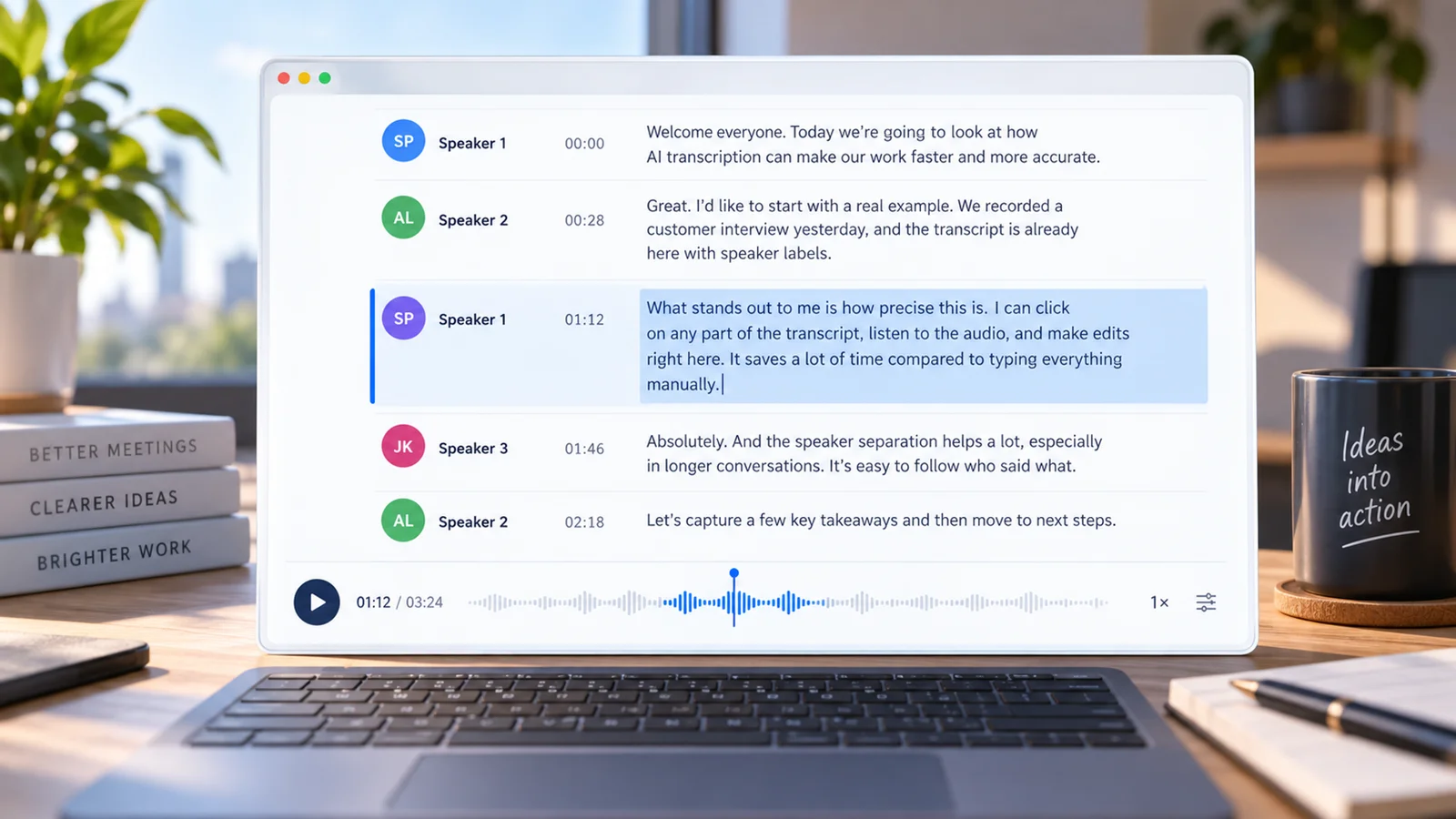
Speaker diarization and model adaptation — Google surfaces speaker diarization and adaptation controls for improving recognition of domain-specific terms, repeated phrases, and multi-speaker audio.
API and no-code testing options — Google now explicitly compares Chirp 3 in Vertex AI's web interface with Chirp 3 in the Speech-to-Text V2 API, giving teams a quick prototyping path and a separate production integration path.
Enterprise security and regional controls — Speech-to-Text V2 is positioned with data residency, audit logging, and support for customer-managed encryption keys, which matters for regulated or larger-scale deployments.
Pricing & Plans
Google Cloud Speech-to-Text is usage-based, not a flat subscription product. The current product page states that Speech-to-Text pricing depends on API version, channels, batch methods, and any related Google Cloud costs, and it shows Speech-to-Text V2 API pricing starting at $0.016 per minute.
| Option | Price | Positioning |
|---|---|---|
| Speech-to-Text V2 API | From $0.016/minute | Managed API for production transcription, with regional and enterprise controls |
| Vertex AI no-code transcription testing | Usage-based within Google Cloud | Best for rapid experimentation and browser-based testing |
| New customer credits | Up to $300 free credits | Useful for proof-of-concept work before regular billing starts |
| Enterprise quote | Custom | Large deployments, support, or negotiated commercial terms |
The main buying nuance is that total cost is shaped by more than the base transcription rate. Google explicitly says pricing depends on API version, channels, batch methods, and other Google Cloud service costs such as storage. So while the starting number is easy to cite, real-world spend depends on audio volume, streaming versus batch usage, regional setup, and the rest of your Google Cloud stack.
Best For
- Teams building production transcription into apps, contact workflows, or internal platforms
- Companies already standardized on Google Cloud
- Products that need streaming speech recognition rather than file-only uploads
- Enterprises with compliance, logging, encryption, or data residency requirements
- Builders who want to prototype in a GUI and then move into API-based deployment
FAQ
How much does Google Cloud Speech-to-Text cost?
The product page currently shows Speech-to-Text V2 API pricing starting at $0.016 per minute. But Google also states that final pricing depends on API version, channels, batch methods, and related Google Cloud service costs.
Does Speech-to-Text support streaming recognition?
Yes. Google explicitly presents synchronous, asynchronous, and streaming transcription methods, including real-time recognition for microphone or streamed audio input.
What model does Google Cloud Speech-to-Text use?
Google currently highlights Chirp 3 as the speech foundation model behind the latest Speech-to-Text experience, especially for multilingual recognition and transcription.
How many languages does Google Cloud Speech-to-Text support?
The current product page highlights support for 85+ languages and variants. Google also links to its supported language documentation for the full list.
Is there a free tier?
Not in the simple SaaS sense, but new Google Cloud customers can get up to $300 in free credits to test Speech-to-Text and other Google Cloud products.
Is Google Cloud Speech-to-Text better than open-source transcription?
It depends on what you need. If you want hosted APIs, streaming support, compliance features, and operational convenience, Google Cloud Speech-to-Text is often the better fit. If you want self-hosting, licensing flexibility, and full infrastructure control, an open-source model can be more attractive.