

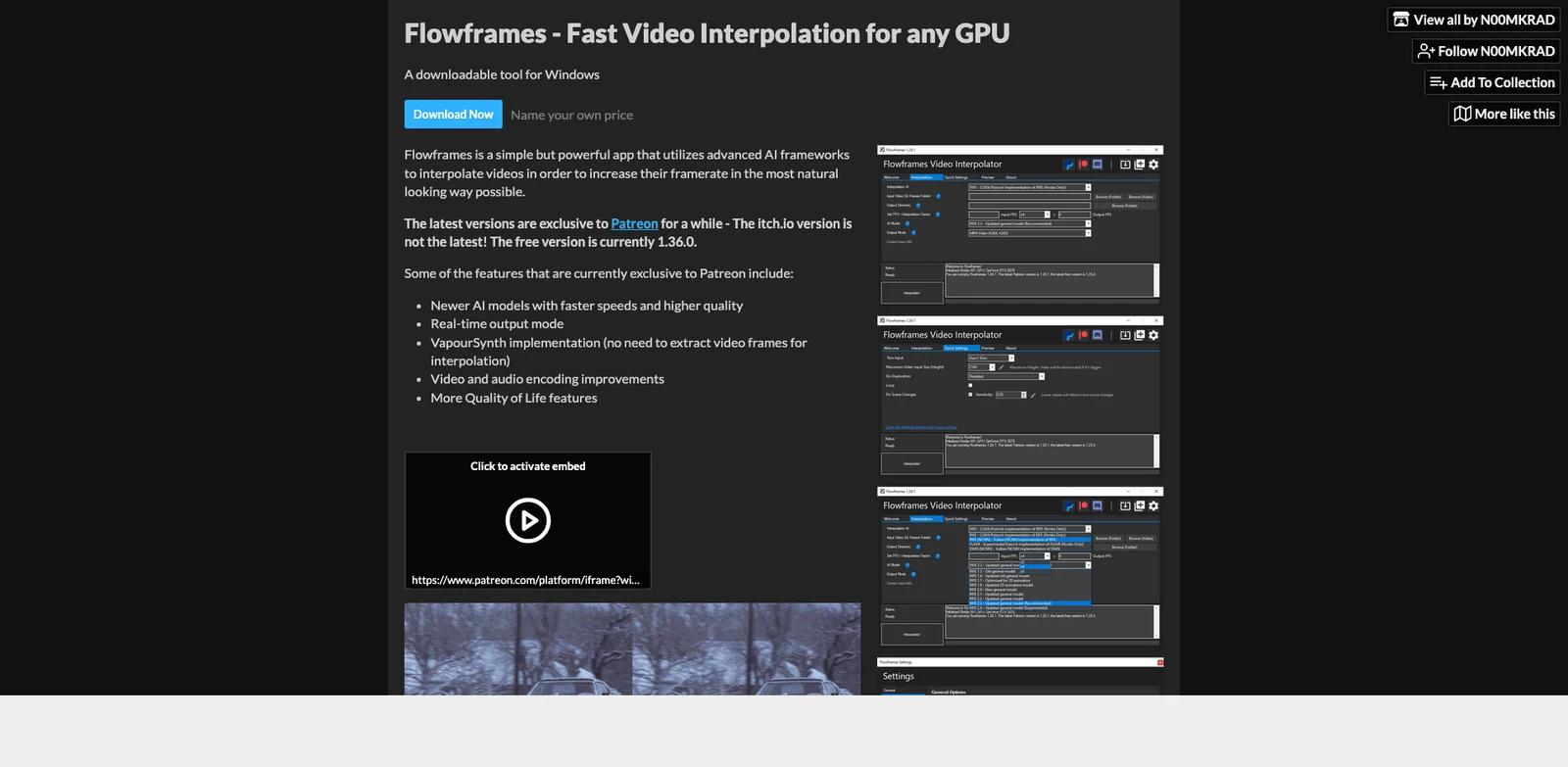


Overview
Flowframes is an AI video enhancer category option built for video editors, creators, restoration teams, and motion designers. Video interpolation for everyone. Up to 100x faster than DAIN, compatible with all recent AMD/Nvidia/Intel GPUs. In practical terms, it helps users move a specific workflow from scattered manual steps into a clearer AI-assisted process: prepare the input, generate or analyze the first result, refine it, and hand it off for review or publishing. That makes Flowframes most useful when the job repeats often enough that speed, consistency, and reviewability matter.
The important buying question is not whether Flowframes can produce a polished demo. It is whether the product handles realistic source material, team constraints, editing needs, and export requirements well enough to save time after review. Use a real sample from your workflow and measure the time saved after cleanup, not just the quality of the first output.
For teams comparing AI tool rankings, Flowframes should be evaluated alongside the process it replaces. Look at the time saved before and after cleanup, whether non-experts can use it safely, how well outputs fit your existing stack, and whether the pricing model makes sense at your expected usage volume.
Key Features
- AI video creation - Flowframes turns scripts, clips, prompts, or concepts into video-ready material, which helps video editors reduce setup time while keeping review and final judgment in the workflow.
- Script-to-video workflow - Flowframes keeps the creative brief connected to the final output, which helps video editors reduce setup time while keeping review and final judgment in the workflow.
- Editing controls - Flowframes reduces repetitive editing steps while preserving human review, which helps video editors reduce setup time while keeping review and final judgment in the workflow.
- Templates and branding - Flowframes helps teams maintain consistent formats across channels, which helps video editors reduce setup time while keeping review and final judgment in the workflow.
- Publishing exports - Flowframes supports practical export workflows for publishing, which helps video editors reduce setup time while keeping review and final judgment in the workflow.
- Team review - Flowframes gives teams a clearer checkpoint before release, which helps video editors reduce setup time while keeping review and final judgment in the workflow.
These features matter most when Flowframes is tested with real inputs. A short demo can show the interface, but a serious evaluation should include messy examples, edge cases, revision loops, and final handoff requirements.
How to Get Started
- Open the official product site - Start from https://nmkd.itch.io/flowframes so you are using the current onboarding and pricing flow rather than an outdated review page.
- Create a realistic test project - Use material from your actual workflow, such as a brief, file, image, recording, lead list, study note, design request, or research question.
- Review the first output carefully - Check accuracy, completeness, editing control, and whether the result is usable before heavy manual cleanup.
- Adjust constraints and settings - Test templates, style controls, integrations, privacy settings, export formats, and team features that matter to your workflow.
- Compare against your current process - Measure cleanup time, approval effort, and handoff quality against your existing stack, including adjacent AI productivity tools.
- Confirm pricing and usage rights - Before rollout, verify plan limits, commercial-use terms, data handling, and whether advanced features require a higher tier.
Pricing & Plans
| Plan | Public pricing signal | What to expect |
|---|---|---|
| Evaluation | Paid, freemium, or sales-led access | Test the core workflow with your own material before rollout. |
| Team / professional | Lowest reliable public price not captured | Expect higher limits, collaboration, exports, integrations, or commercial-use permissions to require paid access. |
| Enterprise | Contact sales where applicable | Admin controls, compliance review, security terms, support, and custom usage may require direct vendor confirmation. |
| The captured public page text did not expose a reliable lowest monthly price for Flowframes. Treat it as paid or sales-led until you verify the official pricing page. |
Best For
- Video editors who use AI video enhancer workflows every week.
- Teams comparing Flowframes against broader AI platforms and specialist alternatives.
- Operators who need repeatable outputs, editable drafts, and visible review steps.
- Managers who care about cost, workflow fit, and adoption friction before rollout.
- Individual users who want a dedicated product surface instead of a generic chat prompt.
FAQ
What is Flowframes used for?
Flowframes is used for AI video enhancer workflows that need AI assistance, repeatable output, and human review. It is most relevant for video editors, creators, restoration teams, and motion designers that want a dedicated product instead of a general-purpose chatbot.
Who should choose Flowframes?
Choose Flowframes if your regular workflow involves repeated production, analysis, generation, or review tasks in this category. It is less suitable if you only need a one-time answer and do not want to learn a dedicated tool.
Does Flowframes have a free plan?
Flowframes appears to have free or trial access plus paid usage based on public pricing signals. Verify limits before committing.
What should I test first in Flowframes?
Start with a realistic sample from your own workflow. Check output quality, editing control, export options, collaboration, and whether the result fits your existing tools.
How does Flowframes compare with generic AI tools?
Generic AI tools can help with drafts and ideas, but Flowframes is built around a more specific AI video enhancer workflow with purpose-built controls, templates, integrations, or exports.
Is Flowframes good for teams?
Flowframes can work for teams when its collaboration, permission, sharing, and admin controls match your process. Smaller teams should verify which controls are included in entry-level plans.
What are the main limitations of Flowframes?
The main risks are plan limits, output variance, learning curve, and dependency on supported formats or integrations. Always test with your own material before rollout.
Can Flowframes replace a specialist?
Flowframes can reduce routine production work, but specialist review still matters for strategy, accuracy, compliance, brand voice, and final approval.
What alternatives should I compare with Flowframes?
Compare it with tools in the broader AI tools directory and with adjacent tools already in your workflow. The best option depends on quality, cost, adoption friction, and integration fit.


