
7 Best SaaS Management Tools 2026 — Spend vs Access
A SaaS inventory, an offboarding workflow, and a procurement service solve different problems. Compare seven options by data coverage, control, and cost.

On this page
The best SaaS management tool depends on the decision your company cannot make today. Finance may need to reconcile software contracts with actual usage. IT may need to remove a departing employee's access. Procurement may need to stop a renewal before the notice deadline. Buying a dashboard for the first problem does not automatically solve the other two.
This comparison is for teams managing software they buy and use internally, not companies looking for a billing system for subscriptions they sell. It compares documented capabilities and buying boundaries, not tested savings or a universal winner. Official product and pricing information was checked on October 18, 2026; quotes, modules, and availability can change.
SaaS management tools at a glance
Start with the first job you need to complete. Each option below links to its detailed evaluation; the order is not a quality ranking.
- Zylo: explain and govern enterprise software spend. Start with finance, contract, and application-usage evidence. Get a quote that distinguishes inventory from advanced actions. Eliminate it if a real renewal cannot be traced from spend to accountable owner and usable license data.
- Torii: connect app discovery to license and renewal workflows. Check the evidence available beyond your identity provider. Scope SMP, identity governance, and AI management separately. Eliminate it if important apps are visible but their required cleanup action is not supported.
- BetterCloud: automate recurring SaaS administration. Begin with the exact Google Workspace and cross-app actions IT runs today. Price the needed modules, not just the free Basic entry. Eliminate it if the workflow stops at a ticket where you need a verified action.
- 1Password SaaS Manager: combine discovery, lifecycle workflows, and renewal tracking. This is the product formerly called Trelica, not merely a password vault. Obtain its own product quote. Eliminate it if your key applications' usage, access, or notice deadlines cannot be represented accurately.
- Zluri: connect license optimization with access governance. Bring actual app roles, user activity, and lifecycle requirements. Scope the required access and SaaS capabilities explicitly. Eliminate it if a connector lists users but cannot perform the entitlement change you need.
- Lumos: reduce access-request friction without keeping permanent access. Start with approved apps, approvers, and time-bound permissions. Request a scoped quote. Eliminate it if an approved request still requires an undocumented manual handoff for your critical app.
- Spendflo: organize purchase approvals, contracts, and renewals. Bring procurement requests and approval rules rather than expecting a discovery dashboard alone. Its pricing describes a platform fee plus completed requests. Eliminate it if request metering or service responsibilities remain unclear.
If nobody owns the inventory, renewal decisions, or integration permissions yet, start with an owner-maintained register: application, business owner, contract, notice deadline, paid seats, and evidence source. A platform is useful when it closes an observable gap in that process—not merely because the app count looks large.
Before the demo: separate visibility, action, and savings
Use three different acceptance tests:
- Visibility: Can the system explain where each application, user, license, and cost observation came from, how recent it is, and what it cannot see? SSO activity can show a login; it does not by itself prove use of a paid feature. Finance data can show a payment without identifying every active account.
- Action: Can it perform the precise change you require, with approval, exceptions, and a log? Detecting a dormant seat, asking its owner, changing the application's license, and revoking access are separate steps. Ask which are native actions, identity-provider actions, custom automation, or manual tasks.
- Savings: Does the action reduce a bill now, release a seat for reuse, or only support a future renewal negotiation? Removing ten seats from use does not erase a prepaid annual commitment. Keep realized savings, cost avoidance, and reclaimed capacity separate.
A broad business automation comparison is useful when the missing piece is moving work between systems. SaaS management adds a different requirement: reliable application, ownership, license, and contract context for those actions.
When software spend is the first unanswered question
Zylo
Zylo is a sensible starting point for enterprise IT, procurement, and finance teams that need a shared software system of record. Its current packages separate Core discovery, spend visibility, and usage connections from Premium capabilities such as benchmarks, IAM actions, Jira automation, and a full CRUD API. Enterprise adds further organizational and security scope. Pricing is by quote; do not assume the lowest package includes every action shown in a demo.
The important boundary is enforcement. Zylo's offboarding explanation separates detection and workflow from access removal and describes the role of a connected identity provider. That is more useful than an undifferentiated “automated offboarding” checkbox.
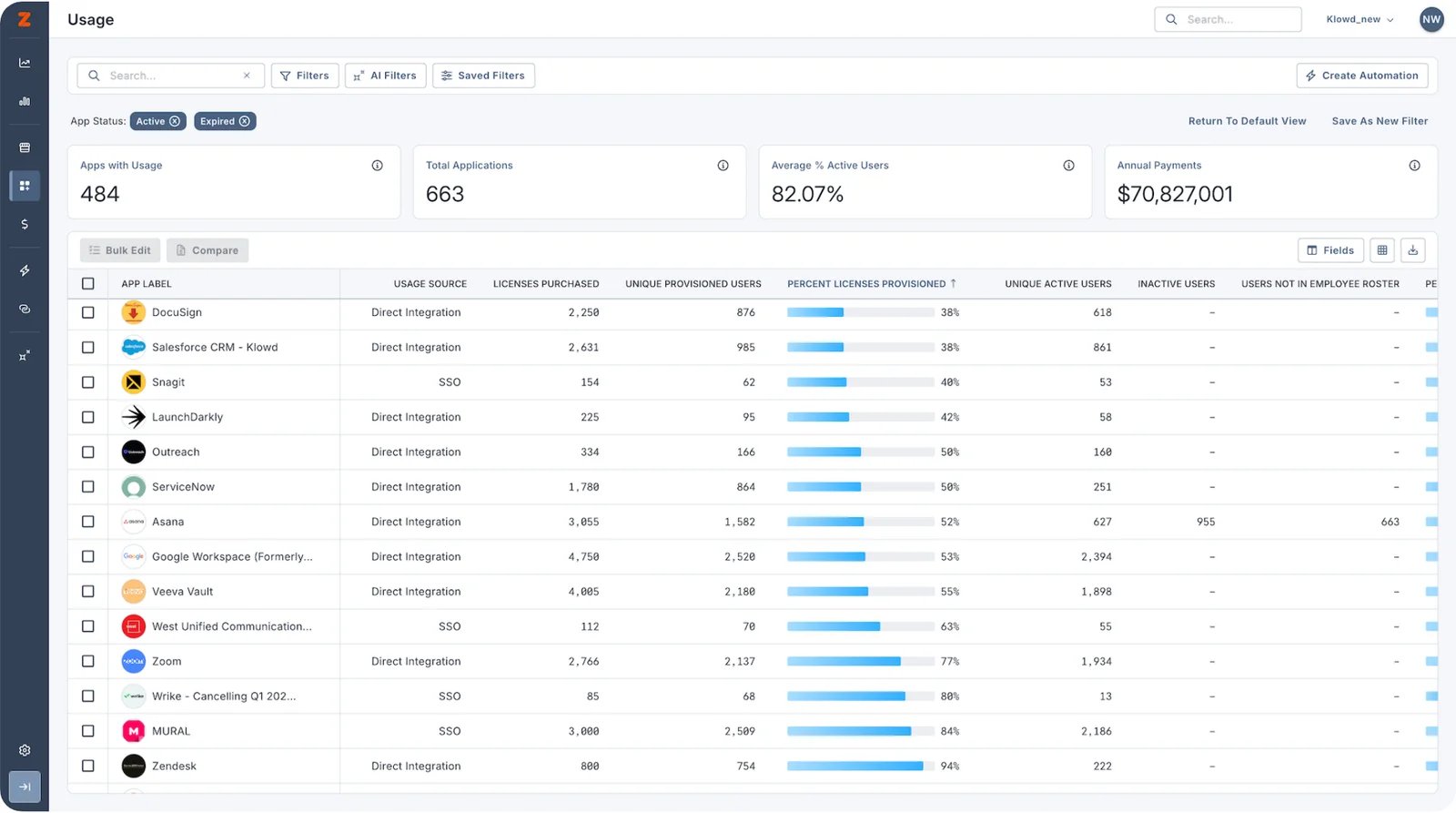
Zylo's published UI example, captured October 18, 2026. The separate usage and provisioning columns show why evidence definitions matter. Sample numbers belong to the vendor illustration, not a ToolWorthy test or measured saving.
First elimination test: take one renewal, an unused paid license, and a former employee. Ask Zylo to show the underlying evidence, owner response, proposed action, enforcement dependency, and result. Skip it as your primary execution layer if the actions you need still fall outside the quoted scope. Evaluate its inventory value separately.
Torii
Torii fits teams that want discovery connected to license optimization and renewal workflows. Its pricing page distinguishes SaaS Management (SMP), Identity Governance (IGA), and AI Management. The relevant question is which combination covers your actual process, not whether the brand advertises all three.
There is a current procurement consideration: on October 12, 2026, Torii announced an agreement to join Freshworks. The announcement says closing is subject to conditions and the companies remain independent until then. Do not purchase on the assumption that future Freshservice integration or bundling is already delivered. Ask for current contract, support, and integration commitments. Its separate AI Management page is labeled early access; confirm availability before treating it as part of an ordinary SMP purchase.
First elimination test: use an approved SSO app, an expense-paid app, and an app outside SSO. For each, ask what Torii actually discovered and which license or lifecycle action it can execute. Skip it if your must-have app's action remains a roadmap promise.
When IT needs to execute the lifecycle, not just report it
BetterCloud
BetterCloud is worth evaluating when repeated administration is the main burden: onboarding, offboarding, license reclamation, and Google Workspace operations. Its current commercial structure includes User Automation, Spend Optimization, and Workspace Management for Google. The quote depends on licenses, connected apps, modules, and add-ons.
The same page advertises Spend Optimization Basic at $0/month. Treat this as a limited starting point for utilization and contract visibility, not a free entitlement to the complete automation platform. The separate File Governance trial is also not proof that every module has the same trial terms.
First elimination test: give the vendor your existing departure checklist. Have it demonstrate approval, account suspension, required data ownership transfer, license changes, failures, and evidence of completion for the relevant connectors. These are acceptance requirements, not a claim that every action is supported everywhere. Skip it if a critical step cannot be executed or safely handed to a named owner.
1Password SaaS Manager
This is a distinct SaaS management product, formerly Trelica. Its product page describes discovery, policy-based lifecycle workflows, access reviews, and spend optimization. The enterprise pricing page offers a SaaS Manager quote; do not use a Personal or Business password-manager subscription price as its cost.
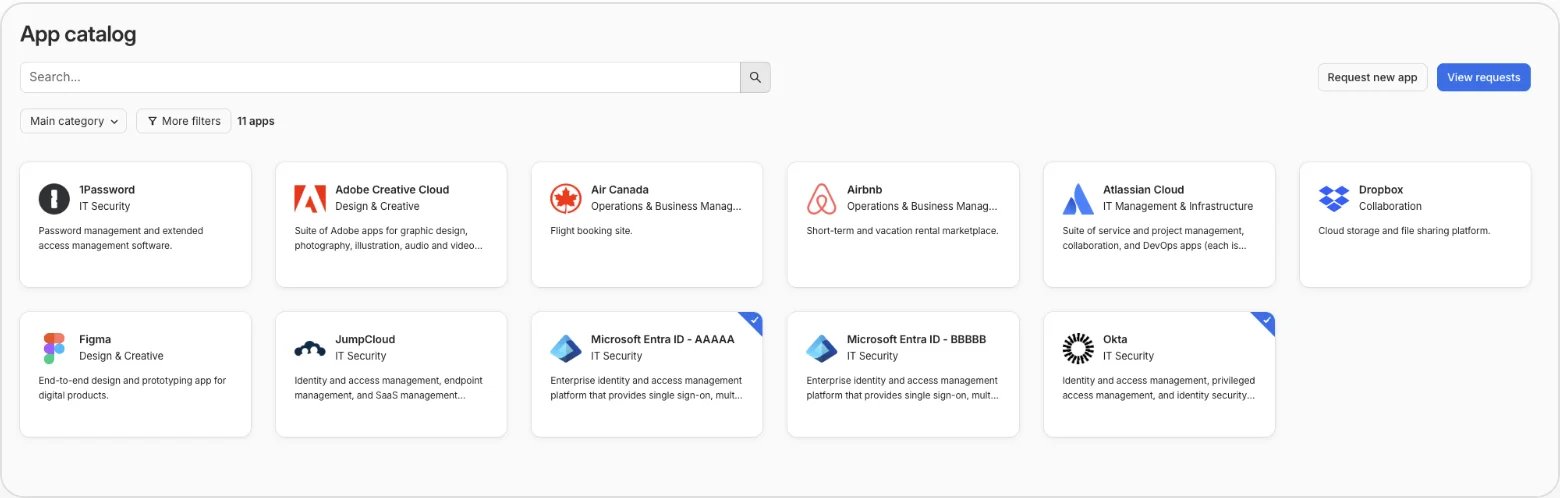
Official App catalog example, captured October 18, 2026—not our company tenant. The employee's approved-app directory is distinct from the administrator's discovery inventory. Access can require approval; the catalog alone does not prove automated fulfillment.
Its renewal documentation exposes a useful buying test. Contract end date, notice period, and calculated notice deadline are different fields. Renewal notifications default to the end date, so merely entering the notice period is not enough: verify when your configured reminders actually fire. A reminder can be accurate and still arrive too late to cancel.
First elimination test: import one contract with a cancellation notice period and one application with non-SSO accounts. Check the reminder schedule, discovery evidence, workflow action, and exception queue. Choose it when the combined inventory/lifecycle process fits; skip it if a familiar 1Password name is the only reason for accepting gaps in the demonstrated SaaS workflow.
For shared or sensitive credentials beyond SSO, also ask whether your intended workflow requires Enterprise Password Manager licensing and integration; do not assume the SaaS Manager quote includes it.
When the problem is who should have access
Zluri
Zluri is a useful candidate when software usage and access decisions need to share context. Its SaaS management offering includes discovery, utilization, contracts, and renewals, alongside access-related products. Its license optimization page describes reclaiming or downgrading licenses using usage thresholds.
That makes it worth considering for teams whose decisions are more specific than “this account has not logged in.” A paid-tier downgrade and removal of privileged access are different operations. Ask the vendor to demonstrate the exact license, role, and account actions supported by each important connector. Request a written quote for the SaaS and access capabilities you need; the reviewed pricing route leads to a demo rather than a verified fixed dollar tariff.
First elimination test: select one application where a user needs basic access but no longer needs its premium or administrative entitlement. Validate the activity evidence, proposed change, approval, and resulting state. Skip it if the required granularity cannot be shown on your relevant app and plan.
Lumos
Lumos is the more focused route when employees wait for software access and temporary permissions become permanent by accident. Its AppStore product centers self-service requests, policy-based approvals, and time-bound access. Evaluate the request-to-revocation loop, rather than buying it solely to create a software expense dashboard. Its public pricing route asks for an assessment; get a scoped commercial proposal.
There is an important operational caveat in the app-owner guide: an approval may lead to automatic fulfillment or a ticket, and app owners provision access when auto-provisioning is not enabled. An attractive request experience does not prove every backend action is automated.
First elimination test: request temporary access to a real, noncritical test entitlement. During an approved trial, verify the approver path, fulfillment owner, expiry, revocation, and audit trail. Skip it if your critical app cannot close that loop and the remaining manual work defeats the reason to buy.
When purchases and renewals stall before IT can act
Spendflo
Spendflo belongs on the shortlist when buying and renewing software is itself the bottleneck: intake, approvals, contracts, purchase orders, and responsibility for the next action. It is a procurement-oriented route, not an interchangeable replacement for application-level access governance.
Its current pricing page describes a platform fee plus per completed request, with scope based on requirements and spend tier. Grow, Scale, and Enterprise differ in included agents and controls; the accounts-payable agent is an add-on. There is no verified universal dollar starting price in the reviewed page. Old “percentage of SaaS savings” descriptions are not a substitute for this current buying model.
The page lists 1,000 requests per year included and says credits are consumed only on successful processing, with unused credits rolling over without expiry or a cap. These are vendor-published terms: confirm their application to your quoted tier and contract before estimating usage charges.
First elimination test: map a new purchase, a renewal, and an exceptional request through intake, security/legal/finance approvals, vendor communication, and completion. Obtain a written definition of a billable completed request, included volume, and how reopened, duplicate, or failed requests are handled. Confirm whether negotiation services are included and who owns each deliverable. Skip it if those answers prevent a credible total-cost comparison.
Why some familiar names are not in the main comparison
Do not copy a historical shortlist without checking current availability. Productiv's official support notice states that its SaaS platform would cease operations on August 6, 2026. Its old root domain now leads to an unrelated fulfillment business. It is not a current purchase recommendation here; do not mistake the reused domain for product continuity.
CloudEagle.ai and Sastrify are credible additional candidates, not rejected quality losers. CloudEagle presents a broader mix of SaaS, identity, and AI governance; Sastrify combines software management and procurement. Add one to your vendor evaluation if that scope matches your job better. The seven detailed options above provide contrasting decision routes without turning this into an exhaustive directory.
If SaaS decisions must share data with installed-software licensing, IT asset management, and FinOps, also evaluate Flexera One SaaS Management. Its published scope includes hybrid application usage and unified estate insights. Validate the SaaS connectors and actions you need, and get the complementary products and implementation scope itemized; broader platform coverage is not proof that every component is included.
An identity provider, expense card, or contract repository may already solve part of the problem. Ask what evidence or action is missing before purchasing another control layer. For a wider organizational policy problem, use the separate AI governance tools comparison; an AI-app inventory alone is not a complete governance program.
Run a proof of value that can actually reject a tool
Bring a small but deliberately awkward sample: an SSO app, a non-SSO app, a paid license with little activity, an approved test offboarding case, and a renewal with a notice deadline. You do not need to connect the entire company to discover a fatal mismatch.
- Before connecting: agree on required data, connector permissions, employee privacy notice, retention, region, subprocessors, and who can authorize writes. Begin with the least access needed for the evaluation; keep destructive actions out of the initial discovery exercise.
- Before trusting the inventory: reconcile the sample against your own finance, contract, identity, and application records. Label missing or stale data. A vendor's headline integration count does not guarantee usage depth or write capability for your exact plan.
- Before enabling changes: require approvals for the test action, preserve necessary employee files, identify service accounts and API credentials separately, and define rollback or manual recovery. Disabling an SSO sign-in is not proof that every session or credential is revoked.
- Before signing: document what failed, who will operate exceptions, what is included in implementation, and how to export inventory, contracts, ownership, and audit records if you leave. Compare the full annual fee and operating effort with realistically recoverable value.
For example, 100 licenses × $20/month × 12 = $24,000/year of nominal seat value. That is an illustrative calculation, not a vendor saving or a promise. Subtract seats you must keep, contracts you cannot reduce yet, implementation expense, and ongoing platform fees. A useful platform can still be worth buying for control or reduced manual work—but those benefits should not be mislabeled as cash recovered.
If legal review is the remaining bottleneck, contract review tools address clause analysis rather than application discovery. Their output still needs your authorized procurement and legal decision-makers.
FAQ
What is the difference between SaaS management and SaaS spend management?
Spend management focuses on what you buy, what it costs, and what can change at purchase or renewal. Broader SaaS management may add application discovery, usage, access, and lifecycle operations. Compare the actual quoted modules and connectors rather than relying on either label.
Is there a free SaaS management tool worth starting with?
BetterCloud currently advertises Spend Optimization Basic at $0/month. Check its limits before relying on it. A maintained inventory and notice-deadline calendar may be sufficient for a small, stable stack; a free entry product is not evidence that full offboarding or access governance is included.
Can these tools automatically cancel subscriptions or remove every account?
Do not assume that. Approval, license reclamation, application deprovisioning, identity-provider enforcement, and vendor cancellation are distinct actions. Verify each one for your actual applications and contract terms. A detected saving or an approved task is not proof of a completed cancellation.
Which tool should I try first?
Start with Zylo or Torii for portfolio/spend questions, BetterCloud or 1Password SaaS Manager for SaaS administration, Zluri or Lumos for access-centered work, and Spendflo for procurement execution. These are routes into a proof of value—not claims that the products have identical scope or guaranteed results.
Get ToolWorthy Weekly
New AI tools, practical guides, and selected AI signals in one weekly brief.
For AI tool founders
Built a tool that belongs in this decision set?
Request an editorial evaluation for possible inclusion in ToolWorthy.
Submit your tool for reviewPaid submission does not guarantee a ranking, recommendation, inclusion, or editorial outcome.